Get in touch: +1 888 453 5021




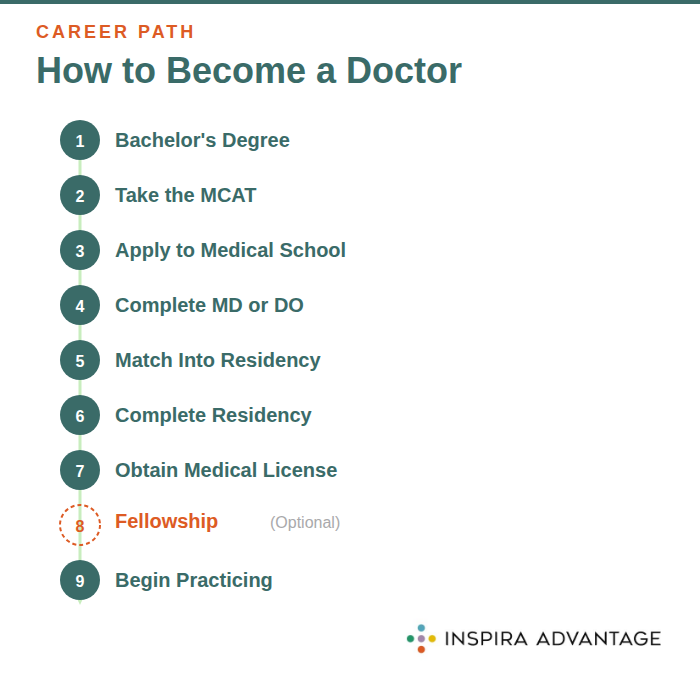
Below, we’ll outline the steps you need to follow to become a doctor.
Before applying to med school, you must complete a bachelor's degree. Your major doesn’t necessarily matter as long as you complete all the necessary prerequisites for medical school. Each school may have its own requirements, so check the admissions page of your target schools to help direct your timetable.
Once you’ve completed the necessary prerequisite courses, take the Medical College Admissions Test (MCAT). Most schools require an MCAT score, so taking the exam is a necessary step.
Once you’ve completed your bachelor’s degree (or are on track to do so), you can begin gathering your medical school application materials. To apply to medical school, you’ll need:
Every medical school has unique requirements, so you should familiarize yourself with what your target schools are looking for.
Work with Inspira Advantage counselors to help you on your journey to becoming a doctor. With our expert support, you’ll submit an application that actually gets you accepted to medical school.
Decide whether you want to complete your DO or MD degree at an accredited med school. You can become a physician with either degree, and the type of medical school you attend will not affect your job prospects.
Most medical school programs are four years long, with the first two years consisting of general science courses and the last two years focusing more on your interest areas.
After your second year, you’ll also take the USMLE Step 1 exam, the first of three licensing exams you’ll need to complete throughout your education. Most students also take the USMLE Step 2 in their last year before residency, a crucial step in family doctor schooling.
MD graduates become allopathic physicians. DO graduates become osteopathic physicians. Both complete residencies, pass board exams, and hold identical practice rights in all 50 states.
Both DO and MD degrees produce fully licensed physicians who can practice in every specialty, prescribe medications, and perform surgery. The distinction matters less than most pre-med students think, but understanding it early helps you target the right schools.
The core difference is that osteopathic medicine emphasizes whole-body, musculoskeletal-focused care and includes 200+ additional hours of Osteopathic Manipulative Treatment (OMT). Allopathic medicine follows a more conventional biomedical model without that hands-on component.
Pick your degree path based on where you want to spend your career, not just the next four years. A traditional MD gets you into clinical practice fastest. Dual-degree programs add one to four extra years but open doors that are difficult to access later.
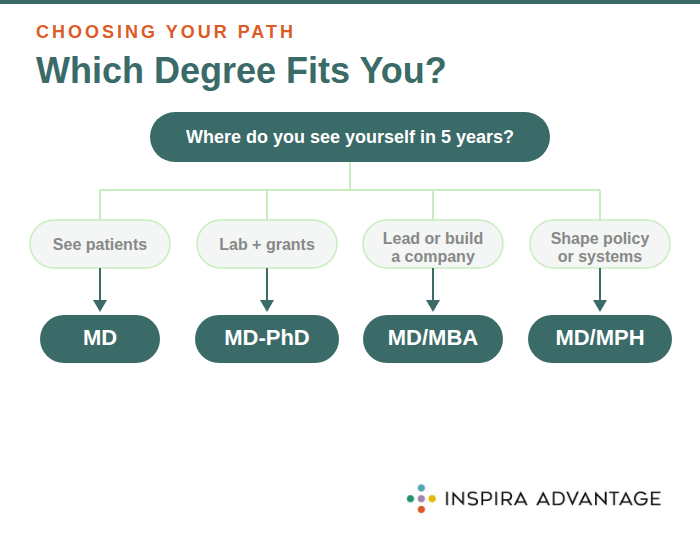
Every path listed below leads to a fully licensed physician. The difference is what you can do beyond patient care.
Ask yourself one question: Where do you want to spend your non-clinical hours five years after residency?
Avoid stacking dual degrees just to strengthen your application. Admissions committees and residency directors see through credential-collecting quickly. Choose the path that aligns with a specific career vision you can articulate clearly.
Once you’ve completed your medical degree, it’s time to match into a residency program. Popular specialties students often consider include internal medicine, pediatrics, general surgery, emergency medicine, and psychiatry.
Use the Electronic Residency Application Service (ERAS) application system to apply to your top programs. Then you can participate in residency interviews to learn more about programs.
After your interviews, you can use the National Residency Matching Program (NRMP) system to rank your top residency programs. Once your top choices are considered, the Match pairs each resident with programs on their list.
Before applying to residencies, ensure you research each program. Your list for the match should be well-informed and consider factors like location, pay, length, and program-specific requirements.
Start exploring specialties in your third year of medical school during clinical rotations. Most students enter clerkships with assumptions about what they'll love, only to leave surprised by what actually clicks.
Pay attention to three things during each rotation:
Loving cardiology as a concept means nothing if you hate the unpredictable hours and high-acuity emergencies that define the specialty in practice. The doctors who burn out fastest are those who choose based solely on prestige or earning potential.
Shadow residents (not just attendings) in any specialty you're considering. Attendings have shaped their schedules and practices over the course of decades. Residents show you what the next three to seven years of your life will actually look like.
Talk to doctors who left their original specialty. They'll tell you exactly which warning signs they ignored, and those conversations will provide you with more clarity than any career quiz.
Match your personality to the work, not the title. If you need closure and defined outcomes, surgery delivers that in ways internal medicine rarely does. If you thrive on long-term relationships and diagnostic puzzles, primary care and its subspecialties will keep you engaged for decades.
Use resources like the AAMC's Careers in Medicine program for different perspectives from people currently in training.
Residency length varies widely by specialty. Some programs, such as family medicine and internal medicine, take about three years, while others, such as general surgery, neurology, and OB/GYN, take four to five years. Highly specialized fields like neurosurgery can take seven years or more. Your residency is where you gain supervised, hands-on clinical training and develop the skills you’ll use as an attending physician.
Beyond completing the USMLE, medical licensing requirements vary by state. Applying for state licensure typically means submitting your test scores and other information for review. The proper authorities verify the information you’ve provided, and then state licensure is typically granted within 60 days.
A fellowship is optional, but it gives you the chance to train with experts and develop a subspecialty after residency. Fellowships can open doors to more specialized roles, higher earning potential, and advanced clinical experience. They are often selective, and many physicians view fellowship acceptance as a meaningful professional milestone.
Once you’ve obtained licensure and completed residency, you’re ready to begin looking for jobs.
It takes 11 to 15 years to become a doctor in the U.S. after high school. That usually includes four years of college, four years of medical school, and three to seven years of residency, depending on the specialty.
Typical path to becoming a doctor:
Becoming a physician allows you to care for patients, make a real impact on their health, and pursue a rewarding and in-demand career. Here's a closer look at its top benefits:
Doctors can work in a wide range of specialties, including internal medicine, surgery, pediatrics, psychiatry, emergency medicine, and more. This flexibility lets you explore what interests you, and each day can be different depending on your specialty.
If you enjoy interacting with people, listening to their problems, diagnosing their illnesses, and helping them heal, a career as a physician offers regular opportunities to make a real difference. Caring for patients from diverse backgrounds and stories brings both challenges and rewards.
Demand for physicians continues to grow, and the supply isn't keeping up. The AAMC's most recent workforce projections estimate the U.S. could face a shortage of 13,500 to 86,000 physicians by 2036. Primary care alone accounts for up to 40,400 of that gap, and surgical specialties could fall short by nearly 19,900. Population growth and aging are the biggest drivers: by 2036, the population aged 75 and older is projected to increase by over 54%, and older adults require significantly more complex and frequent care.
Those numbers actually represent an improvement over earlier forecasts. The AAMC's 2021 report projected a steeper shortfall of 37,800 to 124,000 doctors by 2034. The gap narrowed because researchers modeled hypothetical increases in residency positions funded by states, hospitals, and Congress. Without those investments, the AAMC warns that shortage projections would climb back toward the original 2021 figures.
Meanwhile, a significant portion of the current physician workforce is approaching retirement. According to the same report, 1 in 5 practicing physicians is already 65 or older, and another 22% fall between 55 and 64. The pipeline of new doctors entering practice cannot replace those who exit quickly enough under the current training capacity. For anyone entering medical school now, the career outlook is as secure as any profession in the U.S. economy.
Physicians have the power to change lives by diagnosing illness early, managing chronic conditions, improving long-term health, and contributing to public health. Doctors remain a critical pillar of any health care system.
Yes, there are excellent job opportunities for doctors in the U.S. The U.S. faces a growing physician shortage. According to the Association of American Medical Colleges, by 2034, there could be a shortage of 37,800 to 124,000 doctors across all specialties, creating strong demand for qualified physicians nationwide.
The median annual wage for physicians and surgeons was at least $218,380. Earnings vary significantly by specialty, area of practice, and experience. For example, specialties like surgery or cardiology often pay more than general practice or internal medicine.
Residency programs vary by specialty. Most general residencies take three to seven years, while highly specialized fields such as neurosurgery can take seven years or more. Residency provides hands-on training under supervision to prepare you for independent practice.
No. In the U.S., completing at least one year of residency is required to obtain state medical licensure. If you are not accepted into a residency program, you can reapply in the next cycle or explore other healthcare roles while you wait.
There are dozens of specialties to choose from as a doctor, including internal medicine, surgery, pediatrics, psychiatry, emergency medicine, anesthesiology, radiology, and more. Choosing a specialty depends on your interests, lifestyle goals, and career aspirations.
Dr. Jonathan Preminger was the original author of this article. Snippets of his work may remain.
Orthopaedic Surgery Resident Physician
Lewis Katz School of Medicine at Temple University


.svg)


