Get in touch: +1 888 453 5021




To write a residency letter of interest, start by researching the program before you write a single word. The writing itself becomes much easier once you know exactly why you want that specific program and what you bring to it.
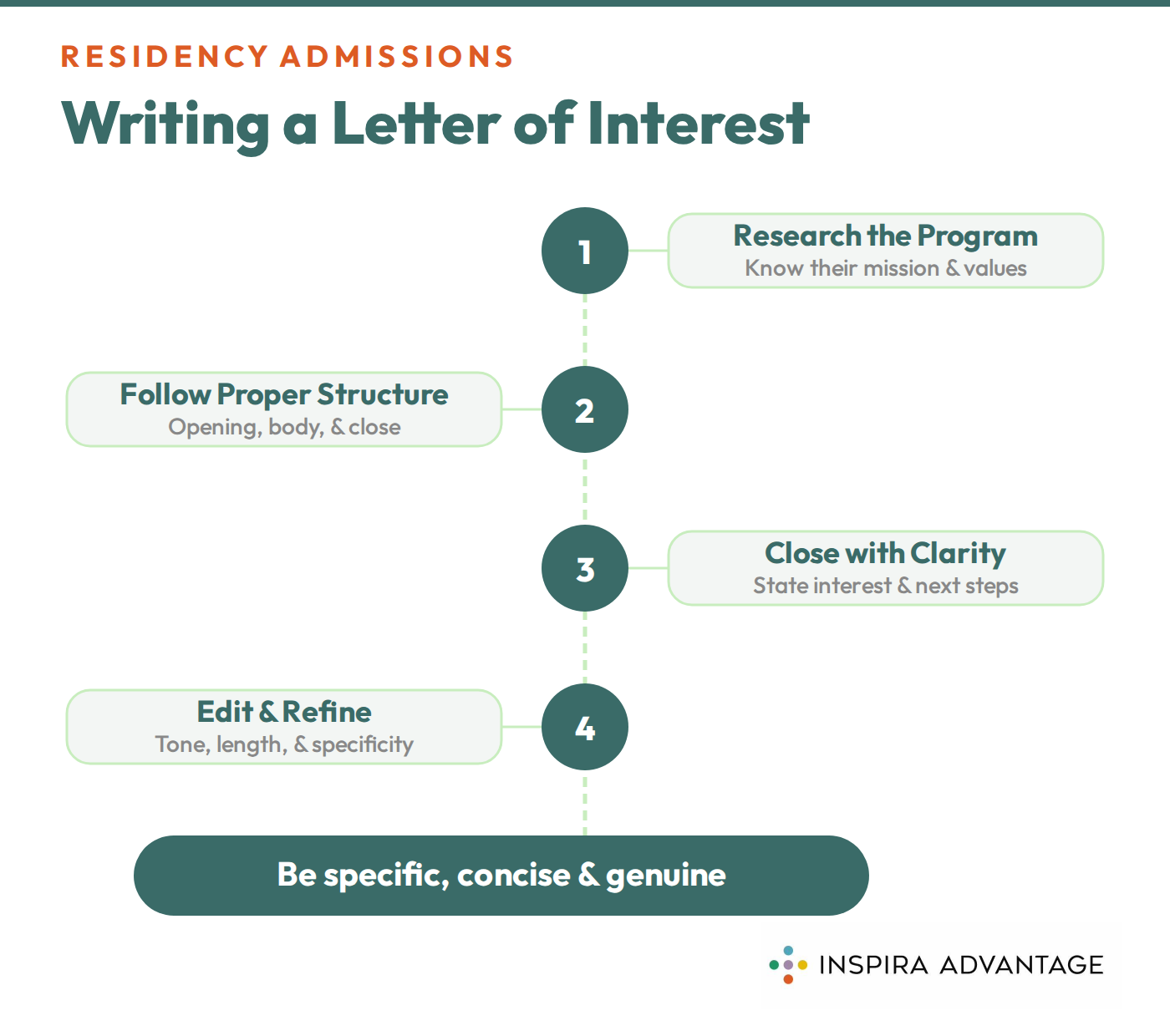
Visit the program's website, read recent faculty publications, and look up their current residents on social media. Write down three to five specific details that genuinely interest you.
Maybe the program director published a study in your area of focus, or the curriculum includes a special rotation site. These details become the foundation of your letter and prevent it from sounding generic.
Every strong letter of interest medical residents write should cover five core elements:
Miss any one of these, and your letter reads like a generic template.
You need a letter of interest because residency programs receive thousands of applications and have limited ways to gauge who actually wants to train with them. Your Electronic Residency Application Service (ERAS) application tells a program what you've done. A letter of interest tells them why you want to do it there.
Follow these steps in order to produce a letter that reads as intentional rather than recycled.
Draw on your residency CV and align your strongest experiences with the program's priorities. A program known for global health outreach needs to hear about your international clinical work. A program investing heavily in simulation training wants to know about your procedural skills.
Good example: "During my research year, I co-authored two publications on health disparities in rural emergency departments, which aligns directly with your program's Rural Medicine Track and Dr. Patel's ongoing work in underserved ED access."
Bad example: "I have published two research papers, presented at three conferences, volunteered at a free clinic and completed an away rotation in emergency medicine."
The good example works because it connects a specific qualification to a specific program feature and names a faculty member. The bad example reads like a condensed CV with no connection to the program at all.
Program directors already have your application. They don't need a summary of it. They need to understand why your experience matters within their program.
Your first sentence should name the program, the specialty, and your reason for writing. Program directors read hundreds of these letters, and most open with the same vague enthusiasm.
Address your letter to the program director by name. Find the correct name, credentials, and title on the program's GME webpage or residency landing page. Double-check the spelling before you send anything. "To Whom It May Concern" and "Dear Program Director" show that you didn't bother looking up who actually runs the program. If the program lists a recruitment coordinator or associate director who handles applicant correspondence, address the letter to that person instead.
Good example: "Dear Dr. Harold Johnson,
I am writing to express my strong interest in the Internal Medicine Residency Program at Johns Hopkins after rotating with Dr. Martinez during my third-year clerkship, where her approach to integrating clinical research into patient care reinforced my commitment to academic medicine."
Bad example: "To Whom It May Concern,
I am writing to express my interest in your esteemed program. I have always been passionate about internal medicine and believe your program would be an excellent fit for my career goals."
The good example establishes three things in a single sentence:
The bad example could be copied and pasted into a letter for any program in the country without changing a word. "Esteemed program" and "excellent fit" are phrases program directors have read thousands of times, and they show that the applicant didn't take the time to research anything specific.
Every sentence in your opening should fail the copy-paste test. If you can swap in another program's name without rewriting the sentence, it's too generic.
Dedicate one paragraph to your connection with the program and another to your relevant qualifications. In the connection paragraph, reference the specific details you gathered during research. In the qualifications paragraph, link each accomplishment back to the program's mission or strengths.
Write the way you'd talk to an attending you respect: Professional but human. Robotic language, such as "I would be most honored to be considered for a position at your esteemed institution," makes it feel like it was copied from a template, or worse, AI.
Every sentence in the body should answer one question: Why does the reader care about what I'm saying?
Good example: "After attending your program's Grand Rounds presentation on trauma-informed care in pediatric emergency settings, I reached out to Dr. Lin, whose research on adverse childhood experiences overlaps with my thesis work at [institution]. My two years coordinating a community-based screening initiative for at-risk youth gave me firsthand exposure to the patient population your program serves, and I'm eager to build on that foundation during residency."
Bad example: "I have always had a deep passion for pediatrics and have gained extensive experience in clinical settings throughout medical school. Your program is widely known for its excellent training and supportive learning environment. I am confident that my strong work ethic and dedication to patient care would make me a valuable addition to your team."
The good example names a specific event, a specific faculty member, and a specific experience tied to the program's patient population. The bad example strings together phrases that could describe any applicant writing to any program.
Restate your enthusiasm for the program in one sentence. Then invite the reader to continue the conversation by providing your email and phone number.
Avoid overselling yourself in the final lines. A simple "I welcome the opportunity to discuss how my background aligns with your program's mission" carries more weight than a paragraph of superlatives.
Good example: "I would welcome the opportunity to discuss how my background in health equity research aligns with Emory's commitment to serving Atlanta's underserved communities. Please feel free to reach me at [email] or [phone number]. Thank you for your time and consideration."
Bad example: "I am confident that I would be an outstanding addition to your program and would bring an unparalleled work ethic, exceptional clinical skills, and a deep passion for medicine that sets me apart from other candidates. I look forward to hearing from you soon."
The good example closes with a specific connection to the program and provides clear contact information. The bad example stacks superlatives that every applicant uses and makes claims that no letter can prove. Phrases like "unparalleled work ethic" and "sets me apart" sound like filler because they are.
Program directors trust evidence over adjectives. Let your qualifications in the body of the letter do the heavy lifting and keep the closing clean and professional.
Read the letter out loud and cut any sentence that could apply to a different program without changes. Keep the total length under one page. Remove filler phrases like "I believe I would be a great fit" and replace them with concrete evidence.
Ask a mentor or advisor to review the final draft before sending, especially someone familiar with the specialty you're targeting.
If you need advice on how to write your letter of interest, get residency admissions support from Inspira Advantage. Our counselors have over 15 years of experience helping students craft the perfect letters of interest for even the top residency programs.
Most program directors use letters of interest as a tiebreaker rather than a primary evaluation tool. When two applicants have similar board scores, clinical grades, and research output, the one who sent a thoughtful letter demonstrating genuine knowledge of the program gets the advantage.
Directors also use these letters to gauge whether a candidate will actually rank their program highly. Programs want to fill their match list just as much as you want to fill yours, so a credible signal of interest carries more weight than you think.
The National Resident Matching Program (NRMP) Program Director Survey is a biennial NRMP survey of residency program directors that identifies the specific criteria they use to rank applicants for interviews and in the Main Residency Match. In the 2024 NRMP Program Director Survey, the highest-weighted ranking factors for the Main Residency Match were interpersonal skills (89%) and interactions with faculty during interviews and visits (87%).
A letter of interest won't replace those factors. But it can create the conditions for them. Reaching out before interview season puts your name in front of faculty and opens a line of communication that makes your interview day more memorable.
Here’s a look at the factors cited by residency program directors when ranking applicants in the Main Residency Match.
Sending no letter means relying entirely on your application metrics to speak for you. In a cycle where hundreds of applicants share similar scores and experiences, a specific and well-timed letter of interest gives you one more way to stand apart.
Send your residency letter of interest between mid-October and mid-November, after programs have reviewed initial applications but before they finalize interview invitations. Letters sent during this window land when program directors are actively building their interview lists and deciding which borderline candidates to invite.
Most ERAS applications are sent to programs on September 29. Programs spend the next several weeks screening candidates. A letter sent in mid to late October shows your interest while your application is still under active review.
Wait at least two weeks after transmission so the program has had time to process your file. A letter that arrives before anyone has looked at your application has nothing to attach to.
Reference something specific from the interview day, such as:
Program directors remember specifics far more than they remember praise.
If you need more assistance with your residency interview prep, check out the video below.
The fastest way to weaken your letter of interest is to send something that could apply to any program in the country. Program directors read hundreds of these letters each cycle and can identify a template in the first two sentences. Below are the mistakes that turn a strong candidacy signal into wasted effort.
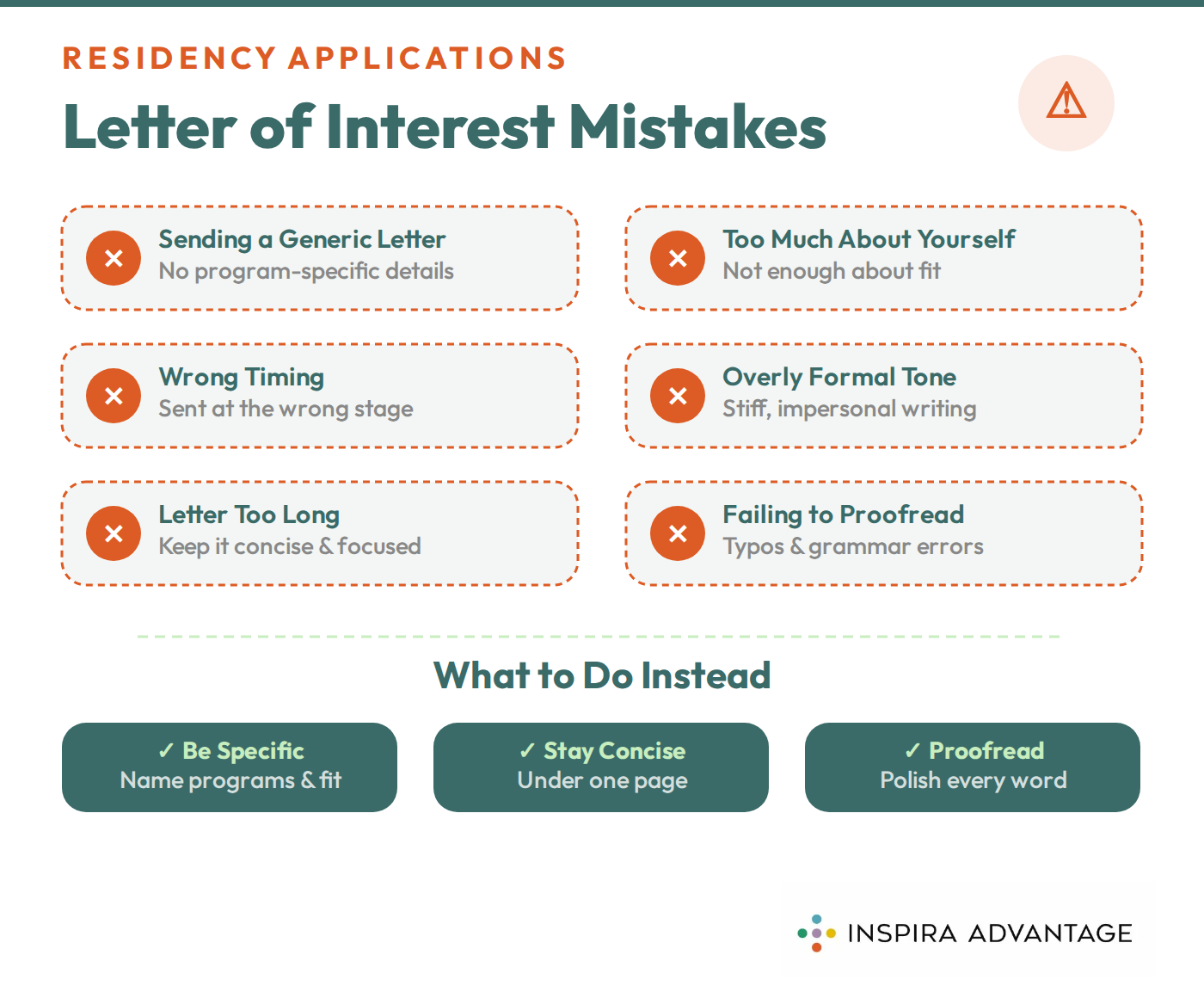
Replace broad compliments with evidence that you researched the program. "I am very interested in your prestigious program," tells a program director nothing. Name a faculty member whose work aligns with yours, reference a specific curriculum track, or mention a patient population the program serves. One concrete detail does more than three sentences of flattery.
A letter of interest is not a second personal statement. Listing every accomplishment on your CV without connecting those experiences to the program's mission makes the letter feel self-centered.
Every qualification you mention should answer a single question: Why does the program care? If you can't draw a direct line between your experience and something the program values, cut it.
If a letter arrives in September, before programs open, programs will disregard it completely. A letter sent in January to a program that already finalized its interview list arrives too late to matter.
Match your timing to the program's decision cycle. Mid-October through mid-November is the strongest window for pre-interview letters. And within one week is the standard for post-interview follow-ups.
Program directors are clinicians and educators, not royalty. "I would be most honored and grateful for the opportunity to be considered for a position at your esteemed institution," sounds robotic. They’ll notice.
Write the way you would speak to an attending you respect: professional, direct, and conversational. Robotic language creates distance between you and your reader, and distance is the opposite of what a letter of interest should accomplish.
Keep your letter under one page. Program directors spend seconds, not minutes, on each letter. A two-page letter shows that you either can't prioritize information or don't respect the reader's time. If a sentence doesn't strengthen your case for that specific program, delete it.
A misspelled program director name, an incorrect institution name, or a leftover bracket from a template ("[Insert Program Name Here]") will end your letter's credibility before the reader finishes the first paragraph.
Read the letter out loud, run spell check, and have a mentor review it before sending. Small errors suggest carelessness. No program wants a resident who overlooks details.
Dear Dr. Patel,
I am writing to express my interest in the Internal Medicine Residency Program at the University of Colorado. During my sub-internship at UCHealth this past summer, I worked closely with Dr. Sarah Chen on her outcomes study examining early mobilization protocols in the MICU, and that experience solidified my commitment to training at your program.
My clinical research has focused on critical care quality improvement, including a first-author publication in CHEST examining ventilator-associated event prevention in community ICU settings. Dr. Chen's work on post-ICU functional recovery directly extends the questions I've been investigating, and I see the opportunity to continue that collaboration as a resident as one of the strongest draws of your program.
Beyond research, your program's structure stood out to me during my rotation. The longitudinal continuity clinic at the Denver Health FQHC gave me exposure to a patient population I want to continue serving throughout residency. I also valued the emphasis on resident-led quality improvement projects, which aligns with my long-term goal of bridging clinical research and systems-level care delivery.
I would welcome the chance to discuss how my background in critical care research and community health aligns with your program's mission. I can be reached at jmiller@email.com or (303) 555-0142.
Thank you for your time and consideration.
Sincerely,
Jordan Miller, MD Candidate
University of Michigan Medical School
Dear Dr. Nakamura,
Thank you for the opportunity to interview with the Pediatrics Residency Program at the Children's Hospital of Philadelphia on November 14th. My visit confirmed that CHOP is where I want to train, and I plan to rank your program first.
During my interview with Dr. Ramos, we discussed the program's integrated advocacy curriculum and how residents partner with PolicyLab on community health initiatives. That conversation resonated deeply with my experience leading a school-based asthma management program in West Philadelphia during my third-year community health rotation. I left the interview with a clear picture of how I could contribute to and grow within that work as a CHOP resident.
I was also struck by the culture your residents described during lunch. Several PGY-2s mentioned the protected time for scholarly work and the mentorship structure that pairs first-year residents with faculty advisors from day one. Having spoken with Dr. Okafor about her experience mentoring residents through their first QI projects, I can see how that structure produces the academic pediatricians your program is known for developing.
I am more enthusiastic about your program now than I was before interview day, and I would welcome any opportunity to discuss my candidacy further. You can reach me at acohen@email.com or (215) 555-0198.
Sincerely,
Alina Cohen, MD Candidate
Perelman School of Medicine at the University of Pennsylvania
Dear Dr. Washington,
I am writing to update you on a recent development in my application and to reaffirm my strong interest in the General Surgery Residency Program at Emory University.
Since submitting my ERAS application, I have accepted a first-author publication in the Journal of Surgical Research examining the use of indocyanine green fluorescence imaging in laparoscopic cholecystectomy. The study analyzed outcomes among 340 patients at two community hospital sites and found a statistically significant reduction in bile duct injury rates when fluorescence imaging was incorporated into the standard protocol.
I wanted to share this update with your program specifically because of Emory's investment in advanced surgical technology and simulation training. During Dr. Hayes's presentation at the ACS Clinical Congress on intraoperative imaging techniques, I recognized how closely my research questions align with the work your department is already doing. Training at a program where faculty are actively advancing the tools I study would accelerate both my clinical development and my research trajectory.
Your program's combination of high operative volume, structured research mentorship, and emphasis on surgical innovation makes Emory my top choice. I would welcome the opportunity to discuss how my work complements your department's goals. I am available at kpatel@email.com or (404) 555-0267.
Thank you for your consideration.
Sincerely,
Kavya Patel, MD Candidate
Emory University School of Medicine
Use the template below as a structural guide, not a fill-in-the-blank shortcut. Every bracketed placeholder should be replaced with details specific to the program you're targeting. If you can swap in a different program name without changing anything else in the letter, the content isn't specific enough.
Dear Dr. [Program Director Last Name],
I am writing to express my interest in the [Specialty] Residency Program at [Institution Name]. [One to two sentences explaining your specific connection to the program: a rotation, a faculty interaction, a conference presentation, or a research overlap that prompted you to reach out.]
[Body Paragraph 1: Program Connection. Describe what draws you to the program using specific details you gathered through research, clinical experience, or direct interaction. Name a faculty member, a curriculum feature, a clinical training site, or a patient population. Explain why that element matters to you and how it connects to your career goals.]
[Body Paragraph 2: Relevant Qualifications. Highlight two or three experiences that align with the program's priorities. Link each qualification directly to something the program values rather than listing credentials in isolation. If the program emphasizes research, discuss your publications or ongoing projects. If the program focuses on community health, describe your work in underserved settings.]
I welcome the opportunity to discuss how my background in [your area of focus] aligns with [Institution Name]'s mission. I can be reached at [email address] or [phone number].
Thank you for your time and consideration.
Sincerely,
[Full Name], [Degree Designation]
[Medical School Name]
A letter of interest signals strong enthusiasm for a program. A letter of intent commits you to ranking that program first. Confusing the two can damage your credibility, so understanding the distinction before you send anything is critical.
Send a letter of interest when you want a program to know you're serious but haven't finalized your rank list. Send a letter of intent only after you've completed all your interviews and are certain about your No. 1 choice.
If you're still weighing two or three programs, a letter of interest to each is the appropriate move. Save the letter of intent for the moment you've made your decision and are ready to put it in writing.
A residency letter of interest is a brief, targeted message you send to a residency program to show your genuine enthusiasm for training there. Unlike your personal statement, which speaks broadly about your career goals and motivations, a letter of interest explains why you see yourself as a strong fit.
You'll typically send a letter of interest in one of two scenarios:
Either way, the letter should be concise (under one page), specific to the program, and professional in tone. Program directors read these quickly, so every sentence needs to earn its place.
A letter of interest impacts your residency application by giving program directors a credibility signal that your ERAS materials alone can't provide. The 2024 NRMP Program Director Survey ranks interactions with faculty (87%) and interpersonal skills (89%) among the highest-weighted factors in programs' rank lists. A well-timed letter opens a line of communication, making those interactions more likely. Programs also use letters of interest as tiebreakers between applicants with similar scores and clinical profiles, so a specific and well-researched letter can move you from the waitlist pile to the interview invite list.
Address your letter of interest to the program director by name. Find the correct name, credentials, and title on the program's GME webpage or residency landing page, and verify the spelling before you send anything. Never use "To Whom It May Concern" or "Dear Program Director" because generic salutations show that you didn't research the program enough to identify the person reading your letter. If the program lists a specific coordinator or associate director who handles recruitment correspondence, address the letter to that person instead.
Competitive specialties don't formally require letters of interest, but programs in fields like dermatology, orthopedic surgery, plastic surgery, and ENT have come to expect them as a standard part of the application cycle. Applicant pools in these specialties are smaller and more closely networked, so program directors pay closer attention to signals of genuine interest when building rank lists. Sending a targeted letter in a competitive specialty carries more weight than in larger fields because directors are more likely to remember your name and associate it with specific program knowledge. Skipping the letter in these specialties risks looking less committed than applicants who took the time to send one.
Yes, email is the standard and preferred delivery method for residency letters of interest. Send your letter as the body of the email rather than as an attachment, since attachments sometimes get filtered by institutional spam systems. Use a clear subject line that includes your name, the specialty, and the phrase "Letter of Interest" so the recipient can identify and file your message quickly. Find the correct email address on the program's residency webpage or through the GME office rather than guessing at a format or using a generic departmental inbox.
A residency letter of interest should be professional but conversational, matching the tone you would use when speaking with an attending you respect. Stiff, overly formal language ("I would be most honored to be considered for a position at your esteemed institution") creates distance and makes your letter sound templated. Write in clear and direct sentences that show confidence without sounding either casual or robotic. Program directors are clinicians and educators who read hundreds of these letters each cycle, so a natural and professional voice stands out far more than academic formality.
Yes, send letters to multiple programs, but only to programs where you can write something specific and meaningful. The number of letters you send matters far less than the quality of each one. A targeted letter to 10 programs will serve you better than a templated letter to 40.


.svg)


