Get in touch: +1 888 453 5021



The American Association of Colleges of Osteopathic Medicine Application Service (AACOMAS) is the centralized application service for all osteopathic medical schools based in the United States. So, if you plan to attend an osteopathic medical school, you'll need to use AACOMAS.
AACOMAS opens in May, but you have to wait until June to submit the application. Keep in mind that the submission deadline varies by school.
The application covers:
Some sections are straightforward, and others trip up even the most organized applicants. We'll walk through every part of the application below so you know exactly what to expect, where common mistakes occur, and how to put together the strongest possible submission.
The AACOMAS requires applicants to complete the following sections as shown in the table below.
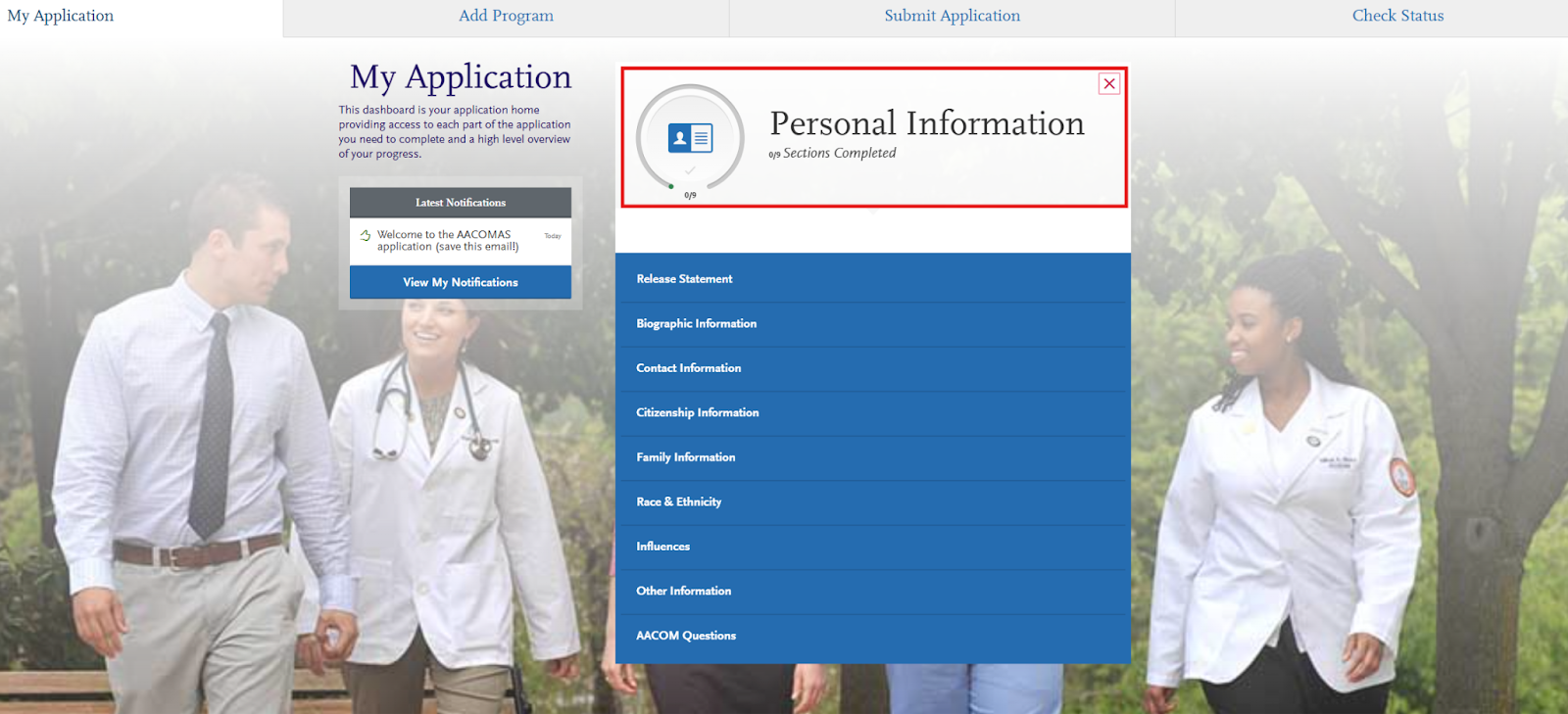
The personal information section of the AACOMAS application requires you to fill in your:
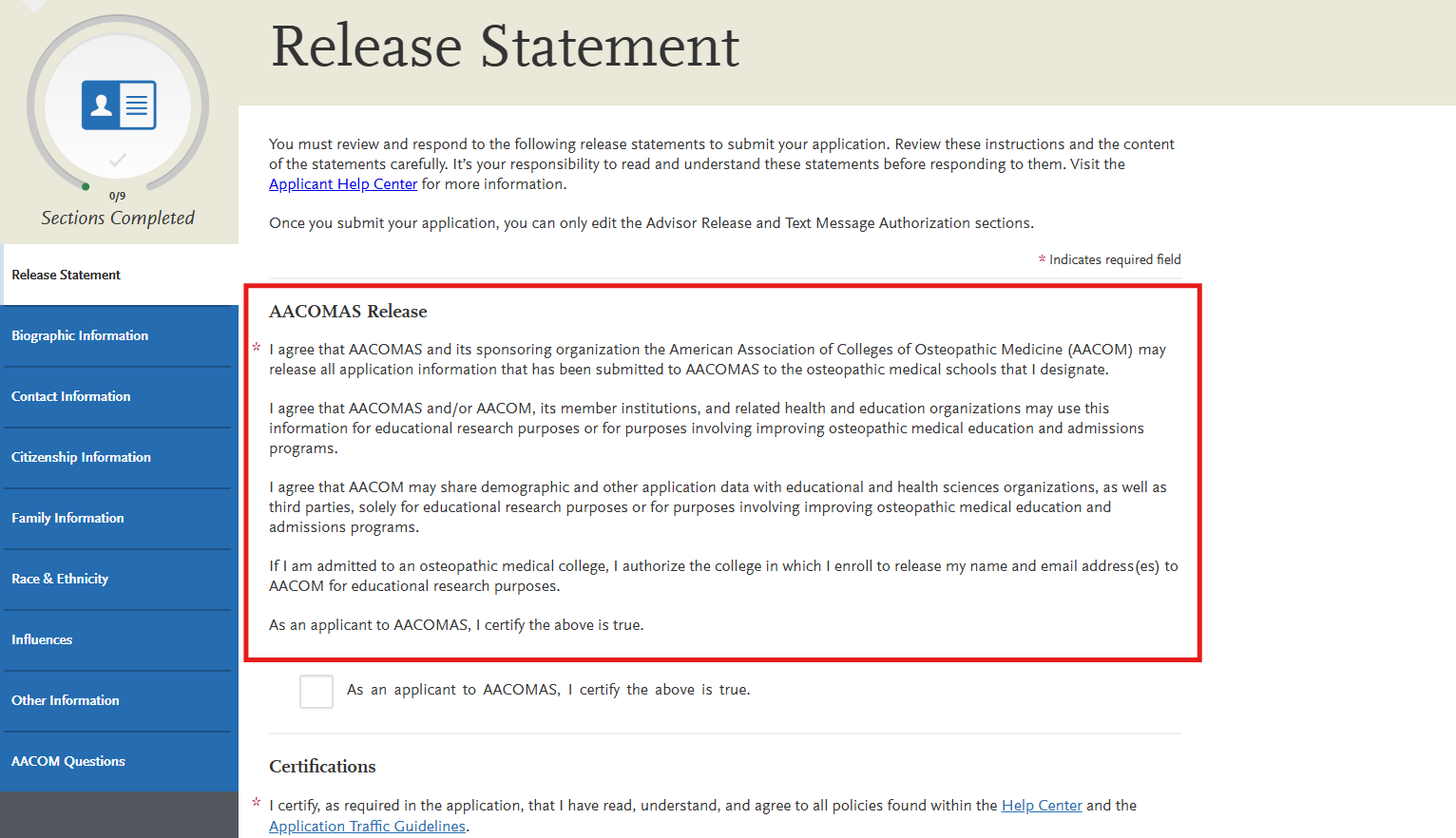
The release statement is the first thing you'll encounter in the Personal Information section. Before you can move forward with anything else, AACOMAS requires you to review and accept a set of agreements that function as a legal signature on your application.
By signing, you're confirming that everything in your application is accurate, and you're acknowledging that you've read and understand all the terms outlined in the AACOMAS Applicant Help Center. You're also authorizing AACOMAS to share your name and contact information with the programs you apply to. It allows schools to send you important updates about their admissions process while you're still completing your application.
You'll also be asked whether you want to let AACOMAS share certain application details, like your GPA, the schools you applied to, and where you ultimately enroll, with pre-health advisors at your undergraduate institution. Saying no won't hurt your application in any way, but opting in helps advisors support future applicants with better data. Finally, you'll choose whether to authorize text message communication from AACOMAS and your selected programs.
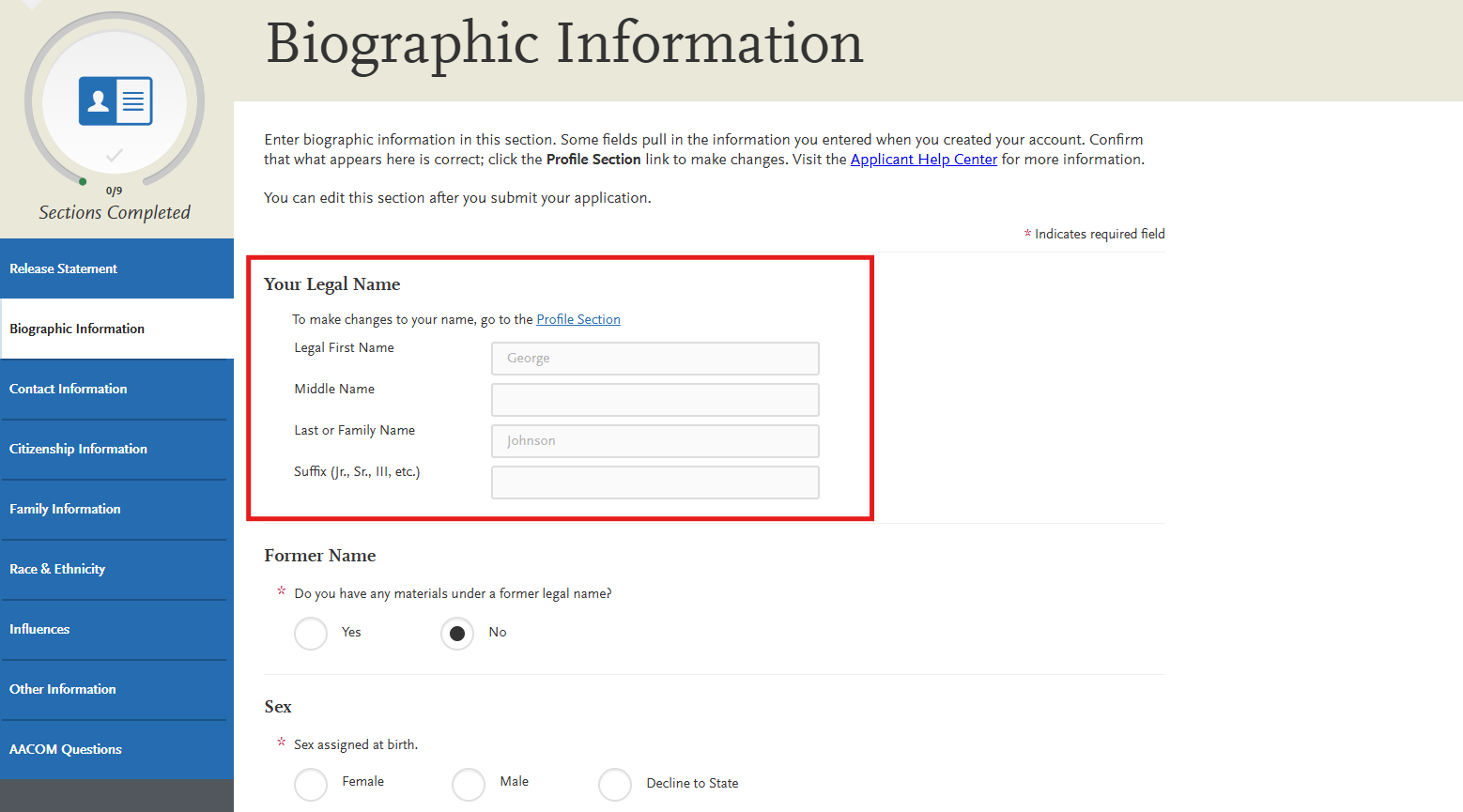
The biographical information subsection records your:
You'll also enter your birth country, state, and county precisely to avoid verification delays. This fits within the broader Personal Information section, which starts with a release statement and includes contact info, citizenship, family details, race/ethnicity, influences (e.g., DO physician relatives), and disclosures like criminal history.
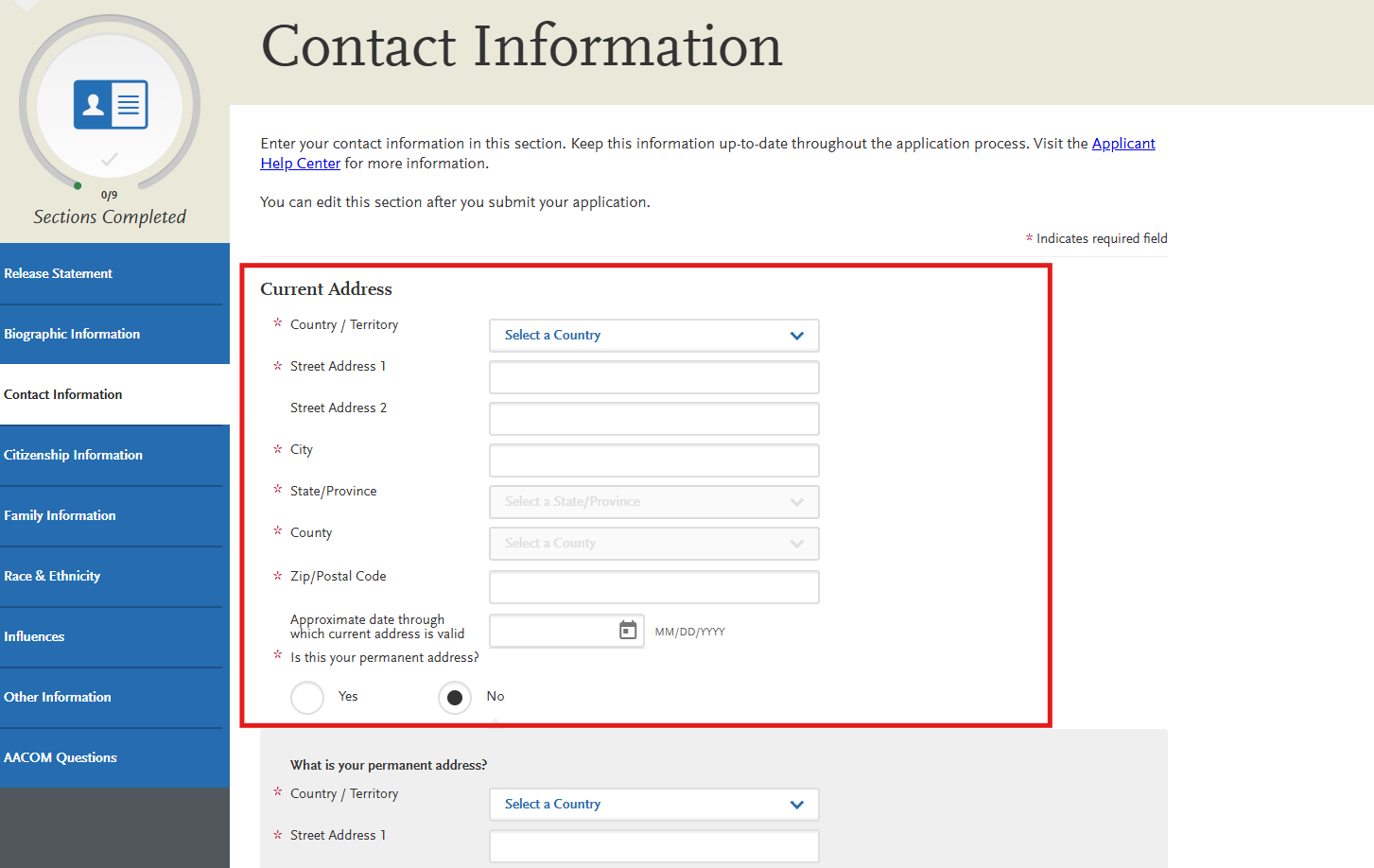
In the contact information subsection, you'll enter your current mailing address, permanent address (if different), primary email address, and phone number—with the option to add a secondary or alternate number.
Keep all of this up to date throughout the entire application cycle. AACOMAS uses your contact information for all communications, verification requests, and score releases. If your email or mailing address changes mid-cycle and you forget to update it, you could miss time-sensitive requests from schools or verification updates from AACOMAS itself.
Take 30 seconds to double-check your entries before moving on, and set a reminder to revisit this section if you know a move or email change is coming.

In the citizenship information subsection, select from options such as
Dual citizens must list the second country and indicate their legal state of residence with supporting details for verification.
Your citizenship status directly affects which schools will consider your application. Some DO programs do not accept international or DACA applicants at all, while others accept DACA recipients but cannot guarantee state licensure. Many schools that accept DACA applicants still give admissions preference to U.S. citizens and permanent residents.
Before you invest time and application fees, check the eligibility requirements for every program on your list. The AACOM Choose DO Explorer is the fastest way to verify which schools accept applicants with your specific citizenship status, helping you avoid hundreds of dollars in wasted application fees.
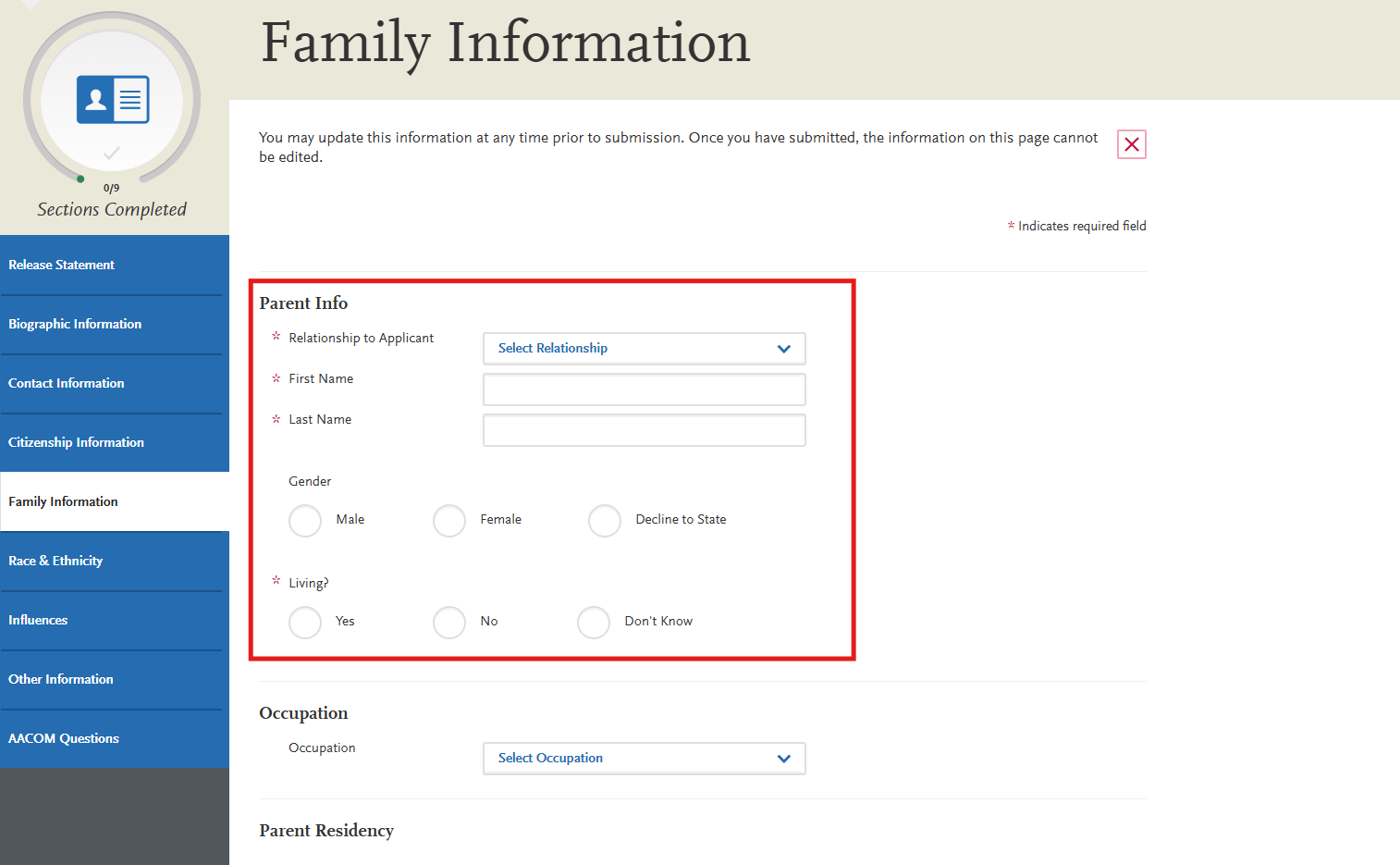
In the family information subsection, you must enter data for each parent/guardian, their relationship to you, names, gender, living status (living, deceased, or unsure), occupation, residency location, education level, and whether they formed your primary household (birth to age 18).

The race and ethnicity subsection explicitly states that it's optional and used solely for statistical purposes by programs that track diversity. So filling out this section is completely up to you.
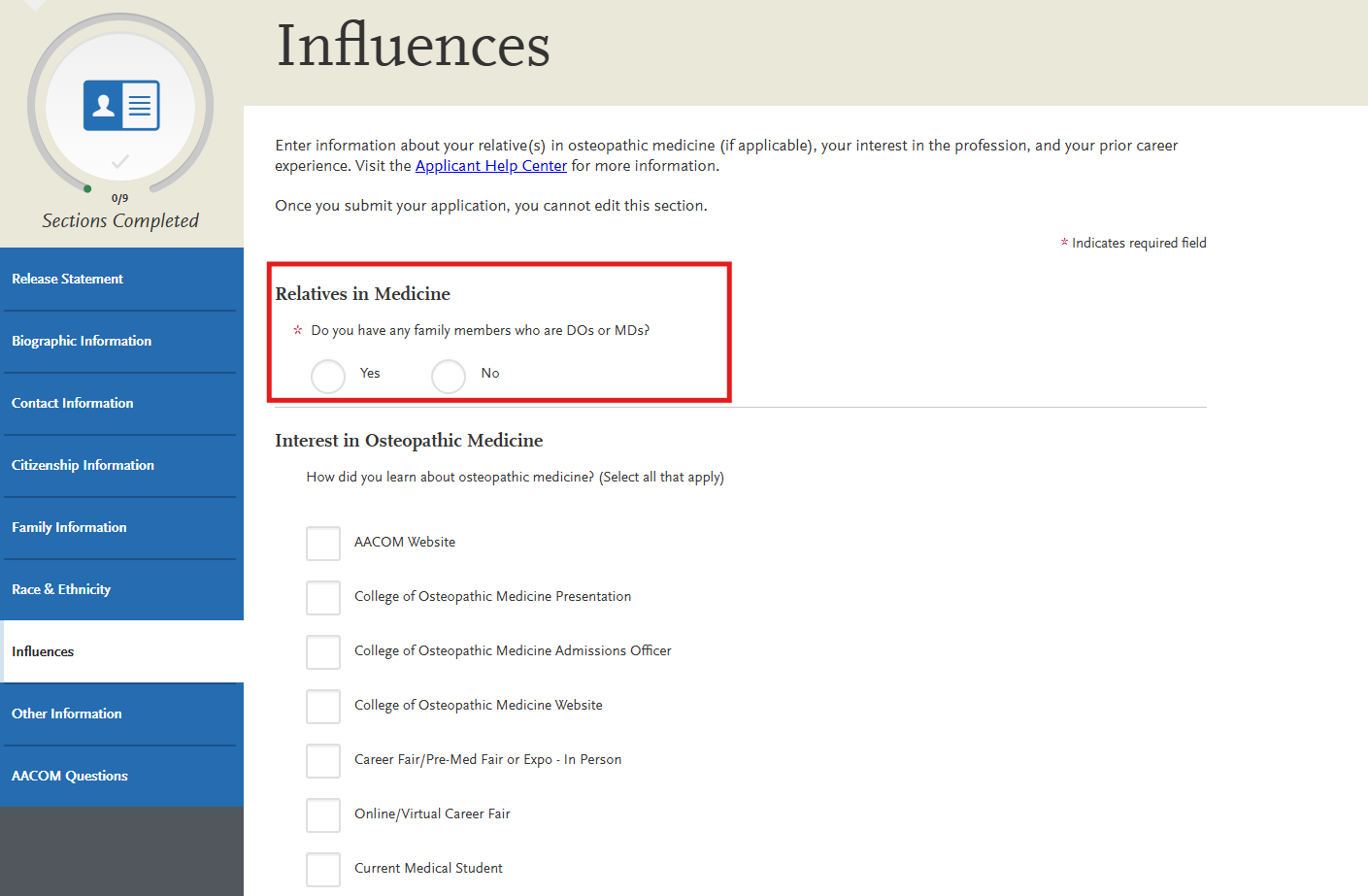
The influences subsection prompts you to indicate interest in osteopathic medicine (e.g., via checkboxes for shadowing and prior DO/MD exposure) and list any MD or DO relatives with details like relationship, name, medical school, and graduation year.
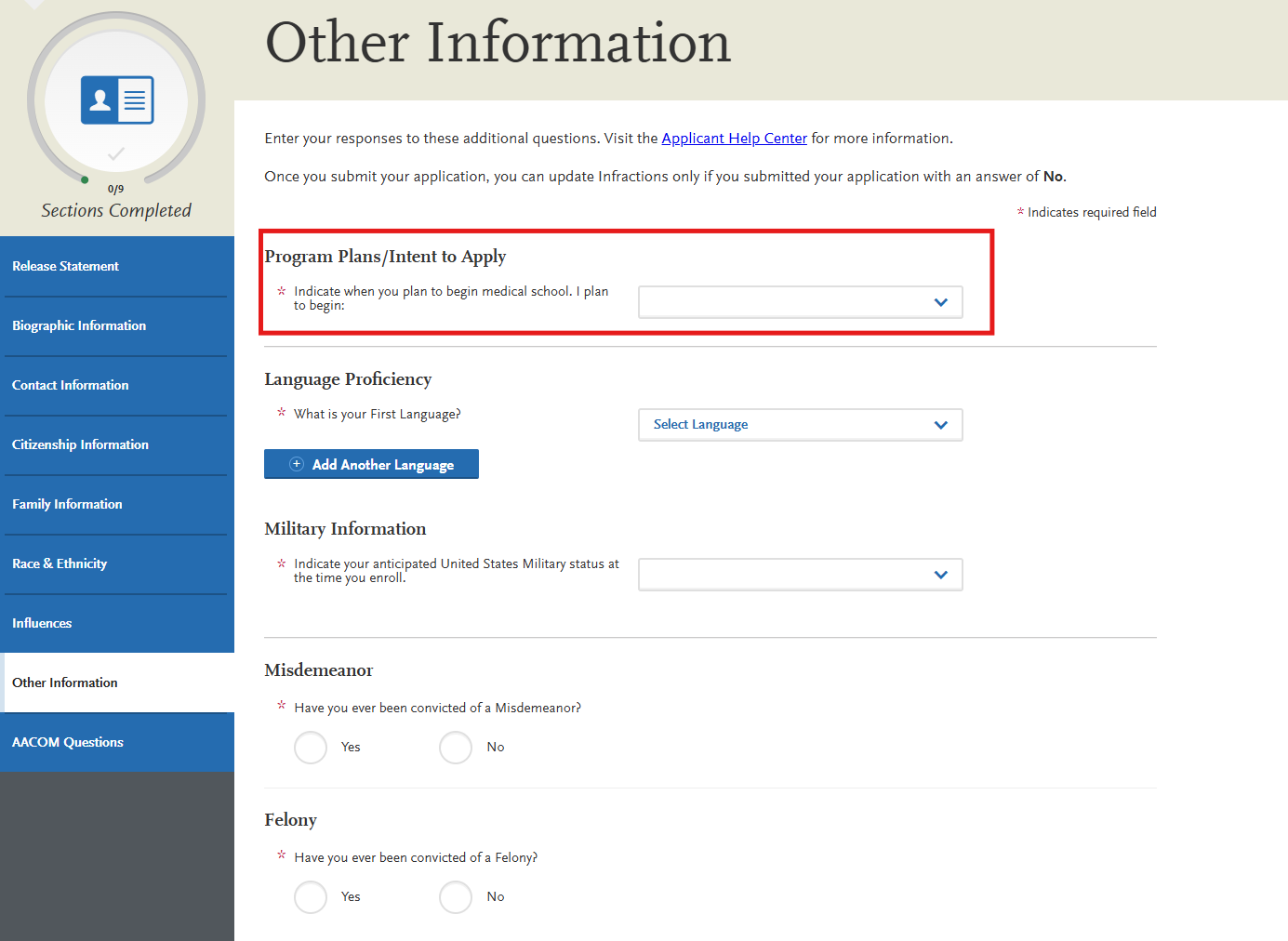
In the other information subsection, you can note additional information such as military status (e.g., branch, service dates if applicable), languages spoken (with proficiency levels), optional Social Security Number (required by some programs for aid), plus disclosures on background like convictions, academic infractions, prior medical school attendance, license issues, and Pell Grant receipt.
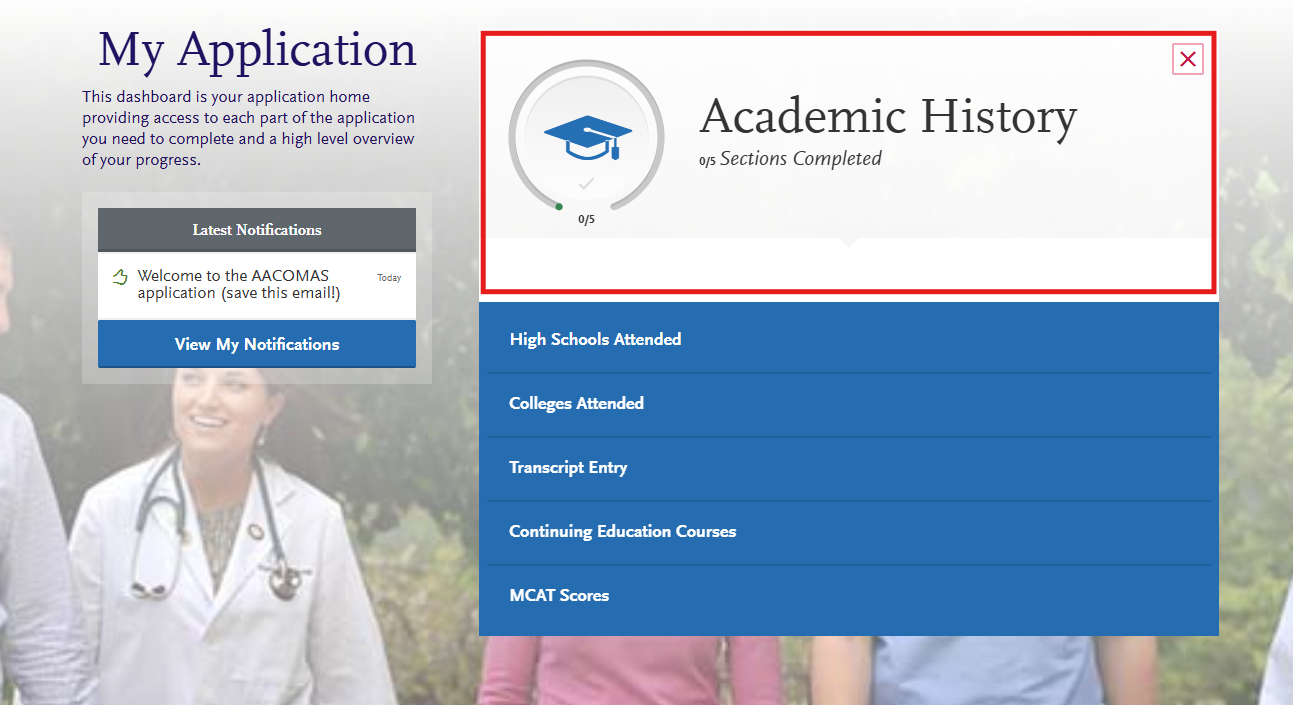
The AACOMAS academic history section requires you to report information on the colleges they attended. You also need to record the tests you’ve taken, such as the MCAT.
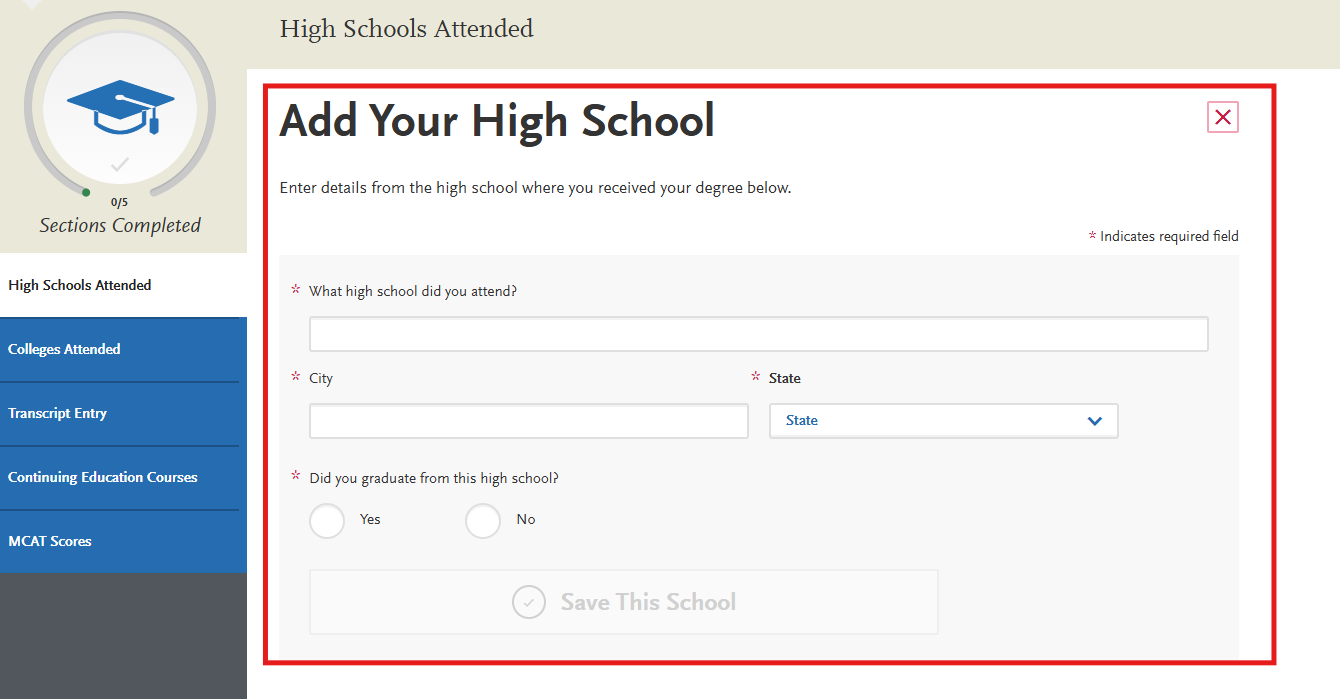
In the high school attended subsection, enter details for every high school you attended: name, graduation date, and location. Include every school, even if you transferred, attended briefly, or didn't graduate from that institution.
If your high school history is a little nontraditional (you moved around, switched schools, or completed a GED), AACOMAS needs a complete and accurate record. List everything, keep the details consistent with your other records, and move on to the sections that add value to your application.
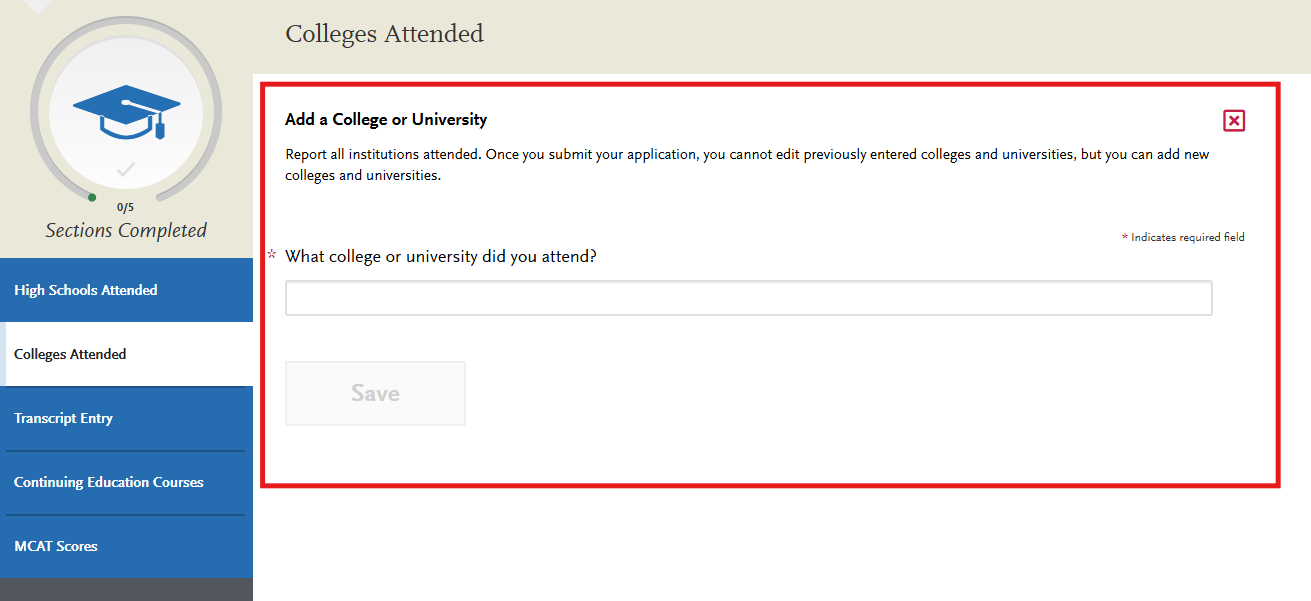
In the colleges attended subsection, list all colleges/institutions you attended post-high school, regardless of relevance, including summer courses, community colleges, military academies (excluding SMART/JST), post-baccs, and study abroad. List all schools, even if your credits were transferred to a different school or if no degree was earned. Enter each school only once, regardless of multiple degrees or attendance gaps.
Send official transcripts directly from each institution to AACOMAS (paper or electronic via registrar). This precedes coursework entry for GPA verification.

In the transcript entry subsection, manually enter all coursework from U.S. and English-Canadian colleges/universities listed in Colleges Attended, not just prerequisites. This includes repeats (AACOMAS averages them into GPAs), withdrawals, labs, non-graded/orientation/gym/test credits, and using exact prefixes, numbers, titles, credits, and grades from transcripts.
You can apply via AACOMAS even before you receive your transcripts, but your application will only be reviewed once they are submitted. Ensure you set aside enough time to fill out your AACOMAS application correctly. To do so, carefully read each section and fill in all the required information.
During transcript entry, select from AACOM's fixed dropdown of course subjects (e.g., Biology/Zoology for science GPA, English for non-science) to classify every course precisely as on your transcript.
These classifications feed into AACOMAS GPAs, including overall, science (biology, chemistry, physics, and organic chem), and non-science. Unlike AMCAS, AACOMAS counts more subjects toward the science GPA for holistic review.
The PTE allows specialists to enter your completed coursework from accredited US/English-Canadian schools for a fee (e.g., $85 for 1-3 transcripts, up to $160 for 7+ transcripts), saving you time if entry feels overwhelming.
However, PTE is unavailable for unlisted/foreign schools, planned/in-progress courses, or narrative transcripts. You’ll need to enter those yourself first. Transcripts must arrive before PTE starts (post-submission), with a 10-business-day turnaround.
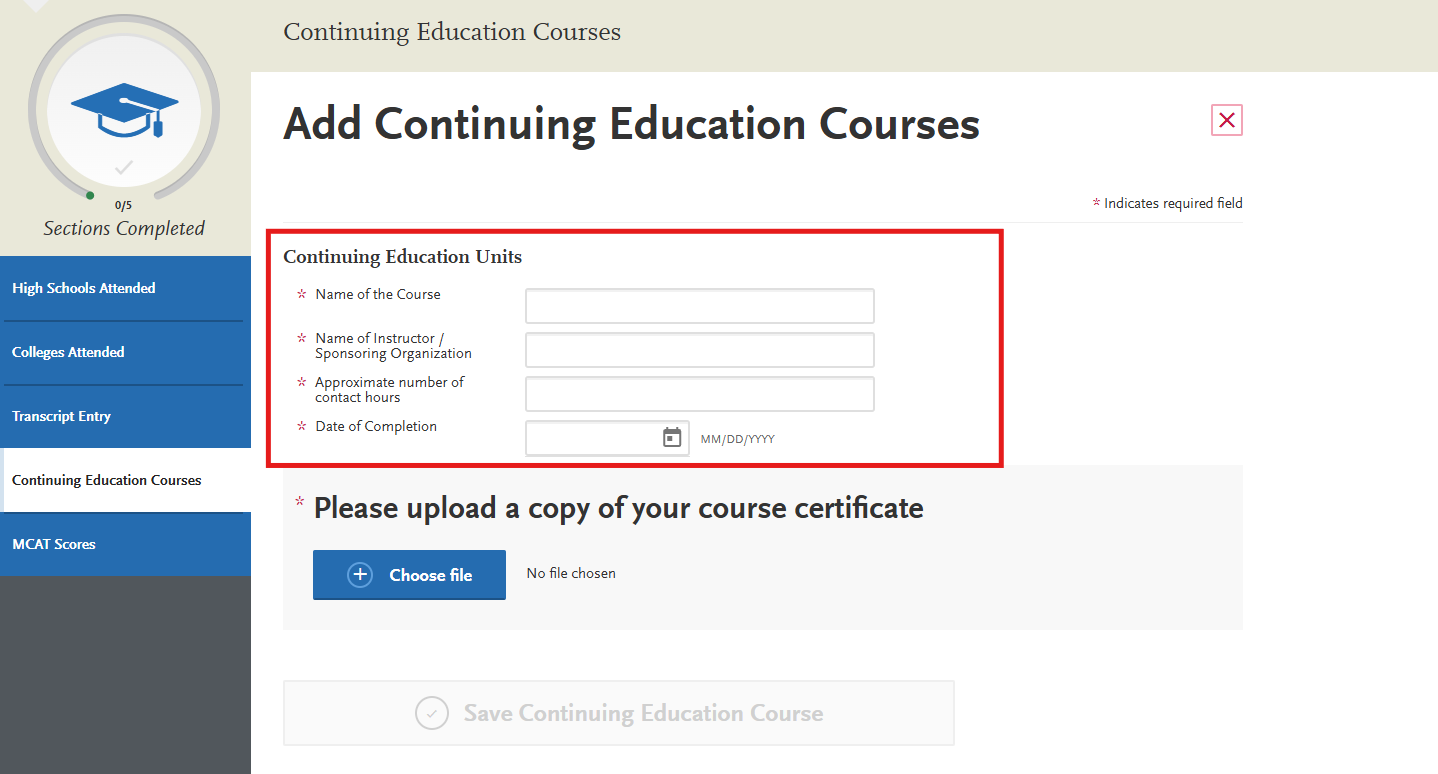
In academic history, list any Continuing Education Units (CEUs) earned (e.g., certifications like BLS or non-accredited military JST coursework), including course title, dates, credits/hours, and sponsor.
Upload a PDF certificate for each entry directly in the app. There isn’t a specified limit, but prioritize relevant CEUs first. These supplement regular transcripts and don't factor into GPAs.
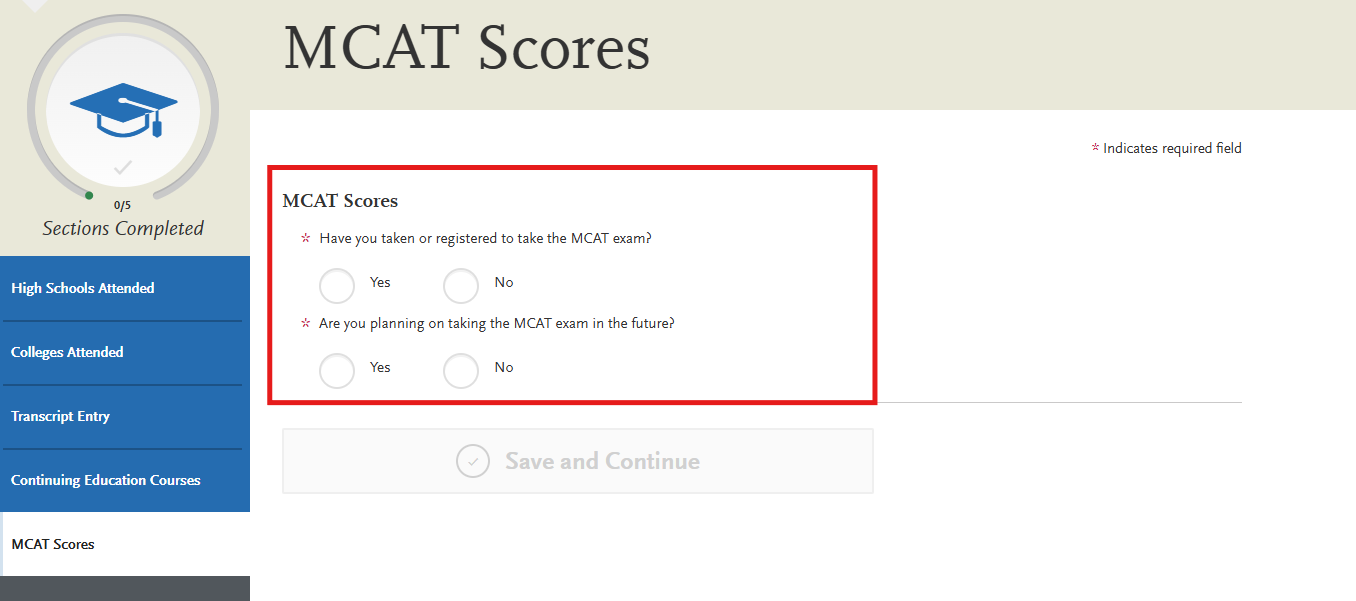
The MCAT Scores section is primarily for your MCAT score and the GRE if you're applying to a combined DO/PhD program.
For any test you've already taken, enter the date, your scores, and your test ID. If you're scheduled to take the MCAT but haven't yet, add the test date and your ID, but leave the score blank. If that date changes, come back and update it.
Reporting your MCAT score in AACOMAS is not the same as sending your official score. You need to log into the AAMC website separately and request that your scores be released to AACOMAS.
AACOMAS matches your official score to your application using your name, date of birth, and AAMC ID, so double-check that all three match exactly across both systems.
Score processing takes time because AAMC sends scores to AACOMAS in batches. Don't wait until the last minute to request that release. Plan for at least a couple of weeks to ensure you submit everything on time.
After you submit your application, you can add new test entries if you retake the MCAT, but you can't edit or delete scores you've already reported.
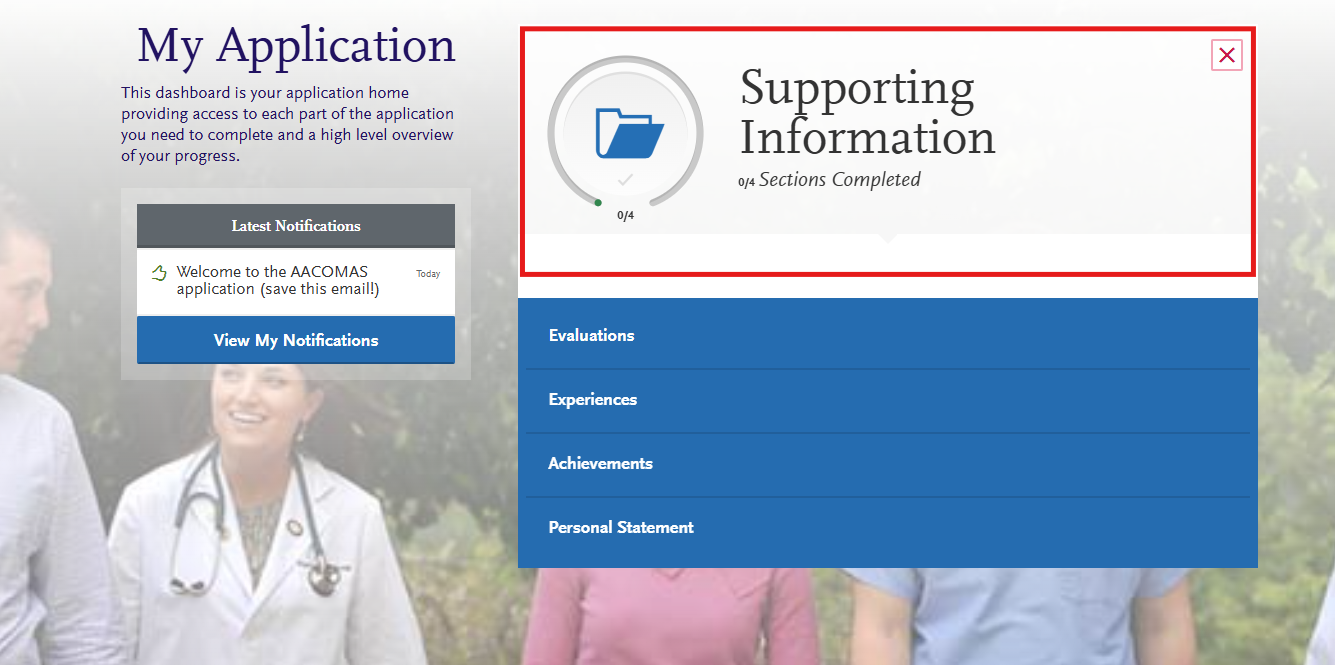
The supporting information section requires you to provide key non-academic details, such as experiences/activities, achievements/awards, a personal statement, and letters of recommendation.
Beyond your GPA and MCAT score, AACOMAS evaluates the full picture of who you are. This includes:
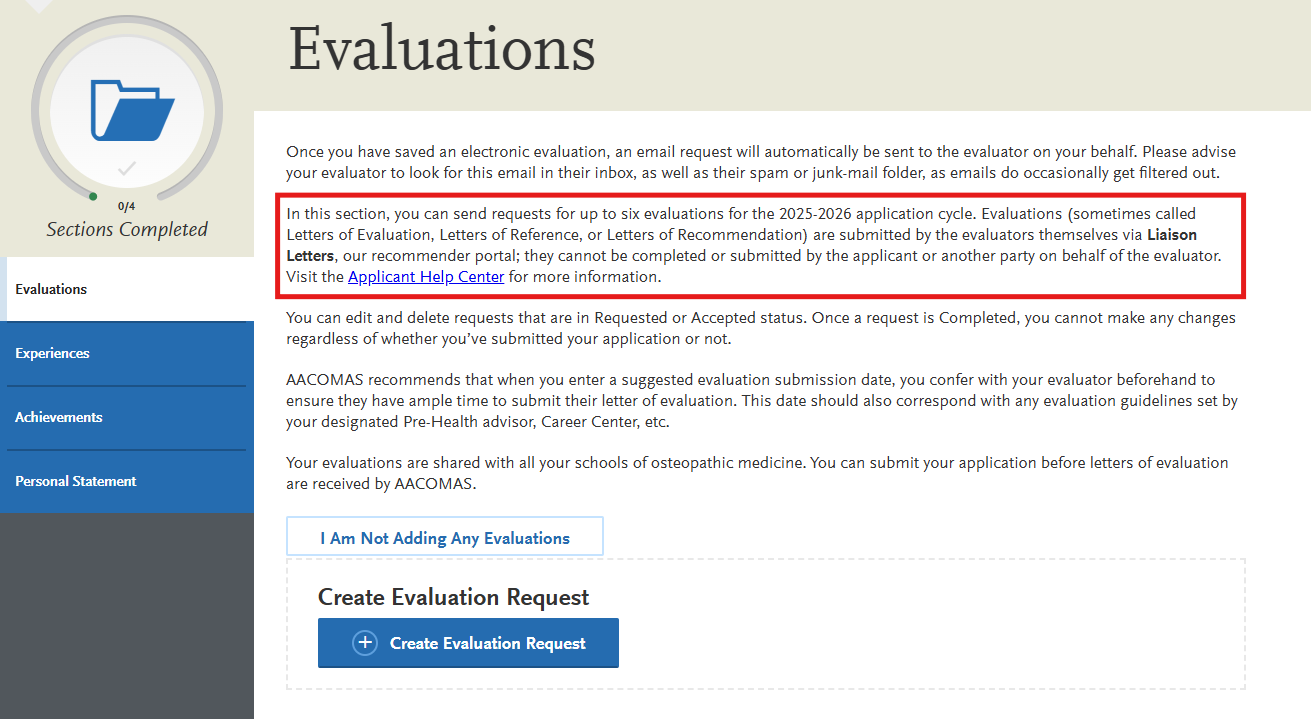
The evaluations section is where you set up your letters of recommendation. AACOMAS calls them "evaluations," but these are the recommendation letters your schools will read from professors, physicians you've shadowed, committee letter writers, or anyone else supporting your application.
You can create up to six evaluation entries. For each one, you'll enter the recommender's name, email, and their relationship to you, and you'll waive your right to view the letter (schools expect this, and opting out can raise flags). Once you save each entry, AACOMAS generates a unique link and sends it to your recommender through its Letters by Liaison portal. Your recommenders upload their letters directly.
After you've sent requests, follow up with your letter writers personally. AACOMAS lets you resend reminder emails through the portal, but a direct message from you carries more weight.
Give your recommenders a clear deadline that's at least two to three weeks before you plan to submit, and check back if you haven't seen their letter come through. Chasing down late recommendation letters is one of the most common sources of unnecessary stress in this process, and it's entirely avoidable if you start early and stay on top of it.
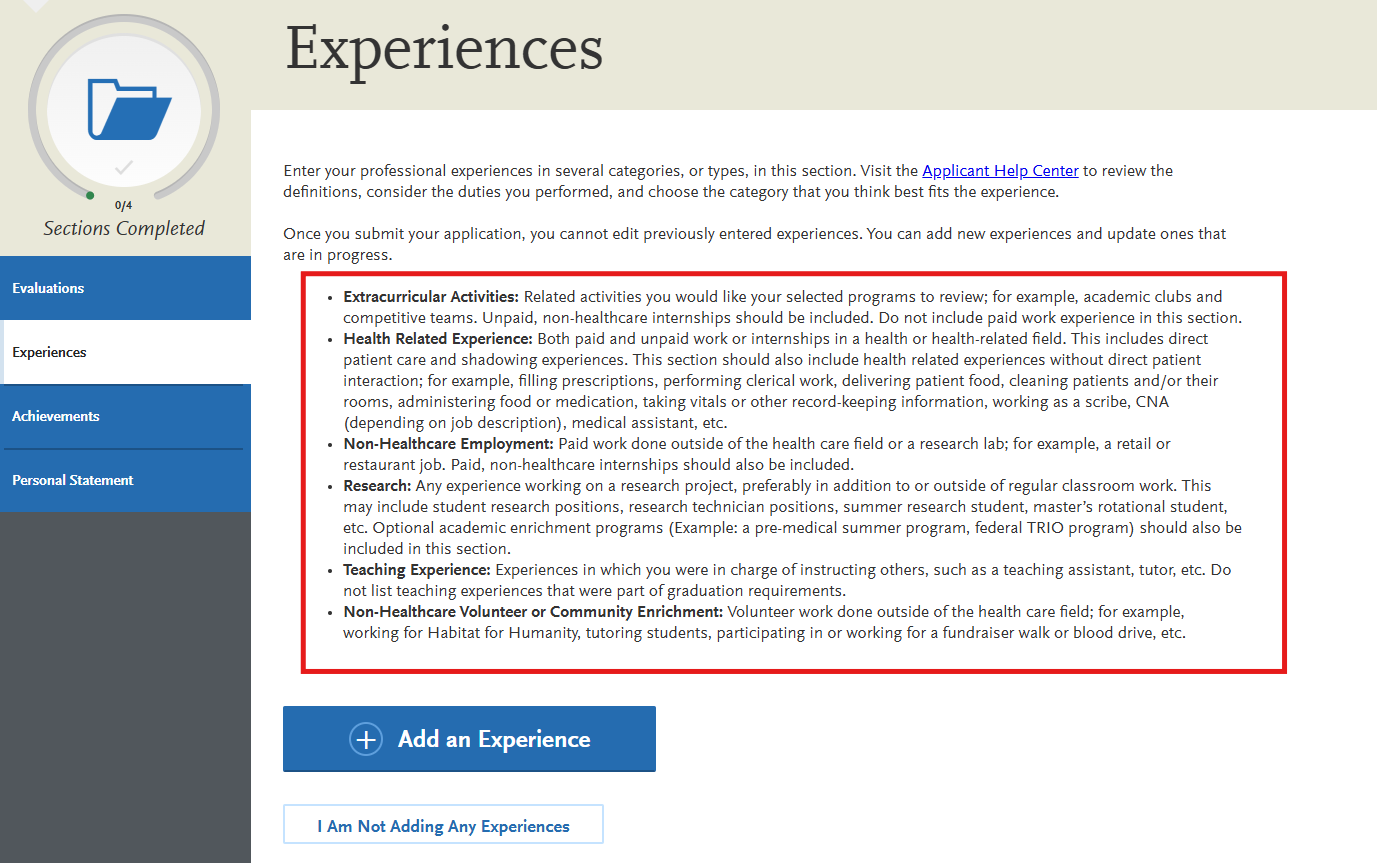
The experiences section is where you list everything meaningful you've done since high school. AACOMAS asks you to place each experience into one of four categories:
Some experiences won't fit into one category. A paid position at a hospital gift shop, for example, could go under either non-healthcare employment or healthcare experience.
When you're deciding, think about what you actually did day to day. If the core of the role involved patient interaction or clinical exposure, it belongs in a healthcare experience. If it didn't, place it elsewhere, even if the setting was medical. Choose the category that most accurately reflects the work itself, not just where it happened.
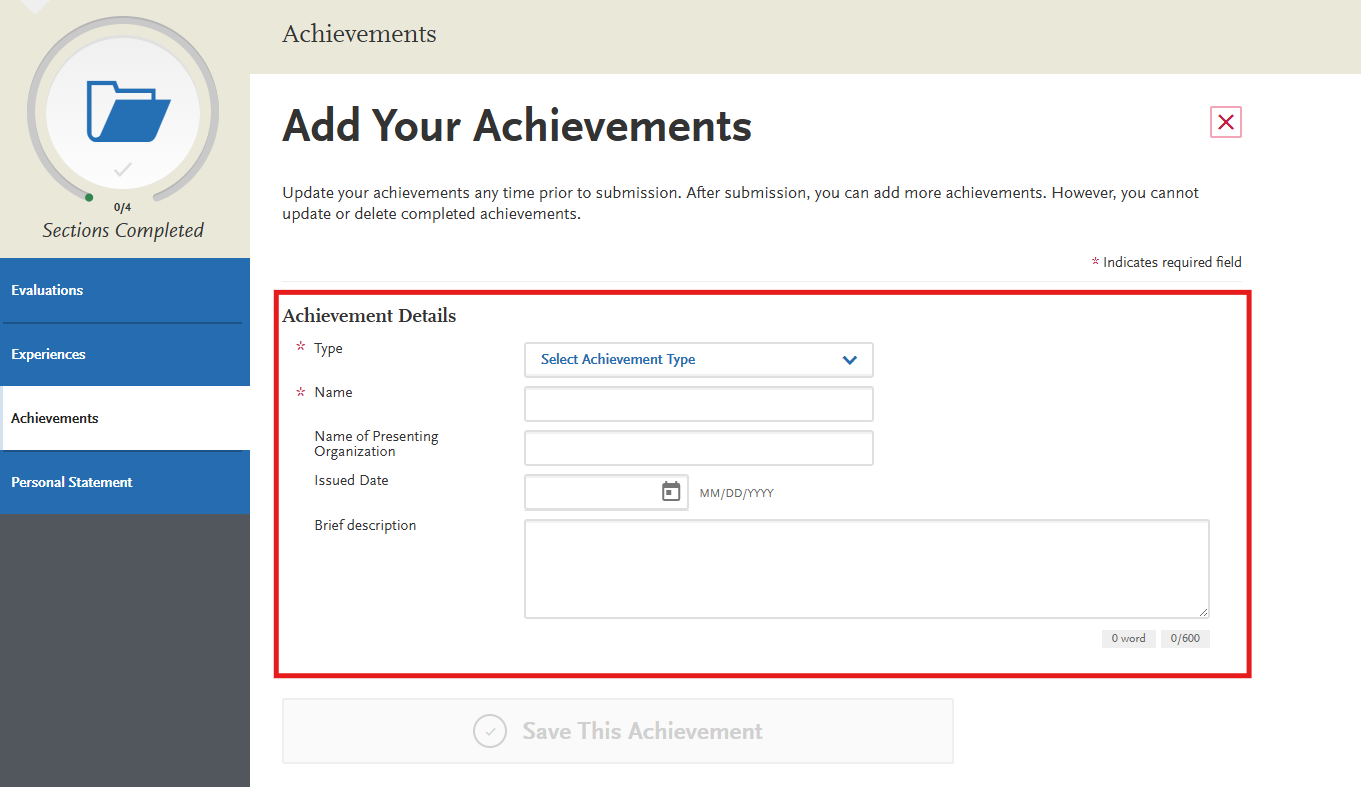
The achievements section lists awards, presentations, scholarships, honors, and publications. You can add as many entries as you want, but focus on achievements from the last 10 years, as admissions committees care most about what you've been doing recently, not an award you won as a high school sophomore.
Each entry allows up to 600 characters and asks for details such as the date earned, the granting organization, a title, and a verification contact, if applicable. You'll also categorize each achievement by type.
Prioritize entries that demonstrate leadership, academic excellence, or a sustained commitment to healthcare and service. For example, a poster presentation at a research symposium, a scholarship awarded for community health work, or an honor society induction all belong here. Skip anything that doesn't add meaningful context to your candidacy. Filling this section with small awards decreases the impact of the achievements that actually matter.
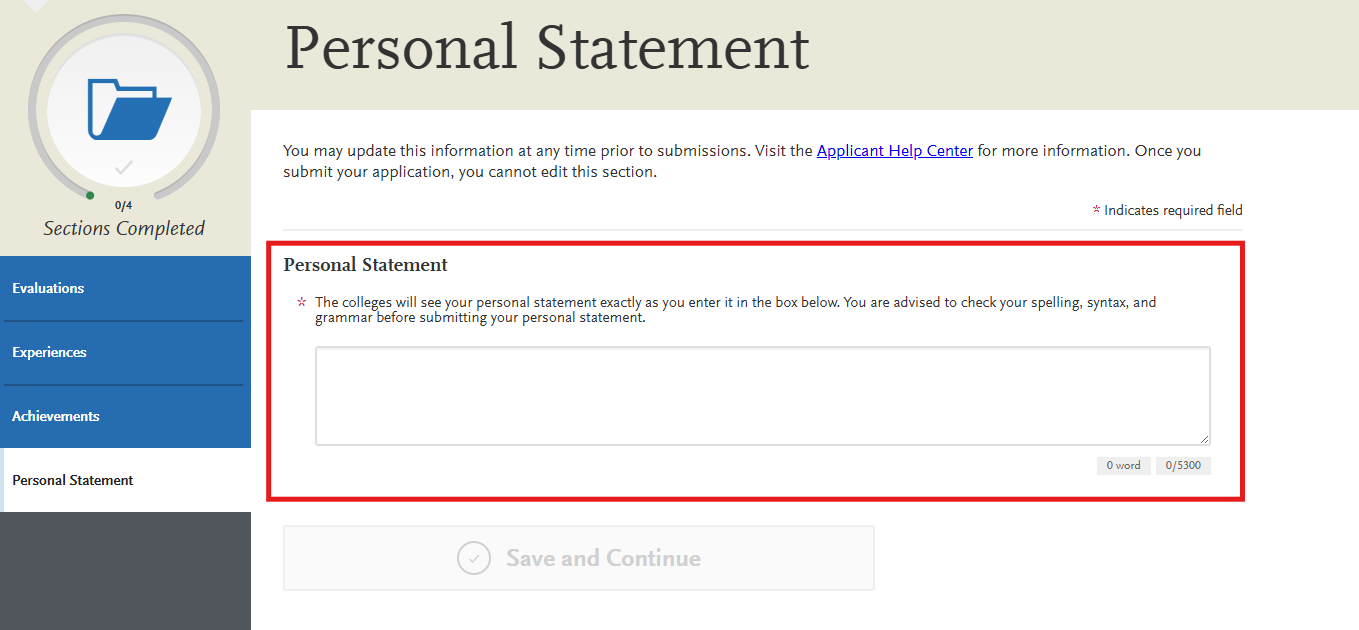
Your personal statement should answer the core question that medical admissions committees want to know: why do you want to become an osteopathic physician? Not just why medicine in general, but why osteopathic medicine specifically.
Admissions committees want to see that you understand what makes the DO approach distinct and that your motivation to pursue it comes from real experiences, not a surface-level interest. If you've shadowed a DO, worked in a setting that practices holistic or patient-centered care, or had a personal experience that connected you to osteopathic principles, focus on that in your personal statement.
You have 5,300 characters, including spaces (roughly 700 words), or about a page and a half single-spaced. Plain text only, no bold or italics. Keep your topic general rather than tailored to one specific school, since every DO program you apply to will read the same statement.
If you're also applying to MD programs through AMCAS, don't just copy and paste that essay here. The AMCAS personal statement asks why medicine; the AACOMAS personal statement asks why osteopathic medicine.
Admissions committees can tell when an applicant swapped "MD" for "DO" and called it a day. Write a statement that reflects the emphasis on treating the whole person, the connection between structure and function, and the focus on preventive care. Ground it in your own experiences rather than restating definitions you pulled from a website.
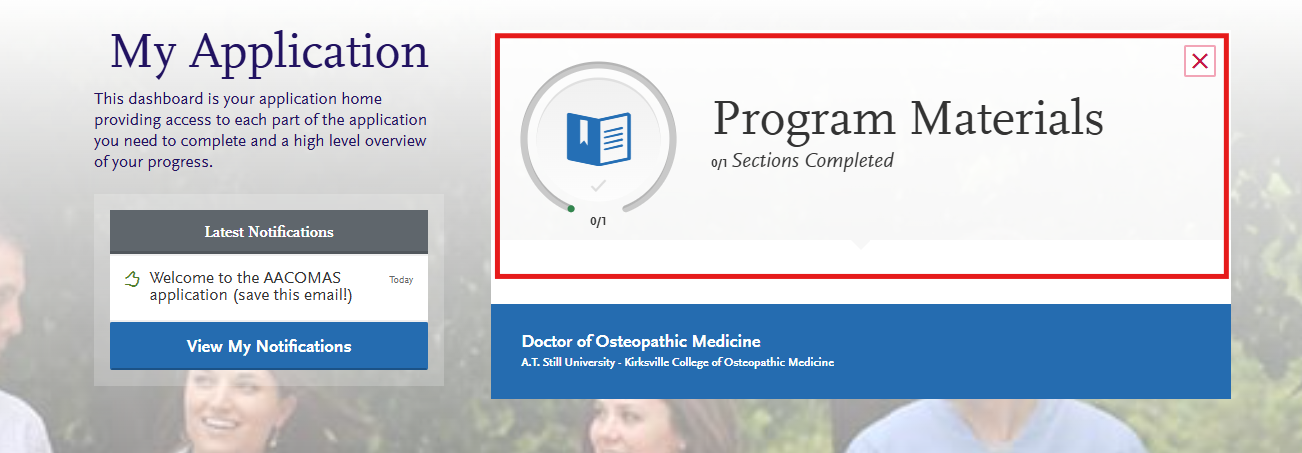
The program materials section is where each school you've selected gets to ask you for something specific. Unlike the rest of the AACOMAS application, the program materials section is tailored to each individual program, and requirements vary widely.
When you click on a school's name in this section, you'll see a Home tab with that program's deadlines, special instructions, and any additional details they want you to know.
Some programs also include a Questions tab with school-specific prompts. Other programs may ask you to upload supporting documents or identify which of your courses fulfill their specific prerequisite requirements.
Some of the programs you apply to will include additional questions in this section. These can range from multiple-choice prompts to short-response essays.
For example, asking you to explain your biggest challenge, describe volunteer work with underserved populations, or articulate why you want to attend that specific school. Don't rush through them. Schools use these responses to gauge whether you've done your homework on their program and whether your values align with their mission.
If you have taken, or plan to take, any courses that meet your program’s prerequisites, use this section to indicate that. The school will review your courses and decide whether you meet the prerequisites.
Before any program receives your materials, AACOMAS verifies your application. This is essentially an accuracy check to ensure everything you entered matches your official records.
During verification, AACOMAS staff review all of the coursework you entered and compare it against your official transcripts. Your courses get categorized by subject, your grades get converted to the AACOMAS grading scale, and your GPA is recalculated, which is why your AACOMAS GPA may look different from what your school reported. AACOMAS also confirms any degrees you've listed as awarded.
Once your application reaches "Complete" status, verification typically takes up to 10 business days. If there’s an error, your application is returned to you in "Undelivered" status for corrections, and the application timing window is reset. In a rolling admissions cycle where every week matters, a single transcript mismatch or misclassified course can cost you valuable time.
Admissions committees won't receive a copy of your application until verification is complete. Until that happens, your application is effectively invisible to every school on your list. Monitor your status closely through the AACOMAS portal after you submit, and resolve any flagged issues immediately.
Secure at least one letter from a DO physician, ideally one who supervised your shadowing or clinical experience. Most schools auto-reject applications without a letter of recommendation. Admissions committees treat a strong DO letter as direct evidence that you've engaged with osteopathic medicine firsthand, not just read about it.
To make this as easy as possible for them, email a concise one-page packet by March that includes your CV and two specific, memorable stories from your time together.
For instance, you could write, "During my 20-hour shadow, I assisted during OMM treatment for a patient with chronic low-back pain." Send them the direct AACOMAS submission link. Follow up with a reminder four weeks before the deadline.
In an Inspira Advantage webinar discussing DOs vs. MDs, Dr. Nakia Sarad, an expert Inspira Advantage consultant, provided advice on applying to DO schools. Dr. Sarad graduated from Touro College of Medicine and has over a decade of experience in medical and DO admissions.
"If you are determined to apply to DO schools, it's really important to have some sort of osteopathic background and some sort of experience,” she says. “[It’s also important to] have a lot of recommendations that's going to make you more competitive for the DO program so that you'll have a higher chance of more interviews."
Dr. Sarad emphasizes that a successful DO application requires more than just high scores; it requires proof that the applicant understands the philosophical differences of the osteopathic path, ideally evidenced by a solid letter of recommendation from a DO.
In the experience subsection, use every one of the 600 characters available for each entry, because blank space here is solely a missed opportunity. A strong entry follows this structure:
For example: "I trained 5 CNAs on documentation protocol, reducing charting errors by 20%; I shadowed OMM procedures, connecting holistic technique to measurable improvements in patient retention."
Prioritize recent healthcare experiences totaling 100 or more hours, and aim to list 15-20 experiences overall. Where possible, frame entries to show growth over time. For instance, noting that you "evolved from observer to patient advocate" signals maturity and self-awareness to reviewers.
In Inspira Advantage’s DO vs. MD webinar, Dr. Andrew Warburton, a director of advising at Inspira Advantage, commented on specific research experiences for DO schools. Dr. Warburton has extensive experience advising medical school applicants.
Dr. Warburton notes that while many components of the application (such as the personal statement and interview) are similar to those of MD schools, DO programs often look for deep clinical and volunteer experience to support the applicant's commitment to a holistic medical career.
In the personal statement subsection, begin with a patient-centered story in your first 100 characters that anchors directly to osteopathic philosophy or osteopathic manipulative medicine (OMM). For instance, "Witnessing a DO resolve a patient's chronic migraine through cranial manipulation reframed everything I understood about medical care."
From there, build toward the full 5,300-character limit, making sure you address the prompt precisely. Describe a meaningful adversity you've overcome and articulate clearly why you are pursuing DO medicine specifically, not simply medicine in general.
Plan for at least three rounds of substantive edits before submission, and at least one of those rounds should come from someone other than you. Because AACOMAS strips all formatting, write and proofread your statement in plain text, and paste it into Notepad before submitting to catch any hidden formatting that could impact the final copy.
In the achievements subsection, treat vague entries as a liability and quantify everything you list.
A strong example looks like this: "1st Place, Keystone Research Symposium (2025): Presented 'OMT in Post-Stroke Recovery' to an audience of 200 attendees; abstract subsequently published."
Limit your list to 10 to 12 achievements from the past 10 years to keep the section focused and relevant. For your most significant awards, include a verifier contact, as this small step verifies authenticity and distinguishes applicants who've genuinely earned recognition from those just padding their applications.
In the program materials subsection, map each school's prerequisite requirements to your transcript before you submit, confirming specific course equivalencies. For example, verifying that your PSYC 201 satisfies Philadelphia College of Osteopathic Medicine (PCOM)'s Behavioral Science requirement.
When answering school-specific questions, align your goals with the school's mission statement and back it up with a concrete example. For instance, combining the phrase "whole-person care" into a real patient interaction will read as genuine alignment rather than generic flattery.
Our DO consulting services guide you through the AACOMAS process, from experience selection to essay review, to help you submit a competitive, mistake-free application.
AACOMAS opens annually in early May for the next entry cycle. Here is the complete 2025-2026 AACOMAS timeline:
Make sure you submit your application and complete payment by 11:59 PM ET on your school's declared deadline. AACOMAS will not process an application with an incomplete payment, so don't just hit submit and walk away.
Stay on the page, confirm the transaction went through, and check your email for a confirmation receipt before you close the browser.
In the evaluation subsection, never submit without at least one DO physician letter, as many schools auto-reject the application without it. Add the letter of evaluation via "Create Evaluation Request" with the DO's email. Evaluators will upload the letter only via the Recommender Portal.
When you enter each course in the transcript entry section, AACOMAS asks you to classify it by subject from a dropdown list. Where most applicants get confused is when a course title doesn't map clearly to a single category. A "Microbiology" course belongs under Biology, not Other Science. "Biochemistry" has its own dedicated category and shouldn't be grouped with Chemistry.
If you're unsure where a course belongs, check the AACOMAS Applicant Help Center. It provides example courses for each subject category. You can also look at how your university's registrar classifies the course within your degree program.
When neither of those gives you a clear answer, go with your best judgment, but know that AACOMAS verification staff will reclassify courses they disagree with. A course you counted toward your science GPA could get moved to non-science, or vice versa, and if that reclassified course had a strong grade, your science GPA drops.
Getting classifications right the first time keeps your GPA where you expect it and your application moving through verification without delays.
In Colleges Attended, list every institution you attended, even if you only received one summer credit. Failure to record all your colleges can trigger the "Undelivered" status to your application. Request official transcripts from each school by mid-June to ensure your verification will succeed.
In the personal statement section, don't paste formatted text, as this isn’t accepted. The maximum number of characters (including spaces) is 5,300, so test this out in Notepad first. DO reviewers often ignore generic, copied-and-pasted MD essays.
Post-verification, don't add new spring grades outside three windows (Sep-Oct, Dec-Feb, Mar-Jun). Submit updated transcripts only for those periods, or schools will see incomplete GPAs.
The AACOMAS application final submission deadline is June 12, 2026, at 11:59 PM ET (for the 2025-2026 cycle). This is the last date to create an account, submit your primary application, request evaluations, or order a Professional Transcript Entry.
AACOMAS application fees for 2025-2026 include $198 for the first school + $60 per additional school. Some schools charge secondary/supplemental fees ($25-$100). Fee waivers cover the initial $198.
Yes, AACOMAS offers a limited fee waiver program covering the initial $198 application fee (first school only). Applicants can qualify via their 2024 Federal Tax Return. Dependent applicants use their parent's/guardian's return, whereas independents submit both.
Yes, you can make limited edits to your AACOMAS application after submission, but most sections are locked once they’re verified. Editable areas include personal info (contact/visa/infractions), new colleges/degrees/in-progress courses, new experiences/achievements, programs/docs, and unsubmitted programs. Locked areas include completed coursework, personal statements, and existing experiences.
Yes, AACOMAS provides status updates via email notifications and the application dashboard. In the Check Status tab, monitor real-time progress:
Regularly view My Notifications for any critical alerts, such as missing items.
If you miss the final submission deadline, your application is permanently rejected. No late submissions are accepted. Even if the application is submitted on time, if the verification/transcripts miss the June deadline, the application processing stops.
Yes, you can apply to both AACOMAS (DO schools) and AMCAS (MD schools) in the same application cycle. The systems are completely separate, with no data sharing between AAMC and AACOM/Liaison.
Currently, 44 DO programs participate in the AACOMAS application.
In the AACOMAS application, find program-specific prerequisites directly in Section 4: Program Materials.
Here are some examples of experiences to include in the AACOMAS experiences section:
Clinical Experience Examples
Volunteering Examples
Research Examples
AACOMAS requires course-by-course U.S. equivalency evaluations (not original foreign transcripts) for all non-U.S./non-English-Canadian coursework, sent directly from approved vendors. List foreign schools in Colleges Attended and select "Order Evaluation"; self-enter coursework from the report in Transcript Entry.
French-Canadian transcripts need evaluation. (English-Canadian transcripts do not.) Study abroad/overseas U.S. programs use regular U.S. transcripts. Most DO programs mandate this for non-U.S. degrees.
All DO schools use the AACOMAS, except for the University of North Texas Health Science Center – Texas College of Osteopathic Medicine, which uses the TMDSAS. In the 2025-2026 admissions cycle, 69 osteopathic medical programs across the country use the AACOMAS.
Orthopaedic Surgery Resident Physician
Lewis Katz School of Medicine at Temple University


.svg)


