Get in touch: +1 888 453 5021




Below is a table of the top 20 medical schools in the U.S., along with their acceptance rates, as reported by the Medical School Admission Requirements (MSAR) database.
To rank the top medical schools in the United States, we evaluated programs using a combination of research productivity, clinical training environment, academic reputation, and faculty resources.
Our ranking system uses several indicators that reflect how effectively a medical school trains future physicians and contributes to advances in medicine:
Gaining admission to a top-ranked U.S. medical school requires a clear narrative with thoughtful and authentic storytelling, clear alignment with a school’s mission, and genuine passion for medicine.
Below are expert-backed strategies that help applicants stand out at highly selective programs.
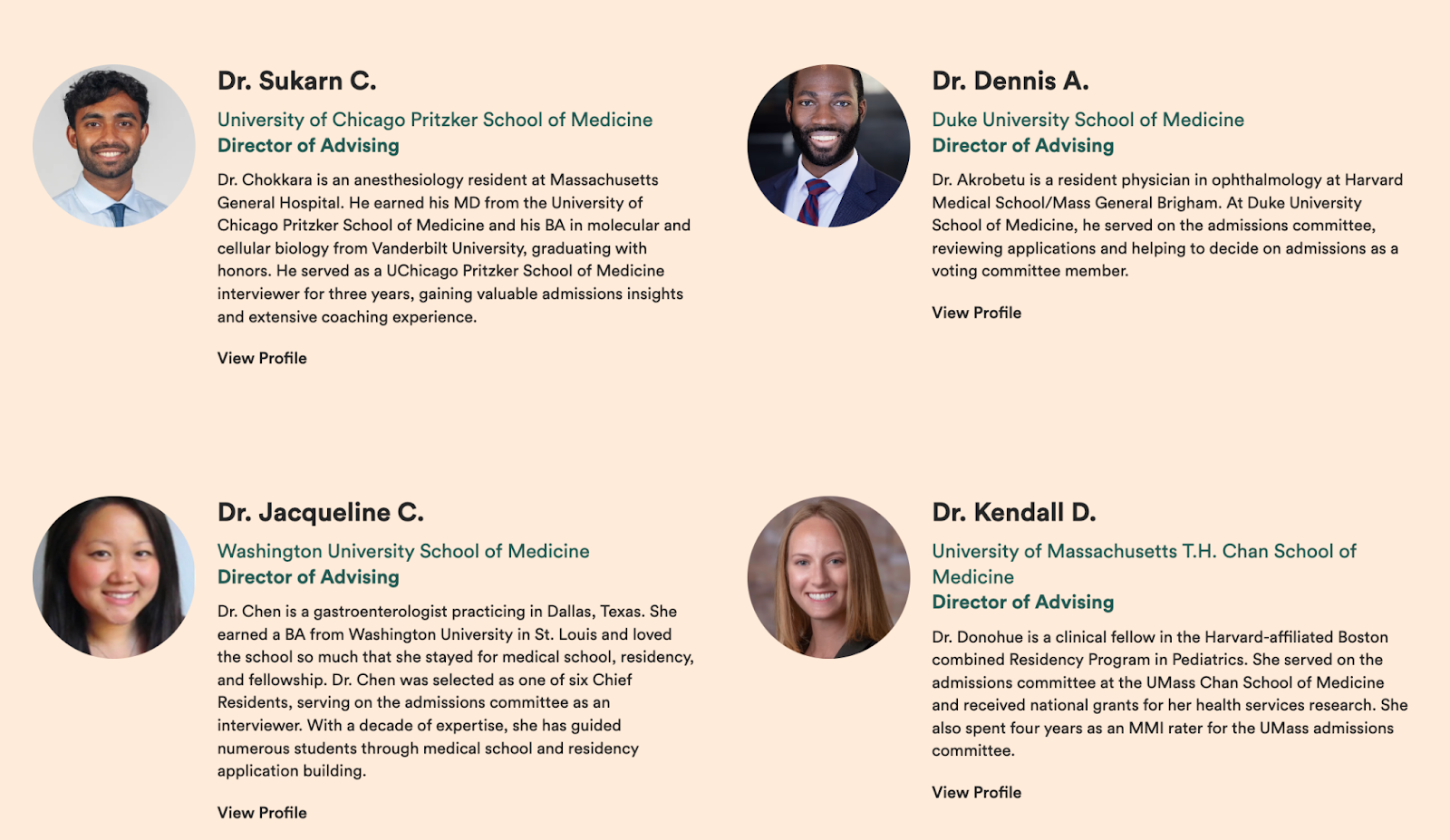
Inspira Advantage's medical school application consultants are physicians, MD graduates, and former admissions committee members who have guided hundreds of students through the process. They know what competitive applications look like from both sides of the table, which means they can identify weaknesses in your application that you cannot see yourself.
Working with a consultant gives you a structured, personalized approach to every component. They help you build a balanced school list, develop your strongest narrative, and craft personal statements and secondary essays that present a clear and compelling case to competitive programs.
Figuring out if medical school admissions consulting is right for you comes down to one question: how much does the outcome matter to you? For students serious about competitive programs, having the right expert on your side to guide your entire application strategy is one of the highest-leverage decisions you can make.
Students who have gone through the process speak to the difference it makes in our admissions consulting reviews.
Top medical schools review thousands of applications each cycle, so admissions reviewers naturally look for patterns that help them remember candidates. Instead of presenting disconnected activities, build a clear narrative thread that ties together your experiences, motivations, and career goals.
In our webinar on how admissions committees review applications, Dr. Katherine Munoz, a PGY-4 plastic and reconstructive surgery resident at the University of Wisconsin who served on medical school admissions boards for five years and now advises applicants at Inspira Advantage, explains that “humans are programmed to find patterns.”
A clear narrative makes an application easier to understand and remember because it helps application reviewers quickly see what drives your interest in medicine and how your experiences support that goal.
For example, if your central theme is health equity, each part of your application should reinforce that focus.
Your personal statement might describe an early experience volunteering in a community clinic where you observed how barriers such as insurance access or language affected patient care, and one of your recommendation letters may come from your volunteer coordinator.
Your secondary essays might expand on how these experiences shaped your interest in community medicine or public health initiatives.
A simple framework to test your narrative is the “pattern check.” Ask yourself whether someone reading your activities, personal statement, essays, and recommendation letters would immediately understand what drives your interest in medicine.
When every part of your application reinforces a consistent story, admissions committees can more easily advocate for you during deliberations.
Strong grades and MCAT scores are the gateway to getting your application reviewed further. What distinguishes applicants past their numbers is authentic storytelling and reflection in their personal statement.
One of our admissions experts, Dr. Jason Gomez, a former Stanford School of Medicine admissions committee member, advises students to fully own their personal story. In one of our MCAT workshops, he emphasizes that applicants should remember they are not just statistics:
“You’re not just a GPA, you’re not just an MCAT score… you’re a person with a voice, a path, and a ‘why.’”
Instead of relying on broad statements such as “I want to help people,” explain specific experiences that shaped your interest in medicine. For example, describe a moment during clinical volunteering when you observed how communication affected a patient’s trust in their physician.
Use the “experience → reflection → motivation” model in your personal statement:
Strong essays also use specific scenes and concrete details rather than abstract statements. Instead of writing, “I learned leadership,” describe the moment you coordinated volunteers during a clinic shortage or trained new team members.
Top med schools expect applicants to show clear alignment with their mission and programs, but most of that customization happens in the secondary application.
Your personal statement is submitted through the American Medical College Application Service to many schools at once, so it should focus on your core motivation for medicine and the experiences that shaped it, not on any single institution.
School-specific alignment is best demonstrated in secondary essays. Dr. Aryaman Gupta, an interventional radiology resident at Johns Hopkins School of Medicine who mentors applicants at Inspira Advantage, explains that successful applicants connect their personal interests to the strengths of each program.
In our admissions webinar, he noted that his own interest in engineering aligned well with Johns Hopkins’ strong biomedical engineering ecosystem.
Use secondary essays to make these connections concrete. For example:
Show how your experiences logically lead you to the program you’re applying to. Specific connections show committees that you understand the school and would actively contribute to its community.
The acceptance rates at the top U.S. medical schools range from 0.76% to 3.80%. These extremely low rates reflect the large applicant pools and small incoming class sizes at highly selective programs.
For example, Ivy League schools like Harvard Medical School have an acceptance rate of only 1.99%.
Students applying to top medical schools should aim for a target MCAT score of 521+ to remain competitive. A 521 meets or exceeds the median MCAT at 14 of the top 20 medical schools in the U.S.
For the top five programs (Harvard Medical School, Johns Hopkins University School of Medicine, Perelman School of Medicine, Columbia University Vagelos College of Physicians and Surgeons, and Stanford University School of Medicine), the median MCAT ranges from 520 to 522. Aim for a 523 to match or exceed the median at every top-five school and give yourself a clear academic edge at the most selective programs in the country.
Top U.S. medical schools require applicants to complete foundational science coursework before applying. These prerequisites ensure that students enter medical school with the scientific background necessary for advanced medical training.
Most programs require one year of biology with laboratory, one year of general chemistry with laboratory, one year of organic chemistry with laboratory, and one year of physics with laboratory. Schools also expect coursework in biochemistry and writing-intensive subjects such as English.
Yes, applicants can still gain admission to a top medical school with a lower GPA if the rest of their application is strong. Admissions committees evaluate candidates holistically by considering MCAT and GPA performance, clinical exposure, research productivity, leadership, letters of recommendation, and personal essays.
Applicants with lower GPAs can strengthen their applications by showing clear academic improvement, strong MCAT scores, significant research contributions, or extensive clinical experience.
A well-written application that clearly explains personal growth and connects experiences to a long-term commitment to medicine can significantly strengthen an applicant’s overall profile.
Competitive applicants to top medical schools present strong academic performance, meaningful clinical experience, research involvement, and a clear motivation for becoming a physician.
Successful applicants demonstrate academic readiness through high GPAs and strong MCAT scores, but they also show how their experiences shaped their interest in medicine. Admissions committees look for evidence of patient interaction, scientific curiosity, leadership, and long-term commitment to service.
Competitive applicants also present a cohesive narrative that connects their academic work, clinical exposure, and personal motivations. When every part of the application reinforces a clear story about why the applicant wants to practice medicine, admissions committees can more easily understand their potential as a future physician.
Prospective students should evaluate clinical training opportunities, research access, mentorship, location, and residency match outcomes rather than relying on rankings alone.
Medical school rankings primarily reflect factors such as research funding or academic reputation. These metrics do not fully capture the day-to-day training environment students experience during medical school.
Students should also consider geographic location, cost of attendance, class size, and the strength of affiliated health systems. These factors affect clinical exposure, networking opportunities, and long-term career development.
Medical school rankings influence residency opportunities to some extent, but they are not the primary factor that residency programs evaluate. Residency program directors prioritize USMLE or COMLEX scores, clinical performance during clerkships, letters of recommendation, research productivity, and interview performance when selecting applicants.
However, attending a highly recognized medical school can provide indirect advantages. Top institutions often offer strong research infrastructure, well-known faculty mentors, and extensive hospital networks, which can strengthen an applicant’s profile and provide access to influential recommendation letters.
Orthopaedic Surgery Resident Physician
Lewis Katz School of Medicine at Temple University


Get 25+ free medical school personal statements written by our succcessful applicants free of charge. No strings attached.

.svg)

