For expert tips on how to get into Baylor College of Medicine (BCM), read our comprehensive guide.
If you’re just here for the requirements, click here.
Privacy guaranteed. No spam, ever.
Baylor College of Medicine Acceptance Rate: 3.69%
The acceptance rate at Baylor College of Medicine is 3.69%. In the 2025-2026 admissions cycle, BCM had 6,073 applicants, and 224 students matriculated. That means your odds of matriculating to BCM are around 4 in 100.
The table below shows how BCM’s acceptance rate has fluctuated over the past five admissions cycles, according to archived data from the AAMC.
Year
Number of Applications
Number of Matriculants
Acceptance Rate
2025-2026
6,073
224
3.69%
2024-2025
5,622
226
4.02%
2023-2024
5,572
226
4.06%
2022-2023
5,877
185
3.15%
2021-2022
7,698
185
2.40%
0.00%
Acceptance Rate for Baylor College of Medicine (2025–2026)
0
Applications Received
0
Matriculated Students
0:1
Applicant-to-Seat Ratio
Out of 100 applicants, roughly 4 matriculate:
Matriculated
Not Admitted
Acceptance rate by cycle
Baylor College of Medicine consistently receives
5,500–7,700+ applications each year for roughly
185–226 seats. Over the past five admissions cycles,
the acceptance rate has ranged between 2.40% and 4.06%,
making BCM one of the most selective medical schools in the country.
Admissions are holistic and consider MCAT scores, GPA, research,
clinical experience, leadership, and mission fit.
The average acceptance rate over the last five years is 3.46%.
The number of matriculants jumped from 185 to 226 between the 2022-2023 and 2023-2024 cycles, a 22% increase in class size. BCM has since held its class size relatively steady at 224 to 226 over the last three cycles. The 2025-2026 acceptance rate dipped slightly to 3.69% as the applicant pool grew by 451 applications compared to the prior year, while the class size decreased by 2 seats.
If we compare the highest and lowest years, the applicant pool dropped significantly from 7,698 applicants in 2021-2022 down to 5,572 in 2023-2024, a 27.6% decline, before rebounding to 6,073 in 2025-2026. The upward trend in applications over the last two cycles, combined with a stable class size, suggests BCM's acceptance rate may continue tightening.
While BCM has recently increased capacity compared to its pre-2023 class sizes, most applicants are still turned away.
How Hard Is It to Get Into Baylor College of Medicine?
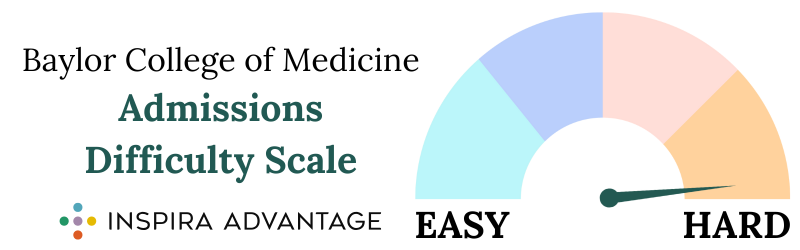
It is very difficult to get into Baylor College of Medicine. Over the last five admissions cycles, BCM has averaged a 3.46% acceptance rate, meaning fewer than 4 out of every 100 applicants matriculate.
We created the Baylor College of Medicine Admissions Difficulty Scale by comparing acceptance rates and overall selectivity across all accredited U.S. medical schools.
What Is Baylor College of Medicine’s Acceptance Rate for In-State Applicants?
The acceptance rate for in-state applicants at Baylor College of Medicine is 4.48%. Last year, BCM received 4,372 verified in-state applications, and 196 students matriculated. That means roughly 4 to 5 in 100 Texas residents earned and accepted admission. In-state students compose 71.99% of the total applicant pool, underscoring BCM's strong preference for Texas applicants.
What Is Baylor College of Medicine’s Acceptance Rate for Out-of-State Applicants?
The acceptance rate for out-of-state applicants at Baylor College of Medicine is 1.74%. Out of 1,608 out-of-state applications, just 28 students matriculated. That means fewer than 2 in 100 out-of-state applicants matriculated. Out-of-state students represent 26.48% of the applicant pool, but only 12.50% of the entering class, showing how competitive it is for non-Texas residents.
What Is Baylor College of Medicine’s Acceptance Rate for International Students?
Baylor College of Medicine received 93 international applications in the 2025-2026 cycle, but no international applicants were interviewed or matriculated. International students made up just 1.53% of the applicant pool.
How Many People Apply to the Baylor College of Medicine Every Year?
Over the past five admissions cycles, Baylor College of Medicine has received an average of 6,168 applications yearly. While BCM's class size has grown in recent years, the school has consistently matriculated fewer than 1 in 25 applicants, underscoring its reputation as one of the most selective medical schools in the U.S.
Privacy guaranteed. No spam, ever.
Admissions Statistics
Baylor College of Medicine Median MCAT Score: 519
The median MCAT score of Baylor College of Medicine accepted applicants is 519. The median MCAT score among matriculants is 518. BCM does not have a minimum MCAT requirement for admission.
Here is a look at the range of MCAT scores for the 2025-2026 accepted applicants and matriculants.
Percentile
MCAT Scores of Accepted Applicants
MCAT Scores of Matriculants
10th Percentile
514
514
25th Percentile
516
516
Median
519
518
75th Percentile
522
521
90th Percentile
524
523
519
Median MCAT Score of Accepted Applicants
Baylor College of Medicine
514
10th Percentile
516
25th Percentile
519
Median Score
522
75th Percentile
524
90th Percentile
Enter your MCAT score
519
472490500510520528
Baylor College of Medicine does not publish a minimum MCAT requirement. The MCAT is one factor in a holistic review that also considers GPA, research, clinical experience, service, leadership, and personal qualities.
The table below shows the MCAT score medians for each section of the 2025-2026 accepted applicants.
MCAT Section
Median Score
Chemical and Physical Foundations of Biological Systems
130
Critical Analysis and Reasoning Skills
128
Biological and Biochemical Foundations of Living Systems
130
Psychological, Social, and Biological Foundations of Behavior
130
The national average MCAT score is 506.3 according to the AAMC. BCM's accepted student average MCAT score of 518.7 is 12.4 points higher than the national average, signifying that BCM admits have MCAT scores well above the typical medical school applicant.
What MCAT Score Makes You Competitive at Baylor College of Medicine?
An MCAT score of 522 is considered competitive at Baylor College of Medicine, as this aligns with the 75th percentile of accepted applicants. Achieving an MCAT score of 522 places you among the top 1% of test-takers nationally.
What this means for competitiveness:
A 519 MCAT score places you at BCM's median for accepted students and confirms you meet the academic benchmark of the admitted pool. But at a school where the 10th percentile is already 514, meeting the median alone won't set you apart. Your clinical experience, research, and secondary essays need to demonstrate why you belong at Baylor College of Medicine specifically.
A 522 MCAT score places you among BCM's top 25% of accepted applicants and gives your application a noticeable academic edge within the admitted pool.
A 524 MCAT score shows you belong in the top 10% of accepted applicants and signals exceptional academic readiness.
Baylor College of Medicine Median GPA: 3.95
The median GPA of Baylor College of Medicine accepted applicants is 3.95. The median GPA among matriculants is also 3.95. Baylor College of Medicine does not require a minimum GPA to be considered for admission.
The table below shows the range of GPA percentiles for BCM's 2025-2026 accepted applicants and matriculants.
Percentile
Total GPA of Accepted Applicants
Total GPA of Matriculants
10th Percentile
3.78
3.79
25th Percentile
3.87
3.86
Median
3.95
3.95
75th Percentile
3.99
3.99
90th Percentile
4.00
4.00
3.94
Median Science GPA of Accepted Applicants
Baylor College of Medicine
3.70
10th Percentile
3.83
25th Percentile
3.94
Median GPA
4.00
75th Percentile
4.00
90th Percentile
Enter your science GPA
3.94
2.002.503.003.504.00
Baylor College of Medicine does not publish a minimum GPA requirement. Science GPA is one factor in a holistic review that also considers MCAT scores, research, clinical experience, service, leadership, and personal qualities.
According to the AAMC, the national average GPA for medical school applicants is 3.67. Baylor College of Medicine's accepted student average of 3.92 is 0.25 points higher, underscoring BCM's rigorous academic standards and the competitiveness of its incoming class.
What GPA Makes You Competitive at Baylor College of Medicine?
What GPA Makes You Competitive at Baylor College of Medicine?
A GPA of 3.99 or higher makes you highly competitive at Baylor College of Medicine because it aligns with the 75th percentile of accepted applicants.
What this means for competitiveness:
A 3.95 GPA (median) can still be competitive when paired with a strong MCAT score, compelling essays, and excellent letters of recommendation.
A 3.99 GPA puts you in the 75th percentile of accepted students and removes academics as a vulnerability in your application.
A 4.00 GPA places you in the top 10% of accepted applicants and is well-positioned for admission.
Baylor College of Medicine Median Science GPA: 3.94
The median science GPA of Baylor College of Medicine accepted applicants is 3.94. The median science GPA among matriculants is also 3.94. Baylor College of Medicine does not require a minimum science GPA to be considered for admission.
Here is a table with the range of science GPA percentiles for BCM's 2025-2026 accepted applicants and matriculants.
Percentile
Science GPA of Accepted Applicants
Science GPA of Matriculants
10th Percentile
3.70
3.70
25th Percentile
3.83
3.80
Median
3.94
3.94
75th Percentile
4.00
4.00
90th Percentile
4.00
4.00
What Science GPA Makes You Competitive at Baylor College of Medicine?
A 4.00 science GPA positions you as a very strong candidate for Baylor College of Medicine, since it matches the school's benchmarks at both the 75th and 90th percentiles for accepted applicants. A 4.00 science GPA places you among the top 25% of the admitted pool, signaling exceptional academic preparation in core science coursework.
If your science GPA falls in the 3.83 to 3.94 range, you sit within the middle 50% of accepted applicants and will meet BCM's academic expectations. But you will need strong MCAT scores, research depth, and clinical experience to differentiate yourself.
Privacy guaranteed. No spam, ever.
Baylor College of Medicine Admissions Requirements
Here is a comprehensive list of admissions requirements to gain admission to Baylor College of Medicine.
At least 90 semester hours (or equivalent) from an accredited U.S. institution
Required undergraduate coursework
The TMDSAS primary application must be submitted between May and November
Baylor College of Medicine interviews are conducted virtually and typically consist of two 25-30-minute, one-on-one conversations with members of the admissions interviewing subcommittee, which may include faculty, residents, fellows, alumni, or students.
What Is the Baylor College of Medicine’s Interview Rate?
Baylor College of Medicine's interview rate in the most recent cycle was 17.49%. Out of 6,073 verified applications, only 1,062 applicants were invited to interview.
However, the interview rate varies significantly by residency status. Texas residents had the highest chance of securing an interview, with 834 interviews offered from 4,372 applications, translating to an interview rate of 19.08%.
Out-of-state applicants faced more competitive odds, with just 228 out of 1,608 applicants being invited to interview, for a rate of 14.18%.
International applicants had the lowest chances of securing an interview, with 0 out of 93 advancing to the interview stage.
These figures demonstrate that BCM is slightly more generous in offering interviews than many top-tier schools, but the process remains highly selective, especially for non-Texas residents.
Privacy guaranteed. No spam, ever.
Secondary Application Essays
After submitting and verifying your TMDSAS primary application, Baylor College of Medicine will invite selected applicants to complete its supplemental application. This step is required for consideration and opens on June 1 each year, with deadlines set for November 1 for the M.D. program and October 1 for the M.D./Ph.D. program.
Baylor College of Medicine's 2025-2026 secondary essay prompts are:
Required Essay 1: Areas of Interest You Want to Pursue in Med School
"Select up to two additional areas of interest you may want to pursue during your medical studies. What knowledge, skills and attitudes have you developed that have prepared you for this career path?" (1,000 characters)
How to Approach This Prompt
Choose one or two areas from the list (Clinical Research, Healthcare Disparities/Medically Underserved Communities, Academic Medicine, Community Health, Simulation in Medical Education, Health Systems Science, Telehealth, Advocacy) and connect each to specific preparation you already have.
If you select one area, you have roughly 150 words to make your case. If you select two, you have about 75 words per area, so every sentence must be meaningful. Do not explain what the area is or why it matters to medicine broadly. The admissions committee already knows. Instead, name the specific experiences, skills, or training that prepared you for that path.
For example, if you select Healthcare Disparities, don't write about why disparities exist. Describe your two years coordinating care at a free clinic serving uninsured patients and explain what that experience taught you about navigating systemic barriers. If you select Clinical Research, reference a specific project, your role in it, and the skills you developed, like protocol design, IRB navigation, or patient enrollment.
If you choose two areas, draw a brief connection between them. Selecting Community Health and Advocacy together, for instance, makes a stronger case if you can show how one experience naturally led to the other.
Required Essay 2: What You’ll Do in Your Gap Year(s)
"Are you planning to matriculate into medical school immediately after completing your undergraduate education? If not, please explain what activities and/or careers you have pursued in the time between your college education and your application."
How to Approach This Prompt
If you are applying directly from undergrad, a brief confirmation is sufficient. If you took gap time, describe what you did and frame it as intentional preparation for medical school.
Keep the response concise and structured. Name your role, the setting, and what you gained from the experience. If you held multiple positions during your gap time, organize them chronologically and briefly explain how each contributed to your readiness for medical school.
For example, if you spent one year as a medical scribe and a second year in clinical research, don't just list both roles. Explain how scribing gave you fluency in clinical documentation and patient-physician interactions, while your research experience taught you how to create studies and evaluate evidence. Connect the progression to why you are a stronger applicant now than you would have been straight out of college.
Required Essay 3: Additional Information About You
"Indicate any special experiences, unusual factors or other information you feel would be helpful in evaluating you, including, but not limited to, education, employment, extracurricular activities, prevailing over adversity. You may expand upon but not repeat TMDSAS or AMCAS application information. This section is mandatory." (2,000 characters)
How to Approach This Prompt
At 2,000 characters (roughly 300 words), you have room for one well-developed topic or two shorter ones.
A strong response includes a hardship or adversity that shaped your resilience and perspective, a meaningful experience that did not fit in your primary application, a professional or personal background that gives you an unusual lens on medicine, or an update since your primary submission that strengthens your candidacy.
The prompt says you may "expand upon but not repeat" your AMCAS or TMDSAS content, so you can go deeper on something you mentioned briefly elsewhere, but you cannot restate it.
If you choose to write about adversity, follow the same structure that works for any resilience prompt: state what happened directly, explain how you responded with specific actions, and reflect on what you learned about yourself. Connect the takeaway to the kind of physician you plan to become, particularly in the context of Baylor Med's location within the Texas Medical Center, the largest medical complex in the world, and its mission to serve Houston's diverse patient population.
If adversity is not the right fit, use the space to highlight something distinctive about your background. Maybe you built a career in a different field before pivoting to medicine, hold a unique skill set that most applicants lack, or have a community connection that drives your interest in a specific patient population. Regardless, the goal is to add new information to help the admissions committee understand who you are beyond your transcripts and scores.
Privacy guaranteed. No spam, ever.
How to Improve Your Chances of Getting Into Baylor College of Medicine
Follow these expert tips and insights to improve your chances of getting into Baylor College of Medicine.
1. Apply Early Through TMDSAS
The application cycle begins when the TMDSAS portal opens in early May, but the strongest applicants aim to submit by June or early July. Remember that TMDSAS verification can take several weeks, so waiting until August or September leaves little margin for delays.
In addition, TMDSAS requires applicants to rank their school preferences by January 31, unique to Texas schools. Applicants who delay their TMDSAS submission risk being left out of the early review pool and may weaken their chance of being ranked highly enough to match with BCM.
In a recent webinar with Inspira Advantage, admissions counselor Benji Popokh, a Texas medical school student, spoke about the advantage of applying early:
“I really encourage all of my students to have [their TMDSAS application] ready by May 15 … many people can be done by November–December if they pre-match.”
As Benji put it, aim to be ready by May 15, which keeps you in the earliest review waves and maximizes pre-match odds by late fall. This gives you a concrete internal deadline and a realistic outcome.
A strong strategy is to plan to have your TMDSAS primary submitted in June or early July, your secondary drafted and ready by the time BCM sends it out, and all letters of evaluation uploaded well in advance of November 1. Doing so positions you for an early review and signals the qualities BCM looks for, like organizational skills, reliability, and commitment.
2. Treat the Casper Test as a Scored Competency
Baylor College of Medicine requires a Casper score for both the MD and MSTP programs. BCM does not require Duet or Snapshot. Results are valid for one admissions cycle only, and you can take Casper once per cycle, so plan to get it right the first time.
Book an early summer test date and add BCM to your distribution list in your Acuity Insights account so your score is delivered well before BCM begins interview invitations. Check the official dates page for BCM-eligible sessions and choose a date that predates BCM’s distribution deadline. Earlier is safer in case of tech issues or rescheduling constraints.
Prep for the Casper like it’s another scored section of your application. Casper is a timed, open-response situational judgment test that samples professionalism and social intelligence (ethics, empathy, collaboration, problem-solving).
Use Acuity’s full practice test to rehearse realistic timing, and complete all of the timed scenarios (typed and video responses) so you’re fluent in the format and pacing.
3. Pre-Write Baylor College of Medicine’s Secondary Essay With School-Specific Alignment
Because Baylor College of Medicine’s supplemental essays go beyond generic storytelling, you should pre-write them with BCM in mind rather than recycling copy from other schools. Review BCM’s mission statement, curriculum structure, and unique emphases, such as its Houston location in the Texas Medical Center, its leadership in health-systems science, and its strong commitment to serving diverse and underserved communities.
Then, connect your own background and goals to those themes. For example, if you’ve worked in free clinics or public health initiatives, tie that directly to BCM’s emphasis on equity and advocacy. If your interests lie in translational research or innovation, show how BCM’s integration with cutting-edge hospitals and institutes aligns with your ambitions.
As Popokh states:
“There are two additional TMDSAS essays… Personal Characteristics and ‘Optional’—optional is not optional.”
Popokh emphasizes treating TMDSAS’s ‘optional’ as mandatory. Use the optional essay to localize what your primary application can’t: Houston-specific service context, Texas ties/intent to practice in-state, and how your background enriches your peers.
Pre-writing allows you to have tailored drafts ready before the secondary application opens, so you can submit quickly and avoid mistakes that come from writing under pressure. The quality and speed of your submission can make a real difference. The goal is to demonstrate fit at every level: not just that you’re a strong applicant, but your trajectory is specifically compatible with BCM’s training environment, resources, and mission.
4. Show How You Demonstrate BCM’s Service Mission and the Houston Ecosystem
Baylor College of Medicine has a clear service-driven mission: creating “knowledge and applying science and discoveries to further education, healthcare, and community service locally and globally”.
Since BCM is located in the heart of the largest medical complex in the world, students gain direct exposure to diverse patient populations, safety-net hospitals, and community health initiatives across Houston. To stand out, you need to show that your own service record aligns with this ethos and that you’re ready to thrive in BCM’s ecosystem.
Popokh also highlighted how to improve your Texas medical school application. He said:
“Texas really likes service-oriented experiences … serving underserved populations… get unique about this.”
Popokh stresses the importance of including your service experience with measurable outcomes. Translate your service into population-level impact with numbers and mechanisms.
Add a 2–3 sentence impact line for every major role you've held that quantifies your reach, behavior change, and system linkages. Then make it relevant to Houston by connecting your outcomes to issues BCM trainees see (uninsured/underinsured care, language access, chronic disease management).
If you’ve worked in free clinics, rural health settings, or immigrant/refugee support programs, highlight the parallels with Houston’s diverse populations. Show that you’re familiar with service work and ready to scale that commitment in a setting that serves millions of patients from every background.
5. Acquire Strong Letters of Recommendation for Baylor College of Medicine
Baylor College of Medicine receives and processes letters of evaluation through TMDSAS, either as a committee packet or as individual letters. While up to four letters are considered, the minimum requirement is three, so it’s best to think strategically about which voices will most convincingly demonstrate your readiness for BCM.
Prioritize writers who can quantify your impact and connect it to BCM’s values of teamwork, service, and community leadership. For example, a PI can highlight your technical skills and collaboration across disciplines; a clinical supervisor can show how you built trust with patients and staff; and a volunteer director can emphasize your dedication to serving underserved populations.
To maximize letter quality, create a one-page brief for each recommender. This should include your updated CV, Baylor-specific goals, and two concrete stories you’d like them to highlight.
Popokh also stressed the importance of strong letters of recommendation. He said:
“Don’t pick the most prestigious name—pick the person who knows you … a letter where, if you removed the name, I’d still know it’s you.”
For instance, ask your research mentor to discuss your first-author poster and how you independently optimized a protocol; ask your physician supervisor to describe how you handled a sensitive patient interaction with empathy and professionalism.
Plan an alternate writer in case someone becomes unavailable. Identify three primary recommenders plus one backup, and stagger your requests early in the cycle so letters are submitted well before BCM’s November 1 secondary deadline.
6. Work With a Former Baylor College of Medicine Admissions Officer
The best way to improve your chances of getting into Baylor College of Medicine is by working with a former admissions officer who has made real decisions. Inspira Advantage has over 15 years of experience helping students matriculate to Baylor College of Medicine with former admissions officers.
Book a free consultation today to get started on meeting your admissions counselor. With our expert medical school admissions services & programs, you can overcome the low 3.69% matriculation rate and get into Baylor College of Medicine.
Privacy guaranteed. No spam, ever.
MD Programs Offered
Here are the nine MD programs offered at Baylor College of Medicine.
MD Program
Program Length
Key Information
MD Program
4 years
Systems-based curriculum (≈1.5 yrs foundational sciences + 2.5 yrs clinical) with training across the Texas Medical Center; campuses in Houston and Temple
Medical Scientist Training Program (MSTP, MD/PhD)
Typically 7–9 years (goal: 8)
NIH-funded physician-scientist track; BCM notes completion typically ranges from seven to nine years, with an 8-year target.
MD/MPH (with UTHealth Houston School of Public Health)
4 or 5 years
Two schedules: an integrated 4-year plan or a 5-year plan with a dedicated MPH year; designed for population health, epidemiology, policy, and leadership.
MD/MBA (Rice University, Jones Graduate School of Business)
5 years
Complete Rice MBA coursework in ~1.5 years after M3, then return to BCM as an M4; for future leaders in healthcare innovation/administration.
MD/MBA (Baylor University, Hankamer School of Business)
5 years
One accelerated year in Baylor’s full-time MBA (Temple/Waco ecosystem), then return to BCM for the 5th year; healthcare-focused electives and residency exposure.
MD/JD (University of Houston Law Center)
6 years
Structured 6-year pathway (2 yrs BCM → 3 yrs UHLC → final year BCM) for careers at the medicine-law interface (health policy, compliance, IP).
Provisional-acceptance programs such as Baylor2 Medical Track (Baylor Univ.), Houston Premedical Academy (Univ. of Houston/DeBakey HS), St. Mary’s Univ. partnership, and BCM’s participation in JAMP.
Tuition and Scholarships
Baylor College of Medicine tuition for the 2026-2027 academic year is $19,682.50 for Texas residents and $32,782.50 for non-Texas residents.
The estimated total cost of attendance for a first-year medical student, including tuition, fees, insurance, and living expenses, is $65,513.85 for Texas residents and $78,613.85 for non-residents.
Here’s the first-year cost breakdown:
Expense Type
Texas Resident
Non-Texas Resident
Tuition
$19,682.50
$32,782.50
Health Insurance ($592/month)
$6,609.35
$6,609.35
Long Term Disability Insurance
$520
$520
Matriculation Fee
$785
$669
White Coat Ceremony Fee
$104
$101
Student Class Fee
$100
$100
Lab Materials Fee
$785
$785
Curriculum Resources Fee
$1,574
$1,574
Student Affairs Resources Fee
$483
$483
Documentation Fee
$100
$100
Academic Success Center Fee
$180
$180
Educational IT Fee
$375
$375
Malpractice Insurance
$12
$12
Student Activities Fee
$60
$60
Student Services Fee
$38
$38
Yearbook Fee
$71
$71
Direct Charges Subtotal
$31,359.85
$44,459.85
Books, Supplies & Equipment
$1,750
$1,750
Transportation
$4,070
$4,070
Living Expenses, Housing & Food
$25,989
$25,989
Miscellaneous
$1,870
$1,870
Loan Fees
$475
$475
Indirect Charges Subtotal
$34,154
$34,154
Total Cost of Attendance
$65,513.85
$78,613.85
How Much Does Baylor College of Medicine Cost for 4 Years?
Baylor College of Medicine costs approximately $265,076.35 over four years for Texas residents and $317,533.35 for non-Texas residents, based on 2026-2027 figures.
Year
Texas Resident
Non-Texas Resident
Year 1 (MS1)
$65,513.85
$78,613.85
Year 2 (MS2)
$63,983.50
$77,142.50
Year 3 (MS3)
$68,053.50
$81,152.50
Year 4 (MS4)
$67,525.50
$80,624.50
4-Year Total
$265,076.35
$317,533.35
Scholarships & Financial Aid
Baylor College of Medicine offers need-based and merit-based scholarships, federal loans (Direct Unsubsidized and Grad PLUS), BCM emergency loans, and guidance from the Office of Student Financial Aid to build individualized packages using the published COA.
Here is a look at the need and merit-based scholarships at Baylor College of Medicine.
Scholarship
Criteria
Estimated Amount
Alfred E. Cinnamon Endowed Scholarship Fund
Student with demonstrated financial need.
Up to $3,000.
Harold E. Nicholson Jr. Scholarship Fund
Student with demonstrated financial need.
Up to $1,000.
Dr. R. Mason and Mrs. Margie V. Shiflett. Jr ‘45 Endowed Scholarship Fund
Student with demonstrated financial need.
Up to $2,000.
Fries- Vascoe Medical Student Scholarship Fund
Student with demonstrated financial need.
Up to $10,000.
Senator Judith Zaffirini Endowed Scholarship Fund
Student from the South Texas Area with needs.
Up to $5,000.
Richard M. Hirshberg Memorial Scholarship Fund
Student with demonstrated financial need.
Up to $3,000.
Victor C. Tillmans, MD Endowed Scholarship Fund
Student with demonstrated financial need.
Up to $8,000.
Thomas B. Hoover, MD Endowed Scholarship Fund
Student with demonstrated financial need.
Up to $4,000.
Mary and Ronald Carver Endowed Scholarship Fund
Student with demonstrated financial need.
Up to $2,000.
Crawford and Hattie Jackson Endowed Scholarship Fund
Must be a U.S. citizen and a student with need. (must be awarded to a different student each year)
$10,000 to one student.
Dr. Julius Giessel Memorial Scholarship Fund
Student in Year 4, "Great deal" of Loan Indebtedness.
Up to $ 5,000.
Hasina Khatun Rahman Scholarship
Students who are socio-economically disadvantaged and must maintain "Good Academic Standing" during their tenure as a student
Up to $1,000.
Sidney Wilberforce, M.D. Family Fund
Need-based award for medical students with household income below the median income level.
BCM holistically reviews files and releases interview invites.
Interview season
Aug 2026 – Jan 2027
Interviews conducted for Houston/Temple.
Regular MD deadlines (all due 5:00 p.m. CST)
Nov 1, 2026
Deadline to submit TMDSAS primary, TMDSAS letters, and BCM supplemental applications.
Rank list due (TMDSAS Match)
Jan 31, 2027 (5:00 p.m. CST)
Applicants rank schools of preference in TMDSAS.
Match Day (TMDSAS)
Feb 14, 2027
Match results announced; rolling admissions resumes afterward.
Hold-one-offer rule (AAMC traffic date)
Apr 30, 2027
Applicants may hold only one acceptance.
Offers to TX residents holding another seat end
May 15, 2027
TMDSAS schools stop making offers to TX residents already holding a TMDSAS seat.
Orientation for entering class
Mid-July 2027
BCM orientation begins.
FAQs
Do I Apply Through TMDSAS or AMCAS at Baylor College of Medicine?
If you are an MD applicant, you must use TMDSAS to apply to Baylor College of Medicine. MD/PhD (MSTP) applicants must use AMCAS.
How Do Letters of Evaluation Work and How Many Does BCM Require?
All letters of evaluation are sent through TMDSAS. BCM requires three letters and may review up to four recommendation letters.
Can I Send Updates or a Letter of Intent?
Yes, BCM allows updates (e.g., new grades, publications) and will accept letters of intent/interest. If you send an update, keep it brief and focused on new, substantive information that strengthens your application rather than restating what the committee has already reviewed.
Does BCM Prefer In-State Applicants Over Out-of-State Applicants?
BCM states it does not give preference based on state residency in its review process. However, according to last year's admissions data, 4.48% of in-state applicants matriculated to BCM compared with 1.74% out-of-state applicants. That gap suggests that while the official policy is residency-neutral, Texas applicants have a measurably higher chance of landing a seat in the entering class.






.svg)


