Get in touch: +1 888 453 5021


In this guide, we’ll cover how to get into the University of California, Los Angeles, David Geffen School of Medicine (UCLA DGSOM), including its acceptance rate, admissions statistics, GPA and MCAT benchmarks, and what UCLA DGSOM values most in its applicants.
If you’re just looking for the requirements, click here.
UCLA David Geffen School of Medicine has an acceptance rate of 1.40% for the 2025-2026 admissions cycle. Based on official data from the AAMC’s Medical School Admission Requirements (MSAR), the school received 12,474 verified applications and enrolled 175 students.
Here’s a closer look at UCLA DGSOM’s acceptance rate over the past six years:
UCLA David Geffen School of Medicine has had an average acceptance rate of 1.39% over the past six years. The number of applicants each year is substantial, with an average of 12,682 applicants competing for roughly 175 seats a year.
It is very difficult to get into UCLA DGSOM. The school had an acceptance rate of 1.40% in the 2025-2026 admissions cycle. To put this low acceptance rate into perspective, UCLA DGSOM received 12,474 verified applications for 175 MD seats, enough to fill its class more than 71 times over with qualified candidates.
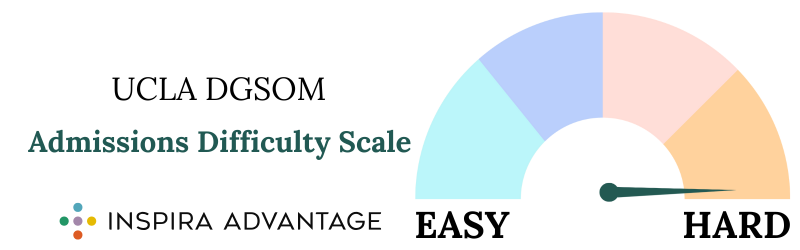
The UCLA DGSOM Admissions Difficulty Scale was created by comparing acceptance rates and overall selectivity across all accredited US medical schools.
The median MCAT score among UCLA David Geffen School of Medicine accepted applicants is 515. The median MCAT score among matriculants is 513. UCLA DGSOM does not publish a minimum MCAT score for admission consideration.
The table below shows the MCAT score range for UCLA DGSOM accepted applicants and matriculants based on percentile data:
Here is how the 2025-2026 accepted applicants scored across every section of the exam:
To put the UCLA DGSOM MCAT score range in perspective, a 515 score sits at the 91st percentile of all MCAT test-takers nationally. A 507 MCAT score falls in the 71st percentile. That means even the lowest-scoring UCLA DGSOM accepted applicants outscore roughly 7 out of every 10 people who sit for the exam.
The AAMC reports a national average MCAT score of 506.3 for applicants. UCLA DGSOM's accepted students had an average MCAT score of 514.9, which is 8.6 points higher.
The median total GPA among accepted students at the UCLA David Geffen School of Medicine is 3.88. The median total GPA among matriculants is 3.83.
UCLA DGSOM does not publish a minimum GPA requirement. The table below shows the total GPA percentile range for the 2025-2026 accepted applicants and matriculants:
The spread from 3.61 at the 10th percentile to 3.99 at the 90th percentile tells you that UCLA DGSOM admits some applicants with GPAs in the low-3.6 range alongside near-perfect students. The middle 50% range falls between 3.75 and 3.96, meaning most successful applicants have GPAs in the mid-3.7 to high-3.9 range.
For context, the AAMC reports a national average GPA of 3.67 for applicants. UCLA DGSOM's accepted student has an average GPA of 0.16 points higher than that, at 3.83.
The median science GPA among UCLA David Geffen School of Medicine accepted applicants is 3.84. The median science GPA among matriculants is 3.79.
The wider spread on the science GPA (0.49 points from 10th to 90th, compared to 0.38 for total GPA) means some UCLA DGSOM admits earned perfect marks in their science prereqs, while others had a few Bs and still earned admission.
UCLA DGSOM’s admissions requirements include:
Here is a comprehensive breakdown of the UCLA DGSOM prerequisites:
While UCLA DGSOM lists these courses as recommendations rather than strict coursework prerequisites, applicants are strongly encouraged to complete all of them. Taking multiple science and mathematics courses at advanced levels shows academic readiness and the ability to handle the rigor of medical school.
UCLA David Geffen School of Medicine conducts one-on-one virtual interviews as its primary format. Each interview is designed to provide a comprehensive assessment of an applicant’s academic preparation, personal qualities, and alignment with UCLA DGSOM’s mission, with particular emphasis on communication skills, ethical reasoning, and commitment to diversity and service.
NYU Grossman School of Medicine's overall interview rate is 8.92%. According to MSAR data, NYU Grossman interviewed 748 of the 8,385 students who submitted verified applications during the most recent admissions cycle.
Of the 748 students interviewed, 81 were in-state applicants, 655 were out-of-state applicants, and 12 were international applicants.
The interview rate varies significantly by applicant type:
California residents receive interviews at a moderately higher rate than out-of-state applicants (6.05% vs. 4.97%), which reflects a mild in-state advantage at UCLA DGSOM.
UCLA David Geffen School of Medicine's secondary application consists of three required essay prompts and three conditional prompts that apply to specific applicant circumstances.
UCLA DGSOM's secondary is shorter than many medical school secondaries, but the 800-character limit per response demands precision. Every sentence needs to earn its place. At roughly 130 to 150 words per prompt, you cannot afford a slow buildup or vague framing. Lead with your answer, then support it with one concrete example.
UCLA David Geffen School of Medicine's 2025-2026 secondary essay prompts are:
"At the David Geffen School of Medicine at UCLA, students are provided with curriculum and experiences enabling them to become an 'Outstanding Physician, AND...,' dedicating themselves to important societal missions. What missions do you want to embrace? What have you done toward your missions?" (800 characters)
"Respond to the following and indicate how these areas of experience have impacted your progress toward your future career goals in relation to becoming an 'Outstanding Physician, AND...'"
Part A: "Describe your most unique leadership, entrepreneurial, or creative activity." (800 characters)
Part B: "Describe your most important volunteer work and why it was meaningful." (800 characters)
Part C: "Describe your most scholarly project (thesis, research or field of study in basic or clinical science or in the humanities) and provide the total number of hours, dates and advisor." (800 characters)
"Describe how the COVID-19 pandemic has impacted your pathway to medical school. Include any academic, personal, financial or professional barriers, as well as other relevant information." (800 characters)
"Did you experience or are you anticipating time between graduating from college and matriculating into medical school? If yes, describe the activities in which you participated or are planning to participate." (800 characters)
"Do you identify as being part of a group that has been marginalized in terms of access to education or healthcare? If yes, describe how this inequity has impacted you or your community." (800 characters)
"Are you re-applying to DGSOM? If yes, describe what has changed since you last applied. Please be specific." (800 characters)
Here are some tips to get into the UCLA David Geffen School of Medicine:
UCLA DGSOM values applicants who can demonstrate excellence across multiple areas, not just one. As Travis McAllister, Admissions Operations & Data Manager, explains in UCLA DGSOM’s video, “What is the Holistic Admissions Approach for Medical School?”
“We're looking at your experiences. What kind of clinical experiences do you have? What type of community service volunteer experiences do you have? What type of leadership experiences do you have? Do you have any research experience: labs/presentations? We’re looking for all of that.”
The numbers from UCLA DGSOM’s 2025 matriculating class shared by the MSAR reflect this focus on diverse experience:
These figures show that most successful applicants present a well-rounded profile that blends service, clinical exposure, and research. In your application, avoid simply listing these activities. Instead, use your essays and interview to explain how each experience shaped you and how it connects to your future as a physician.
For example, if you volunteered at a community health fair, describe how you learned to explain medical information to people with no healthcare background. If you worked as a medical scribe in an ER, share how watching real-time decision-making deepened your understanding of patient care under pressure.
Presenting your experiences this way adds value because it shows admissions committees how you think, reflect, and grow. It demonstrates that you are not only completing activities but also gaining lessons that prepare you to succeed in medical school and as a future physician.
UCLA DGSOM wants to see that your clinical exposure is both ethical and relevant to US healthcare standards. Dr. Theodore Hall, Associate Dean for UCLA DGSOM Admissions, shared the following advice in a blog titled “Preparing for Medical School Applications”:
“Within the medical admissions community, there is increasing concern about applicants performing unsupervised invasive procedures overseas… Students should know that if they engage in these activities and then discuss them on their applications, they can be harming their applications.”
To avoid these issues, focus on US-based opportunities that provide meaningful patient interaction under supervision. Examples include working as a medical scribe, EMT, certified nursing assistant, or certified medical assistant. Volunteering in hospitals, clinics, or hospice care centers can also give valuable insights into patient care while ensuring your experience meets the admissions committee’s expectations.
While UCLA DGSOM looks for well-rounded candidates, two qualities consistently stand out: a strong research background and a meaningful commitment to community service. Dr. Hall explains,
“We’re all scientists here. And we all need to know how the scientific method impacts our clinical practice on a daily level.”
In essence, Dr. Hall suggests you share how your research experience sharpened your ability to ask questions, interpret data, and apply findings to patient care. Likewise, your community service should reflect empathy, cultural competence, and a commitment to improving access to healthcare.
For example, you might highlight how leading a public health outreach project informed your interest in preventive medicine or how your clinical research on health disparities connected directly to your volunteer work in underserved neighborhoods.
The goal is to present these two pillars—research and service—not as separate achievements, but as interconnected threads in your journey to becoming a physician.
There is no single formula for getting accepted to UCLA DGSOM. As McAllister puts it,
“If anything, there’s 175 ways [to get into our school], because that's going to be the size of our matriculating class. So I tell applicants: 175 ways at least to get into our school.”
To meet what UCLA DGSOM is looking for, focus on building an authentic, multidimensional profile rather than following a rigid checklist. Choose experiences that genuinely excite you and align with your vision for a career in medicine. One applicant might combine biomedical research with advocacy for underserved populations, while another might focus on primary care and lead global health initiatives.
Tell your story with intention. Use your essays, interviews, and activity descriptions to connect each experience to your values, your future approach to patient care, and the unique perspective you will bring to UCLA DGSOM. The most memorable applications stand out because they feel real and purposeful, not because they follow someone else’s path.
With an acceptance rate of 1.40%, gaining admission to the UCLA David Geffen School of Medicine requires a carefully planned, highly competitive application. Our UCLA DGSOM admissions counselors provide expert, school-specific guidance to help you stand out in one of the nation’s most selective applicant pools.
UCLA DGSOM offers the following MD programs:
UCLA DGSOM tuition and fees for California residents total $52,363 for the 2026-2027 year. Non-resident students pay an additional $12,245 in Nonresident Supplemental Tuition, bringing their tuition and fees to $64,608.
The estimated total cost of attendance for a first-year medical student living off campus or in university housing is $97,756 for residents and $110,001 for non-residents.
UCLA DGSOM costs about $424,217 over four years for California residents and $473,197 for non-residents, including summer sessions. Medical students are enrolled year-round, so the summer term costs are a real part of the financial picture and should factor into your borrowing and budgeting plans.
Here's the estimated year-by-year breakdown:
Non-resident students can reduce their total cost significantly by establishing California residency after their first year. UCLA DGSOM notes that gaining residency status eliminates the $12,245 annual nonresident supplemental tuition starting in year two, saving approximately $36,735 over years two through four.
UCLA David Geffen School of Medicine offers a variety of internal and external scholarships to make medical education more affordable.
Among its most prestigious awards is the Leaders of Tomorrow Scholars Program, which provides full tuition for four years plus a one-time $5,000 research stipend. All applicants are automatically considered based on their medical school application and interview performance.
Students may also receive UCLA Philanthropic Scholarships, funded by alumni and donors, which are often need-based and awarded annually through the financial aid process. In addition, L.A. Care Scholarships offer full-ride funding for students committed to improving healthcare for vulnerable populations.
Here is the complete UCLA DGSOM application timeline:
Yes, you can apply to multiple UCLA DGSOM pathways at once. You may express interest in any or all of the PRIME-LA, Global Health Equity, or the Medical Scientist Training Programs within your application, but each pathway has unique supplemental requirements and review processes.
The David Geffen Leaders of Tomorrow Scholarship is extremely competitive, with only a handful of UCLA DGSOM applicants selected each year. All admitted students are automatically considered, so your only chance at the award is to present an outstanding overall application.
Selection is based on a combination of exceptional academic performance, a strong MCAT score, significant research and service achievements, and an interview that demonstrates leadership potential, a clear vision for your medical career, and alignment with UCLA's mission.
Because the scholarship covers full tuition for four years plus a $5,000 research stipend, competition is intense, and recipients typically rank among the top applicants in the nation.
No, UCLA DGSOM does not prefer applicants who earned their degree at a University of California campus. Admission decisions are based on a holistic review that evaluates academic performance, MCAT scores, clinical and research experience, community service, leadership, and personal qualities, regardless of where you studied.
That said, UC graduates may have some indirect advantages, such as familiarity with the UC system, access to research opportunities at UC medical centers, and strong faculty connections for letters of recommendation. However, applicants from non-UC schools, including private and out-of-state institutions, are admitted every year and make up a significant portion of the class.
To succeed as a UCLA pre-med, maintain a strong GPA by mastering your core science prerequisites, including biology, chemistry, physics, math, and English, and using campus resources like the Center for Academic Advising and the Undergraduate Research Center. Choose a major you enjoy and can excel in, get involved in clinical volunteering, research, and shadowing through UCLA programs like PULSE and the Volunteer Center, and prepare early for the MCAT. Balancing academics with meaningful extracurriculars is key to building a competitive medical school application.
Dermatology Resident Physician
The George Washington University School of Medicine and Health Sciences


.svg)


