In this guide, we’ll learn how to get into the Mayo Clinic Alix School of Medicine (MCASOM), including acceptance rates, admissions statistics, GPA and MCAT benchmarks, application requirements, and what the admissions committee values most.
If you only want the quick requirements, click here.
Privacy guaranteed. No spam, ever.
Mayo Clinic Alix School of Medicine Acceptance Rate: 1.84%
The Mayo Clinic Alix School of Medicine has an acceptance rate of 1.84%. According to AAMC’s Medical School Admission Requirements (MSAR) database, MCASOM received 5,920 verified applications and welcomed 109 matriculants into its 2025 class.
Here’s a breakdown of MCASOM acceptance rate over the last six years:
Year
Acceptance Rate
Number of Applicants
Number of Matriculated Students
2025-2026
1.84%
5920
109
2024-2025
1.90%
5,591
106
2023-2024
1.96%
5,503
108
2022-2023
2.05%
5,067
104
2021-2022
1.99%
5,323
106
2020-2021
1.66%
6,327
105
1.84%
Acceptance Rate
5,920
Applicants
109
Matriculants
Out of 100 applicants…
MatriculantsNot admitted
Acceptance rate by cycle
Acceptance rate has never exceeded 2.05% in the last six years
The Mayo Clinic Alix School of Medicine has a highly competitive admissions landscape, with an average acceptance rate of 1.84% over the past six admissions cycles. AAMC data shows that annual applicant volume has stayed high, ranging from 5,067 to 6,327 verified applicants, while class size has remained steady at around 104 to 109 matriculants each year.
How Hard Is It to Get Into the Mayo Clinic Alix School of Medicine?
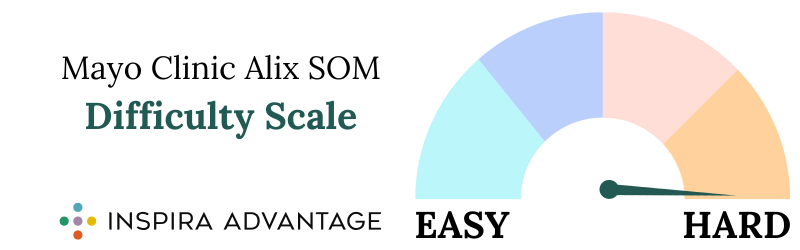
Getting into MCASOM is extremely difficult. In 2025, only 109 students matriculated out of 5,520 applicants, resulting in a 1.84% acceptance rate. With 5,920 applicants competing for just over 100 seats, MCASOM could fill its class more than 54 times over.
The MCASOM’s Admissions Difficulty Scale was created by comparing acceptance rates and overall selectivity across all accredited US medical schools.
Want deeper insights into your chances of acceptance to Mayo Clinic Alix School of Medicine? Use our quick Med School Competitiveness Calculator to get an instant estimate.
You can work with our expert admissions counselors for extra MCASOM application help to ensure you stand out in a competitive pool of applicants!
What Is MCASOM’s Acceptance Rate for Out-of-State Applicants?
MCASOM’s out-of-state acceptance rate was 1.84%. The MSAR reports that out-of-state applicants made up 91.10% of the pool (5,393 of 5,920 applications), with 99 students matriculating.
What Is MCASOM’s Acceptance Rate for In-State Applicants?
In-state MCASOM applicants had an acceptance rate of 2.23% in 2025, according to the MSAR. They represented 5.30% of the total pool (314 of 5,920 applications), with only seven matriculants.
What Is MCASOM’s Acceptance Rate for International Applicants?
MCASOM’s acceptance rate for international applicants is 1.41%. They represented 3.60% of the applicant pool (213 of 5,920), with three students matriculating.
How Many People Apply to MCASOM Every Year?
Approximately 5,622 people apply to MCASOM annually. Verified applications over the past five years have ranged from 5,067 to 6,327.
Privacy guaranteed. No spam, ever.
Admissions Statistics
MCASOM Median MCAT Score: 521
MCASOM’s median MCAT score was 521 in 2025. MCASOM does not have a minimum MCAT score requirement.
According to data from the AAMC’s MSAR database, students admitted to the 2025 cycle achieved:
MCAT Section
Median Score
Chemical and Physical Foundations of Biological Systems
131
Critical Analysis and Reasoning Skills (CARS)
129
Biological and Biochemical Foundations of Living Systems
131
Psychological, Social, and Biological Foundations of Behavior
131
Here’s a closer look at how MCASOM’s 2025 entering class performed on the MCAT:
Percentile
MCAT Score for Accepted Applicants
MCAT Score for Matriculants
10th Percentile
514
513
25th Percentile
519
518
Median
521
521
75th Percentile
523
523
90th Percentile
525
526
521
Median MCAT Score of Accepted Applicants
Mayo Clinic Alix School of Medicine
514
10th Percentile
519
25th Percentile
521
Median Score
523
75th Percentile
525
90th Percentile
Enter your MCAT score
521
472490500510520528
MCASOM does not have a minimum MCAT requirement for admission. Scores are one factor in a holistic review.
MCASOM’s median MCAT score of 521 for the 2025 entering class falls in the 99th percentile of all MCAT test-takers from 2022 through 2025. For context, only about 1% of examinees nationwide achieve a score at or above this level.
What MCAT Score Makes You Competitive at MCASOM?
An MCAT score of 523 makes you competitive at the Mayo Clinic Alix School of Medicine, as this range aligns with the top end of 2025’s admitted applicants’ scores. Achieving a 525 places you in the 99th percentile of all MCAT test-takers nationwide.
What this means for competitiveness:
● A 523 score places you among the strongest Mayo accepted applicants
● Although a 521 MCAT score is the median for Mayo, it can still be competitive if paired with exceptional research, volunteer, and clinical experience
● Aim for a 525 if you want to truly stand out, as this puts you at the very top of Mayo’s admitted students
Can I Get Into Mayo Clinic Alix School of Medicine With a 514 MCAT Score?
Yes, it is possible to get into Mayo Clinic Alix School of Medicine with a 514 MCAT, but it is unlikely. A 514 is at the 10th percentile for accepted applicants, below the median of 521. Applicants with this score need exceptional clinical experience, research, and volunteer work to be truly considered for admission.
Our experienced admissions counselors can guide you strategically, helping you present your strongest possible application and maximize your chances of acceptance.
MCASOM Median GPA: 3.95
MCASOM’s median GPA was 3.95 in 2025. MCASOM does not set a minimum GPA requirement.
Here’s a breakdown of the GPA range of successful Mayo Clinic Alix 2025 applicants:
Percentile
Total GPA of Accepted Applicants
Total GPA of Matriculants
10th Percentile
3.71
3.71
25th Percentile
3.89
3.86
Median
3.95
3.95
75th Percentile
3.99
3.99
90th Percentile
4.00
4.00
3.95
Median GPA of Accepted Applicants
Mayo Clinic Alix School of Medicine
3.71
10th Percentile
3.86
25th Percentile
3.95
Median Score
3.99
75th Percentile
4.00
90th Percentile
Enter your GPA
3.95
0.001.002.003.004.00
MCASOM does not have a minimum GPA requirement for admission. GPA is one factor in a holistic review.
For perspective, the national average GPA for medical school applicants and matriculants in the 2024-2025 cycle was about 3.67. With an average GPA of 3.95, Mayo Clinic Alix admits sit well above the typical applicant — their gap to a perfect 4.0 is roughly one-seventh the size of the average applicant's.
What GPA Score Makes You Competitive at the Mayo Clinic Alix School of Medicine?
A 3.99 GPA makes you highly competitive at the Mayo Clinic Alix School of Medicine. Since a 3.99 GPA was reported at the 75th percentile for accepted students in 2025 (with 4.00 at the 90th percentile), this score places you within the top 25% of admitted students.
MCASOM places significant weight on GPA as a reflection of your ability to excel across rigorous coursework in both science and non-science fields. A GPA at or near 4.0 demonstrates not only academic excellence but also consistency, discipline, and mastery of the foundational knowledge Mayo expects students to carry into its research-intensive curriculum.
MCASOM Median Science GPA: 3.95
MCASOM’s median science GPA was 3.95. Here’s a breakdown of the science GPA range of the matriculants:
Percentile
Science GPA of Accepted Applicants
Science GPA of Matriculants
10th Percentile
3.68
3.63
25th Percentile
3.84
3.82
Median
3.95
3.95
75th Percentile
4.00
4.00
90th Percentile
4.00
4.00
What Science GPA Makes You Competitive at the Mayo Clinic Alix School of Medicine?
A 4.00 science GPA makes you highly competitive at the Mayo Clinic Alix School of Medicine. A 4.00 GPA was reported at the 75th percentile for admitted applicants in 2025, meaning a 4.00 GPA places you within the top 25% of admitted students.
MCASOM places particular weight on science GPA since it reflects your ability to succeed in demanding biology, chemistry, physics, and math coursework. A near-perfect science GPA demonstrates mastery of core concepts, strong study discipline, and the intellectual preparation needed to thrive in Mayo’s rigorous, research-focused curriculum.
Privacy guaranteed. No spam, ever.
Mayo Clinic Alix School of Medicine Admissions Requirements
There are no course requirements to apply to MSASOm. However, there are certain prerequisites that MCASOM applicants are recommended to have:
Biology
Microbiology
Biochemistry
Chemistry
Physics
Successful applicants have a strong background in the life sciences and social sciences.
MCASOM Interview Format
MCASOM uses a traditional, semi-structured on-campus interview format. Each applicant invited to interview participates in two 30-minute, one-on-one conversations with members of the MD Admissions Committee. Interviews provide a holistic evaluation, covering academics, research, clinical exposure, community service, and extracurricular involvement.
Interviewers also assess qualities such as communication skills, maturity, professionalism, and alignment with Mayo’s mission of patient-centered care, collaboration, and innovation.
Applicants also participate in welcome sessions, Q&A sessions, and a campus tour to meet current students and experience Mayo’s community firsthand, ensuring you feel connected to the school as if you were already part of it.
In our recent webinar, “The RIGHT Way to Write The AMCAS Work and Activities Section,” Dr. Aditya Khurana, a Mayo Clinic radiology resident, Duke Neuroscience graduate, and admissions expert at Inspira Advantage, underscored that interview performance is built through intentional practice and deep familiarity with one’s application:
“Interviewing is a skill set, and the name of the game is practice. The more that you practice interviewing, the more it’s going to feel like a natural skill on interview day. It’s also really important to have a strong understanding of your application. You need to be the expert on your application.”
Because Mayo’s interviews are conversational and committee-led rather than purely scripted, applicants who rehearse articulating their experiences and can clearly connect their work to Mayo’s values tend to perform best.
Strong interview preparation is not about memorized answers, but about confidently explaining your own journey, motivations, and fit with Mayo’s collaborative, patient-centered culture.
What is MCACOM’s Interview Rate?
MCACOM has an interview rate of 12.77%. In 2025, 756 out of 5,920 applicants were invited to interview. In-state applicants had the highest chance of being invited, with 146 of 314 applicants (46.50%) receiving interview invitations. Out-of-state applicants saw an 11.13% interview rate, with 600 of 5,393 invited, while international applicants had a 4.69% interview rate, with 10 of 213 invited to interview.
Privacy guaranteed. No spam, ever.
Secondary Application Essays
Mayo Clinic Alix School of Medicine's secondary application consists of two required essay prompts, both with a 500-word limit.
Mayo Clinic Alix School of Medicine's 2025-2026 secondary essay prompts are:
Required Essay 1: Why You Choose Mayo Clinic Alix School of Medicine
"At Mayo Clinic Alix School of Medicine, we seek students whose values align with our mission to put the needs of the patient first. Please share why you are drawn to our school and the top track you selected. What unique strengths do you bring to our community to advance our commitment to excellence, compassion, and innovation?" (500 words)
How to Approach This Prompt
Answer three questions in one essay: why Mayo, which track, and what you bring. Structure your response so each question gets clear, dedicated space.
For "why Mayo," go beyond reputation and rankings. Mayo's defining feature is its team-based, patient-first model where physicians are salaried and collaboration across specialties is built into everyday practice. If that model resonates with you, explain why through a specific experience where you saw the value of integrated care or where its absence created problems for a patient.
For the track selection, name your chosen track and explain what draws you to it. Mayo offers tracks like clinical and translational research, medical humanities, health equity, and others depending on campus. Connect the track to work you have already done or a direction you plan to pursue.
If you chose the research track, reference a specific research interest and explain how Mayo's infrastructure supports that work.
For the strengths you bring, pick one to two qualities and ground each in a concrete example. "Compassion" on its own is not a strength. Describe a moment where you demonstrated compassion in a way that changed an outcome for someone, then explain how that quality would show up in Mayo's collaborative environment.
Required Essay 2: Your Background and How It’s Influenced You
"At Mayo Clinic Alix School of Medicine, we value the vast lived experiences, perspectives, and backgrounds of our students as they contribute to a vibrant learning environment and enhance how we care for our diverse patient population. Reflect on how your personal, cultural, or professional experiences have shaped your identity, and how they may help you contribute to a collaborative learning environment and advocate for your future patients." (500 words)
How to Approach This Prompt
Pick one thread of your identity and follow it from experience to impact. The prompt asks you to reflect on how your background shaped who you are and then project forward into how that shapes the kind of physician and classmate you will be.
Start with a specific experience rooted in your personal, cultural, or professional background. Describe what happened and what it taught you about yourself or about how people experience healthcare. Then explain how that insight would translate into a medical school setting and eventually into patient care.
Connect your personal identity to a concrete perspective on healthcare. For example, if growing up bilingual in a household that navigated the U.S. healthcare system without English fluency shaped how you think about communication barriers, describe a specific moment that illustrates that experience.
Then, explain how that lens would influence how you interact with classmates from different backgrounds and how you would advocate for patients facing similar barriers.
Avoid writing a general diversity statement. The prompt asks for reflection and specificity, not a list of identity markers. Focus on one experience or dimension of your background and develop it fully rather than covering multiple topics at surface level.
Privacy guaranteed. No spam, ever.
How to Improve Your Chances of Getting Into the Mayo Clinic Alix School of Medicine
Here are three tips to get into the Mayo Clinic Alix School of Medicine.
1. Gain Comprehensive Clinical Exposure and Volunteering Experience
Most MCASOM matriculants bring substantial patient‑facing or volunteer experience. According to MSAR data, 89% had community service or volunteer experience, leaving 11% who did not. Similarly, 95% had physician shadowing or clinical observation, meaning 5% lacked any shadowing experience.
For medical or clinical community service/volunteer work, 86% participated, leaving 14% without this type of exposure. Applying without meaningful clinical or volunteer experience risks placing you in this small minority, which could raise red flags for admissions committees, as they look for applicants with demonstrated commitment to patient care and community service.
“There is no magic number and there is no magic threshold … volunteering and clinical shadowing are really important … but you can also demonstrate your interest in medicine through other activities and other opportunities.”
Dr. Katherine Munoz, Plastic & Reconstructive Surgery resident at UW–Madison Med and an admissions counselor at Inspira, reinforced this point in our webinar on “Everything You Need to Know Before Applying To Medical School” by saying “a longitudinal investment means a lot more than a scramble at the end.”
As such, you should aim for sustained, hands-on, patient- or community-centered volunteering or shadowing.
2. Paid Clinical Roles Can Stand Out, But Only If You Take Initiative
Paid clinical or medical-related employment is common among competitive applicants. Approximately 62% of matriculants had medical or clinical paid employment experience, often in roles such as scribing, clinical research assistant, CNA, or EMT. These positions offer more exposure and responsibility than passive shadowing.
Overholtzer shared his experience, saying he:
“Worked as an emergency department scribe … worked in a clinical research department … [and] was paid … [he] probably got a lot more clinical exposure than [he] would have gotten through shadowing.”
“About whether it is paid or unpaid, it is a lot about initiative, leadership and what you have done with the clinical experience … you really want to push yourself.”
Applicants should understand that simply holding a paid position is not enough. Superficial or administrative roles without meaningful patient contact or responsibility will not impress admissions committees.
Instead, aim for positions where you can take initiative, demonstrate leadership, and actively engage with patients or clinical teams. Doing so not only mirrors the experiences of successful matriculants but also gives you concrete examples to highlight in your application and interviews, helping you stand out in a competitive pool.
3. Pair Clinical Exposure with Research or Service to Tell a Cohesive Story
Research and clinical experience go hand-in-hand in MCASOM admissions. Almost all students have research experience (96%), and nearly all have clinical exposure or shadowing. Admissions committees look for applicants who can combine these experiences into a cohesive narrative that demonstrates both intellectual curiosity and commitment to patient care.
“This is not a check box. If you are checking a box, you might actually not be a great candidate. Screeners ask: do they hit thresholds for research, community service, and commitment to medicine?”
Applicants should demonstrate how volunteering, clinical work, and research connect to tell a story of sustained commitment and growth. Admissions committees are less impressed by fragmented or last-minute experiences. Thoughtfully framed, longitudinal engagement shows resilience, intellectual curiosity, and readiness for medical school.
Can I Get Into Mayo Clinic Alix School of Medicine If I Have No Research Experience?
It is possible to get into Mayo Clinic Alix School of Medicine without research experience, as about 4% of the 2025 matriculants did not have research experience. However, 96% of matriculants did, so lacking it will limit your competitiveness.
Applicants without research should emphasize strong clinical exposure, volunteering, or other sustained activities to demonstrate commitment to medicine and intellectual curiosity.
Do I Need Research Publications To Be Competitive For Mayo Clinic Alix School of Medicine?
No, publications are not required to be competitive at Mayo Clinic Alix School of Medicine. What matters is meaningful research experience that shows curiosity, initiative, and growth. Without publications, applicants should ensure research is combined with clinical or volunteer work to create a cohesive application that demonstrates preparedness for medical school.
However, having publications will still strengthen your application, as it provides concrete evidence of sustained engagement, scholarly contribution, and the ability to see a project through to completion.
Real-Life Example of an Ideal Mayo Clinic Alix School of Medicine Applicant
Here is the profile of a recent MCASOM admit, illustrating the combination of academics, clinical experience, research, and service that helped them get accepted.
Metric / Attribute
Applicant’s Value / Background
GPA
4.00
MCAT
519 (130 / 129 / 129 / 131)
Gap Years
2
Clinical Hours
~4000 (paid + volunteer + shadowing)
Volunteer Hours (non-clinical)
~700
Research Hours
~300
Research Publications
0
URM Status
No
Secondary Application Turnaround
~26 days
Lessons From this Profile:
Academic Excellence: A perfect GPA signals consistent performance across coursework.
MCAT Flexibility: A 519 is below the median for MCASOM (522), but combined with strong extracurriculars, it still yields a competitive application.
Hands-On Experience Matters: 4000 clinical hours and 700 volunteer hours demonstrate long-term commitment to patient care and community service.
Research Engagement: Even without publications, 300 research hours show intellectual curiosity and exposure to scientific inquiry.
Consistency Over Flash: Sustained involvement in multiple areas (clinical, volunteer, research) is more valuable than short-term or last-minute efforts.
Holistic Narrative: The combination of academics, clinical experience, volunteering, and research builds a cohesive story that admissions committees look for.
The estimated total cost of attendance for a first-year medical student, including tuition, housing, food, transportation, personal expenses, and other indirect costs, is $110,400.
Here's a complete breakdown of the estimated cost of attendance for one year at Mayo Clinic Alix:
Item
Cost
Tuition
$70,280
Housing and Food ($2,225/month)
$26,700
Home Internet ($85/month + $100 one-time install)
$1,120
Transportation ($1,400/month)
$4,800
Personal and Miscellaneous ($625/month)
$7,500
Total Cost of Attendance
$110,400
How Much Is Mayo Clinic Alix School of Medicine for 4 Years?
The total estimated cost of attendance for four years at Mayo Clinic Alix School of Medicine is approximately $441,600, based on current 2026-2027 costs. The estimate assumes consistent tuition and living expenses across all four years and does not account for annual increases.
Scholarships
Mayo Clinic Alix School of Medicine offers financial support through institutional scholarships, grants, and loans. Scholarships are awarded based on merit and financial need and are renewable each year, provided students maintain satisfactory academic performance. The school uses parental income and asset information to determine eligibility.
96% of students receive scholarships.
49% of graduates in the class of 2025 had less than $100,000 in student loan debt.
71% of students borrowed student loans to help fund their education.
In addition to institutional scholarships, students are encouraged to pursue external grants and scholarships to further reduce loan dependence.
Mayo Clinic uses a need-aware admissions process where financial aid is awarded after admission based on demonstrated need. All financial aid is applied first to tuition bills, and excess funds are refunded to students.
The Mayo Clinic Alix School of Medicine Application Timeline
Here is the full MCASOM application timeline, along with when you should start preparing your application to submit on time:
Stage / Month
Action / Focus
Junior Year: Jan – Mar
Focus on MCAT prep. Take practice tests, review weak areas, and consider tutoring if needed. Aim to finish your test by April.
Junior Year: Apr
Finalize your school list. Begin drafting your primary application, including personal statement and AMCAS Work and Activities section.
Junior Year: Early May 2026
AMCAS opens. Begin submitting primary application materials and request letters of recommendation.
Application Window: June 1 – Oct 1, 2026
Submit your AMCAS application as early as possible. Early submission improves your chances in a rolling admissions system.
Secondary Applications: Jun – Oct 2026
Complete Mayo-specific secondary applications quickly, ideally within two weeks. Prepare essays and supporting materials.
MCAT / Transcripts Deadline: Oct 15, 2026
Ensure all MCAT scores, transcripts, secondary applications, letters of recommendation, and fees are submitted by this date.
Interview Invitations: Aug – Nov 2026
Mayo begins sending interview invitations. Prepare thoroughly for interviews, reviewing common questions and your application narrative.
Campus Interviews: Sep – Dec 2026
Attend in-person campus interviews. Show clinical experience, research engagement, and community involvement.
Acceptance Offers: Feb 2027
Initial offers of acceptance are sent. Evaluate financial aid, fit, and location carefully.
Waitlist Decisions: Apr – Jun 2027
Applicants accepted from the waitlist are notified. Stay responsive and provide updates if requested.
Pre-Matriculation: Jun – Aug 2027
Complete required paperwork, connect with future classmates, and prepare for orientation. Use this time to rest and plan for medical school.
FAQs
Where Is Mayo Clinic Alix School of Medicine Located?
Mayo Clinic Alix School of Medicine has campuses in Rochester, Minnesota; Phoenix/Scottsdale, Arizona; and Jacksonville, Florida.
Does MCASOM Accept Transfer Students?
No, Mayo Clinic Alix School of Medicine does not accept transfer students from other medical schools at any of its campuses. All applicants must apply as first‑year students through the standard admissions process and complete the full curriculum at MCASOM to earn their MD degree.
Does Mayo Clinic Alix School of Medicine Use Pass/Fail Grading?
Yes, Mayo Clinic Alix School of Medicine uses a pass/fail grading system across its curriculum. The school does not rank students or use tiered letter grades during the preclinical years.
MCASOM adopted pass/fail grading over two decades ago, and the school has published research showing lower stress, better mood, and stronger group cohesion among students under the system.
In practice, pass/fail grading means your clinical and board performance carry more weight for residency applications than internal class rank, which MCASOM does not generate.




.svg)


