How We Helped Samir Differentiate His Application & Earn Admission to Perelman, Feinberg, and a Full-Tuition Scholarship at Vanderbilt School of Medicine
We’ve changed identifying details, including the student's name, in this case study to protect the student's privacy.
We helped Samir get into several top medical schools by solving a positioning problem. He had the stats, but he needed an expert to uncover his story and articulate his narrative for studying medicine. Our team helped him find his unique calling to medicine and turn it into a differentiator and he got accepted to the Vanderbilt University School of Medicine on a full-ride scholarship.
Challenges Samir Faced
Samir didn't have a weakness in the traditional sense, as he achieved an extremely competitive GPA and MCAT score and majored in physics with a biology minor. What he had was a positioning problem. Here are the top challenges Samir faced:
He was competing in an already competitive admissions cycle at some of the top medical schools in the country.
He needed a standout personal statement with a unique story to truly set him apart from thousands of other competitive candidates.
He needed to position his research experience that reinforced his passion for studying medicine.
He had to prepare for interviews that tied all of his experiences back to his anchor story, which he didn’t even have yet.
Samir came to us in his junior year. By the end of senior year, he had a 4.00 GPA at a top-10 university and a 515 MCAT score, putting him in the competitive range for every program on his list. But at top medical schools, most applicants already have impressive stats. High numbers get your application noticed, but they don’t get your application accepted.
Samir’s primary issue was the lack of a clear application narrative. He had an interesting connection to medicine because of his childhood medical challenges, but it was completely hidden.
Once we figured out his anchor point, we then connected all of his application components back to it. At first glance, his resume was very impressive. However, it didn’t connect any of his experiences to an anchor story, so they weren’t as impactful as they could’ve been.
I spoke with Samir’s consultant, who said that Samir didn't need better stats. He needed a better story. Everything on his application indicated that he was academically prepared to study medicine, but we needed to help him articulate exactly why and how.
Northwestern University Feinberg School of Medicine
Perelman School of Medicine
NYU Grossman School of Medicine
The University of Chicago Pritzker School of Medicine
Ultimately, he wanted to get accepted to at least one of these eight schools.
How Inspira Advantage Helped Samir Get Into a Top Medical Schools and Earn a Full-Tuition Scholarship
We worked with Samir to diagnose exactly where his profile stood, rebuild his personal statement from scratch, tailor his application strategy school by school, and prepare him to handle difficult interview questions.
Initial Assessment: Where Samir Stood
When Samir came to us, we initially mapped his profile against two questions:
What will admissions committees notice first?
What conclusion will they draw from it?
Our expert consultant, a former admissions officer at Loyola University Chicago’s Stritch School of Medicine, noted that admissions officers would almost immediately notice his impressive stats. But they’d want to know more about his passion or calling to medicine.
We also found something interesting in our early brainstorming sessions that would become the foundation of his entire narrative. Samir had endured a childhood illness at a very young age.
The doctors discovered a life-altering condition during what he thought was just a routine checkup. Years of scans, follow-ups, and uncertainty followed. Samir realized he wanted to become a physician after his doctor explained exactly what they’d do to resolve his issue. He felt that the doctor had given him a sense of calm and clarity, which he wanted to pass on to his own patients one day.
This was such a pivotal story, but he never led with it in any of his personal statement drafts. It sat as a rough outline, a bullet point sandwiched between childhood memories and college activities.
That was the first thing we needed to help him with, as it would become Samir’s anchor story.
Building the Narrative: From Outline to Acceptance-Worthy Personal Statement
Samir's first draft had the foundation of a good personal statement, but it was just a brainstorm organized by order of events.
He had outlined his life chronologically:
Childhood classroom memory
Adolescence
College
Future goals
His initial opening featured a camp counselor telling him to help the younger campers pack up, tied to a theme of "passing it on to the next person." He acknowledged it was a cliché, but he kept it because he didn't know where else to start.
Admissions readers recognize chronological personal statements within the first paragraph. They list events rather than show who you are. And at schools that receive thousands of applications per cycle, a structure that fades into the background is easily forgotten.
We looked at three specific areas in that first draft.
First and foremost, the life-threatening illness story was completely hidden. Samir's experience as a child patient sat as a weak afterthought in a section on his transition to adolescence. He had never considered leading with it, even though it was his strongest differentiator and the reason he wanted to become a physician.
His experience as a student council president took up roughly a third of the outline. He wrote about navigating political conflict on campus. It was a strong leadership experience, but it didn't answer the "why medicine" question.
He also left teaching experience as an afterthought. He didn’t know which experience counted as research and which counted as teaching. His strongest clinical-adjacent experiences had no narrative weight.
We helped him rewrite the entire piece around what his counselor identified as his four strongest memories.
How We Structured Sahil’s Personal Statement
Each scene in the final draft of the personal statement had a specific purpose.
Scene 1: Samir was performing an elephant toothpaste demonstration with a young patient in a children’s hospital. The reader lands right into a pediatric ward watching Samir connect with a patient through science. The opening does what every strong personal statement opening should do: It shows who you are before it tells you.
Scene 2: Walking through that same pediatric ward triggers a flashback to when Samir was a patient there: His dad sending him out of the room, his doctor welcoming him back in and explaining every result, fear turning into understanding. We repositioned a buried bullet point into the emotional anchor of the entire essay.
Scene 3: A patient fainted from low blood sugar while fasting. Samir's training said to administer glucose, but the patient expressed that he was observing Yom Kippur. He paused, asked the patient questions, and built a plan that honored both medical protocol and the patient's beliefs.
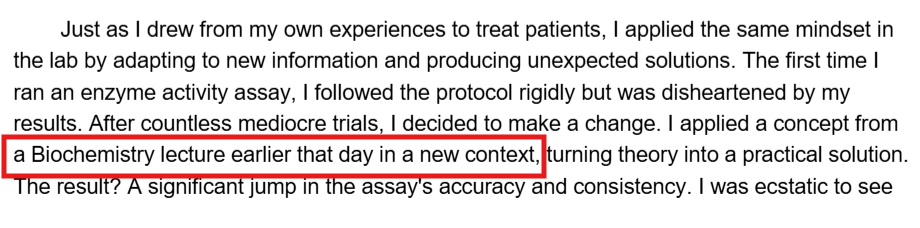
Scene 4: Instead of listing publications, we focused on the failed enzyme activity assay and the moment Samir applied a classroom concept to fix it. This presented Samir’s research experience as problem-solving rather than passive engagement.
Teaching tied all four scenes together. Every scene circled back to communication, education, and the accessibility of knowledge.
Application Strategy: Positioning a Physics Major for Eight Elite Programs
Samir's school list was ambitious by any standard. Submitting the same generic application to all eight elite schools would’ve been a waste of time and money.
Each school on that list evaluates candidates through a slightly different lens. Research-heavy programs want to see intellectual depth. Clinically oriented programs want evidence of patient interaction and empathy. Schools with strong community missions want proof that you care about more than your own career. Samir's profile had a good foundation for all of those angles, but he was leading with the wrong differentiators at each school.
Samir’s counselor noticed that his initial CV listed only his research and clinical experiences, with vague descriptions of what he did. He had accumulated an impressive amount of hours, but he needed to lead with action verbs, refer back to specific moments in each bullet point, and show his passion for studying medicine.
For Samir’s secondary essays, we tailored each one to the specific medical school, curriculum structure, or clinical opportunity that matched Samir's profile.
Interview Prep: Answering the Question Every Physics Major Gets Asked
We helped Samir prepare stronger interview responses that emphasized the story of his childhood illness. Not as a sympathy play but as a concrete turning point with a clear through-line to every clinical decision he had made since.
Every interviewer would look at his profile and immediately notice his impressive stats. But he also needed to highlight his impressive story to make the reader want to interview him.
At a young age, his doctor explained his illness, included him in conversations, and empowered him to feel better about his condition, and Samir wanted to do that for other people. His research experience provided the scientific foundation he needed, and his clinical work demonstrated he could handle the pressure of becoming a physician. The childhood illness story explained the motivation behind both.
Results
Samir was planning to apply to medical schools with a 4.00 GPA and a 515 MCAT score (90th percentile), so his stats would've cleared the initial screening at all the schools he applied to. But, his core struggle was that he needed someone to help him stand apart from the thousands of other competitive candidates.
Samir was accepted to the Perelman School of Medicine at the University of Pennsylvania, the Vanderbilt University School of Medicine, and the Northwestern Feinberg School of Medicine. He ultimately decided to enroll at Vanderbilt University School of Medicine on a full-tuition scholarship.
Without an expert’s opinion on his application, he likely would’ve faded into the background. His inital personal statement draft hid his most important differentiator, but with the support of an admissions expert, he turned it into his strongest asset.
Our expert consultant helped Samir with many of his application components:
He turned Samir’s personal statement brainstorm into a compelling essay that made three top medical schools want him
He worked with Samir to find the personal story that Samir used as his narrative anchor
He cut the content in his personal statement and CV that wasn’t helping his application
He gave Samir unlimited edits to ensure his personal statement and secondary essays stood out
He helped Samir prepare for even the most difficult interview questions
He edited Samir’s research and clinical experiences to use action verbs and specific examples, tying everything back to his application narrative
He was a friend, mentor, and advocate for Samir during the admissions process
Samir’s consultant said that the hardest part wasn't even finding Samir's story, because he had already done that work. It was building up his confidence and convincing him that his most personal experience was also his most powerful one.
Samir had the numbers to get in. We helped him uncover the narrative that would help him stand out.
Samir can now envision his life as a future physician after accepting his offer to attend Vanderbilt University School of Medicine on a full-ride scholarship.
Arush Chandna is the Co-Founder of Inspira Advantage and a nationally recognized expert on graduate school admissions. Arush has used his 12+ years of experience in higher education to help 10,000+ applicants get into their dream graduate programs.




.svg)


