I’ve modified all specific details in this story to protect our student’s privacy.
Inspira Advantage helped Samuel get into Sidney Kimmel Medical College with a $100,000 scholarship by securing more clinical hours, helping him craft a strong personal statement, and improving his interview answers.
This all helped him differentiate his application from those of thousands of other compelling applicants. He had strong numbers to clear the initial screening phase, but he needed an expert to help him with the other components of his application to truly stand out.
Here’s a timeline of Inspira’s support with Samuel during the medical school admissions process:
Inspira Advantage Case Study
How We Got Samuel Into Sidney Kimmel Medical College on a $100K Scholarship
From unfocused application to acceptance with funding — click each step to see what we did and why.
3.97
GPA
510
MCAT
32
Schools Applied
$100K
Scholarship
Assessment
Initial Application Review
Samuel came to Inspira in the spring of his senior year — later than most applicants. He had a 3.97 GPA and a 510 MCAT, which cleared the numbers threshold at every school on his list. But his application lacked a core narrative connecting his experiences to medicine.
His counselor identified the gap immediately: Samuel had strong individual components — research, clinical hours, faith, service work — but nothing tied them together into a cohesive story.
Key finding: Strong stats, unfocused narrative
Experience Building
Securing Meaningful Clinical Hours
Samuel had started earning clinical hours in his junior year and wanted to hit target thresholds: 150+ hours of non-clinical volunteering, 50+ hours of shadowing, and 1,000+ clinical hours. His counselor helped him find and secure positions at old-age homes, hospitals, physician clinics, and his local church.
These weren't just about padding numbers. Every new experience gave him richer material for his personal statement and interview responses — stories with emotional weight that admissions readers would remember.
Surpassed all target hour thresholds
Narrative
Building a Cohesive Personal Statement
Samuel's early drafts read like a retelling of his resume — research listed here, clinical hours there, faith mentioned but never connected. His counselor found the thread: Samuel's faith, his personal experience with medical illness overseas, his research, and his bedside care were all expressions of a single belief that healing is both physical and spiritual.
The final draft opened with a meaningful passage framing his conviction, then moved through his service work, his time witnessing a patient's loss of independence, and into his research on treatment resistance in the very disease he'd personally experienced. Each paragraph built on the last.
Personal statement finalized with unified narrative
Strategy
School List Tiering & Secondary Essays
With 32 schools on his list and a two-week turnaround window per secondary, the workload could easily have overwhelmed him. Samuel's counselor tiered the list by mission alignment — flagging programs that prioritized community health, underserved populations, and translational research as high-priority targets.
Since Sidney Kimmel was his top choice, that secondary essay was written first. The workflow was structured so the personal statement and highest-priority secondaries were finalized early, giving Samuel a strong early submission window for his best-fit schools.
Top-choice secondary submitted in earliest window
Interview Prep
Mock Interviews & Narrative Coaching
Samuel initially didn't think he had enough material for interviews — then, after hitting his experience targets, he had the opposite problem: too much to cover. His counselor coached him to lead with one well-told story rather than trying to touch on five competing narratives.
Sidney Kimmel explicitly evaluates motivation, leadership, maturity, compassion, and community involvement. Mock sessions were tailored to those criteria, with Samuel practicing how to connect his overseas research, childhood illness, and clinical depth into responses that hit each factor naturally.
Fully prepared for Sidney Kimmel's selection criteria
Strategy
Scholarship Application Support
Sidney Kimmel awards scholarships to academically competitive individuals who demonstrate a dedication to improving others' lives. Samuel's counselor ensured his application highlighted the most scholarship-relevant differentiator: his overseas research on the very illness he personally experienced as a child.
That experience was deeply personal and showed the kind of dedication and cultural immersion that funding committees look for — a candidate whose work extends beyond academics into meaningful impact.
$25,000/year renewable scholarship awarded
Result
Accepted to Sidney Kimmel Medical College
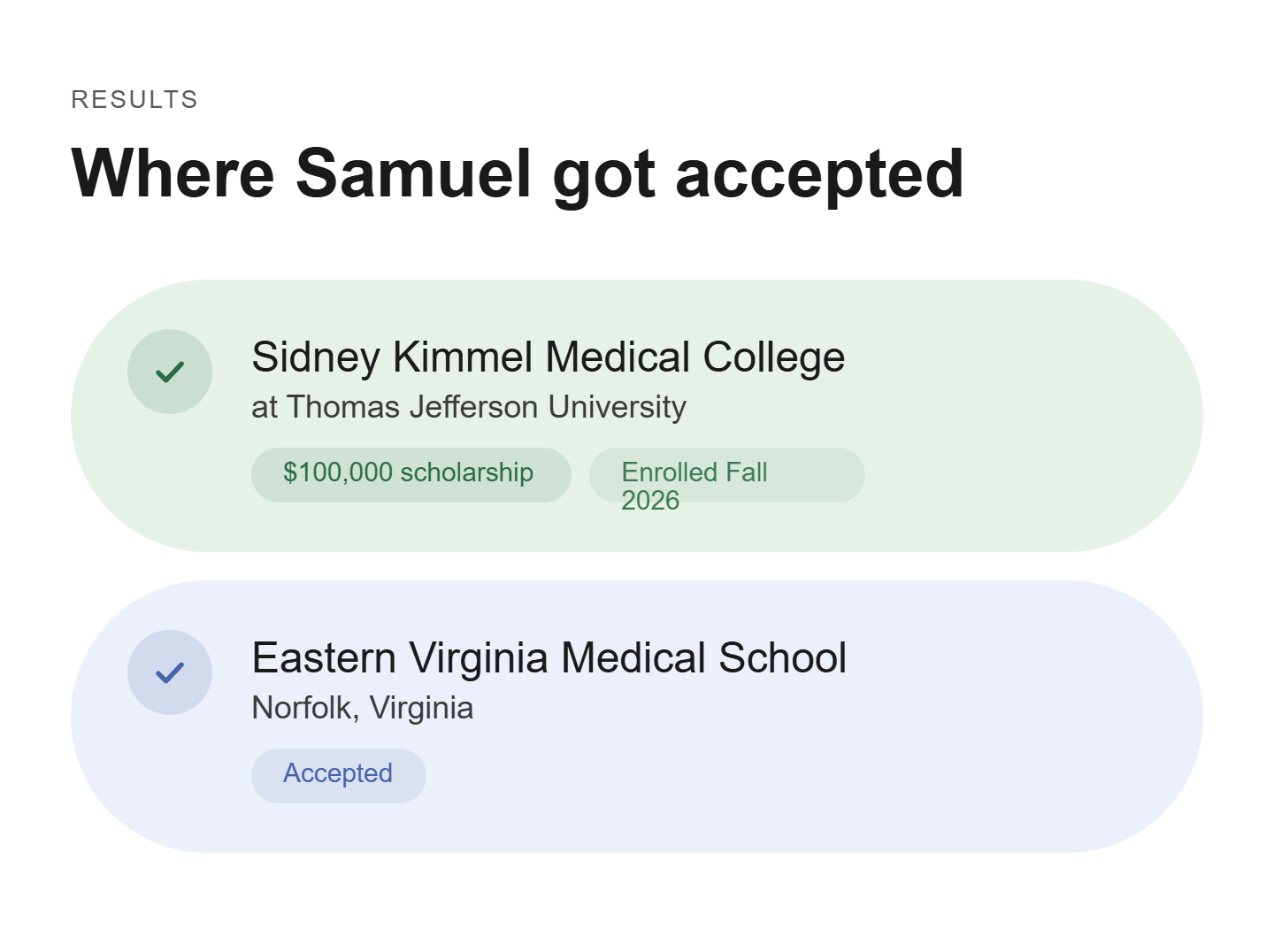
Samuel was accepted to Sidney Kimmel Medical College at Thomas Jefferson University and Eastern Virginia Medical School. He chose Sidney Kimmel, which awarded him a renewable $25,000-per-year scholarship — totaling $100,000 over four years.
For an applicant who came to Inspira in his senior year with a loose narrative strategy, the outcome speaks for itself. A 3.97 GPA and 510 MCAT opened the door, but the application Inspira helped him refine is what kept it open.
$100,000 total scholarship over four years
🎓
Sidney Kimmel Medical College
Thomas Jefferson University — Class Member with Scholarship
$100,000
Challenges Samuel Faced: Strong Academic Background, But a Weak Application Narrative
GPA3.96
Science GPA3.95
MCAT Score510
Our initial assessment of Samuel’s application profile was that he was academically competitive, but he needed a strong narrative to tie everything together. He had only a foundation for a personal statement, so we knew we needed to dig deep to identify his application differentiators.
This was the most important part of his application because, without a core narrative, everything falls apart. Thankfully, Samuel’s Inspira admissions counselor had years of experience improving personal statements and securing clinical hours, so we were confident we could help him get into a good medical school.
Samuel was worried he wouldn’t stand out because he had only just started earning clinical hours a year before he came to us, and he didn’t have a finalized personal statement yet. However, he was determined to get into at least one school on his broad list.
Samuel had fewer than 75 hours of non-clinical volunteering experience, but he wanted to increase it to at least 150 by the time he applied. He also had only about 25 hours of shadowing experience, but he wanted at least 50. His personal statement was just a first draft and a brainstorm, so he knew that also needed a lot of improvement. He also had yet to prepare for any interviews, so he was worried about how he’d respond.
These challenges led Samuel to take a gap year. He decided to seek admissions consulting to ensure he wouldn’t make any mistakes and could apply and be accepted on his first attempt.
Samuel’s counselor gave us more insight into his struggles during the application process:
"Samuel had a strong initial application, but it was unfocused. Most of his components were good, but nothing told the reader exactly why he was applying to medical school in the first place. He really needed a good personal statement and more clinical hours to help him stand out."
If Samuel had a cohesive story that could connect everything, he’d be applying with a standout application in the competitive medical admissions cycle. All he needed was someone who’s been on the other side of the admissions table to provide expertise he couldn’t get anywhere else.
Samuel’s Goal Schools
Samuel wanted to get into a good medical school, so he applied broadly. He applied to 32 medical schools, and several schools accepted him. Here are all the schools Samuel applied to:
Sidney Kimmel Medical College at Thomas Jefferson University
Eastern Virginia Medical School
NYU Grossman Long Island School of Medicine
Rutgers Robert Wood Johnson Medical School
David Geffen School of Medicine at UCLA
University of Miami Leonard M. Miller School of Medicine
Geisinger Commonwealth School of Medicine
George Washington University School of Medicine and Health Sciences
Penn State College of Medicine
Oakland University William Beaumont School of Medicine
West Virginia University School of Medicine
University of Wisconsin School of Medicine and Public Health
Virginia Commonwealth University School of Medicine
Medical College of Wisconsin
Lewis Katz School of Medicine at Temple University
Saint Louis University School of Medicine
Tulane University School of Medicine
Wayne State University School of Medicine
Howard University College of Medicine
Morehouse School of Medicine
Meharry Medical College
University of Kentucky College of Medicine
Cooper Medical School of Rowan University
Michigan State University College of Human Medicine
Indiana University School of Medicine
Drexel University College of Medicine
Albany Medical College
University of Iowa Roy J. and Lucille A. Carver College of Medicine
Alice L. Walton School of Medicine
Anne Burnett Marion School of Medicine at TCU
Geisel School of Medicine at Dartmouth
Wake Forest University School of Medicine
Samuel was accepted at Sidney Kimmel Medical College at Thomas Jefferson University, where he eventually decided to enroll. The medical school offered him a $25,000 renewable scholarship, totaling $100,000 over four years of medical school.
How We Got Samuel Accepted
Samuel came to Inspira in the spring of his senior year. We only had four months to ensure he had all his materials ready to submit a competitive application.
Our Initial Assessment of Samuel’s Application Profile: Where Samuel Stood
Samuel had above-average academics, direct patient care experience, published research posters, and a deeply personal connection to medical research. But the application as a whole lacked a narrative that connected Samuel’s academics, experiences, and desire to pursue medicine.
Here’s what Samuel’s admissions counselor prioritized when assessing his initial application:
Helped Samuel craft a competitive personal statement through several drafts
Supported him with finding impactful clinical and shadowing experiences to get him to his target number of hours
Helped him apply to the right scholarships with an insider’s perspective
Conducted mock interviews with Samuel to help him prepare for his responses
Samuel really needed to start building a case for what his experiences taught him about himself. All of his experiences needed to be turned into a cohesive narrative, as they would become his biggest differentiator.
Clinical Hours: Helping Him Secure Meaningful Experiences to Differentiate His Application
Samuel had only started earning his clinical hours in his junior year, so he didn’t have as many as he had hoped for. Ideally, he wanted to complete at least 150 hours of non-clinical volunteering, 50 hours of shadowing, and 1,000+ clinical hours by the time of his application. He decided to take a gap year, especially since medical schools like to see longitudinal involvement in your activities.
Samuel’s counselor helped him find and secure volunteering positions at nursing homes, direct patient care experience at hospitals, shadowing positions with physicians at clinics, and tutoring positions at his local church. He worked through these additional experiences the year before he applied to medical school, which allowed him to surpass his target thresholds.
However, these opportunities didn’t just give him more hours. They gave him more experiences to highlight in his personal statement and recommendation letters, which was the next thing he needed support with.
Building the Narrative: Turning a Complex Profile into a Cohesive Story
Samuel's earliest personal statement drafts read like retellings of his resume. He listed his research, mentioned his clinical hours, referenced his faith, and described his healthcare service work. Each paragraph covered a different experience, but none of them felt connected. A reader could finish the essay and know what Samuel had done without understanding why any of it mattered to him personally.
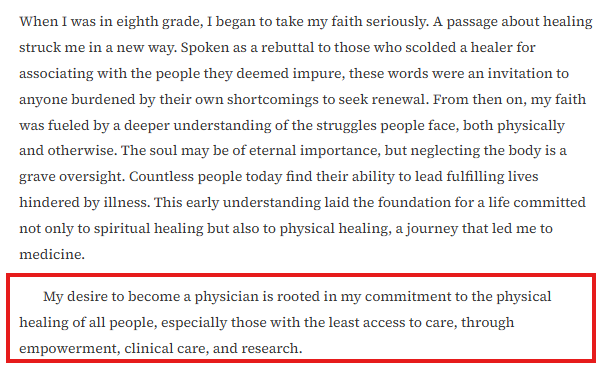
Samuel's counselor worked with him to find the connective tissue. The breakthrough was recognizing that his faith, his experience with medical illness overseas, his research, and his bedside care were expressions of his belief that healing is both physical and spiritual, and that the people who need it most are often the ones with the least access to it.
Samuel already had the foundation, but his counselor provided him with the knowledge and expertise to submit a standout personal statement.
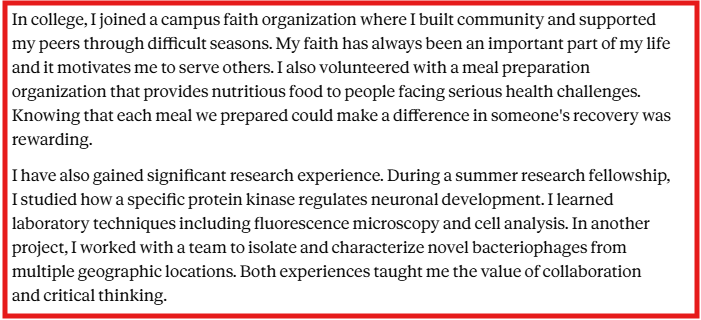
The final personal statement draft opens with a religious passage that frames his conviction, then moves through his healthcare service work, his time providing direct patient care and witnessing a young patient lose her independence to a sudden medical event, and ultimately into his research on treatment resistance in the very disease he had experienced firsthand.
In his final draft, each paragraph built on the one that preceded it. The admissions reader would finish knowing exactly who Samuel is and what kind of physician he intends to become.
Application Strategy: School List, Secondaries, and Timing
Samuel wanted to apply to 32 medical programs, hoping to get into at least one. That number isn't unusual for applicants who feel uncertain about where they stand, but a list that large can also create its own problems.
Every secondary essay takes time and energy to tailor to each school. And when you have a two-week turnaround window with 30+ secondary essays, that can be overwhelming.
Samuel’s consultant helped him prioritize which schools he really wanted to attend. Rather than treating all 32 schools equally, they tiered the list based on where his profile was strongest. Knowing that he wanted to attend Sidney Kimmel, his consultant helped him write that secondary essay first.
We flagged programs with a mission emphasis on community health, underserved populations, or translational research as high-priority targets because Samuel's story aligned exceptionally well with those values.
Since Samuel came to Inspira in the spring of his senior year and planned to take a gap year, we knew we had to help him build and submit a complete application when most applicants are still finalizing their activity lists. His consultant structured the workflow so that Samuel finalized his personal statement and highest-priority secondaries first, giving Samuel a strong early submission window for his top-choice schools.
Interview Prep: Handling the Hard Questions
Before working with his Inspira Advantage counselor, Samuel didn’t think he had enough material to talk about in his interviews. However, after reaching his target thresholds for his experiences, Samuel had more than enough material to provide substantial information; he just needed help articulating this.
We spoke with Samuel’s advisor about his biggest interview challenges, and this is what she had to say:
"The best interview answers don't just cover the most ground, they provide more depth on fewer things. Since he had so much to talk about, Samuel had to learn to trust that one well-told story would do more work than five different misaligned narratives."
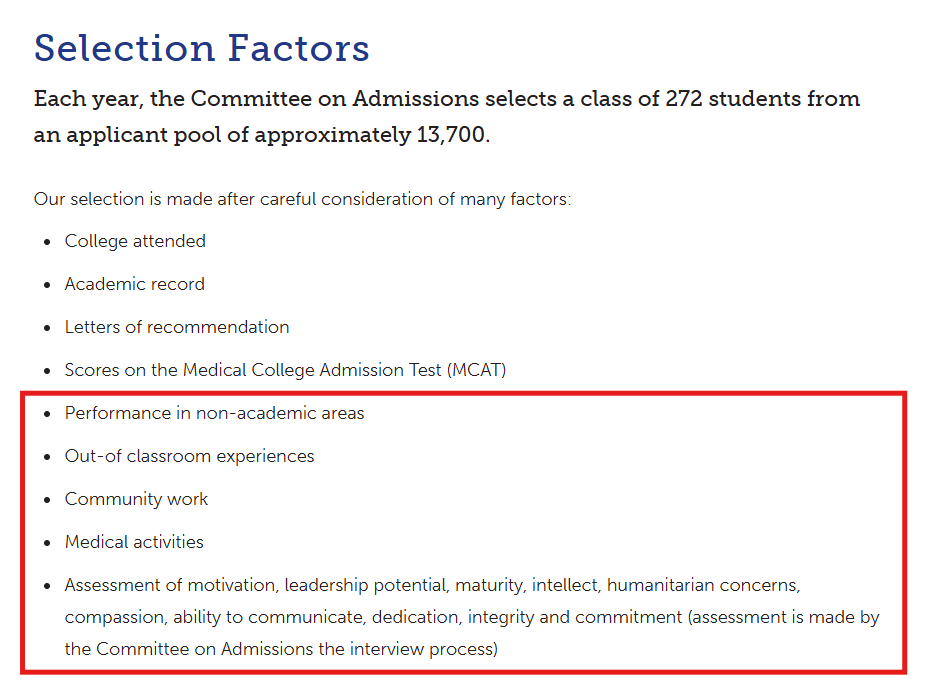
Sidney Kimmel Medical College makes clear what it looks for in a competitive application. They state on their website that they look for an “Assessment of motivation, leadership potential, maturity, intellect, humanitarian concerns, compassion, ability to communicate, dedication, integrity and commitment,” with all of that being assessed throughout the interview.
Knowing that, Samuel’s consultant helped him uncover the most challenging parts of his experiences and turn them into impactful interview responses that demonstrated motivation, leadership, and maturity. With expert mock interviews, Samuel was fully prepared to properly demonstrate these qualities to the admissions committee.
Sidney Kimmel Medical College also explicitly states that it looks for evidence of community work, medical activities, and experiences beyond the classroom. Samuel’s counselor helped him prepare by highlighting his research experience overseas, especially since it was directly related to the illness he personally experienced as a child.
Hitting all these core selection factors helped Samuel stand out in the interview process at Sidney Kimmel Medical College. With dedicated practice, he differentiated his application from thousands of others with competitive stats.
Scholarship Application Support: Finding the Best Opportunities
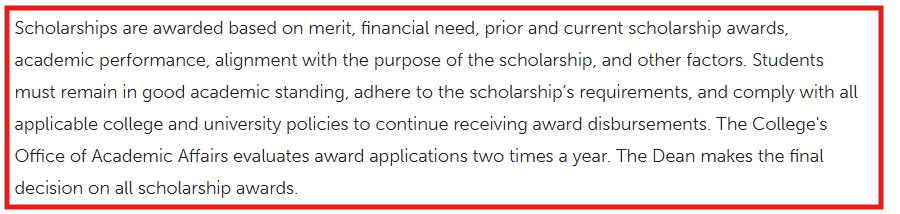
Sidney Kimmel Medical College provides scholarships to academically competitive individuals who demonstrate a dedication to improving the lives of others.
We knew that Samuel’s academics would help him qualify for a good scholarship, but his experiences needed to demonstrate his dedication to supporting his community. That’s why his final personal statement and interview responses included his overseas research experience.
Samuel had experienced a severe childhood illness. It was because of this illness that he wanted to study medicine. So he traveled to the eastern side of the world to conduct research on this illness. This was a transformative experience for him because it was deeply personal and helped him better understand what he had feared for much of his life.
He was also able to immerse himself in a new culture, and that really differentiated his application. Sidney Kimmel Medical College recognized this dedication to supporting others through his research and clinical experience and offered him a renewable $25,000 scholarship for his medical education.
Results
Samuel was accepted to Eastern Virginia Medical School and Sidney Kimmel Medical College at Thomas Jefferson University, with the latter giving him a renewable $25,000-per-year scholarship, totaling $100,000 over four years.
For an applicant who came to Inspira in his senior year with a loose narrative strategy, that outcome speaks for itself. A 3.97 GPA and a 510 MCAT score opened the door for him, but the application we helped him refine is what kept it open. The scholarship, in particular, shows that Sidney Kimmel invested in him because they saw a candidate whose story, clinical depth, and research trajectory aligned with the kind of physician their program aims to produce.
Here’s exactly how Samuel's consultant helped him throughout the admissions process:
Identified a dominant narrative and spoke to it with every application component
Tiered his 32-school list by mission alignment, prioritizing programs that valued community health, underserved populations, and translational research
Front-loaded the workflow so the personal statement and highest-priority secondary essays were submitted early
Restructured the role of faith across all application materials so it reinforced his character without overshadowing his clinical and scientific identity
Coached him through mock interviews designed to lead with one strong narrative anchor rather than trying to cover every experience
Prepared him to address the broad school list with confidence
Refined activity descriptions so each entry connected back to the central theme
Helped him find the right scholarships and apply to competitive ones
With the help of his consultant, Samuel identified his core narrative theme and connected everything. He had a personal experience with a disease that directly informed his research experience. That connection between lived experience and scientific work is exactly what admissions committees look for when evaluating applicants. Before working with his consultant, Samuel had buried that connection under other equally valid but competing experiences.
Samuel’s consultant said we didn't need to make him a stronger applicant, because he already was one. He needed us to help him organize his activities, experiences, and narrative so that admissions committees would see that he was born to become a physician, and it was the only logical next step in his career.
Arush Chandna is the Co-Founder of Inspira Advantage and a nationally recognized expert on graduate school admissions. Arush has used his 12+ years of experience in higher education to help 10,000+ applicants get into their dream graduate programs.


.svg)


