Get in touch: +1 888 453 5021





When pre-med students think about doing research for med school, they usually picture themselves in a lab, wearing a white coat, and running experiments. With that picture in mind, online lab research usually feels like a weaker alternative, and students often wonder whether analyzing data on a laptop, rather than in a lab, carries the same value.
To find a clear answer, I spoke to several admissions experts on my team. They all agreed that online research experience absolutely can have the same value, so long as the experience gives you a legitimate research question to interrogate, meaningful responsibilities, regular mentorship, and something concrete to discuss in your application and interviews.
Those factors matter because not every virtual opportunity offers the same depth. Below, I’ll explain what counts, how med schools view online versus in-person research, and how to find a credible opportunity to strengthen your application.
Virtual research does count as meaningful research experience for medical school, and research does not have to take place in a physical lab to count on your AMCAS, TMDSAS, or AACOMAS application.
In fact, TMDSAS acknowledges that students often pursue virtual experiences and specifically asks you to indicate if the research was virtual.
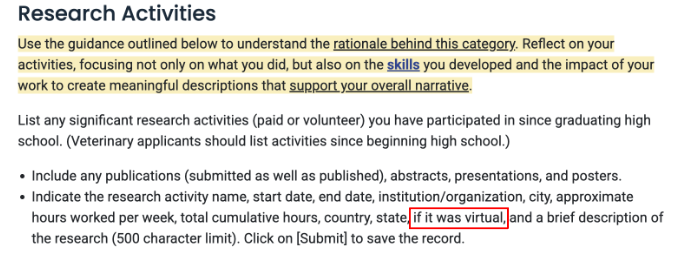
Source: TMDSAS
Some research, such as clinical research, also requires more online work, like analyzing patient data and outcomes rather than physically conducting experiments. That makes many legitimate research responsibilities possible remotely.
You could analyze datasets, perform statistical or computational analyses, conduct a systematic literature review, interpret results, contribute to manuscript development, or investigate an independent research question under a mentor.
What matters is that you are actively contributing to the research process, rather than simply attending online lectures or observing someone else's work.
The AAMC also notes that research helps applicants develop critical thinking, quantitative reasoning, scientific reasoning, teamwork, and communication. Those skills don’t just disappear because you developed them remotely.
Research can actually appear in several places on the AMCAS Work & Activities section. The application has separate experience types for Research/Lab, Presentations/Posters, and Publications, so a productive project can result in multiple activities on your application.
Choose “Research/Lab” as the experience type on AMCAS to explain the organization, dates, completed hours, and a research mentor or other contact who can verify your participation.
You should mention the research was virtual in your description, but you shouldn’t spend valuable space defending why the project was virtual. Instead, explain the research question and focus on your specific contribution, skills, findings, challenges you solved, and your growth.
In-person research for medical school has obvious advantages when the project requires physical work. Students conducting basic science research, for example, may need to perform tests, maintain cell cultures, handle samples, or learn laboratory techniques that can’t really be replicated online.
But being physically present in a lab doesn’t automatically make a research experience better.
Medical schools just want to understand what you contributed and what the experience demonstrates about you. Strong research can show intellectual curiosity, scientific reasoning, persistence, teamwork, and your ability to make sense of evidence.
Research is becoming increasingly important in medicine. In fact, the AAMC’s data for the medical school Class of 2025 shows that 85.8% of the class had at least one undergraduate research experience. So, any research is better than none. And in some cases, online opportunities allow you to do more.
A virtual student who develops a research question, analyzes evidence, works closely with a mentor, and contributes substantially to a manuscript will have considerably more to discuss than an in-person student whose role primarily involves routine tasks like cleaning beakers or entering data without understanding how these tasks contribute to the larger project.
The experts on my team also emphasized the importance of tangible outcomes to strengthen your virtual research work. Posters, presentations, abstracts, and publications give admissions committees additional evidence that you meaningfully contributed to the work, and you were actually able to produce something from your research, even though it was virtual.
You can take a closer look at the strengths of each research type in this tool:
Remember: Research demonstrates skills like scientific inquiry and critical thinking. Your clinical, service, and other in-person activities demonstrate interpersonal and patient-facing skills. Committees assess these experiences together as part of a holistic review.

Remember, your online research experience is just one part of your application. It’s different than your other extracurriculars, which likely won’t be virtual. Research is meant to demonstrate skills such as scientific inquiry and critical thinking, not prove that you can communicate with others or function in a clinical environment.
Your clinical, service, and other in-person activities can demonstrate those interpersonal and patient-facing skills instead. Admissions committees assess these experiences together as part of a holistic application, rather than expecting every individual activity to demonstrate every competency.
There are several places you can find high-quality online research experiences:
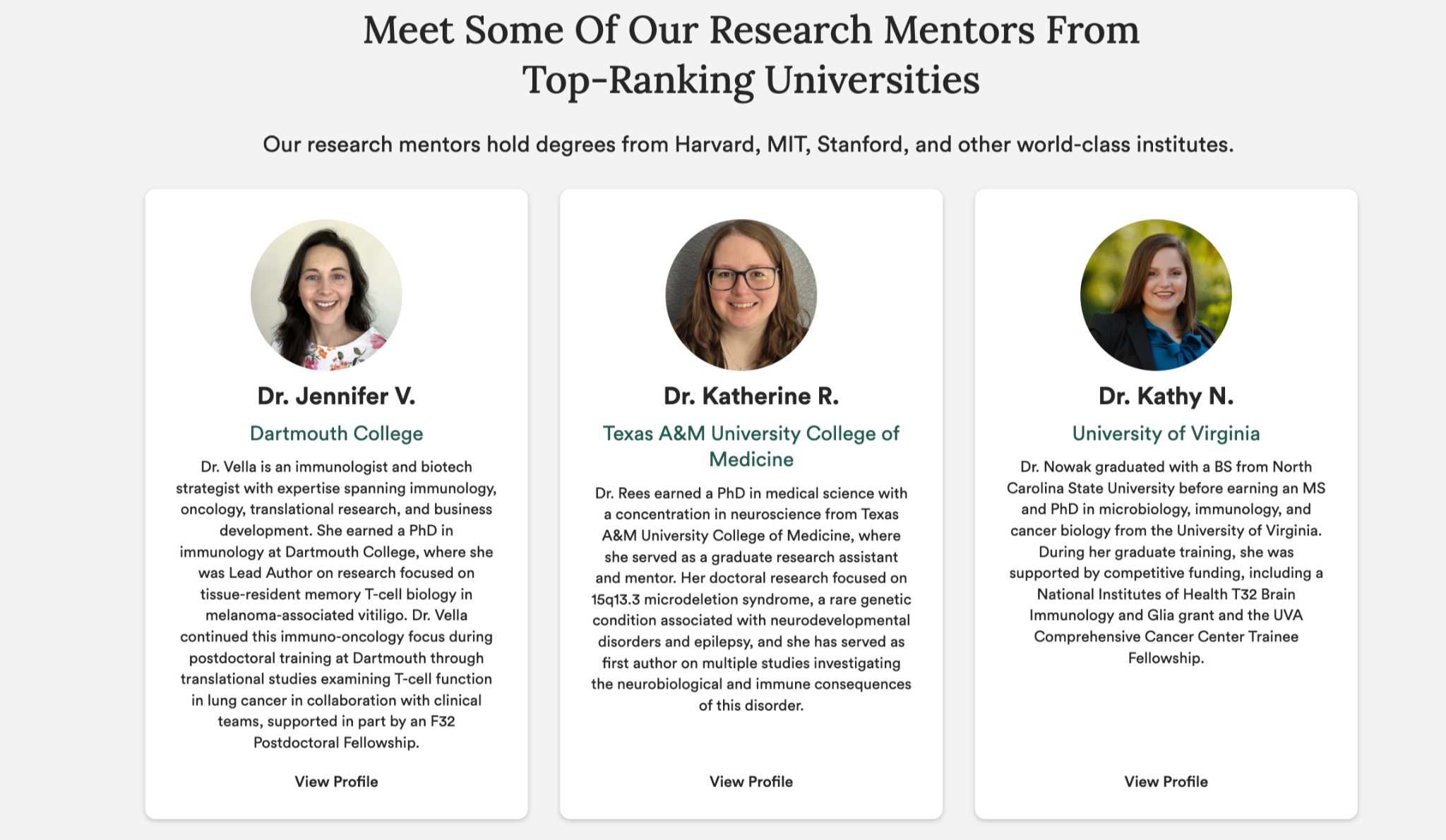
For instance, Inspira's medical research & publication support allows students to complete a remote medical research project with one-on-one guidance from an experienced research mentor. Students develop a research question, analyze existing scientific literature and data, write a formal research paper, and receive support through presentation and publication.
Ultimately, online research can absolutely strengthen your medical school application when the work itself is rigorous and meaningful. Focus less on whether your mentor is sitting in the same room as you and more on whether you can clearly explain the question you investigated, what you contributed, what you learned, and what came from the work.


.svg)


