I’ve changed identifying details in this story to protect the student’s privacy, including their name, school, and specific work history. We’ll call them Mina. But every rewrite, every hard conversation about her GPA, and every rejection risk she faced is real.
Mina came to us with a strong story, a strong MCAT score, and almost no time to spare. Mina was a non-traditional applicant in several ways; she was 30 years old, took eight years to complete her undergrad, had a lower GPA than anticipated, was applying to med school for the first time, and needed a full application ready before the cycle passed her by. With our help, Mina got into their No. 1 choice, UC Davis School of Medicine.
Challenges Mina Faced
Mina’s 3-Month AMCAS Application Turnaround Timeline Was (Almost) Impossible
Most application overhauls happen over a year or two. Mina’s happened over 12 weeks.
Mina reached out in April, already set on applying to med school in just a few months. That meant we only had one shot to do it right, not time for a slow build. We put Mina on our All-Inclusive Application Support track with a Director-level advisor, who was able to work across all 25 of their target schools at once.
Mina submitted their AMCAS application by mid-June. Getting submission-ready involved a full personal statement rewrite, interview preparation, and secondary essay strategy. Our consultant worked with Mina to draft, review, and finalize each secondary essay for all 25 schools Mina applied to by early July.
Here’s a look at how Mina’s timeline looked compared to a typical med school applicant:
~10 Weeks vs. 12+ Months
Same milestones. A fraction of the time.
Jan – MarYear Before
Research & Self-Assessment ▾
~3 months
Identify target schools, assess GPA/MCAT readiness, and begin outlining personal statement themes. Most applicants spend this phase reflecting on experiences and building a school list.
Apr – Jun
Personal Statement Drafting ▾
~3 months
Write multiple drafts of the personal statement, get feedback, revise. Finalize the activity section and gather letters of recommendation. AMCAS opens in May.
May – Jun
AMCAS Work & Activities ▾
~4–6 weeks
Craft up to 15 experience entries with tight character limits — each one needs to frame the activity, demonstrate impact, and connect to medicine. Most applicants go through several rounds of revision per entry. This section alone can take longer than the personal statement.
Jun – Jul
AMCAS Submission ▾
~4–6 weeks
Submit the primary application as close to opening day as possible. Verification can take 4–6 weeks, so early submission matters for competitive timing.
Jul – Sep
Secondary Essays ▾
~2–3 months
Schools send secondary invitations. Most applicants juggle 15–30 unique essay sets over the summer, completing them on a rolling basis as they arrive. Pre-writing helps, but this phase is still a grind.
Sep – MarInterview Season
Interviews & Decisions ▾
~6 months
Interview invitations roll in over months. Preparation, travel, and follow-up stretch across the fall and winter. Final decisions arrive as late as April.
April
Mina Reaches Out ▾
Week 1
Already committed to applying that same cycle, Mina connected with Inspira and was placed on the All-Inclusive Application Support track with a Director-level advisor. One shot — no time for a slow build.
Apr – May
Personal Statement Rebuild ▾
Weeks 2–4
Mina's personal statement was completely rebuilt from scratch — drafted, reviewed, and polished — while simultaneously developing their school list across all 25 target schools.
May – Jun
AMCAS Experiences Overhauled ▾
Weeks 4–7
While most applicants spend weeks agonizing over each of their 15 Work & Activities entries one at a time, Mina's advisor worked through all of them in parallel — reframing each experience to connect meaningfully to medicine within tight character limits. This ran concurrently with the personal statement, not after it.
Mid-June
AMCAS Submitted ▾
~Week 7
Mina's full primary application — personal statement, all experiences, and school list — was submitted by mid-June. Right on pace with applicants who had been preparing for months, with all 25 schools targeted from day one.
Early July
All Secondaries Finalized ▾
~Week 10
Every one of Mina's secondary essays — across all 25 schools — was drafted, reviewed, and finalized. What most applicants stretch across the entire summer, Mina completed before most had even started.
July +
Interview Preparation ▾
Ongoing
With the written application locked down in record time, Mina shifted focus to interview prep — entering interview season fully prepared, not still scrambling to finish secondaries.
⚡
Most application overhauls happen over a year or two. Mina's happened in roughly ten weeks — a full personal statement rebuild, a complete secondary strategy across 25 schools, and interview preparation, all within a single spring.
Mina’s GPA Wasn't Quite What It Looked Like
Transcript GPA3.70
AMCAS GPA3.56
AMCAS Science GPA3.34
Here’s something that came up early and mattered more than expected: Mina’s own resume listed their GPA as 3.70, the number straight off their UC Berkeley transcript.
But that wasn’t their true GPA. AMCAS recalculates GPAs in its own way. By AMCAS’ math, Mina’s numbers came in much lower. They ended up with a 3.56 cumulative GPA and a 3.34 science GPA.
AMCAS counts every attempt at a repeated course, including early low grades that were retaken. Mina’s own school’s transcript calculated that repeated course differently. AMCAS also sorts courses into science and non-science categories with its own rules, which don’t always match how a college sorts courses.
That meant Mina walked into her application process thinking they had one GPA story to tell, when they actually had two. And the one the admissions committees would see was far less favorable than the one Mina thought they had. We caught this early enough to build their secondary essays and interview answers around the AMCAS numbers, not the numbers on their resume.
Mina’s Next Challenge: Creating a Cohesive Narrative
Mina had many impressive experiences but a narrative that didn’t quite capture them.
They’d spent years pursuing different paths:
Performing dance professionally
Caregiving for family during a serious illness
Working full-time in social work case management
Running wet lab research
Completing hands-on clinical extern work
Every one of those stories held up on its own. None of them, read together, explain in one sentence why Mina wanted to be a physician now, at 30, after building a much different career.
On top of that, Mina’s path through undergrad was different than most applicants’. Their transcript showed a 3.70 on paper, which is a strong number by any measure. But they'd also had some rough patches in college and went through a period of personal hardship.
Mina’s hardships included an accident and family caregiving responsibilities serious enough to require a temporary course withdrawal, to cause a failed prereq, and to result in an eight-year-long undergrad. Being a nontraditional applicant didn’t put her at a disadvantage, but it did mean we had to be extra cautious about how we framed her unique path.
Mina needed their application to explain that trajectory clearly and confidently, not to bury it. Their application also needed to showcase their determination and resilience as a nontraditional student.
How We Helped Mina Build a Focused Med School Application Narrative in Weeks, Not Years
Here's what Mina’s 10-week application-building session actually involved:
Ranking their five life stories to find the one that explained the rest
Strengthening their personal statement through five rounds of detailed feedback and revision
Helping Mina explain her low GPA and the circumstances around it in her essays
Helping Mina draft and revise secondary essays for 25 schools that each needed a slightly different angle on the same core story
Finding the One Story That Explained the Rest
Mina’s first personal statement draft moved through their life in order: dance, then immigration and caregiving, then social work, then research. Every section read well. But nothing really built on anything else.
The test was simple: did the story explain the other four, or did it just sit next to them?
Dance explained nothing beyond itself. The lab research proved Mina could think analytically but didn’t explain why they wanted to be a physician specifically. Caregiving supported their motivation to pursue medicine but not their specific shift from advocacy work to wanting to provide care directly.
Mina’s counselor found that the only one story that truly passed that test: watching their advocacy work for elderly patients run into its limits and realizing they wanted to be the person providing care, not just connecting people to it. That became the anchor.
Everything else moved from co-lead to supporting evidence, including the dance background, which we kept but shrank down to a single grounded scene instead of the essay’s opening and closing act.
We Worked With Mina on Five Drafts to Create the Perfect Personal Statement
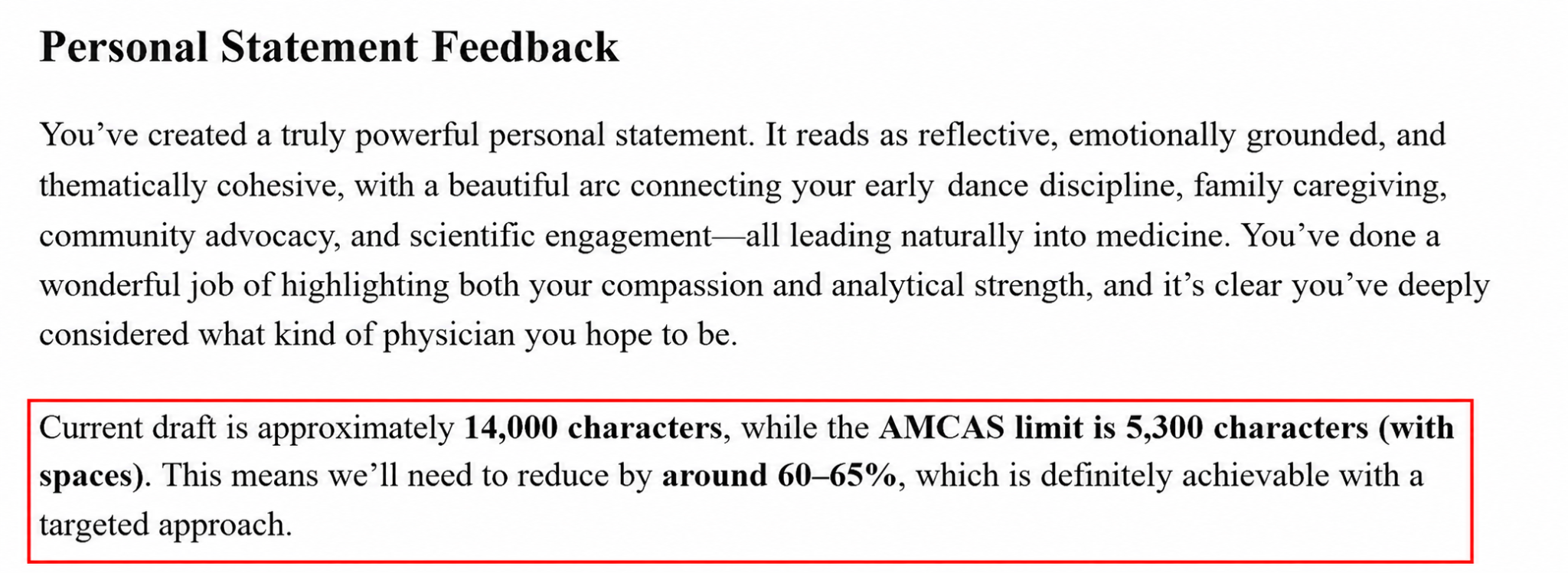
Mina’s first personal statement was way too long. It came to around 14,000 characters. AMCAS only allows 5,300 characters with spaces, which means we had to help Mina cut their essay by more than half. We had to carefully cut entire sections while making sure we still protected the ones that mattered most to her story.
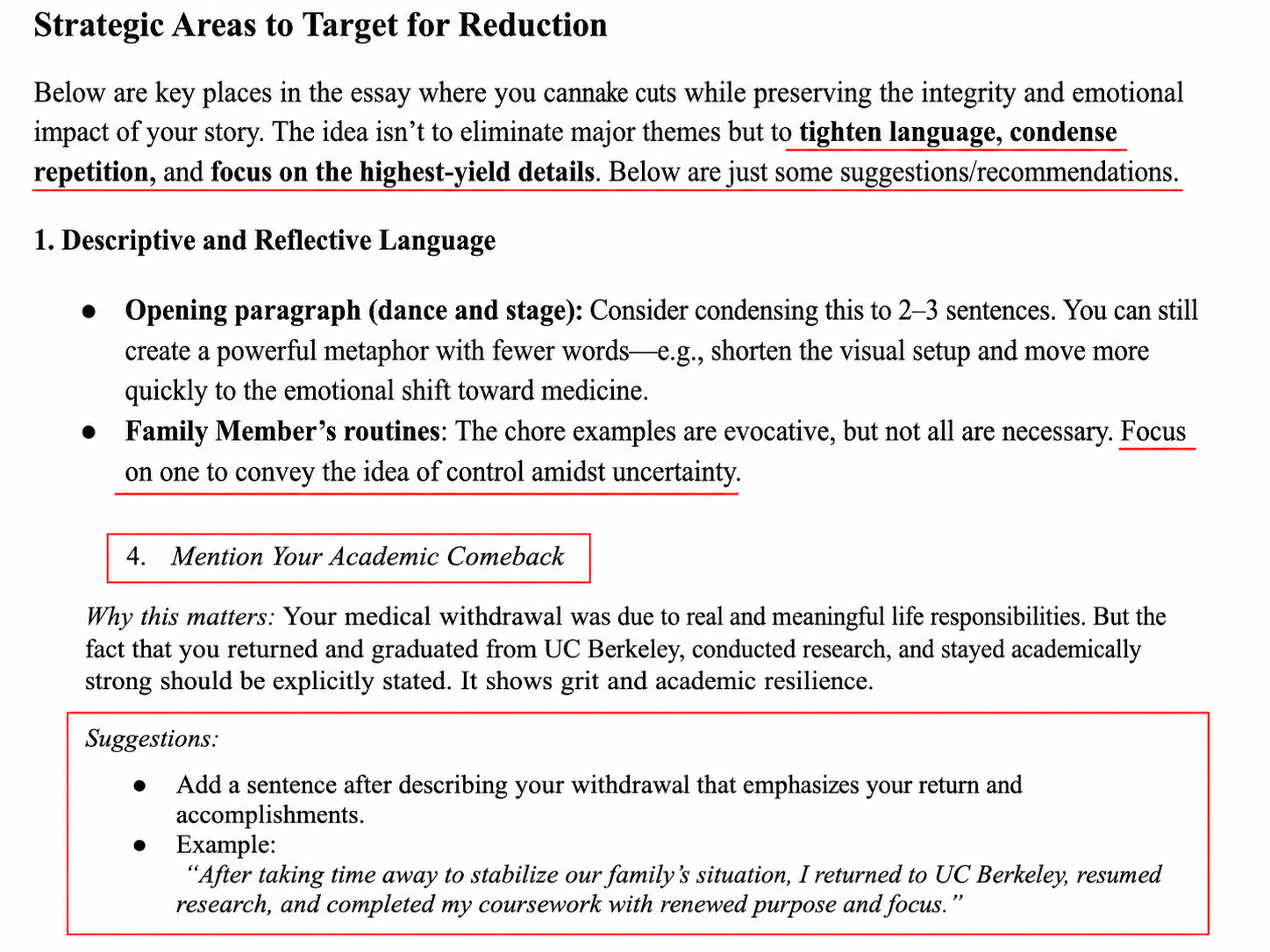
This first draft had too many competing stories but ultimately gave us a clear idea of what had to survive no matter what. Mina’s opening dance-to-medicine image, family member’s illness, elder advocacy work, and two strongest clinical moments were essential to keep in.
Mina’s first draft also revealed one important gap. Mina explained why they withdrew from school, but they didn’t clearly show what happened after they returned.
We encouraged them to follow the withdrawal with a clear academic comeback. They returned to UC Berkeley, resumed research, completed their coursework, and graduated with a renewed focus. All of these steps took perseverance and self-awareness, which we knew Mina needed to highlight to admissions committees.
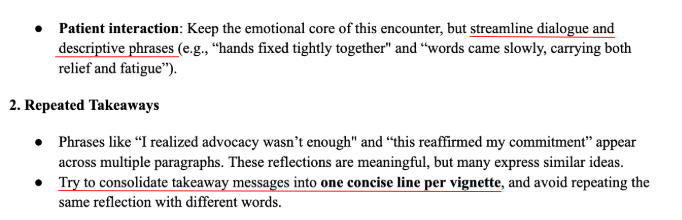
Draft two mainly targeted repetition. Mina kept making the same reflections after three different scenes. We picked one moment to keep in the reflection and gave Mina strategies on how to cut the rest.
The third draft involved one of the most challenging revisions: cutting one full clinical anecdote entirely instead of trimming every clinical story a little. We kept the two moments with the most direct patient care and reworked Mina’s other clinical roles into a single sentence. Mina’s research shrank to two lines, and dance shrank to one scene.
We revised draft four to create better tone and structure within each paragraph, ensuring each one flowed cohesively into the next and stayed focused.
By the fifth and final draft, Mina was within the AMCAS character limit, and every scene that actually mattered was included, and any repetition was deleted.
Explaining the Hardship Without Overexplaining It
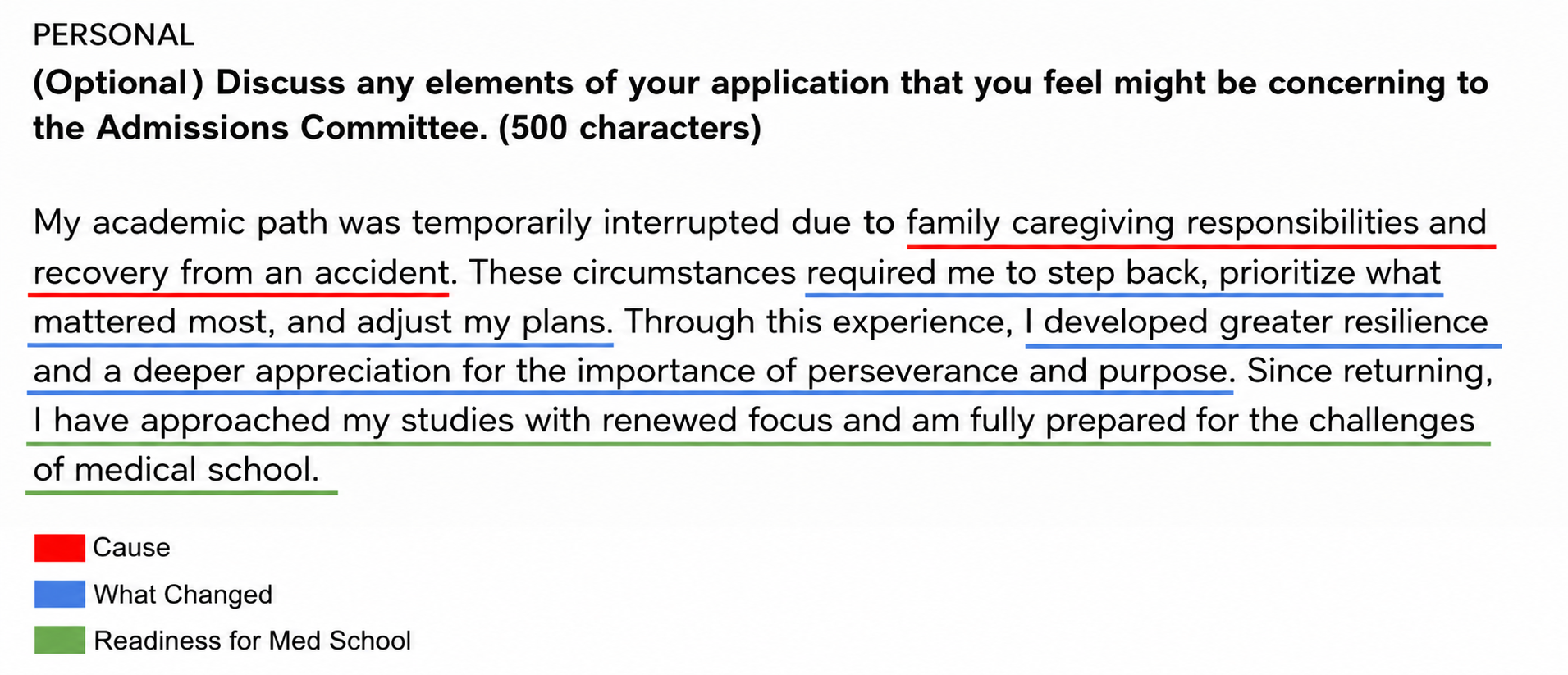
Several of Mina’s target schools, including UC Davis School of Medicine, gave them an optional secondary prompt asking them to address anything in their application the committee might find concerning. For a non-traditional applicant with a documented GPA and lower GPA, we treated the prompt as required, not optional.
We named the real causes plainly: a history of personal hardship, an accident, and family caregiving responsibilities. All of which were serious enough to require a temporary withdrawal.
Instead of dwelling on any one of them longer than the others, Mina closed on what changed when they came back. They had a renewed focus, a completed degree, and a clear understanding of why they were ready for med school now.
We also checked that response against Mina’s personal statement and their activities section to make sure all three were consistent. A committee that reads three different accounts of the same gap can see those inconsistencies as a red flag.
Same Anchor, 25 Different Angles
With 25 schools on their list, Mina couldn't send one generic secondary package.
Research-heavy programs needed Mina’s wet lab research positioned as evidence of scientific rigor. Mission-driven programs, such as UC Davis School of Medicine, needed Mina’s case management and language-access work positioned as direct proof Mina already lived out that school’s stated priorities.
We rewrote Mina’s experience entries to lead with specific moments and outcomes instead of duty lists. And we made sure every secondary essay traced back to the same anchor story, just from a different angle depending on what each school said it valued the most.
Results
Mina applied as a 30-year-old, first-time, non-traditional applicant with a strong MCAT score and a GPA story that was more complicated than it first appeared. They had about 10 weeks to turn a scattered, five-threat narrative into one focused application across 20 schools.
Mina was accepted to their #1 choice, UC Davis School of Medicine, along with two additional programs on their list. They enrolled at the UC Davis School of Medicine.
Here’s what that Director-level engagement actually included:
The advisor ranked five competing life stories against each other to find the one that explained the rest.
The advisor guided five full rounds of personal statement revisions, cutting Mina’s essay by more than half without losing what made it theirs.
The advisor caught the gap between Mina’s transcript GPA and their AMCAS-calculated GPA early and built their strategy around the number committees would actually see.
The advisor helped to brainstorm, draft, and revise Mina’s secondary response addressing their academic gap plainly, briefly, and consistently with the rest of their application.
The advisor helped Mina tailor their secondary essays across all 25 schools to the same core story, angled to what each program said it valued.
The advisor prepared Mina to talk about their GPA and their gap year directly in interviews without sounding defensive
Mina needed someone to find the one thread that already explained everything else and the discipline to build a full application around it in 10 weeks instead of two years. And that’s exactly what we gave them.
Arush Chandna is the Co-Founder of Inspira Advantage and a nationally recognized expert on graduate school admissions. Arush has used his 12+ years of experience in higher education to help 10,000+ applicants get into their dream graduate programs.


.svg)


