CASE STUDY
How We Helped a 486 MCAT Scorer Get Accepted to One of Their Top DO Programs
GPA
3.79
MCAT
486
KHSU
ACCEPTED
KHSU-KCOM

Written By:
Arush ChandnaDate Published:
September 16, 2026
The applicant's name and identifying details have been changed to protect her privacy.
Samantha came to us with an unusually complex profile. She had a strong 3.79 GPA, 3,700+ hours of caregiving, clinical, community, leadership, and shadowing experience, and a clear and compelling reason to pursue medicine.
But she also had a very low MCAT score that clashed with the rest of her otherwise strong profile and could’ve easily crushed her dreams of getting into med school her first cycle.
With the help of Inspira Advantage, Samantha built a stronger application around the parts of her profile that could still move the needle. She got 30+ secondary application interviews, three DO interviews, and an acceptance to one of her top-choice DO programs. All with a 486 MCAT score.
To put her MCAT score into perspective, a 486 is currently in the 12th percentile, meaning about 88% of recent test-takers scored higher. In 2025, DO matriculants also had an average MCAT score of 502.95. That means Samantha’s score is about 17 points below the average DO matriculant.
And while there’s no real universal rule that says you can’t apply to med school with an MCAT score below 500, 500 is a very real dividing line at many medical schools.
So, Samantha wasn’t simply applying with a below-average MCAT. She was applying with a score that would automatically take her out of consideration at some schools and make admission statistically unlikely at many others.
Here’s a closer look at her profile diagnostic:
We knew there was no way to write around the score or pretend it wasn’t a major weakness. Our job was to make every other part of Samantha’s application strong enough to give schools a reason to keep considering her anyway.
One of Samantha's counselor’s first priorities was timing.
We worked backward from the opening of the application cycle, setting deadlines for her activities, personal statement, school list, and final primary application so she could submit at the end of May. We kept track of this and all of Samantha’s progress in a detailed project tracker:
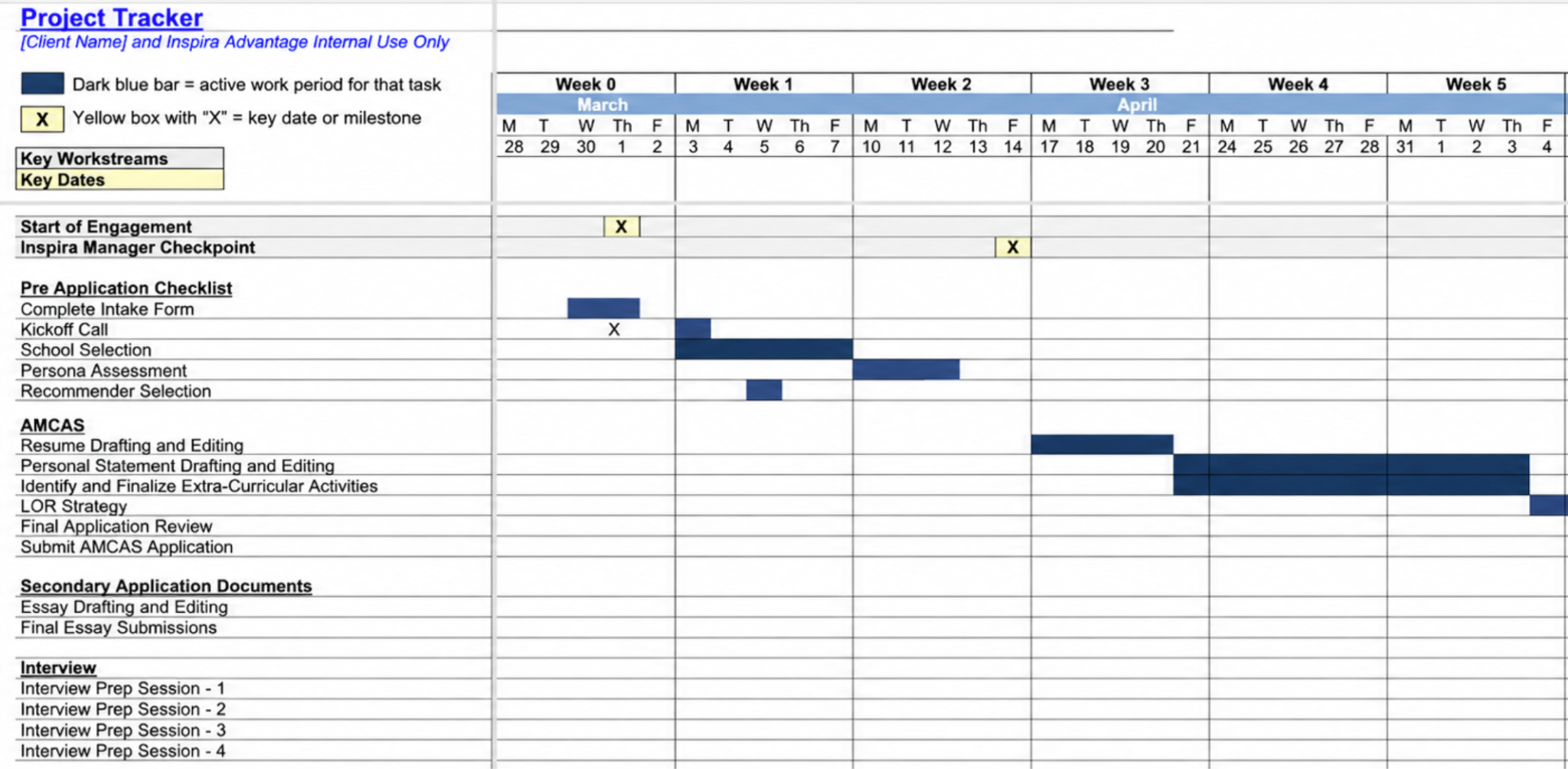
This was especially important for Samantha because she indicated she needed a counselor to keep her on track and motivated throughout this overwhelming process. With the MCAT uncertainty hanging heavily over her, Samantha’s counselor reminded her that there were still several pieces of her application that she could control, and we needed to polish them and have them ready to submit. With any application, applying as early in the cycle as possible provides a real advantage. For Samantha, that was an advantage she couldn’t afford to let slip away.
By April, Samantha was completing several activity entries at a time while her counselor quickly reviewed and revised them. In fact, her counselor was available 24/7 for Samantha throughout the process, with several late-night texts and calls to make sure Samantha met every deadline. Her personal statement followed, and by the middle of May, we were finalizing both her personal statement and her letter of recommendation strategy.
She submitted her primary application on May 28, 2025, the very first day AMCAS allowed submissions.
Once her MCAT score became part of the equation, we also had to be realistic about the schools Samantha targeted.
She initially hoped to be competitive for MD programs and came to us with a list of only 15 MD schools and three DO schools. We knew only applying to MD schools would limit her, and we didn’t want to build an entire application around an outcome we knew would be extremely rare with her numbers.
So her counselor helped her cast a much wider and more strategic net across 48 schools, including 30 MD programs and 18 DO programs.
The point wasn't simply to apply to as many schools as possible. We looked for programs where other parts of Samantha's background could carry more weight, including her sustained service, experience with underserved patients, caregiving, community involvement, leadership, and evidence that she understood medicine beyond academics.
That meant accepting that many of her MD schools would be reaches while building a stronger group of realistic DO options as well. We still asked her to choose a few top DO options from our list so we could be sure to make her dreams come true as much as possible. That balance was key to her ultimate acceptances, and she did get into her number one DO choice.
Samantha's extracurricular profile gave us a lot to work with. She had roughly 645 hours of clinical and research experience, 225 hours of physician shadowing, 460 hours of non-clinical service, more than 2,100 hours of family caregiving, and additional teaching and leadership experience.

But the sheer volume of her hours alone wasn’t going to overcome the concern her MCAT score created. Her activities needed to make admissions committees understand the person behind the numbers and prove her readiness for med school and determination to become the best physician, even if she didn’t test well.
One of the biggest changes we made was deciding which experiences deserved the most space. Unsurprisingly, Samantha assumed her longest experience, years spent caring for an older relative, would become one of her “Most Meaningful” activities. But we took a different approach.
Her final selections instead included a teaching role, an international service experience, and a student wellness initiative she helped build.
We knew her extensive caregiving experience, while impressive, wouldn’t hold as much weight since it wasn’t truly a clinical experience. It deserved to be explained, but elsewhere in her application.
These new “Most Meaningful Experiences” her counselor helped her choose revealed parts of Samantha that weren't already obvious elsewhere in her application. They showed how she teaches, how she responds when someone needs support, how she communicates across differences, and how quickly she notices when someone around her feels overwhelmed or unseen.
Those qualities became a much bigger part of the story we wanted admissions committees to remember.
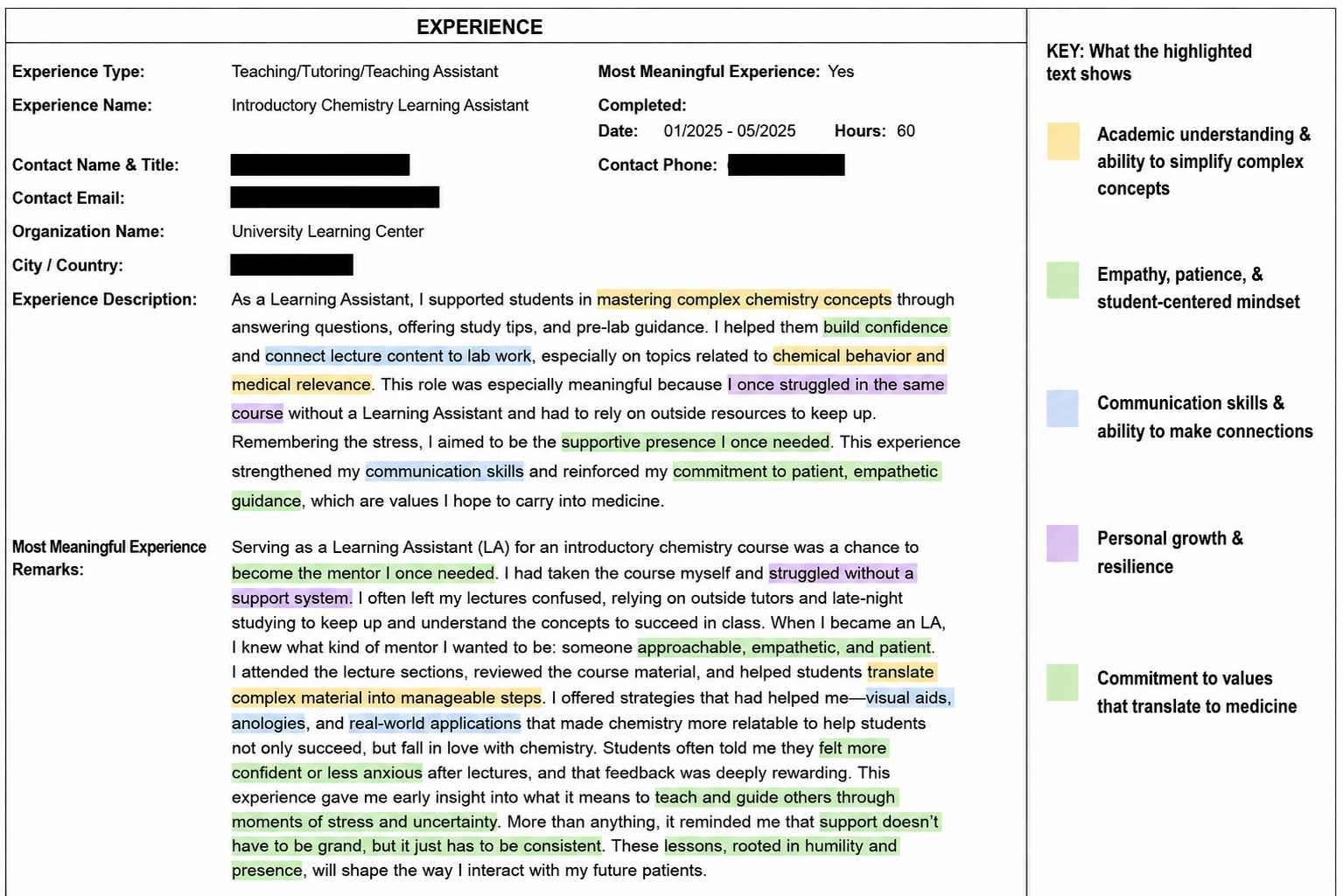
Samantha only had 60 hours as a peer chemistry learning assistant. Based on these numbers alone, she assumed it wasn’t impressive enough to be labeled as one of her “Most Meaningful Experiences.”
Compared with more than 2,000 hours of caregiving and hundreds of hours in healthcare settings, it could have looked insignificant. Her counselor saw something else in the experience that Samantha completely overlooked.
Samantha had previously struggled in the same chemistry course she later helped teach. She remembered leaving lectures confused and relying heavily on outside resources because she didn't have the type of peer support she later provided herself. That was the story.
So, instead of writing:
Helped students understand chemistry concepts, answered questions, and assisted with pre-lab material.
We used the experience to show why Samantha taught the way she did. She used visual explanations, analogies, and different approaches depending on what each student was struggling with. More importantly, she understood what it felt like to be the confused student sitting on the other side of the conversation. By the final version, the activity wasn't really about chemistry; it was about Samantha recognizing a need she had once had herself and deliberately becoming that source of support for someone else.
It read like this in the end:
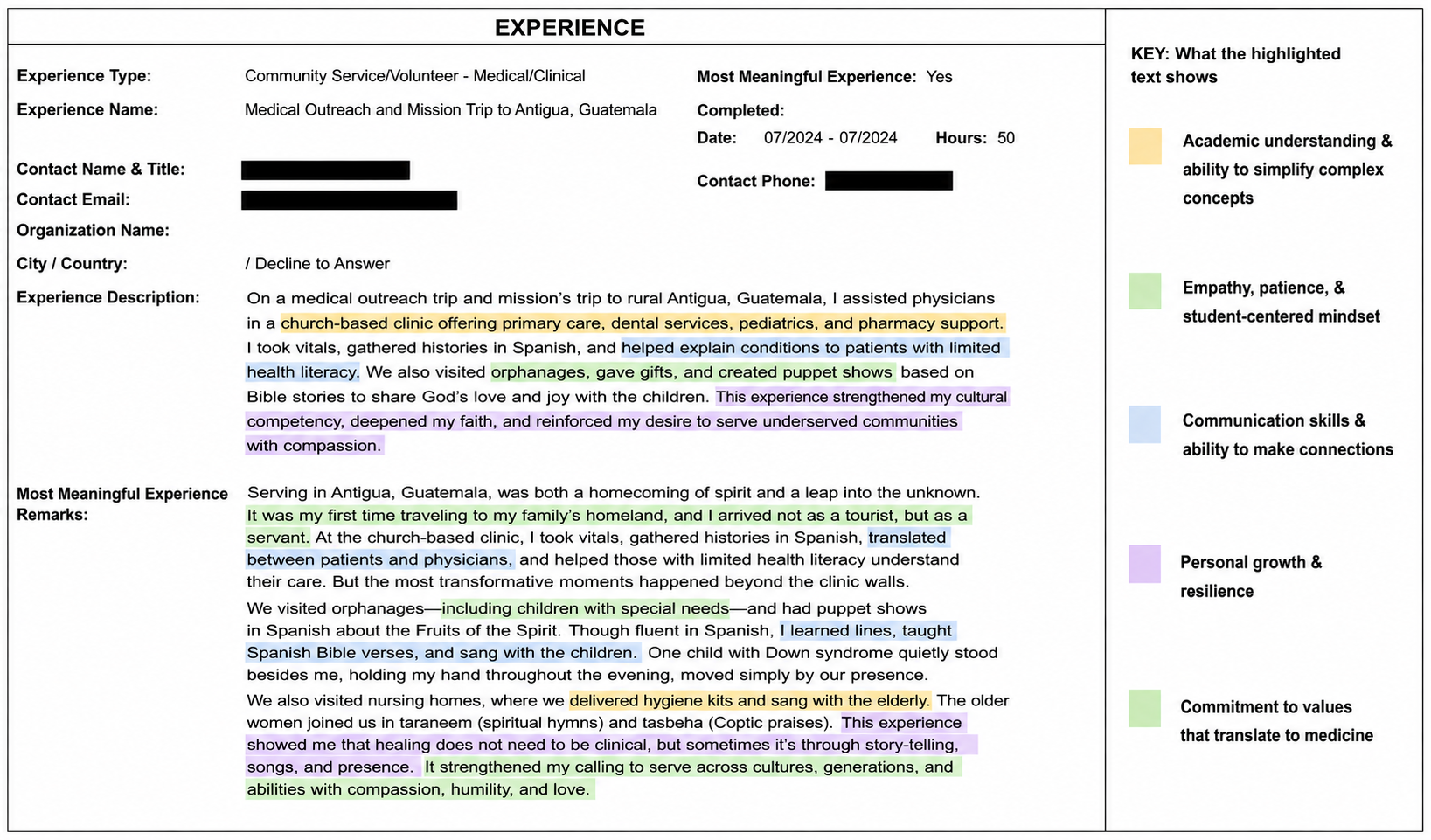
We made similar changes to an international health outreach experience she participated in over one of the summers between her undergrad years. Her first draft tried to explain almost everything she did: distributing basic supplies, rotating through different stations, assisting with medications, taking patient information, giving health education, and interacting with children during breaks.
There was plenty of activity, but not enough Samantha. Her counselor helped narrow the final version around what she had actually learned from entering a community different from her own and communicating with patients who didn't always understand their care. We homed in on her role explaining health information, translating from English to Spanish when appropriate, and adapting to patients with limited health literacy.
Then we added reflection. Instead of ending with a broad statement about developing cultural competence, Samantha could articulate a much more personal lesson: Sometimes, being useful in healthcare means knowing how to be present, listen, and make someone feel understood even when you aren't the person making the diagnosis.
Her final activity description looked like this:
We made that “here's everything I did” to “here's what this changed in me” change throughout the activities section.
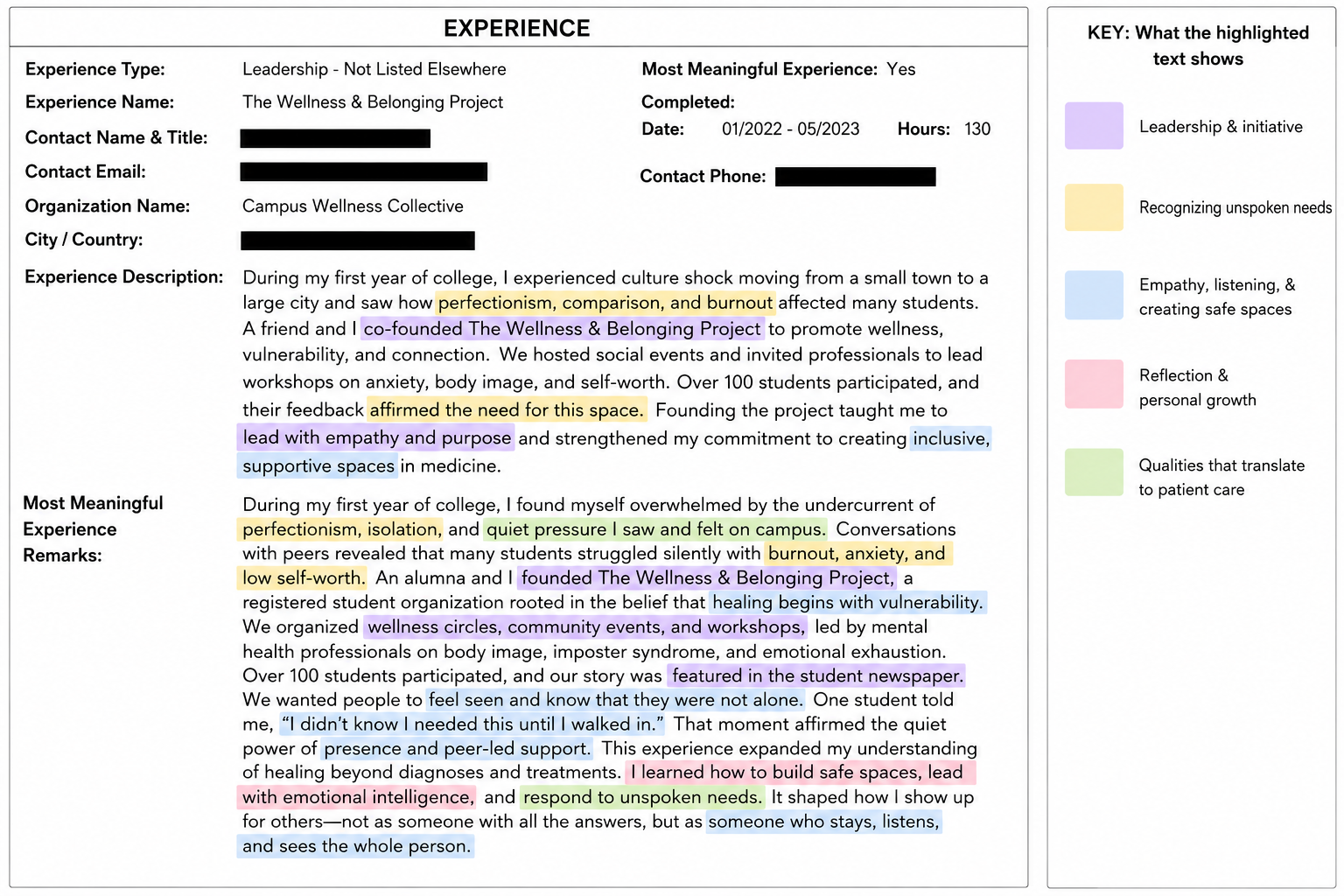
Samantha also co-founded a student initiative focused on wellness and belonging. That was a unique experience that few other students would have on their applications, so we knew we had to highlight it.
Her early activity description mostly explained what the organization accomplished: events, workshops, attendance, and the fact that other students continued the initiative afterward. Those were good achievements, but we wanted to know what Samantha learned from building it. The final version focused much more heavily on why she created the group in the first place. She had noticed that students around her were struggling with pressure, comparison, burnout, and isolation, even when they weren't openly asking for help.
She helped create a place where those conversations could happen. The experience ultimately gave her a much more interesting leadership lesson than “I learned how to organize events.”
She learned to notice needs that people may not explicitly voice, listen without assuming she has all the answers, and create an environment where someone feels comfortable enough to speak. Those are qualities that translate naturally to patient care without us needing to force a medical connection into every sentence. This activity was able to show, not tell, the admissions committees that she already had some of the skills to succeed as a physician.
Here’s the activity description she ultimately submitted:
Samantha had another common problem: She had several compelling experiences, but they initially risked reading like separate reasons she was interested in medicine. There was family caregiving, international service, and clinical research. Her counselor helped her find the connection between them.
We ultimately built the personal statement around a much simpler idea: Medicine could give people back parts of their lives that illness had taken from them. The essay started at home, and that was where we thought Samantha should delve deeper into her substantial caregiving experience.
For several years, Samantha had helped care for an older relative with multiple chronic conditions. She managed medications, helped with day-to-day needs, and assisted with medical communication when language became a barrier. We could have focused on the sheer number of hours she spent caregiving, but this wasn’t an activity description. It was a narrative. Committees wouldn’t care about the numbers; they’d care about the story.
Instead, we focused on dignity. She had seen how much it mattered for a sick person to feel heard and retain some sense of independence even when their health was deteriorating. Her international service experience then expanded that lesson. One interaction showed her that health education and communication could build trust even when she wasn't providing the treatment herself. Finally, her clinical research experience brought science into the narrative. Rather than describing research protocols, her essay focused on a patient whose mobility improved after a cardiovascular procedure. Months later, the patient could once again play with his grandchildren.
Her counselor connected that moment back to the relative Samantha had cared for and the small victories she remembered celebrating at home. Three experiences that could have felt unrelated had a reason to exist in the same essay.
Caregiving showed her what illness takes away. Service taught her the importance of meeting patients where they are. Research showed her how medical innovation can restore independence and quality of life. The final personal statement brought those experiences together rather than leaving the reader to find the connection themselves.
Her counselor worked through each draft with her one by one, cutting unnecessary task descriptions and pulling forward the moments that showed how Samantha interacted with people, what she noticed, and what she learned from those experiences.
We couldn't rewrite Samantha's MCAT score, but we could make sure it wasn't the only part of her application worth remembering. So, instead of just seeing a low-scoring applicant, the admissions committee saw a 3.79 GPA student who succeeded academically for years and spent thousands of hours caring for someone else. They saw service, teaching, research, leadership, and real exposure to physicians and patients.
More importantly, they saw the same qualities across all the experiences: presence, patience, empathy, communication, and a habit of noticing what other people need.
Samantha ultimately received three interview invitations from osteopathic medical schools and earned acceptance into one of her top-choice DO programs: Kansas Health Science University–Kansas College of Osteopathic Medicine (KHSU-KCOM).


.svg)


