CASE STUDY
How We Helped a 4-Time Med School Applicant Get Accepted
GPA
513
MCAT
3.79
VT
ACCEPTED
Virginia Tech Carilion School of Medicine

Written By:
Arush ChandnaDate Published:
September 19, 2026
When Ryan reached out to us, he was on his fourth attempt at applying to med school. He was frustrated, a little defeated, and eager to finally start on his dream of becoming a physician.
But after three unsuccessful application cycles, it was clear that submitting another version of the same application wasn’t going to cut it. Inspira Advantage helped Ryan rethink his entire strategy and submit a much stronger application with a more focused narrative. He ultimately earned an acceptance to one of his top choices: Virginia Tech Carilion School of Medicine.
At first glance, Ryan seemed like a competitive applicant. He had a 3.79 GPA, a 513 MCAT score, 2,000 hours of experience as a medical assistant, 4,000 hours of research experience, five peer-reviewed publications, research presentations, physician shadowing, hospital volunteering, and teaching experience.
It was clear that Ryan didn’t need more accomplishments. He needed a clearer application strategy and a much stronger narrative, as although his experiences were impressive individually, they didn’t come together to show admissions committees who he was, how he had grown, or what had changed since his previous applications.
He needed to revamp his personal statement, activities, Most Meaningful Experiences, and resume to change his admissions outcome.
Here’s a closer look at his profile diagnostic:
After three unsuccessful cycles, our experts dug into his previous school lists. They found that he previously applied only to MD programs in Florida and along the East Coast each admissions cycle. He had the stats for these schools, but he couldn’t just apply to the exact same ones again for a fourth time.
It was clear these schools also didn’t all align with his research-heavy profile. So, we helped him build a larger but more strategic list that still included programs he genuinely wanted to attend but gave him more realistic opportunities for admission.
For a reapplicant, school selection can be just as important as strengthening the application itself. In the end, we took his previous school list from only 19 schools to over 30.
Ryan’s counselor knew his 3.79 GPA should have opened more doors, but after looking at his transcript more closely, there was an important piece of his story that was overlooked. He started college with exceptionally strong grades, but then his performance changed. He had a C+ in physics and several B-range grades in his final years. That’s the opposite of what admissions committees expect to see. They expect lower freshman grades and a strong upward trajectory in more advanced courses. This was a red flag that needed context.
His previous personal statement didn’t meaningfully address what had happened during that period. Instead, his essay focused on how a childhood orthopedic injury introduced him to medicine, how watching a parent work in rehabilitation therapy influenced him, and how his research eventually led him to seek more direct patient contact. He needed to add context for admissions committees to understand the inconsistencies in his transcript.
Here’s a look at what his transcript looked like:
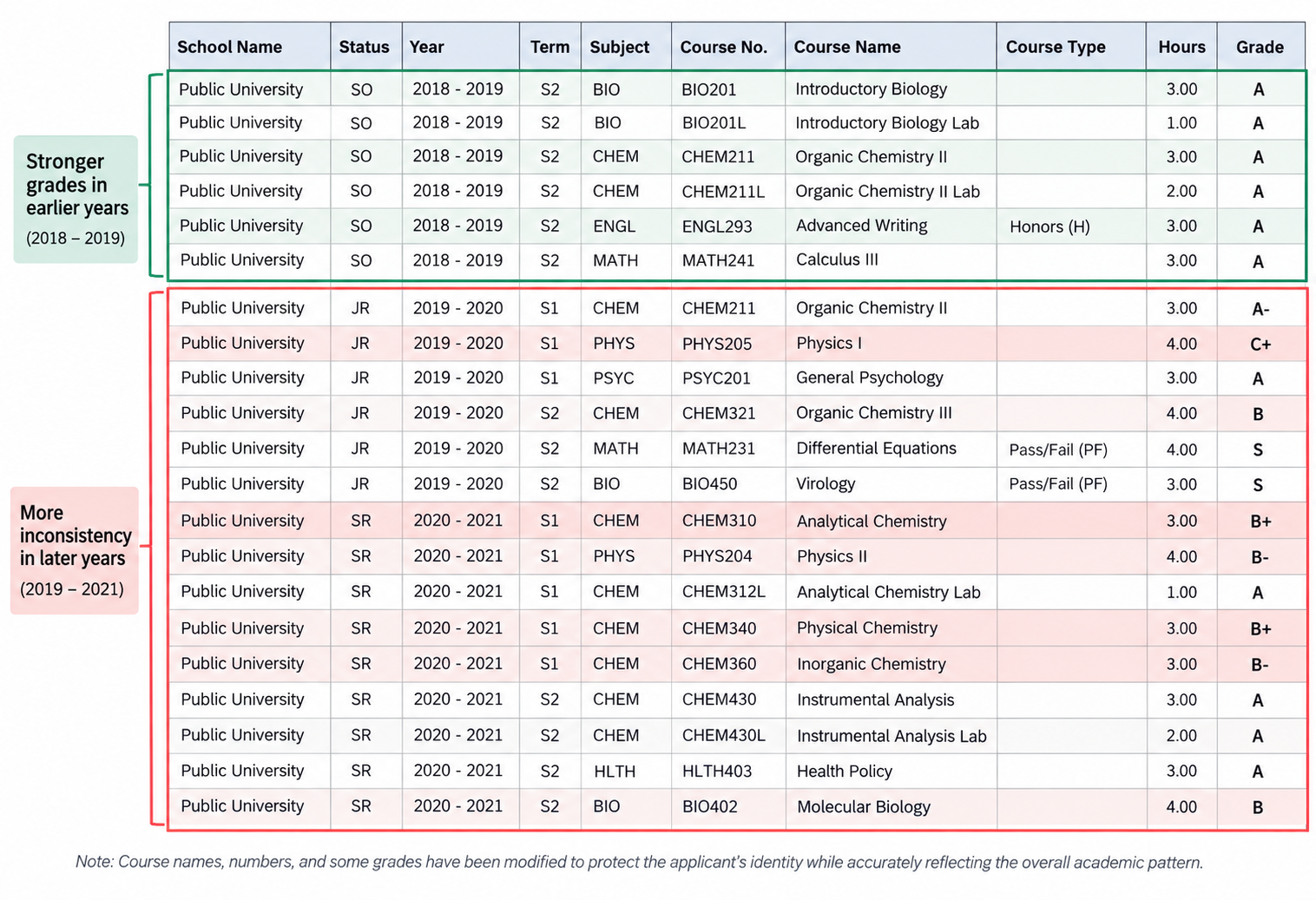
His revised personal statement explained that his grades had declined while his family was coping with a parent’s progressive neurological illness. More importantly, he didn’t use the experience simply to justify his academic performance. He reflected on how it forced him to learn to ask for support, manage his time more effectively, and handle adversity differently.
Instead of leaving admissions committees to wonder why his academic trajectory had changed, the new application acknowledged it and showed what Ryan had learned from it.
One of the central pieces of feedback we gave Ryan was to “draw parallels between his orthopedic injuries and recovery process, his academic challenges, and how those experiences would shape him as a future physician.”
That became the foundation of the new statement.
The childhood fracture still opened the essay, but this time it introduced a broader theme of setbacks, recovery, and growth. Ryan described how rehabilitation first showed him the partnership that can develop between patients and healthcare providers.
His family’s health challenges then showed how he had grown emotionally and learned to respond differently when life became difficult. His research and clinical experiences demonstrated how science and compassion could work together in medicine.
Finally, a more recent ACL tear brought the story full circle. Instead of treating the second injury as another unrelated anecdote, Ryan used it to reflect on how differently he now understood recovery after years of academic, research, clinical, and personal growth.
By the conclusion, his orthopedic injuries and academic challenges supported the same message: Setbacks weren’t endpoints. What mattered was how he responded to them.
The statement also gave Ryan a much clearer direction, connecting his experiences to an interest in physical medicine and rehabilitation rather than ending with a broad desire to combine science, medicine, and helping others.
Ryan’s previous activities section had strong experiences, but some descriptions tried too hard to explicitly connect everything back to medicine. His chemistry teaching assistant entry is one of the clearest examples of this. In his 2025 AMCAS application, he compared tutoring students to treating patients. He described diagnosing their “symptoms of chemistry confusion,” developing a “treatment plan,” and prescribing practice problems.
We removed that comparison completely. In his 2026 application, the same activity focused on helping students understand difficult material, sharing his own struggles to reassure them, adapting his explanations, and learning to communicate patiently and supportively. The revised version didn’t need to tell admissions committees that teaching was similar to medicine.
It simply needed to show that Ryan had qualities that could transfer easily to medicine: communication, patience, adaptability, and mentorship.
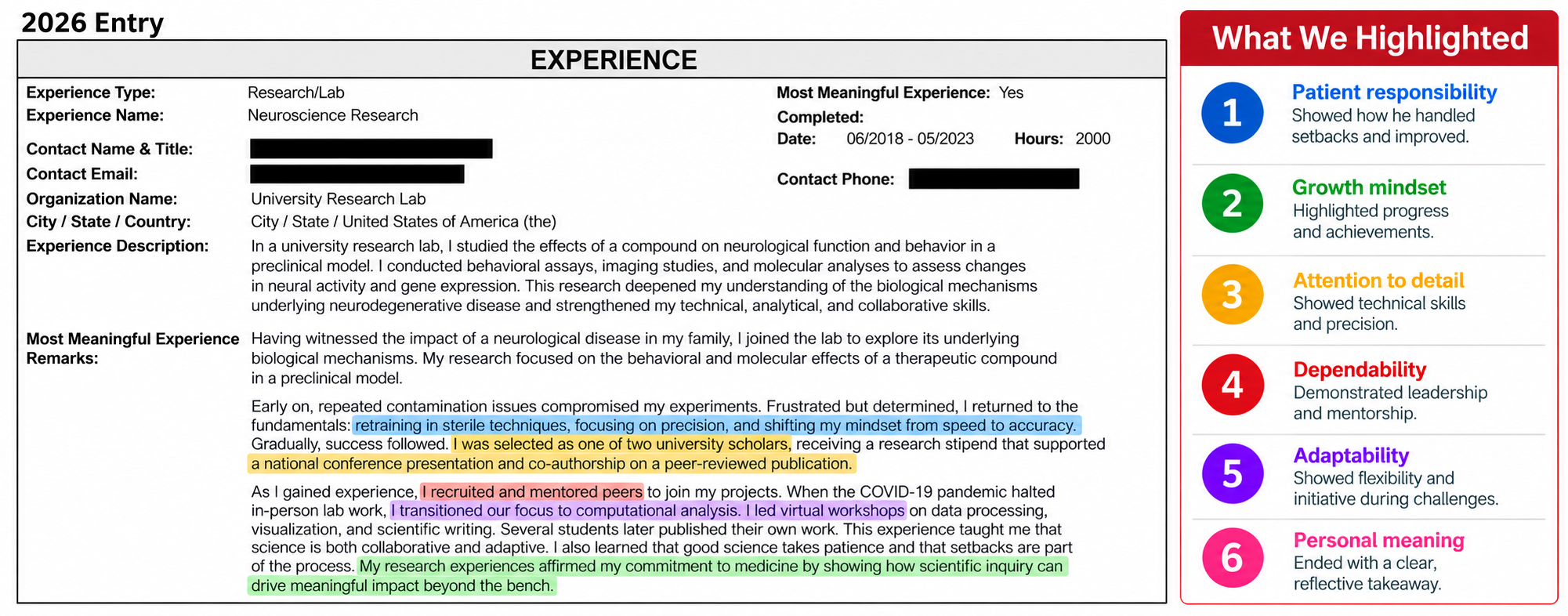
Ryan already had nearly 2,000 hours working as a medical assistant in an ophthalmology clinic, which we knew was one of the most impressive parts of his profile. His old description explained his responsibilities in detail, including measuring eye pressure, conducting retinal imaging, helping with injections, and eventually taking on more advanced imaging responsibilities. His “Most Meaningful Experience” remarks focused heavily on feeling overwhelmed when he first started and gradually becoming more confident.
That was a decently strong story, but we had to make his progression much clearer. The revised version showed Ryan recognizing that even small mistakes could affect patient care. When he struggled, he actively looked for ways to improve: practicing grip strength, asking for feedback, and observing more experienced providers. Over time, Ryan progressed to more complicated responsibilities and eventually earned a lead role.
Instead of ending with a generic sentiment about using these skills in medical school, the new entry focused on what he had actually learned: humility, consistency, attention to detail, dependability, and the importance of being willing to improve. We needed to prove this experience gave him different skills than his chemistry teacher role, to show his true well-roundedness.
Those skills also naturally complemented and added to the same growth narrative we established in his personal statement.
His final activity description looked like this:
Ryan’s research was by far the strongest accomplishment he had on his resume. He had roughly 4,000 research hours across two major experiences and had coauthored five peer-reviewed publications, including a first-author paper. We rarely see students get such substantial research or such substantial outcomes from their research. This was the one key that would help him really stand out amongst other applicants.
But his previous “Most Meaningful Experience” section (that covered 2,040 of his research hours) centered largely on failed experiments with aquatic animals and ended with a metaphor about learning to adapt like a fish embryo riding turbulent currents. We kept the idea of failure and perseverance but made the takeaway more substantive. We noticed a pattern where Ryan tried to almost create mini personal statements for his experiences, building each one around an extended story, metaphor, or narrative arc.
That’s not what the AMCAS Work & Activities section is meant for.
His personal statement already had the job of telling his overarching story. His activity descriptions needed to give admissions committees specific evidence of what he did, the impact he made, the skills he developed, and how he grew through each experience.
The strongest descriptions are packed with concrete details, tangible outcomes, responsibilities, and meaningful reflection, rather than using most of the limited character count to build another narrative. For Ryan’s research, that meant making sure admissions committees could immediately see not only that experiments failed, but how he responded, what he accomplished afterward, and how he grew into a researcher who could mentor others.
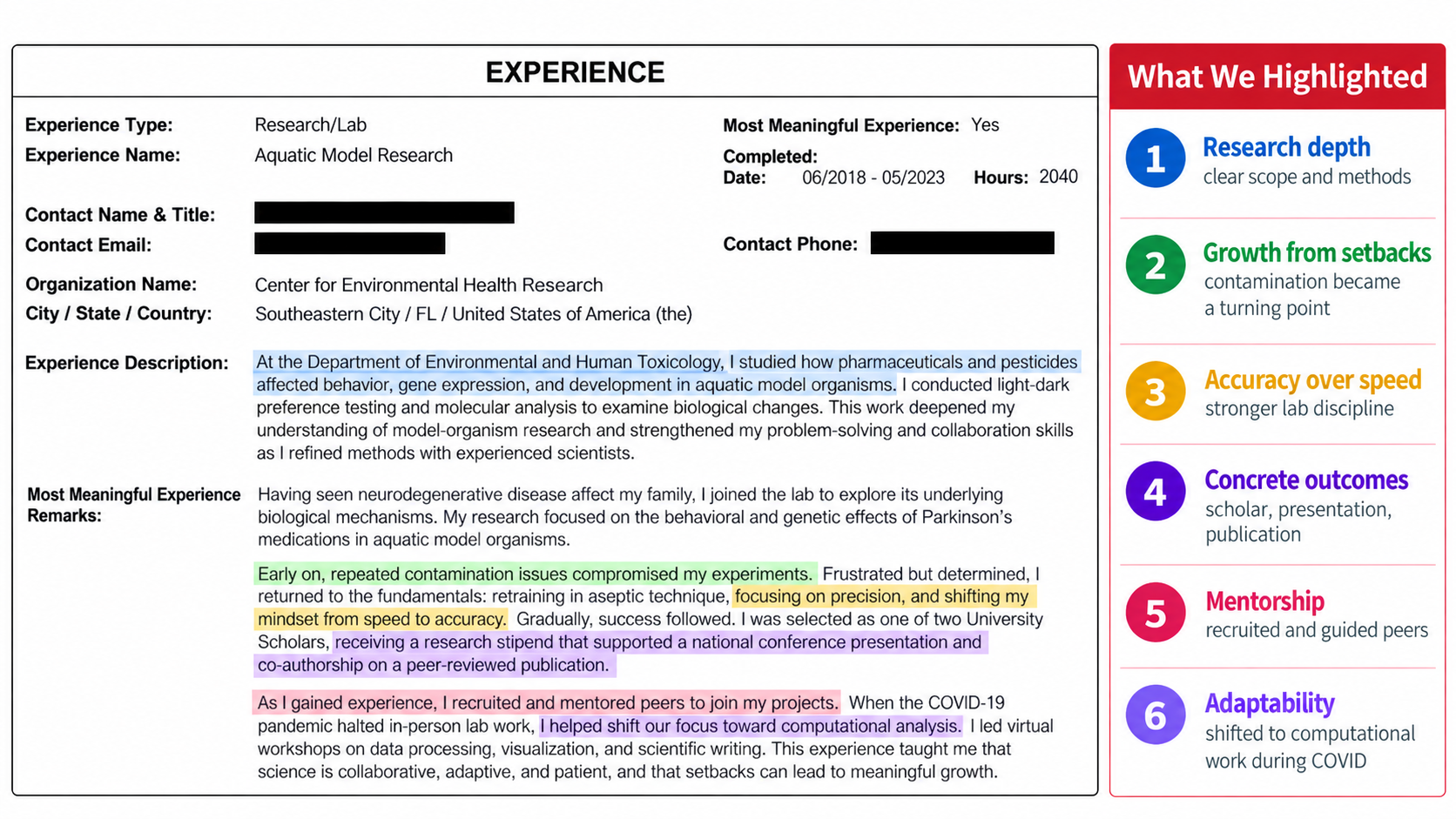
The final version explained how recurring contamination forced Ryan to return to fundamental laboratory techniques, prioritize accuracy over speed, and become more deliberate in his work.
Then, rather than stopping once his own experiments improved, the description showed how Ryan began mentoring other students. When COVID interrupted in-person laboratory work, he helped shift projects toward computational analysis and led virtual workshops on data processing, visualization, and scientific writing. The new description demonstrated much more than scientific ability. It showed adaptability, collaboration, mentorship, patience, and how Ryan responded when things didn’t go according to plan.
Here’s the 2026 activity description he submitted:
Part of improving Ryan’s application meant looking beyond how each activity was written and asking whether it deserved one of the limited spots on his AMCAS Work & Activities section at all. His previous application included a 35-hour Brain Awareness Week volunteer experience and a 24-hour aerial yoga activity. While these were interesting aspects of his pre-med journey, they took up valuable space and needed to be replaced by more substantive experiences.
His new application instead included a 200-hour recreational sports activity and, much more importantly, approximately 2,000 hours of competitive soccer. Soccer became one of Ryan’s three “Most Meaningful Experiences” instead of a previous study abroad experience he had listed. The truth is, the study abroad narrative has become redundant with pre-meds and wasn’t likely to help Ryan stand out. That space was much better used for soccer, which had been part of Ryan’s life for years and reinforced the central themes of resilience, teamwork, leadership, and recovery.
After an ACL tear ended his final season, Ryan transitioned from player to coach. He learned to observe the game differently, give constructive feedback, support teammates, and contribute even when he could no longer participate in the same way. Once again, the experience showed the same pattern: Ryan faced a setback, adapted, and found a new way to contribute.
Ryan’s previous application wasn’t submitted until July 16, 2024, and AMCAS didn’t process it until August 15. His other two cycles followed similar submission dates. By the time medical schools could review that application, the admissions cycle was already well underway.
That matters because the med schools he applied to use rolling admissions. Schools begin reviewing completed applications and allocating interview spots as the cycle progresses. An application that doesn’t reach schools until August is competing for fewer available interview opportunities than one that was completed earlier in the summer.
For his fourth cycle, we knew that had to change. Ryan submitted his AMCAS on June 9, 2025, more than five weeks earlier. Instead of schools first seeing his application in August, his primary was positioned to move through the process much earlier.
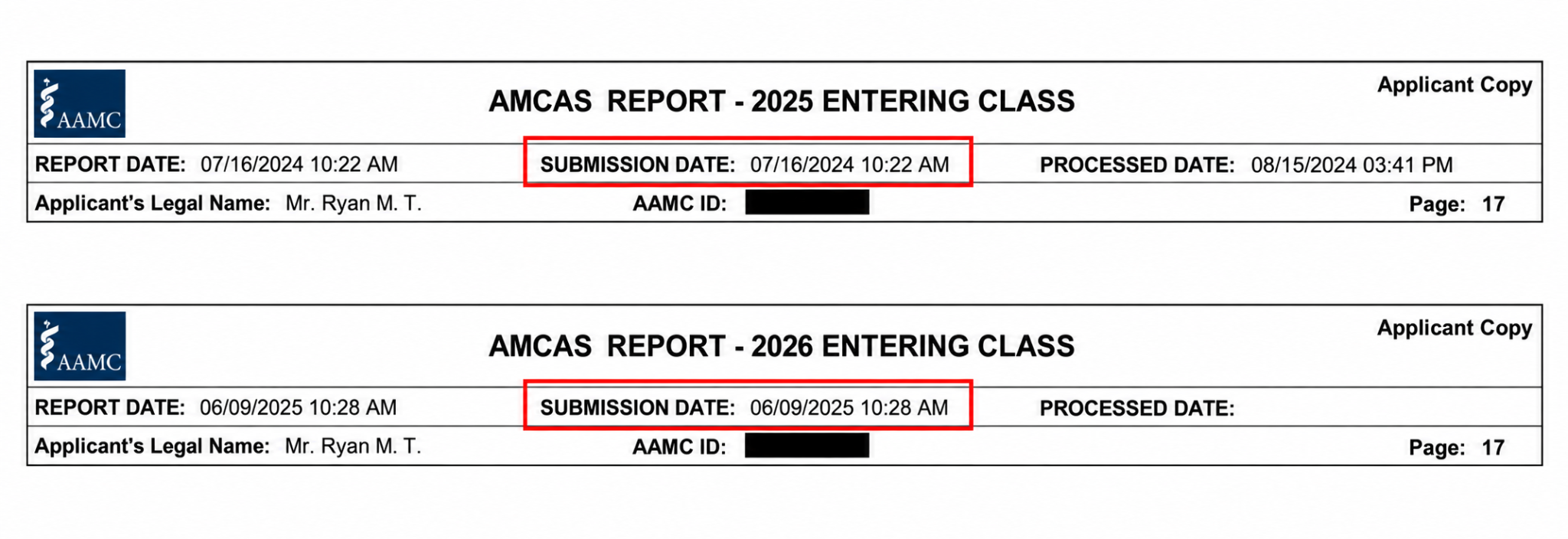
Submitting early alone won’t turn a weak application into an acceptance. But in Ryan’s case, we had already substantially improved the application itself. Getting that stronger application submitted earlier meant admissions committees could evaluate it while more of the cycle was still ahead. This was another meaningful difference between his unsuccessful cycles and the one that ultimately resulted in an MD acceptance.
Ryan came to Inspira Advantage after three unsuccessful application cycles. We got him into the Virginia Tech Carilion School of Medicine on his fourth attempt.
He already had a 3.79 GPA, a 513 MCAT, thousands of hours of research and clinical work, multiple publications, shadowing, teaching, and service. What changed was the application around his otherwise strong profile.
His story is a great example of why reapplicants shouldn’t just assume their scores alone are holding them back. Sometimes, the missing piece is making sure admissions committees can finally see the person, growth, and purpose behind everything that’s already on the page.


.svg)


