Get in touch: +1 888 453 5021




This data was collected from the Medical School Admission Requirements (MSAR) database.
A good medical program might have a stellar reputation in primary care research but offer limited surgical training volume or weak residency placement into competitive surgical specialties. We focused our methodology specifically on what matters for students who plan to match into surgery. We considered:
The figures above show how we determined the best medical schools for surgery. But the quality of surgical training, match outcomes, and institutional reputation can’t be reflected in a single number. Our ranking reflects the full picture of what each surgical program offers students building careers.
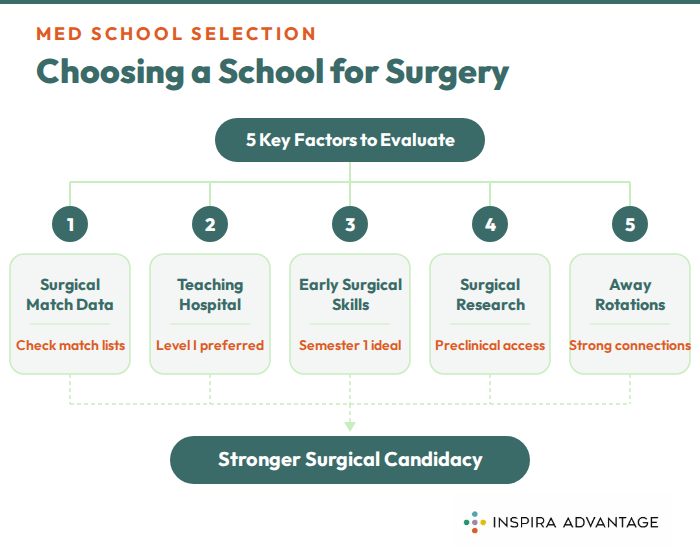
Reference the most recent match data for every school on your list and count how many graduates were placed into surgical specialties. Pay attention to where they matched, not just whether they matched.
A school that sends graduates to university-based surgical residencies at major academic medical centers tells a different story than one where most surgical matches land at community programs. Most medical schools publish their match lists publicly. If a school doesn't, ask the admissions office about match day results.
Your clinical rotations will shape your surgical skills more than any lecture. Find out which hospitals are affiliated with each medical school and what kind of surgical volume they handle.
For example, a Level I trauma center exposes you to emergency surgeries, complex cases, and high-pressure decision-making that a smaller community hospital simply can't replicate. Look at how many operating rooms the primary teaching hospital runs, whether students scrub into cases during their third-year clerkships, and how much hands-on responsibility students actually get versus standing in the corner watching.
Some medical schools put a scalpel in your hand during the first semester through cadaver labs and surgical simulation centers. Others don't expose you to anything surgical until your third-year clerkship rotations begin.
Schools with early surgical skills courses, simulation labs with laparoscopic trainers, and anatomy curricula taught by surgeons give you a head start in developing the hand-eye coordination and procedural confidence that residency programs expect.
Ask each school when students first enter a simulation lab, how often they practice suturing and knot-tying before clerkships, and whether the anatomy course is taught by surgeons or basic science faculty. This can also help you decide what type of surgeon you want to become later in your career.
A competitive surgical residency application almost always includes research. Look at each school's surgery department website and check for active research labs, funded clinical trials, and faculty who publish regularly in surgical journals.
What you want is a program where students can realistically get involved in surgical research during their preclinical years, not one where research opportunities technically exist but every lab is full or focused on non-surgical disciplines.
Even better, look for schools that offer dedicated research years or funded fellowships between your third and fourth years, which give you time to publish and present at conferences like the American College of Surgeons Clinical Congress.
The medical school you attend determines your home institution, but away rotations during your fourth year let you audition at other programs. Some medical schools actively support students in securing competitive away rotations at top surgical residency programs. Others leave you on your own.
Ask how the school's surgery department helps students arrange away rotations, whether they have established relationships with residency programs at other institutions, and how fourth-year scheduling accommodates the away rotation timeline.
A school with strong national connections in surgery gives you access to a wider network than one where the surgical faculty is primarily trained and practices at a single institution.
You can find more medical schools that specialize in surgery with our free medical school selection quiz. Created by medical school admissions experts with years of experience, this tool can help you narrow down your best options.
Johns Hopkins University School of Medicine is the best medical school for surgery in the U.S. It combines a high-volume Level I trauma center, extensive surgical research infrastructure, and one of the strongest surgical residency match records in the country.
It’s very difficult to become a surgeon. According to the NRMP’s Residency Match Outcomes, 1,111 MD seniors matched into surgery out of 1,581 applicants. That means the odds of an MD matching into surgery are roughly 1 in 3.
Once matched, general surgery residency runs five years. Subspecialties like neurosurgery add another seven years of residency alone, with most surgical fellowships adding one to three years beyond that. Residents typically work 60 to 80 hours per week throughout, with some of the highest burnout rates in all of medicine.
From medical school to independent practice, the full path can take 13 to 15 years.
The medical schools that consistently place the most graduates into general surgery residencies include Johns Hopkins University School of Medicine, Harvard Medical School, UCSF School of Medicine, and the University of Michigan Medical School.
You can evaluate a medical school by reading each school's most recent match list and counting how many graduates were placed into surgical specialties. Additionally, evaluate the school's affiliated teaching hospitals for surgical volume and trauma designation, the timing of the curriculum's introduction of surgical skills and simulation, the strength of the surgery department's research output, and whether students receive meaningful operating room time during clerkships.
Orthopaedic Surgery Resident Physician
Lewis Katz School of Medicine at Temple University


.svg)


