This article will explore how to get into Duke University School of Medicine, including tips, admissions statistics, and more.
If you’re just here for the requirements, click here.
Privacy guaranteed. No spam, ever.
Duke University School of Medicine Acceptance Rate: 1.33%
The acceptance rate at Duke University School of Medicine is 1.33%. In the 2025-2026 admissions cycle, Duke Med received 9,234 total applications and admitted 123 students. That means your odds of matriculating to Duke Med are lower than 2 in 100.
Take a look at the interactive infographic below to see how Duke Med’s acceptance rate has changed over the last few admissions cycles, according to data from the Association of American Medical College (AAMC):
0%
Acceptance Rate
0
Total Applicants
0
Matriculants
<2 in 100
Your Odds
Out of every 100 applicants…
Matriculant
Did not matriculate
Duke's acceptance rate has never exceeded 1.44% in the last four cycles.
Acceptance rate by cycle
Admissions Cycle
Number of Applicants
Number of Matriculants
Acceptance Rate
2025-2026
9,234
123
1.33%
2024-2025
8,284
119
1.44%
2023-2024
8,431
118
1.40%
2022-2023
8,613
120
1.39%
Duke University School of Medicine's applicant pool increased by 11.5% between the 2024-2025 and 2025-2026 admissions cycles, yet the school added only four seats to its incoming class. The result is an acceptance rate that dropped to 1.33%, the lowest in the four-year time span.
For context, even the highest acceptance rate in this range (1.44% in 2024-2025) still meant fewer than 15 out of every 1,000 applicants were accepted.
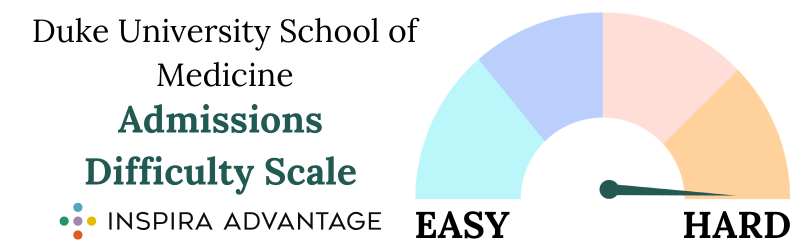
How Hard Is It to Get Into Duke Med?
It’s extremely difficult to get into Duke Med. Since only 1.33% of applicants matriculated in the 2025-2026 admissions cycle.
According to the Association of American Medical Colleges (AAMC), the national average acceptance rate for all accredited allopathic medical schools in the US is 42.8%. Duke Med’s acceptance rate is nearly 41 times lower than the national acceptance rate.
You’ll need above-average academics, a strong personal statement, excellent interview responses, and impressive extracurricular activities to stand out.
What Is Duke Med's Acceptance Rate for In-State Applicants?
The in-state acceptance rate at Duke Med is 2.58%. In the 2025-2026 admissions cycle, Duke Med received 697 in-state applications, and 18 of them matriculated.
North Carolina residents make up only about 7.5% of Duke Med's total applicant pool, but hold an acceptance rate roughly double that of out-of-state applicants. Living in North Carolina gives you a measurable advantage — but not one large enough to offset any weaknesses in your application.
What Is Duke Med’s Acceptance Rate for Out-of-State Applicants?
The out-of-state acceptance rate at Duke Med is 1.26%. In the 2025-2026 admissions cycle, Duke Med received 7,960 out-of-state applications and 100 matriculants.
Out-of-state applicants account for about 86.2% of the total applicant pool and face the steepest odds of any domestic group. Out-of-state applicants must bring exceptional academic credentials, meaningful clinical and research experience, and a specific narrative explaining why the Duke Med curriculum and mission align with their goals.
What Is Duke Med's Acceptance Rate for International Students?
The international acceptance rate at Duke Med is 0.87%. In the 2025-2026 admissions cycle, Duke Med received 577 international applications, and five of them matriculated.
International applicants represent about 6.3% of Duke Med's applicant pool and face the most selective odds of any group. International applicants who earn a seat typically bring distinctive research profiles or clinical experience that stands apart from the domestic applicant pool.
How Many People Apply to Duke Med Every Year?
Duke Med receives approximately 8,641 applications per year, which is the average number of applications received over the past four admissions cycles. The average acceptance rate over the past four admissions cycles is 1.39%.
Privacy guaranteed. No spam, ever.
Admissions Statistics
Duke Med Median MCAT Score: 520
The median MCAT score of accepted applicants at Duke Med is 520. You must have a minimum MCAT score of 500 to be considered for admission.
Here’s an interactive infographic comparing MCAT scores of accepted applicants in the 2025-2026 admissions cycle:
520
Median MCAT Score of Accepted Applicants
Duke University School of Medicine
512
10th Percentile
516
25th Percentile
520
Median Score
522
75th Percentile
524
90th Percentile
Enter your MCAT score
520
472490500510520528
Duke University School of Medicine requires a minimum MCAT score of 500 for admission consideration. Scores are one factor in a holistic review.
The table below highlights MCAT score percentiles for 2025-2026 matriculants and accepted students at Duke Med:
MCAT Score Percentiles
MCAT Scores of Accepted Applicants at Duke Med
MCAT Scores of Matriculants at Duke Med
10th Percentile
512
509
25th Percentile
516
515
50th Percentile (median)
520
518
75th Percentile
522
521
90th Percentile
524
523
For the table above, we’ve used the most recent MSAR data available as of April 2026.
To help you understand what score to aim for, the table below highlights MCAT section scores for 2025-2026 matriculants and accepted applicants at Duke Med:
MCAT Section
Median MCAT Section Scores of Accepted Applicants at Duke Med
Median MCAT Section Scores of All Matriculants at Duke Med
Chemical and Physical Foundations of Biological Systems
130
130
Critical Analysis and Reasoning Skills (CARS)
129
129
Biological and Biochemical Foundations of Living Systems
130
130
Psychological, Social, and Biological Foundations of Behavior
131
131
According to the AAMC, the national average MCAT score of medical school matriculants is 512.1 for the 2025-2026 admissions cycle. Duke Med’s average MCAT score of accepted applicants is 518.7, which is 6.6 points higher than the national average.
Based on these averages, you should aim for an MCAT score at least eight points higher than the national average to be considered competitive for admission.
What MCAT Score Makes You Competitive at Duke Med?
An MCAT score of 522 or higher makes you competitive at Duke Med, as this aligns with the top quarter of accepted applicants in the 2025-2026 admissions cycle.
What this means for competitiveness:
⚈ Applicants who submit a 520 MCAT score (the median) can still be competitive if they supplement it with an exceptional GPA, well-crafted essays, and strong letters of recommendation.
⚈ Applicants who submit a 524 MCAT score (90th percentile) are very competitive, as their score places them in the top 10% of accepted applicants.
⚈ Duke Med will not consider a 516 or lower MCAT score competitive, as it falls below the 25th percentile of accepted applicants. Scoring at the 25th percentile means 75% of accepted applicants at Duke Med scored higher.
Duke Med Median Overall GPA: 3.95
The median overall GPA of accepted applicants at Duke Med is 3.95. You need to have a minimum overall GPA of 3.0 to be considered for admission.
The visual below shows how your overall GPA compares with that of Duke Med accepted applicants in the 2025-2026 admissions cycle. Use it to estimate your competitiveness.
3.95
Median GPA of Accepted Applicants
Duke University School of Medicine
3.71
10th Percentile
3.83
25th Percentile
3.95
Median Score
3.99
75th Percentile
4.00
90th Percentile
Enter your GPA
3.95
0.001.002.003.004.00
Duke University School of Medicine requires a minimum GPA of 3.0 for admission consideration. GPA is one factor in a holistic review.
Here is a table showing Duke Med’s range of overall GPA percentiles for both accepted applicants and matriculants:
Overall GPA Percentiles
Overall GPA of Accepted Applicants at Duke Med
Overall GPA of Matriculants at Duke Med
10th Percentile
3.71
3.63
25th Percentile
3.83
3.79
50th Percentile (median)
3.95
3.90
75th Percentile
3.99
3.98
90th Percentile
4.00
4.00
The national average GPA of medical school matriculants is 3.81, according to the AAMC. Duke Med’s 3.89 average overall GPA of accepted students is 0.08 points higher than the national average.
What GPA Makes You Competitive at Duke Med?
A GPA of 3.99 is considered competitive at Duke Med, as it aligns with the top 25% of accepted applicants in the 2025-2026 admissions cycle.
What this means for competitiveness:
⚈ If you submit a 3.95 GPA (median), you can still be competitive if you supplement it with a 522+ MCAT score.
⚈ If you submit a 4.00 GPA, you are very competitive and will stand out from thousands of other applicants.
⚈ You won't be considered competitive if you submit a GPA of 3.83 or lower, as this indicates you earned a lower GPA than most Duke Med accepted applicants.
Duke Med Median Science GPA: 3.93
The median science GPA of accepted students at Duke Med is 3.93. There is no minimum science GPA required for admission.
The table below shows the full range of science GPA percentiles at Duke Med for both accepted students and matriculants.
Science GPA Percentiles
Science GPA of Accepted Applicants at Duke Med
Science GPA of Matriculants at Duke Med
10th Percentile
3.61
3.49
25th Percentile
3.76
3.68
50th Percentile (median)
3.93
3.86
75th Percentile
3.99
3.97
90th Percentile
4.00
4.00
What Science GPA Score Makes You Competitive at Duke Med?
Submit a science GPA of 3.99 or 4.00 to be competitive at Duke Med. This aligns with at least the top 25% of accepted applicants in the 2025-2026 admissions cycle. You can still be competitive if you submit a 3.93 science GPA (median) if you supplement it with a 3.99+ overall GPA and a 522+ MCAT score.
Privacy guaranteed. No spam, ever.
Duke University School of Medicine Admissions Requirements
Here are all the requirements to get into Duke University School of Medicine’s MD program:
Bachelor's degree (and completion of at least two years at an accredited U.S. university for international applicants)
Duke Med does not require a traditional prerequisite checklist. Instead, the school outlines "academic expectations" rooted in competency-based, cross-disciplinary preparation. You will not find a rigid list of required courses with specific credit hours. What you will find is a clear signal about the knowledge base Duke Med expects you to bring on day one.
Here is what Duke Med strongly recommends you complete before applying:
Biochemistry: A standalone biochemistry course, or interdisciplinary coursework covering biochemistry principles through cell biology, molecular biology, or genetics.
Cellular Biology: A course in cell biology, molecular biology, or genetics. Duke University School of Medicine allows flexibility in how you fulfill this as long as the core content is covered.
Statistics or Biostatistics: Duke University School of Medicine expects you to understand how statistical methods apply to data analysis in biomedical and healthcare research. A single course in statistics or biostatistics will cover this.
Physics or Biophysics: Coursework connecting foundational physics concepts to human physiology and anatomy. Labs are optional.
Sociology: An introductory course with emphasis on social organization and the social determinants of health.
Psychology: An introductory course emphasizing the biological basis of behavior.
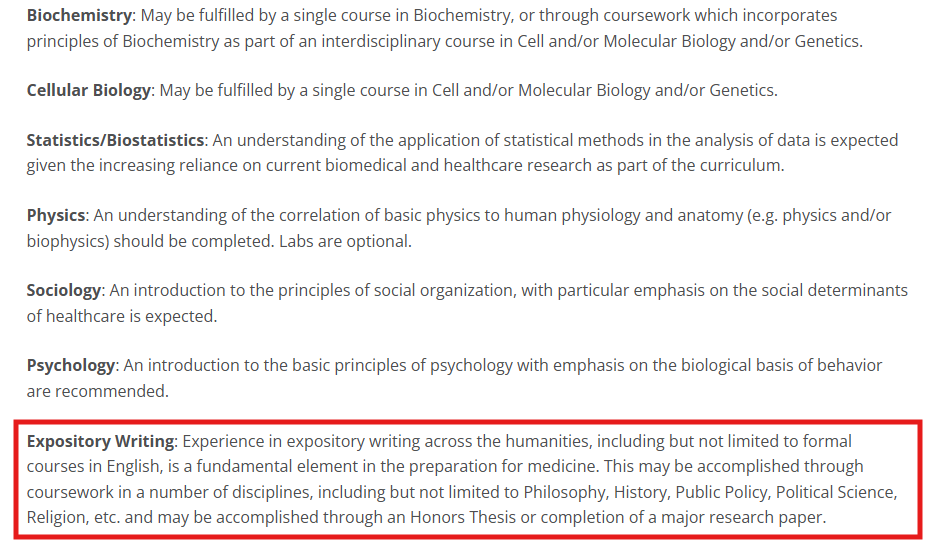
Expository Writing: Experience in analytical writing across the humanities. You can satisfy this through coursework in English, philosophy, history, public policy, political science, or religion. An honors thesis or major research paper also counts.
Duke Med Interview Format
Duke Med uses a virtual MMI for every MD applicant who reaches the interview stage. You rotate through eight to 10 stations, each roughly 10 minutes, with a different rater evaluating you at each stop. No panel interview. No dinner with students. No traditional sit-down as backup.
The format rewards consistency over charisma. Raters weigh a weak station against seven or nine others, and the rater who dislikes your answer cannot see the rest of your application file. Every station resets your slate.
Duke Med designs scenarios to look for six traits:
Empathy
Initiative and resilience
Communication and problem-solving
Teamwork
Insight and integrity
Cultural competence
Raters are not testing medical knowledge. They want to see how you think under time pressure and how you handle ambiguity when no "correct" answer exists.
What Is Duke Med's Interview Rate?
Duke Med's interview rate is 6.95%. Of 9,234 verified applications in the most recent cycle, Duke Med interviewed 642 candidates. Roughly 1 in 5 interviewed applicants matriculate. An invitation means Duke Med already views you as a strong candidate.
Privacy guaranteed. No spam, ever.
Secondary Application
Duke Med's secondary application includes up to nine essay prompts. Most have a 400-word limit, and not all are mandatory. The prompts for the 2025-2026 cycle are:
Share with us your story. Tell us how you wish to be addressed, recognized, and treated. (400 words)
How to Approach This Prompt
Duke Med built its curriculum around patient-centered care and cultural humility. The admissions committee wants to see whether you've reflected on your own identity with the same care you'd bring to understanding a patient's. Applicants who treat the prompt as a diversity checkbox miss the point entirely.
The best essays connect personal identity to interpersonal expectations. For example, write about growing up as a first-generation Vietnamese American and how the constant mispronunciation of your name taught you that small acts of recognition carry enormous weight in building trust. Then connect that to how you want to practice medicine.
Most weak responses fall into two categories. The first is the resume recap disguised as a personal narrative. The second is a vague meditation on "being unique" without grounding it in anything concrete. Both signal that the applicant hasn't done the internal work Duke Med values. Pick one or two dimensions of who you are and go deep into them. The admissions committee remembers specificity. Nobody remembers generalities.
Don't skip the second half of the prompt. Many applicants focus entirely on their story and forget to address how they wish to be recognized and treated. Add your preferences into the narrative naturally rather than tacking on a paragraph at the end. If your story is about navigating a bicultural identity, the "how I wish to be treated" piece should emerge organically from that experience.
Trust and rapport are essential in your day-to-day interactions with people. How do you cultivate a relationship with a person who may be very different from you? (400 words)
How to Approach This Prompt
The admissions committee evaluates whether applicants can articulate a concrete, repeatable approach to connecting with people unlike themselves. They've read thousands of essays that say "I listen without judgment." What stands out is showing how you listen and what you do when listening alone isn't enough.
Start with a real interaction. Maybe you volunteered at a free clinic and worked with a patient who distrusted the healthcare system. Describe what you actually did, not what you believe in theory. Then extract a transferable principle from that experience.
Here’s a great framework:
1. Describe the difference between you and the other person
2. Explain the specific actions you took to bridge that gap
2. Reflect on what shifted in the relationship and what you learned about your own assumptions
The biggest mistake is centering yourself as the hero who "helped" someone else. Duke Med wants mutuality. Show that you gained something from the relationship, too.
If every example positions you as the enlightened one extending a hand downward, the admissions committee will notice. Also, avoid choosing a superficial difference. Working with someone who likes different music doesn't demonstrate the relational skill Duke Med is testing for. Pick a difference that created genuine tension or discomfort and show how you navigated it.
Describe a situation in which you chose to advocate for someone who was different from you or for a cause or idea that was different from yours. Define your view of advocacy. What risks, if any, might be associated with your choice to be an advocate? (400 words)
How to Approach This Prompt
Duke Med wants physicians who will speak up in hierarchical medical environments where silence is easier. The prompt specifically asks about risk because the admissions committee is testing whether applicants understand that real advocacy costs something. Responses that describe advocacy without acknowledging any personal cost reveal that the writer hasn't fully engaged with the concept.
Don't borrow a dictionary definition of advocacy. Build your definition from your experience. If you advocated for a policy change at your university, your definition might center on systemic action. If you stood up for a coworker facing discrimination, your definition might center on interpersonal courage. Either works as long as the definition grows from the story rather than floating above it.
Be honest about what you risked. If the stakes were a mildly awkward conversation, don't inflate them into a career-threatening moment. The admissions committee respects proportional self-awareness. Even social discomfort counts when the applicant is honest about it.
Not achieving a goal or one's desire can sometimes be disheartening. What have you discovered from your setbacks and disappointments and how does this translate to your current way of thinking? (400 words)
How to Approach This Prompt
The admissions committee is assessing resilience with this prompt. They want to see that applicants can handle failure long enough to learn a real lesson from it. The strongest responses show a changed behavior or mindset, not just a changed attitude.
Open with the setback itself. Don't spend 200 words building context before you reach the failure. State what happened and why it mattered to you in the first two or three sentences. Then describe your initial reaction honestly.
If you were devastated or defensive, say so. Admissions officers trust applicants who can articulate their less flattering moments.
Close with how the experience reshaped a specific behavior or decision-making pattern. "I learned to ask for help earlier" is decent. "I now build weekly check-ins with my research mentor because I learned that isolation amplifies small problems into large ones" is significantly better.
Steer clear of anything that raises red flags about your ability to handle the demands of medical school. A story about failing to manage your time during one semester works. A pattern of repeated academic failures without a clear turning point does not.
Also avoid setbacks where you were clearly not at fault. Getting rejected from a program due to funding cuts isn't really a personal setback. The admissions committee wants to see how applicants respond to situations where their own choices or limitations played a role.
What do you value most as a leader and as a contributor? What attributes do you possess as a leader and as a team member and how do you apply them on a daily basis? (400 words)
How to Approach This Prompt
Duke Med's curriculum relies heavily on small-group learning and collaborative problem-solving. The admissions committee wants evidence that applicants can lead when needed and step back when someone else should. Applicants who only describe leadership signal that they may struggle in Duke Med's team-based environment.
Pick one leadership value and illustrate it with a specific daily behavior. "I value transparency" means nothing without an example. "I send my team a weekly update on project status because I learned during my research fellowship that ambiguity breeds anxiety," shows the value in action.
Avoid listing multiple leadership qualities; use a single sentence of support for each. Go deep on one or two and let the specificity speak for itself.
The contributor section is where most applicants lose differentiation. Everyone claims to be a good listener and a hard worker. Instead, describe the specific role you tend to play on teams and why.
Maybe you're the person who notices when a quieter team member hasn't spoken and creates space for their input. Maybe you're the person who identifies when a group discussion has gone off track and redirects it. Name your actual team behavior and back it up with a real example.
The prompt says "on a daily basis" for a reason. Duke Med wants to see that these aren't qualities you dust off for special occasions. Reference routine interactions, not just your most impressive leadership moment. A daily habit carries more weight than a one-time achievement.
Critical thinking involves a number of characteristics. Research experience enhances critical analysis skills. Describe any research experience or similar experience in which you utilized critical thinking. How will critical thinking be important in your future career? (400 words)
How to Approach This Prompt
Duke Med has a strong research culture, but the prompt specifically says "or similar experience." You don't need a published paper to answer well. What matters is demonstrating the ability to evaluate evidence, identify flaws in reasoning (including your own), and adjust conclusions accordingly.
The weakest essays tell the admissions committee the applicant is "a critical thinker." The strongest ones show it.
Describe a specific moment in your research or professional experience where you encountered unexpected results, a methodological flaw, or conflicting data. Walk the reader through your reasoning process step by step.
For example, you may have noticed that your clinical research data showed an anomaly in one subgroup. Rather than dismissing it as noise, you dug into the methodology and discovered a systematic error in how one research site was collecting samples. You then explained how that experience shaped your approach to evaluating clinical evidence. The story did the work. You never had to claim you were a critical thinker.
Avoid vague statements about "evidence-based medicine" when connecting critical thinking to your career. Instead, connect your research thinking skills to a specific clinical scenario you've observed or anticipate encountering
If your research involved analyzing conflicting studies, connect that to how you'll approach treatment decisions when guidelines conflict. Make the connection between past experience and future practice concrete and specific.
Potential sources of health inequities exist. Duke's Moments to Movement (M2M) is a collective stand to address these issues. Discuss your experience with disparities in health, healthcare, and society. (400 words)
How to Approach This Prompt
Duke Med launched Moments to Movement as an institutional commitment to anti-racism and health equity. The prompt tests whether applicants have engaged with these issues through direct experience rather than just academic awareness. Writing about disparities entirely in the abstract signals that the applicant has studied the problem from a comfortable distance.
Anchor your response in something you witnessed, participated in, or experienced personally. Maybe you saw how a clinic's hours made it inaccessible to patients who worked hourly jobs. Maybe you grew up in a community where the nearest hospital was 45 minutes away. Maybe you interpreted for a family member navigating a system that wasn't built for non-English speakers.
After establishing the experience, show what you did with it. Duke Med values action, not just observation. Even small actions count if they demonstrate engagement, like volunteering, organizing, researching, or changing how you approach clinical interactions.
Don't write about a marginalized community as though you're an outsider documenting their suffering. If you're writing about a community you don't belong to, center the people you worked alongside rather than positioning yourself as a savior.
Also, avoid cramming in too many disparities. One well-developed example with clear personal involvement outperforms three surface-level references to different social determinants of health.
Drawing from your clinical experiences, how have you fostered a connection with people? (400 words)
How to Approach This Prompt
Duke Med's patient-centered curriculum prioritizes the human dimensions of medicine. The admissions committee uses the prompt to assess whether applicants can build rapport in clinical settings where patients may be scared, skeptical, or in pain. They're looking for emotional intelligence in action, not a list of clinical hours.
Pick one interaction and commit to it. Don't divide your 400 words across three different patients. Depth always beats breadth in these responses.
Describe what you noticed about the patient before you spoke to them. What cues did you pick up? What did you do differently because of those cues? Strong essays show perceptiveness followed by responsive action.
Close your essay by connecting your approach to patient connection back to why Duke Med specifically appeals to you. Reference a specific program, clinical rotation site, or pedagogical approach at Duke Med that aligns with how you build relationships in clinical settings. Generic statements about "wanting to help people" won't distinguish you from thousands of other applicants.
Please let us know any additional information that you would like us to consider while reviewing your application. (400 words, optional)
How to Approach This Prompt
Write the optional essay to explain a gap year, a significant grade drop, an institutional action, a change in career direction, or an experience that provides critical context for the application. Also, use it if you have a compelling connection to Duke Med that you haven't been able to articulate elsewhere.
Skip the prompt only if your motivation is to add another extracurricular or repeat themes you've already covered. Admissions committees will notice if the ninth essay adds nothing new.
If you're explaining a red flag, be direct. State what happened, take appropriate responsibility, and describe what changed. Don't spend 300 words on context and 100 on resolution.
The admissions committee wants to see that you have processed the experience and moved forward. If you're adding new content rather than explaining a concern, treat the prompt as a bonus opportunity to showcase a dimension of yourself that the rest of the application doesn't capture. Maybe you have a unique hobby, a life experience, or a perspective that rounds out your candidacy in an unexpected way.
Privacy guaranteed. No spam, ever.
How to Improve Your Chances of Getting Into Duke University School of Medicine
Frame Your Clinical Experience Around Patient Interactions, Not Hours Logged
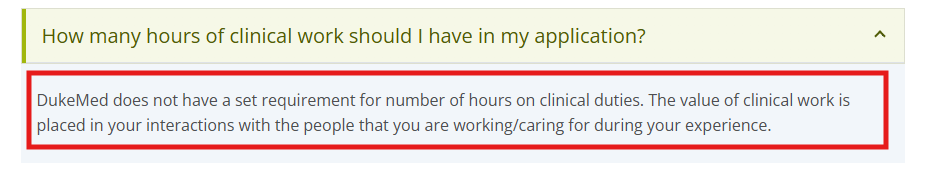
Most applicants list clinical hours. Duke University School of Medicine explicitly tells you not to. The admissions FAQ states that Duke Med does not have a set requirement for the number of hours of clinical experience and that the value of clinical work is placed in your interactions with the people that you are working or caring for.
Translate that into practice. When you describe clinical experiences in your AMCAS activities and secondary essays, lead with a patient. Name what you learned from one specific person, not how many shifts you worked.
If you logged 800 hours of scribing, pick three patients who changed how you think about medicine and write about them. A reader at Duke University School of Medicine will skim past hour counts and look for the moment you understood what patient care actually demands.
The inverse applies, too. If you have fewer hours than your peers but stronger relationships with the patients you did see, Duke University School of Medicine gives you room to make that case.
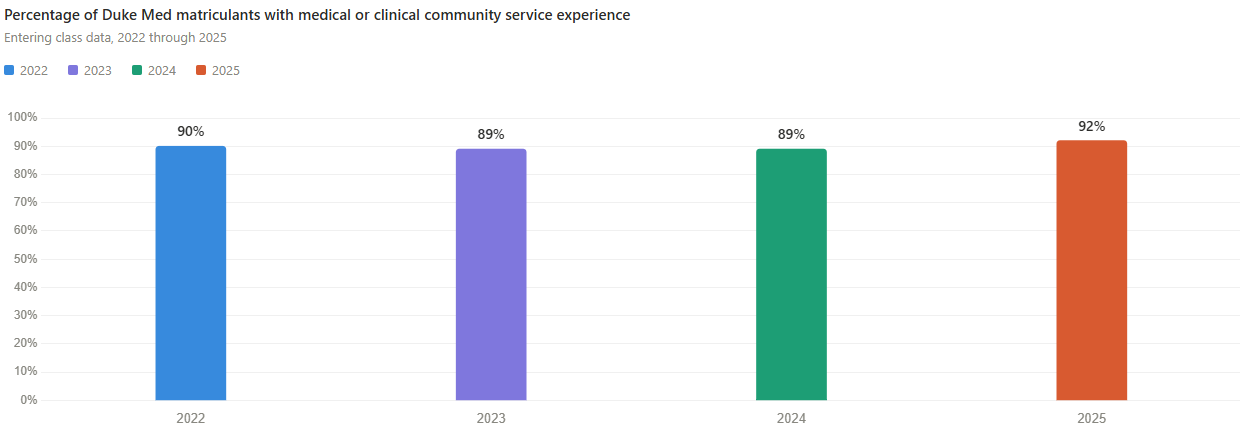
Only 8% of matriculants in the 2025-2026 admissions cycle applied without clinical experience, underscoring how much Duke University School of Medicine prioritizes it.
Other schools weigh hours. Duke University School of Medicine weighs the quality of patient interaction.
Build a Research Track Record You Can Sustain for an Entire Year
Duke Med is the only top medical school that requires a full year of independent scholarly research to graduate. The admissions committee filters out applicants who cannot credibly demonstrate they can handle that year.
The bar is higher than a summer project or a semester in a lab. Duke Med’s third-year researchers often publish, present at national conferences, or produce work that feeds into faculty grants. The admissions committee wants to see that you have already operated at that level, not a promise that you will eventually achieve it.
Take ownership of a defined research experience, not just tasks someone handed you. Follow a project from hypothesis through data collection and analysis. Produce output that exists outside a grade, such as:
A poster
A conference presentation
A manuscript draft
A first-author abstract
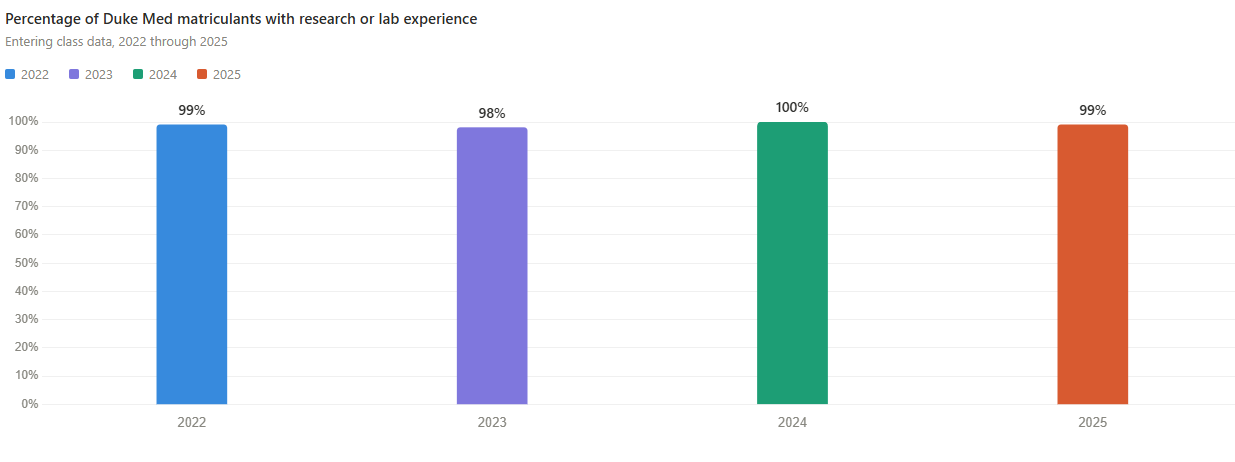
Duke Med applicants with one tangible research deliverable consistently outperform applicants with three years of vague lab hours. In the 2025-2026 admissions cycle, only 1% of matriculants applied with no research experience.
If you’re still developing your research portfolio, delay your application a cycle rather than submitting a weak one. Duke Med admissions reviewers closely review research experience because the third-year requirement makes it a load-bearing component of the entire curriculum.
Prove Your Writing Ability Through Humanities Coursework and Your Essays
Duke Med is one of the few medical schools that names expository writing as an academic expectation.
The admissions page calls for experience in expository writing across the humanities, including but not limited to formal courses in English, a fundamental element in the preparation for medicine.
Applicants who load up on bio, chem, and physics without taking a serious writing-intensive humanities course will look underprepared by Duke Med's own criteria. A single freshman composition class does not satisfy the expectation.
Take at least two upper-division humanities courses with substantial writing components. History, philosophy, literature, or religious studies all qualify. Make sure they appear on your transcript before you apply.
Let your writing carry your secondaries. Duke Med reads over a dozen secondary essays per applicant. And the admissions committee notices a good essay.
Sentence-level quality, argument structure, and economy of language all contribute to a standout essay. Treat the secondaries as writing samples, not checklists.
Watch the video below for expert tips on writing an effective secondary essay:
Structure Your Undergraduate Coursework to Visibly Cross Disciplines
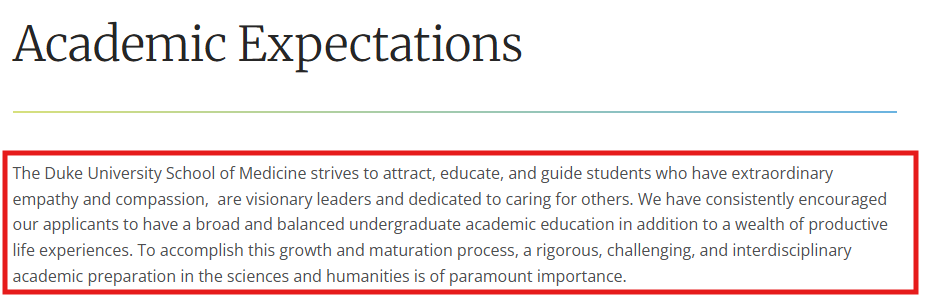
Duke Med uses the words "interdisciplinary" and "cross-disciplinary" across its admissions pages. The school explicitly states it wants a broad and balanced undergraduate academic education in addition to a wealth of productive life experiences. And the curriculum itself runs on cross-disciplinary integration.
A pure biology major with no humanities, social sciences, or quantitative coursework outside bio fits that description poorly. Applicants who look visibly interdisciplinary on paper are read as better matches for Duke Med.
What that looks like in practice is pairing your science prerequisites with real coursework in:
Sociology
Psychology
Statistics
Humanities
Duke Med expects sociology coursework with an emphasis on the social determinants of healthcare and on the application of statistical methods to data analysis. Take those courses intentionally, not as filler.
If you majored in a single science track, use your minor, a second major, or your activities to show your disciplinary range. Undergraduate research that connects medicine and public health, medicine and policy, or medicine and the humanities signals exactly what Duke University School of Medicine's curriculum rewards.
An applicant with a bioethics minor or a substantive social science research project has a better application narrative than a 4.00 GPA biochem major with little interdisciplinary experience.
Anchor Your Personal Statement Around a Moment You Were Out of Your Element
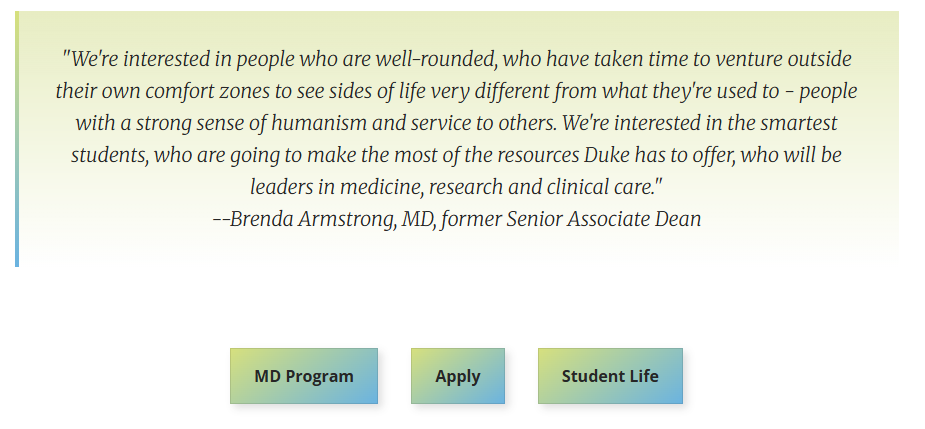
Duke University School of Medicine seeks people who are well-rounded, who have taken time to venture outside their comfort zones to experience sides of life very different from what they're used to, and who have a strong sense of humanism and a commitment to service to others. This is your basis for writing your AMCAS personal statement.
Most applicants write about:
The top research lab
The selective summer program
The high-profile volunteer role
Duke Med asks for the opposite.
The admissions committee wants the moment you were out of your element, culturally unfamiliar with your surroundings, or working with people whose lives you did not understand before you showed up.
Pick one experience where you started out of your element; then build the essay around where you ended up. Start with what you did not know. Move through what surprised you. End with how your thinking changed. Your narrative should focus on growth, not polish.
Personal statements anchored in discomfort also work harder across your entire application list. Top programs read thousands of achievement-focused narratives. At Duke University School of Medicine, a stronger opening is one that shows growth, reflection, and increasing insight into medicine, rather than simply listing accomplishments.
Our experienced advisors can help you submit a compelling Duke Med application. Work with an expert to refine your personal statement, prepare for interviews, and stand out among thousands of applicants.
Duke University School of Medicine's distinctive MD program, structured as one year of basic sciences, one year of clerkships, one year of independent research, and one year of clinical electives
Medical Scientist Training Program (MSTP)
A combined MD/PhD program that trains students as physician-scientists, with continuous NIH funding for nearly 50 years
Clinical Leadership (MHS)
Graduate program for clinicians building leadership and management skills for healthcare systems
Doctor of Physical Therapy (DPT) Program
Clinical doctorate program for students preparing to practice physical therapy
Occupational Therapy Doctorate (OTD)
Clinical doctorate program for students preparing to practice occupational therapy
Physician Assistant Program (MHS, PA)
Nationally top-ranked PA program for students preparing to practice advanced medicine alongside licensed physicians
Master of Biomedical Sciences (MBS)
Graduate program designed to strengthen academic preparation for students pursuing health professions careers
Pathologists' Assistant Training Program (MHS)
Graduate program preparing students to work alongside pathologists in surgical and autopsy pathology
Tuition and Scholarships
Duke Med costs $72,297 in tuition for first-year medical students. When factoring in additional direct and indirect costs, the total cost of attendance is $110,892.
How Much Does Duke Med Cost for 4 Years?
It costs approximately $434,049 across the full four years of the MD program at Duke Med. These numbers can fluctuate every year.
This breaks down as:
Year 1: $110,892
Year 2: $110,619
Year 3: $110,929
Year 4: $101,609
Scholarships
Duke Med automatically considers every admitted applicant for merit scholarships. No separate application, no extra essays. All merit scholarship awards are administered through the Duke School of Medicine Office of Admission, and merit scholarships are awarded during the first year for a total of four years.
Need-based grants run on a separate track. Applying requires the CSS Profile and parent financial documentation.
Duke University School of Medicine Application Timeline
Duke University School of Medicine runs on a standard AMCAS cycle but does not use rolling admissions. The admissions committee notifies applicants of decisions in mid to late February, regardless of when you submit, so early submission helps your interview chances but does not increase your acceptance odds.
AMCAS transmits verified applications to Duke University School of Medicine
July through October 15
Duke University School of Medicine receives verified AMCAS applications
October 15 (11:59 PM EST)
Hard deadline to submit your AMCAS primary application to Duke University School of Medicine
Mid-August
Duke University School of Medicine sends secondary application invitations
November 15 (11:59 PM EST)
Duke University School of Medicine secondary application deadline
Late August through early January
Interview invitations sent on a rolling basis
September through February
Virtual MMI interview season
February
Final admissions decisions released; accepted applicants receive personal calls
Late March
Revisit Weekend for accepted applicants
May 1
"Plan to Enroll" deadline in AMCAS; non-refundable tuition deposit due by 11:59 PM EST
June 15
"Commit to Enroll" deadline; accepted applicants must withdraw all other offers
FAQs: Getting Accepted to Duke Med
How Many Letters of Recommendation Does Duke University School of Medicine Require?
Duke University School of Medicine requires a minimum of four letters of recommendation and accepts up to eight. A committee letter from your undergraduate institution satisfies the four-letter rule on its own. Letters must come on official letterhead, dated and signed, and should focus on your experiences and character rather than restate grades or coursework. All letters are due by November 15.
Does Duke University School of Medicine Require Physician Shadowing?
No, physician shadowing experience is not required at Duke University School of Medicine. There is also no minimum clinical hour requirement, and it does not treat shadowing as a separate admissions category. However, most admitted applicants still provide some direct clinical exposure through scribing, volunteering, or patient-facing research. The quality of patient interaction matters more than the specific hours of clinical experience.
How Old Can My MCAT Score Be When I Apply to Duke University School of Medicine?
Your MCAT scores must be no older than four years when you apply to Duke University School of Medicine. The minimum required score is 500, though the median matriculant scores 520. Plan to take or retake the MCAT by mid-September of your application year so your score reaches AMCAS in time for review.
Does Duke University School of Medicine Require the Casper or AAMC PREview Exams?
No, Duke University School of Medicine does not require the Casper or AAMC PREview examinations for admission consideration. Your application relies on AMCAS materials, the Duke University School of Medicine secondary, letters of recommendation, and the MMI for those invited to interview.
Does Duke University School of Medicine Consider DACA and International Applicants?
Yes, Duke University School of Medicine considers DACA, undocumented, and international applicants for the MD program. DACA students may qualify for institutional financial aid based on financial need. International applicants are eligible for a separate need-based grant program, though funding depends on the number of applications and available resources each year. Applicants whose undergraduate degree comes from a non-U.S. institution must complete at least two years (48 credit hours) at a U.S.-accredited university before applying. The MD/PhD program does not consider international applicants.
Does Duke University School of Medicine Offer Early Decision?
No, Duke University School of Medicine does not have an early decision program. All applicants apply through the standard AMCAS cycle, and final decisions are released together in late February, regardless of when you submitted. Submitting early helps your interview chances because interview invitations go out in waves from late August through early January, but it does not increase your odds of matriculation.
Arush Chandna is the Co-Founder of Inspira Advantage and a nationally recognized expert on graduate school admissions. Arush has used his 12+ years of experience in higher education to help 10,000+ applicants get into their dream graduate programs.







.svg)


