Get in touch: +1 888 453 5021





I've run an admissions consulting company long enough to know that most students don't start looking for help until they're already behind. They get their MCAT score back, realize the timeline is tighter than they thought, and start Googling for an admissions consultant the same week their secondaries are due. By that point, they're not choosing the best consultant for them. They're grabbing the first one they find.
That's a problem, because this industry has almost no barrier to entry. Anyone can call themselves an admissions consultant, build a website, and start charging $5,000 for extremely vague and unhelpful advice. I've seen students come to us after spending thousands on another consultant who never reviewed a single secondary essay or helped them build a school list based on actual Medical School Admission Requirements (MSAR) data.
According to the Association of American Medical Colleges (AAMC), roughly 57.15% of applicants in the 2025-2026 admissions cycle were not accepted. The stakes are way too high to hire the wrong person. A strong consultant changes your entire outcome. A bad one takes your money and gives you the same generic advice you could’ve gotten from ChatGPT.
I’ve come up with 12 questions you can ask each medical school admissions consulting company before deciding to work with them. You’re already stressed about your application. The last thing you need is added stress about whether a consulting company is legit.
Since nearly 60% of medical school applicants aren’t admitted, you should work with an admissions consultant who can demonstrate their credentials and expertise.
A strong track record of reviewing real applications, conducting interviews, or serving on admissions committees means they know how decisions are made, not just how to edit resumes.
When searching for the right consultant, ask whether they can provide specific results, such as how many applicants they’ve supported and where those students were admitted. You should also pay attention to whether the consultant asks about your background first. A consultant who starts giving you advice before understanding your goals probably won’t get you accepted to medical school.
If a consultant avoids discussing their past work or keeps their experience vague, that’s a sign they might not have the insight needed to help you refine your personal statement, edit your secondary essays, and prepare for interviews.
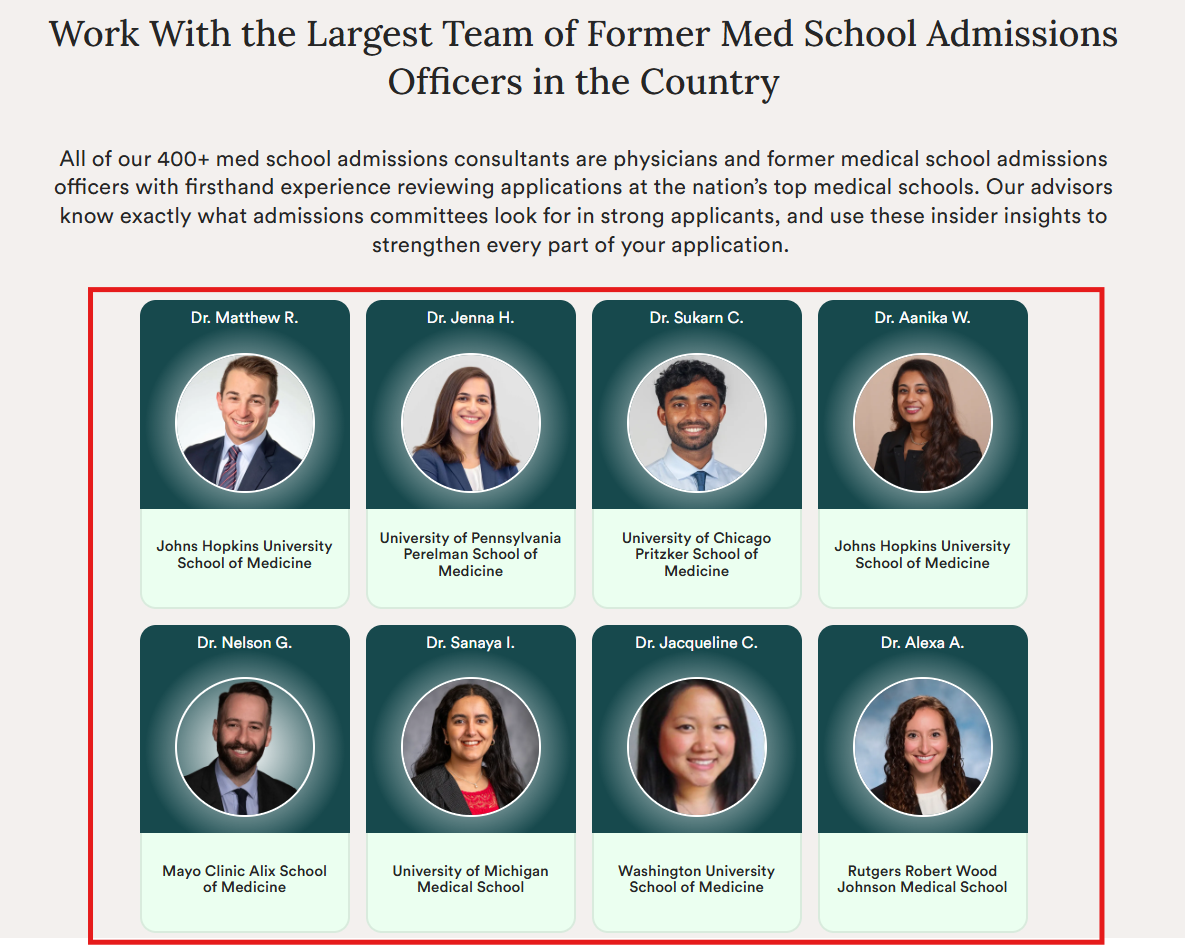
Inspira Advantage has the nation's largest team of former admissions officers and physicians from top medical schools, including Johns Hopkins University School of Medicine, the University of Chicago Pritzker School of Medicine, and New York University Grossman School of Medicine, as evidenced by the picture below.
With 20+ years of experience, Inspira Advantage has helped over 10,000 students get accepted to MD programs nationwide.
For example, Dr. Matthew Rabinowitz, an experienced consultant at Inspira Advantage, has over seven years of mentoring and admissions experience, including serving on the Johns Hopkins School of Medicine admissions committee as a voting member and interviewer, and was personally trained by the admissions dean.
Inspira Advantage’s expert consultants have been involved in real admissions decisions and can provide strategies and insight to build competitive, school-specific applications.
Results matter, and a consultant’s success rate says more than any marketing material ever could. Before you trust someone to shape your application, you should know how many of their students actually got accepted and to which medical schools.
A strong admissions consultant can speak confidently about their acceptance rates, how they define success, and the specific medical schools they’ve helped students gain admission to.
However, when you ask for a medical consultant’s success rate, you’re not just looking for the highest number possible. You want context. For example:
A consultant who shares detailed results, backed by reviews and testimonials, is much more credible than one who relies on vague claims or personal anecdotes.
A lack of clear data, few verified reviews, or vague answers like “most of my students do well” are big warning signs. If they can’t show results, there may not be many to report.

Inspira Advantage has years of experience helping students get accepted to top MD programs, with a 98% success rate that’s been independently verified by Vault, as evidenced by detailed written reviews, video testimonials, and real acceptance letters from previous applicants.
You should know exactly what’s included in your admissions support package before committing to purchasing it. That means understanding:
If the consultant avoids specifics or bundles everything into vague advising time, that’s a sign the service may not be reliable.
Clarity with pricing is critical. Without clarity, you risk paying for far less than you expected, or worse, scrambling at the most important stage of your application cycle.
A high price tag can be justified if it covers unlimited essay edits, school list development, application strategy, interview prep, and ongoing communication. Some medical school consulting packages charge thousands but either limit the number of meetings or provide only an overview of the feedback.
Inspira Advantage offers:
This is all clearly outlined in our comprehensive programs, depicted below.
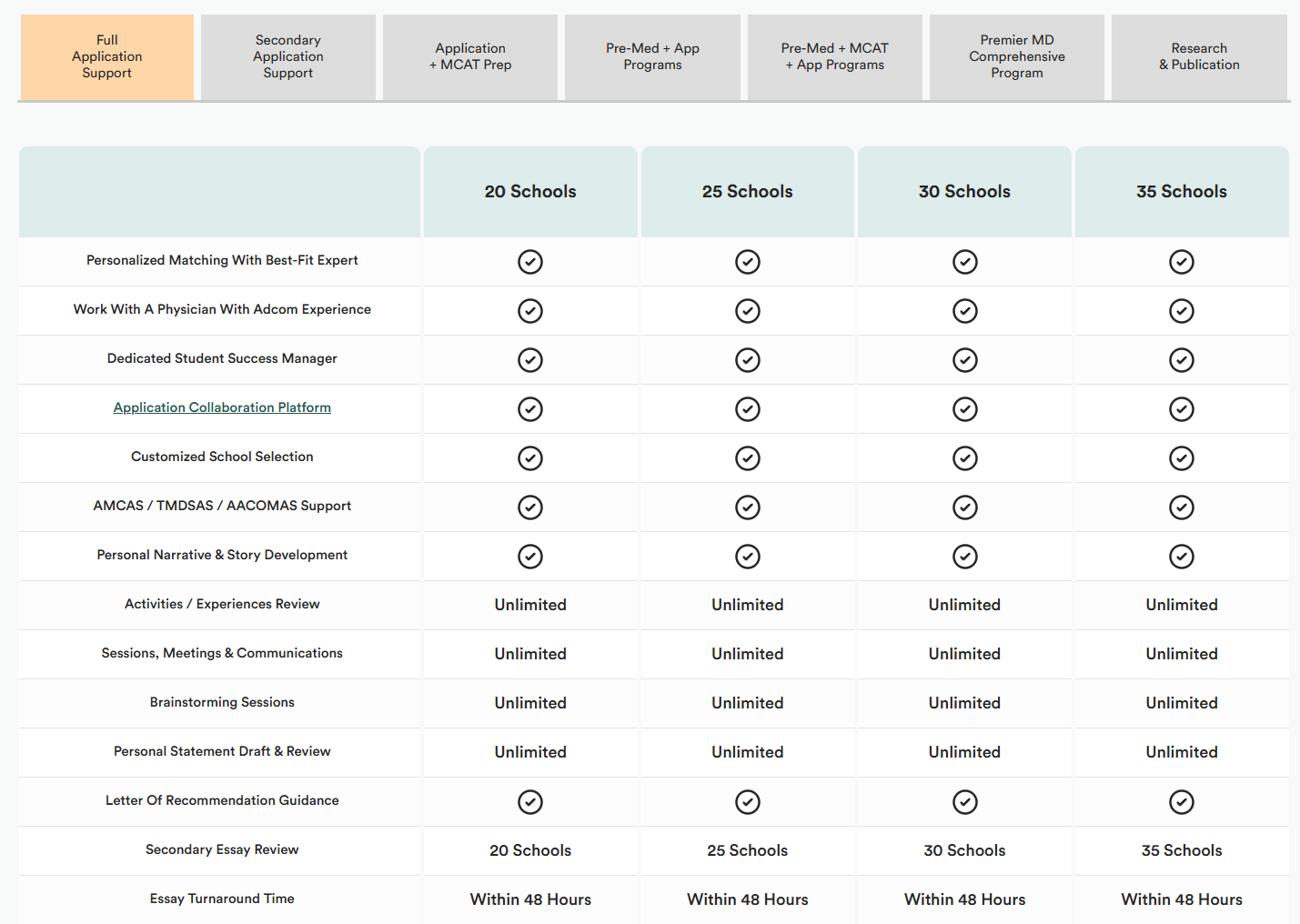
Every program at Inspira Advantage includes direct access to a physician or a former admissions officer, ensuring you receive comprehensive support at every stage.
Additionally, Inspira Advantage offers all applicants a free MCAT practice test, over 100 on-demand webinars, 26 downloadable guides, 25 cheat sheets, and over 34 med school resources for free.
You need to understand exactly how much support a consultant will provide. Based on our experience advising over 10,000 applicants, the typical med school applicant invests between 500 and 800 hours across the full cycle, from MCAT preparation through final decision day.
Between the primary application, secondaries for each school, letters of recommendation, activity descriptions, personal statements, and interviews, much of your application relies on consistency and clarity. A good consultant should be able to support you through the entire process.
Here’s a complete breakdown of the entire med school application timeline:
When looking for the right consultant, ask whether their support covers everything from personal statements and secondary essays to interview prep and school list strategy.
If the admissions consultant can only help with essays or charges a separate fee for interviews, that’s a sign their support may not be as reliable, and you’ll have to prepare on your own during a critical stage in the application process.
Inspira Advantage provides start-to-finish support across every stage of the application process. Each consultant works with applicants to support their school list creation, AMCAS/TMDSAS/AACOMAS applications, personal statements, activity descriptions, secondary essays, and interview prep.
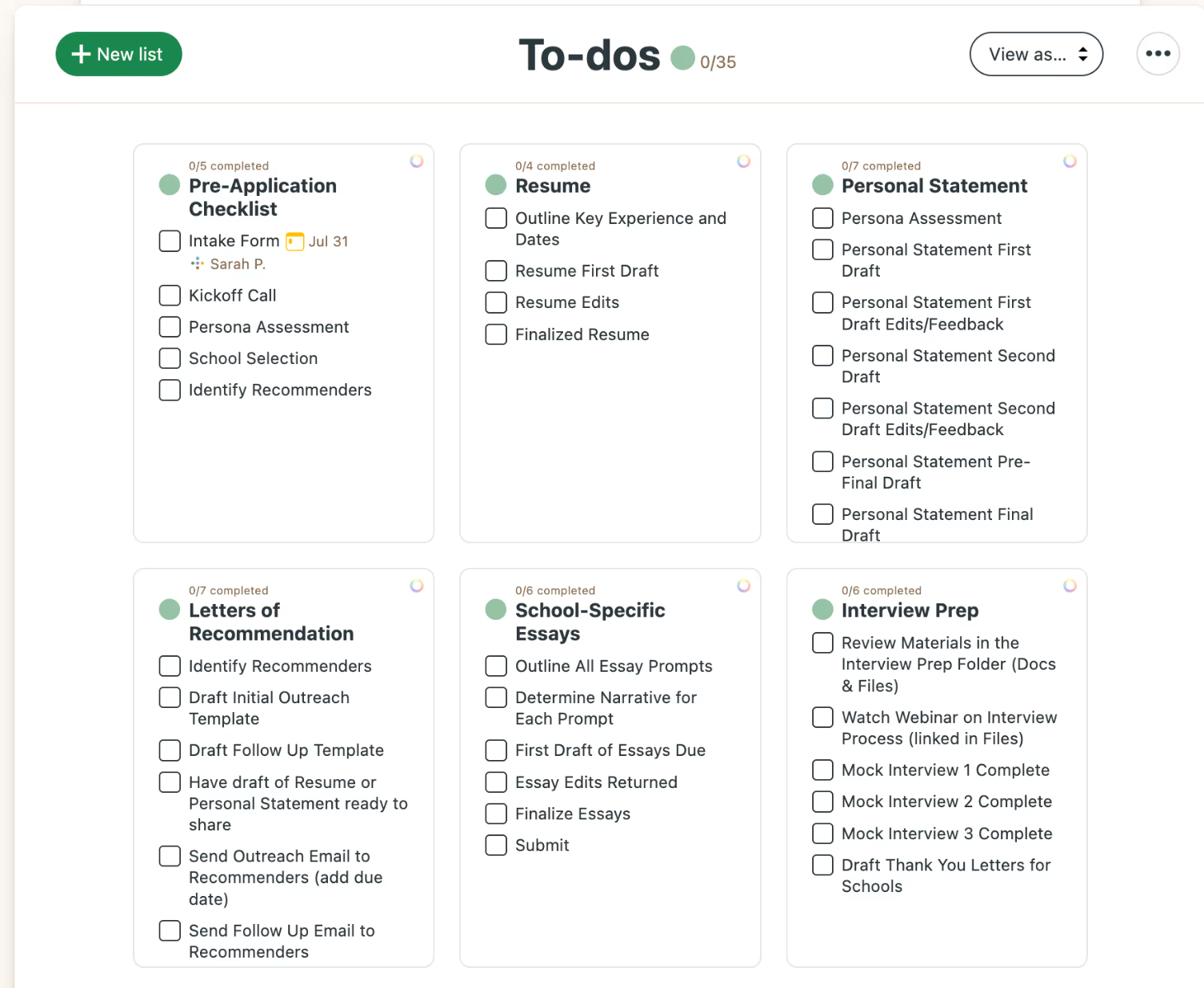
With unlimited advising and essay reviews in every package, students receive consistent support from the first draft to the final decision.
Some consulting companies use a model where a senior advisor handles the initial sales call, but once you sign up, a less experienced team member manages your application. You should know exactly who will review your essays, run your mock interviews, and answer your most pressing questions.
Ask whether you'll have one dedicated consultant or rotate between multiple advisors. Find out their background, how many students they're currently working with, and whether you'll have direct access to them outside of scheduled meetings.
A consultant who’s trying to manage too many students during peak season will miss nuances in your application and slow down your turnaround times. A company that limits caseloads protects the quality of support each student receives.
Inspira Advantage matches every student with a dedicated counselor within two business days and assigns a student success manager to handle logistics, scheduling, and communication. The match takes into account your weekly availability, time zone, target school list, working style, and individual goals.
Inspira consultants work with only three to five students at a time. Most large firms have counselors working with 12-60 students at a time. Our 3:1 to 5:1 ratio means your consultant has the bandwidth to learn your application inside and out.
Once matched, your consultant will reach out to schedule your first call. You'll also get login credentials for AdvantageOS, Inspira's planning platform for students, parents, and counselors. The dashboard lets you message your consultant, track your personalized admissions timeline, and stay on pace through every stage of the application.
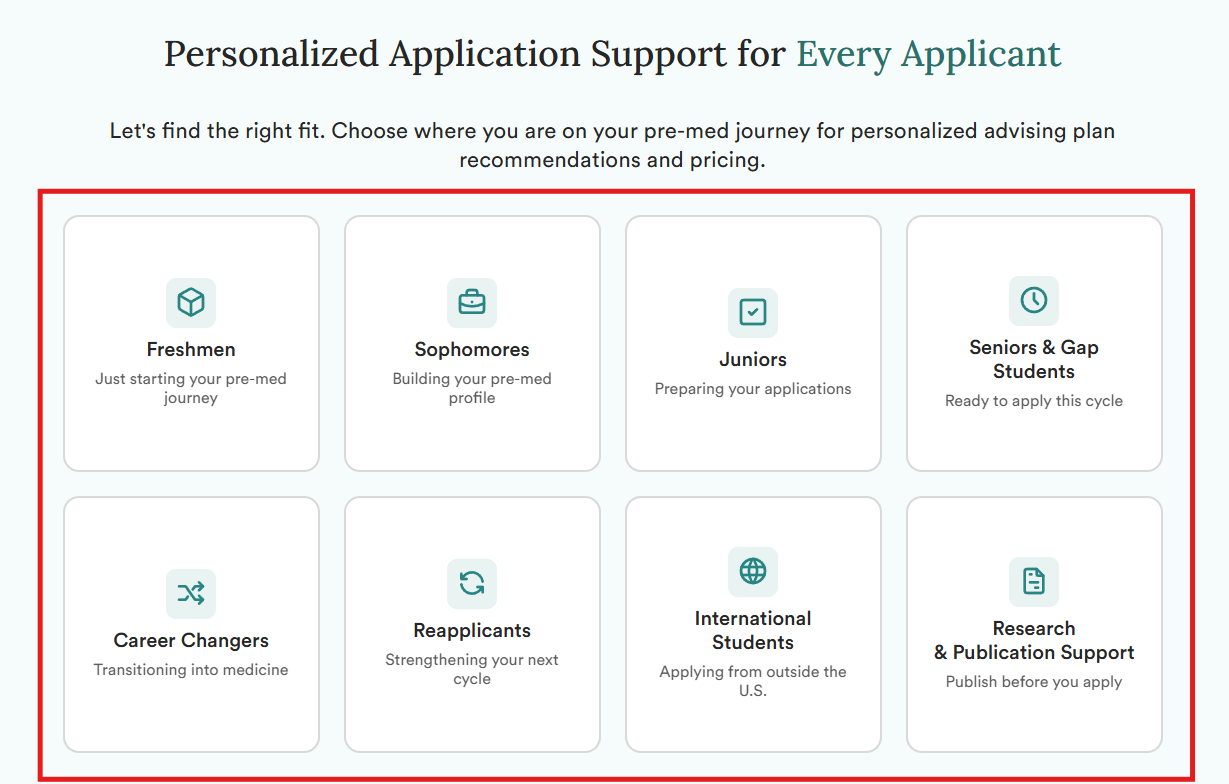
We work with you, no matter the type of applicant you are, as evidenced in the screenshot below.
We also offer a video series featuring each consultant so you can get to know them before you start working with them. If someone stands out and you want to work with them, let your Enrolment Manager know.
The 2026-2027 American Medical College Application Service (AMCAS) cycle application opened on May 5, 2026, with the first submission date on May 28. Schools began receiving verified applications on June 26 and will stop accepting them between September and January, depending on the program. Most competitive applicants aim to submit within the first week of the submission window to clear the verification queue before peak season.
That’s why you need to start preparing months in advance with a counselor who can guide your strategy and keep you on track. Even the strongest applicant might not get accepted due to missed deadlines, slow feedback, or delayed edits. Ask whether the consultant’s schedule aligns with your timeline and whether they’re available to support you throughout the entire six-month period.
You should look for fast turnaround times on essay reviews, clear expectations for response times, and a structured plan that maps out what needs to happen week by week. Consultants should be transparent about how many students they’re working with and how they prioritize your goals during peak season.
If consultants are vague about availability or slow to respond before you’ve even purchased a package, expect multiple delays once the actual application process begins.
Inspira Advantage prioritizes getting students accepted in the current cycle. Our packages include unlimited advising and a guaranteed 48-hour turnaround time for essays and other written materials. Each student has a dedicated student success manager and is matched with a dedicated counselor within two business days.
Not every consulting company offers an acceptance guarantee, but in this competitive landscape, a guarantee is extremely valuable.
Since only 42.85% of applicants were admitted to a medical school in the 2025-2026 admissions cycle, competition is extremely high. You want transparency in the right medical admissions consultant.
A legitimate promise of acceptance should be tied to your participation and academic profile. However, consultants who offer to “get you into med school no matter what” are likely more interested in making a sale than helping you get into your dream program.
Inspira Advantage offers a promise of acceptance for students enrolled in the 35 Schools premium package, provided they meet all eligibility requirements.
For example, students applying to MD schools need to achieve a minimum GPA of 3.40 and an MCAT score of 502 to qualify for our acceptance guarantee, as shown in the screenshot below.

Students enrolled in the 35 Schools premium plan who meet all eligibility requirements and follow their counselor's guidance throughout the process, but still don't receive an acceptance, can qualify for one additional cycle of primary application support at no extra cost. We’ll rework their personal statement, activities section, and provide expert advising for the next cycle.
Not every consultant is the right fit for every applicant. Your academic background, personal story, and goals all influence how your application should be built. That’s why it’s important to work with someone who has supported students like you.
If you’re a non-traditional applicant or you have a low GPA or MCAT score, it’s important to know that the consultant has the expertise to help you get accepted.
Here are four written reviews from students who used our services and got into a medical school, despite their background:
A good consultant will start by asking questions about your academic history, strengths, weaknesses, and career goals before offering any advice. More importantly, they should be able to describe how they’ve helped students in similar situations craft competitive applications and overcome obstacles.
Consultants who give you generic advice or can’t provide specific examples of how they’ve supported students with comparable challenges likely won't help you get accepted to med school.
Inspira Advantage has supported thousands of students from diverse academic and personal backgrounds. Each consultant has several years of experience working with traditional and non-traditional applicants, career changers, international students, and reapplicants.
The videos below show four examples of how Inspira Advantage helped students with varying backgrounds get into medical school.
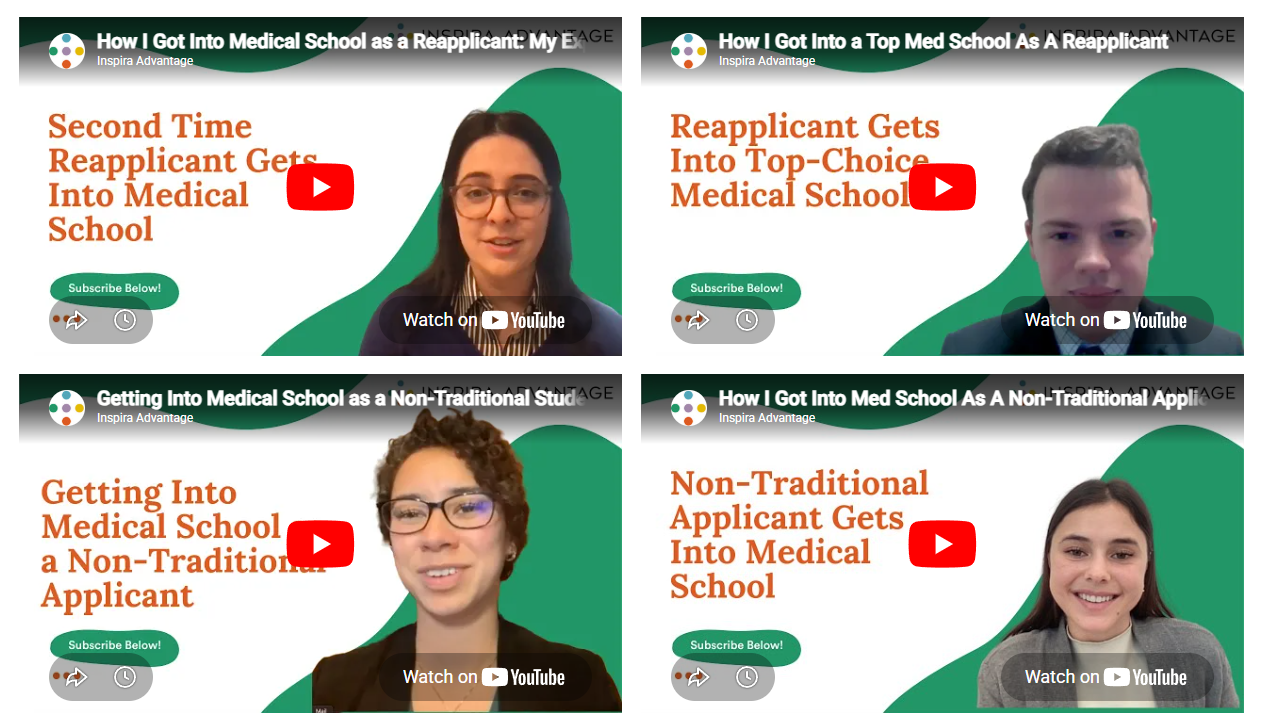
Ask how and how often you'll communicate with your consultant before you commit to any plan. The way a consultant gives feedback and manages communication during the cycle will affect your entire experience.
Find out whether they provide written feedback on essays or verbal notes over a call. Ask how quickly they respond to messages during peak secondary season when turnaround time matters most. Some consultants offer weekly check-ins while others work on an ad hoc basis. Neither approach is inherently better, but you need to know which one you're getting so you can plan around it.
Pay attention to their responsiveness during the sales process itself. A consultant who takes four days to reply before you've paid will take longer once they have your money and a full roster of students. You should also ask how they handle urgent situations, like a surprise secondary with a 48-hour deadline or a last-minute interview invitation.
Inspira Advantage provides every student with direct access to a dedicated counselor and a student success manager who handles scheduling and logistics. All written materials receive feedback within a guaranteed 48-hour turnaround window, and students can communicate with their team through the AdvantageOS platform around the clock.

Good admissions counselors should have a strategy to personalize application support for every student. However, personalization means more than just changing a name on a template. Personalization is about asking the right questions, identifying standout qualities, and building a tailored strategy that aligns with specific school values and expectations.
A strong consultant will take the time to understand your background in detail before offering guidance. Consultants should help you develop a cohesive story across your primary application, secondary essays, and interviews, using your goals and lived experiences as the foundation.
Be cautious if a company's process sounds generic, overly scripted, or too reliant on templates. If you're getting the same advice everyone else gets, your application won't stand out to med school admissions officers.
Personalized attention is exactly what drew Mackenzie to Inspira Advantage before she gained admission to the University of Tennessee Health Science Center College of Medicine:
In the video, Mackenzie explains what led her to choose Inspira Advantage over any other consulting firm.
“I chose Inspira because they offered more personalized attention and each of the counselors only had a limited number of students, so I knew that I was going to get the care and attention I needed in order to be able to get into med school,” she says.
Our expert counselors begin by assessing each applicant’s academic profile, experiences, goals, and challenges, and then build a personalized timeline and strategy based on it. Every element, from personal statement editing to school-specific interview prep, is grounded in who the student is when they’re applying to their dream med school.
Dr. Rahul Bhansali, an Inspira Advantage consultant and current hematology-oncology fellow at the University of Pennsylvania, recently shared how he approaches this level of personalization.
“I really want to get to know the candidate outside of the typical med school candidacy materials,” he explained. “Being able to make those stories come out in an application is invaluable.”
Take a look at the video below to see how Dr. Bhansali approaches personalization in his consulting sessions:
In the video, Dr. Bhansali highlights that his approach centers on communication and adaptability.
“Application materials, prepping for interviews, deciding on schools — these are major decisions,” he says. “It’s helpful to have someone coaching you through that.”
At Inspira Advantage, all applicants receive this tailored support. This ensures that every applicant's authentic voice resonates with admissions officers even after the application gets submitted.
Having a balanced school list is one of the most important strategies in your entire application process. Apply to the wrong mix of schools and even a strong application won't generate enough interviews. A consultant who tells you to "apply broadly" without explaining their methodology for selecting schools isn't offering an expert-level strategy.
Ask how the consultant uses data to build a school list. Strong consultants cross-reference your GPA, MCAT score, state residency, research experience, and clinical hours against program-specific data from the MSAR database. They should also factor in each school's mission, class composition, and historical openness to applicants like you.
A good school list balances different programs that you’re competitive at while accounting for geographic preferences and financial considerations. If a consultant hands you a list of 25 schools without walking you through why each one is there, that list probably wasn't built for you.
Inspira Advantage builds every school list using MSAR data, program-specific admissions trends, and each student's academic and extracurricular profile. Consultants walk applicants through the rationale for each school on the list and adjust the list as the cycle progresses based on secondary invitations and interview activity.
The way each med school evaluates secondaries and interprets an applicant’s fit can differ significantly. That’s why it’s important to work with a consultant who understands the specific values and expectations of the schools on your list.
A strong consultant won’t just review your essays for grammar. They’ll help tailor each secondary essay response to reflect the tone, mission, and focus of the individual medical school. Consultants should also explain how different programs approach interviews, such as Multiple Mini Interviews (MMI), panel interviews, or Modified Personal Interviews (MPI), and help you prepare accordingly.
If the consultant’s advice sounds generic, that’s a red flag. If you can swap the name of the program with another program in your essay or interview responses, you likely won’t stand out in the admissions process.
With firsthand knowledge of what different programs look for, each consultant guides students in crafting secondaries and interview responses that reflect each school's specific values and priorities. This targeted approach helps applicants show not just why they want to go to med school, but why they belong at that med school.
Choosing a med school consultant isn’t a decision to take lightly. With thousands of dollars and your future on the line, you need more than vague promises and affordable prices. You need transparency, proven results, and personalized support that reflects the complexity of this process. Find an admissions advisor with Inspira Advantage to help you get into your dream program.
The right consultant will not only strengthen your application, but they’ll help you see your own story more clearly and tell it in a way that admissions committees won’t forget.
Book a free consultation with a member of our team today to learn how we can help you get accepted to medical school on your first try.


.svg)


