All of the identifying details in this case study have been modified to protect the student’s privacy.
Maya came to us with the kind of academic profile every med school applicant dreams of having. She had a perfect GPA, a 520 MCAT score, and hundreds of hours of research experience. But she had some weaknesses in the rest of her application that would have hurt her admission chances.
But Inspira Advantage turned her perceived weaknesses into strengths and helped her strategically present her experiences and motivations in a way that gave admissions committees a fuller picture of who she was beyond her numbers, and she got accepted to two of her top Chicago choices.
Challenges Maya Faced
Maya’s problem clearly wasn’t her academics. Her problem was that her extracurricular profile wasn’t quite as impressive. She had no physician shadowing experience and very limited community service experience. That latter stuck out to us more because the majority of the schools she wanted to join, like Pritzker and UIC Med, placed heavy emphasis on community service, health equity, and working with underserved patients.
Maya also set one more limitation that added to the complexity of her application. She was determined to join a Chicago medical school only, leaving no room for error in her school list or application strategy.
And there was one final challenge: time.
Maya came to us in early May hoping to submit her primary application before the end of the month. We had only a few weeks to ensure she submitted a strong application to the most competitive med schools in Chicago and two more weeks after that to ensure she wrote strong secondaries.
Here’s a closer look at a full diagnostic assessment of Maya’s profile:
Applicant Profile Diagnostic
Maya
Near-perfect academics. Chicago or nothing. Three weeks to submit.
Click each factor to explore
🎓
GPA — 4.0
Perfect academic record
Strong▼
3.00Average matriculant: ~3.774.00
4.0
Nothing to fix here. A 4.0 clears every Chicago program's academic bar — which means her GPA can't do any more work for her. Every remaining point of differentiation has to come from somewhere else.
📊
MCAT Score — 520
~98th percentile
Strong▼
472Average matriculant: ~511.9528
520
A 520 sits above the median at every medical school in the country, including the most selective Chicago programs. Screening isn't the risk. Getting screened in and then falling flat on mission fit is.
🔬
Research — Hundreds of Hours
Deep, sustained involvement
Strong▼
Substantial research hours signal follow-through and intellectual commitment — a real asset at research-heavy institutions. But research is the one extracurricular box Maya already checked, and it doesn't answer the questions Chicago's mission-driven programs are actually asking.
🩺
Physician Shadowing — None
Zero hours logged
Red Flag▼
0
Maya's shadowing hours
vs
40+
Typical competitive applicant
Shadowing is how applicants prove they've seen the job before choosing it. With none, Maya had no evidence she understood the day-to-day reality of practicing medicine — a gap that lands harder next to a flawless transcript.
🤝
Community Service — Very Limited
Direct conflict with her target schools
Biggest Risk▼
✗ Community service
✗ Health equity work
✗ Underserved patient care
This was the flag that mattered most. Pritzker and UIC weight community service, health equity, and work with underserved patients heavily — and those were Maya's top choices. A 4.0 and a 520 don't substitute for mission alignment at schools that screen for it explicitly.
📍
School List — Chicago Only
No geographic flexibility
Constraint▼
Pritzker
Feinberg
UIC
Rush
Loyola Stritch
Chicago Medical School
Maya's entire universe of options — several among the most competitive in the country.
Most applicants offset selectivity with volume across regions. Maya couldn't. A city-locked list means every single application had to convert, and one weak school-fit essay had nowhere to hide.
⏳
Timeline — Under Four Weeks
Arrived early May, targeting end-of-May submission
Red Flag▼
Early May — Maya arrives
End of May — submit
Personal statement, activities section, school list, and a mission-fit strategy — all inside a few weeks. The compressed window removed the usual fallback of building experience before applying. Whatever Maya had was what she was applying with.
Maya vs. the typical competitive applicant
GPA
4.0
MCAT Score
520
Research Hours
Strong
Shadowing
None
Community Service
Limited
Mission Fit
At risk
List Flexibility
Locked
Time to Submit
3 weeks
Competitive
Needs framing
Gap / risk
What admissions committees would ask
"Has Maya ever actually watched a doctor work?"
No shadowing hours means no proof — and a perfect transcript only sharpens the question.
"Why our school, when our mission is community and equity?"
Pritzker and UIC screen for exactly what Maya's application was thinnest on.
"What happens if Chicago says no?"
Nothing. There was no second region, no wider list, and no time to build one.
The stats were never the problem.
A 4.0 and a 520 got Maya read — but a city-locked list and a mission gap at her top choices meant the application had to do all its work in three weeks.
Five Drafts Turned Her AMCAS Activities from Resume Rehash to Clear Evidence of Commitment
Maya’s AMCAS activities sections needed the most work. Her first draft read more like a resume, focusing solely on what she did in each role instead of showing why the experience actually mattered or how it prepared her for medical school.
Her counselor worked through five rounds of her activities section.
Research Experience Activities
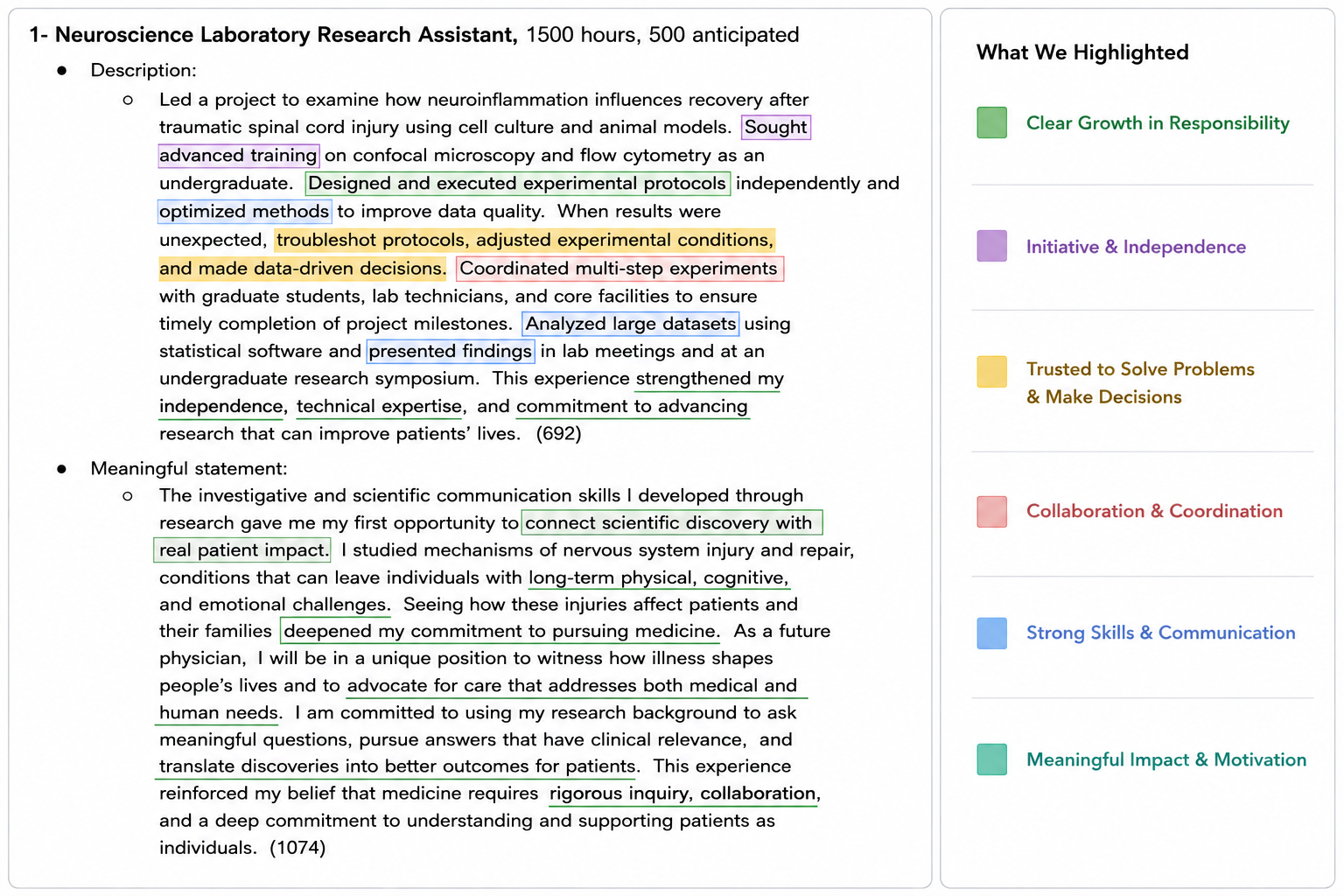
For her research experience, we focused less on listing laboratory techniques and more on the independent thinking she developed through the experience. Maya’s responsibility clearly grew through her impressive 1,500 hours of research, and we wanted to highlight that first and foremost.
Instead of writing that she “assisted with research” or listing the methods she used, we highlighted that she took ownership of a study, sought out advanced training, troubleshot protocols, made decisions when experiments produced unexpected results, and coordinated multi-step work with other researchers and facilities.
Those important details showed that she was trusted to work independently and make meaningful contributions to the project.
That level of responsibility helped her research stand out from applicants who may have had a similar number of hours but much less ownership over the work. Most of those details weren’t coming through clearly in the earlier version, so we made them the focus of the final entry.
By the end, her activity description was perfectly polished and looked like this:
Clinical Experience Activities
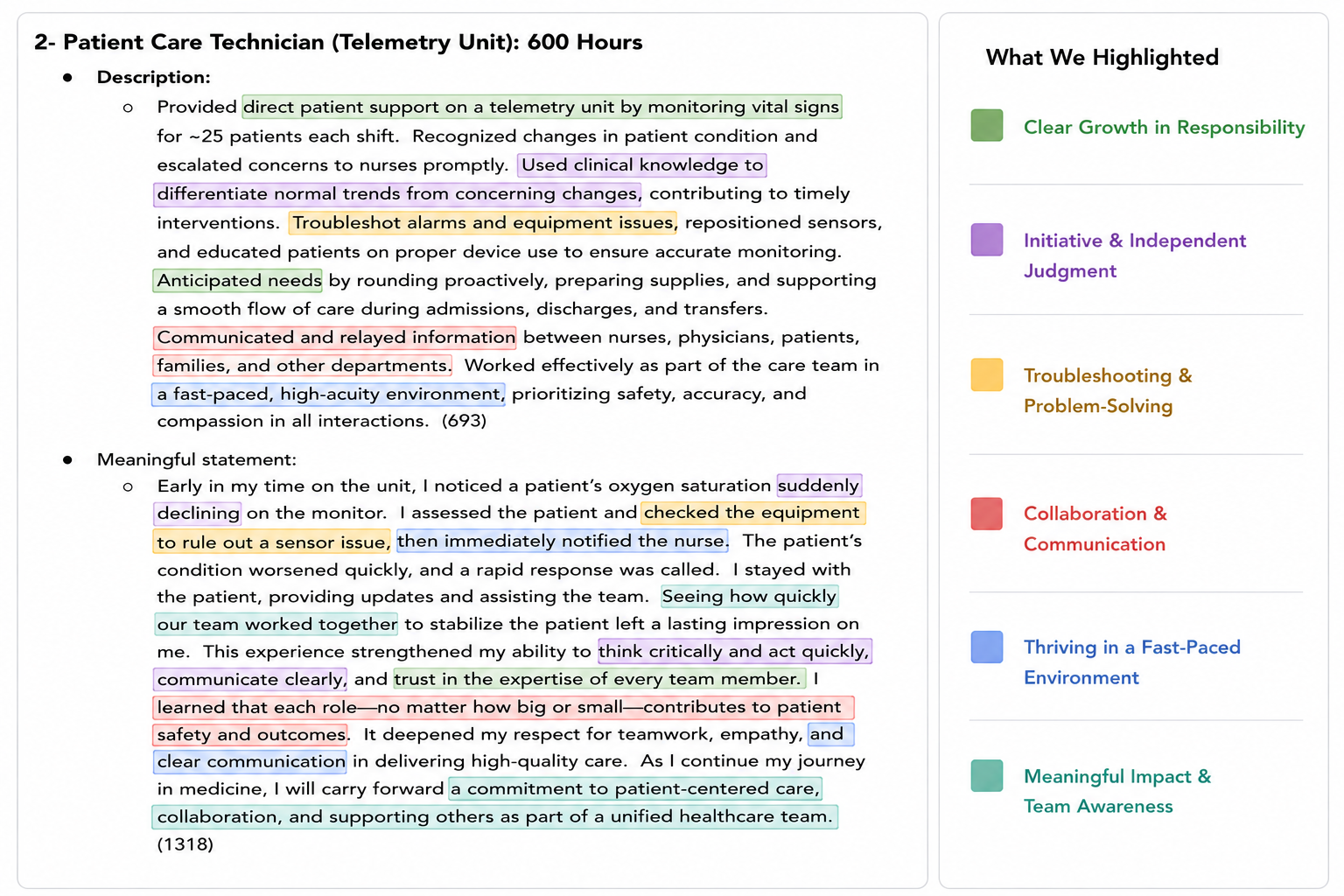
Her clinical work needed a different approach. Maya already had more than 600 hours as a patient care technician, but simply saying she monitored vital signs wouldn’t impress the highly selective admissions committees at the schools she applied to.
So, instead of just listing her responsibilities, we worked with her to include specific patient stories that showed her excellent judgment. She included a moment when she noticed a patient’s oxygen rate rapidly dropping, ruled out an equipment issue, and quickly told the care team just before the patient coded.
That example showed her ability to think under pressure, communicate quickly, and understand how her role fit into a larger clinical team. There’s a clear throughline there for admissions committees to see the potential she already has to be a great healthcare provider and her own self-awareness to know to rely on the other people on her team.
Here’s what her final draft looked like:
Community Service Activities
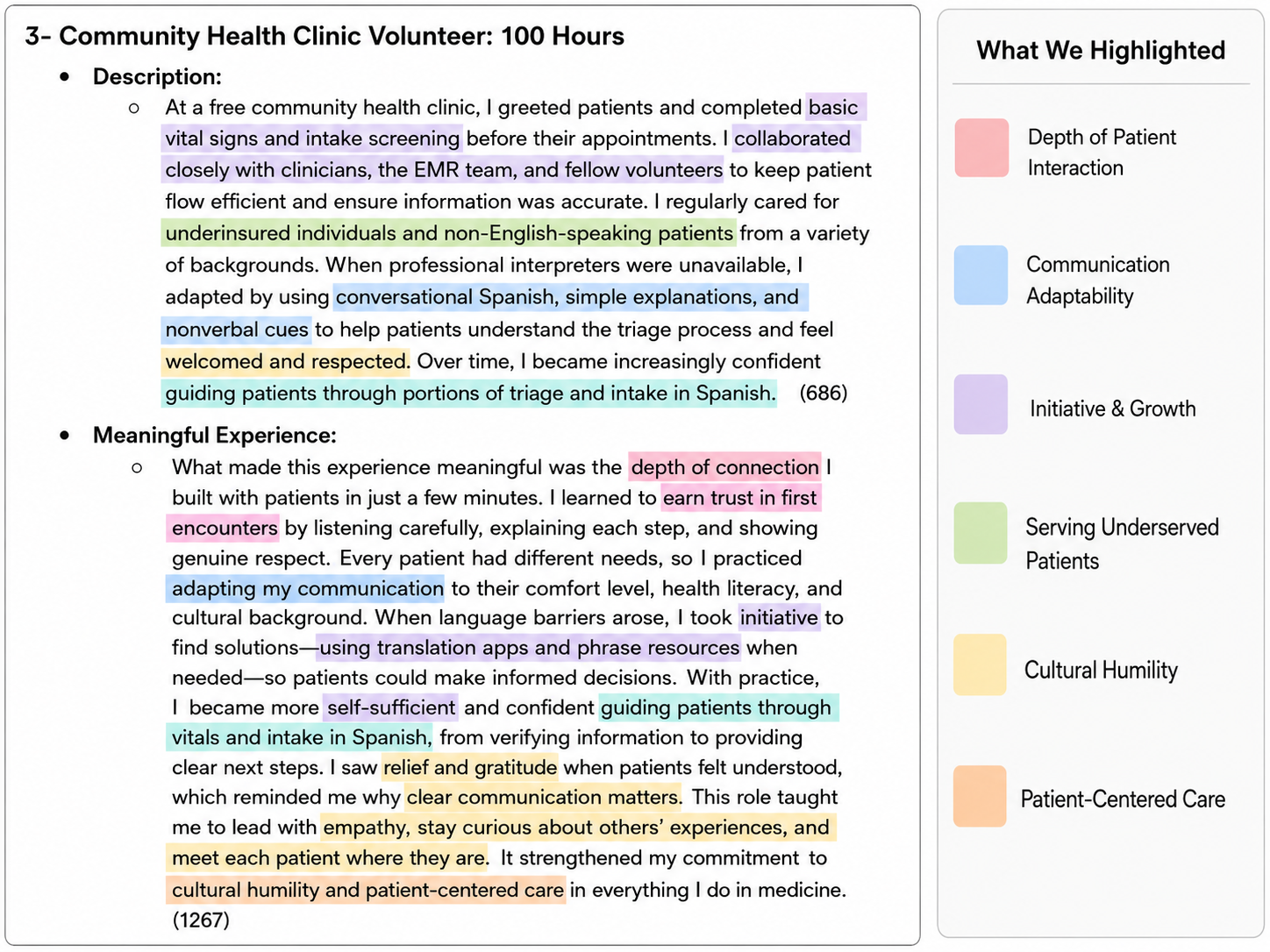
In comparison to her robust research and clinic experience, her community service seemed lackluster at first. She only had about 100 hours at a free clinic, so we knew the numbers alone wouldn’t make the experience stand out.
We had to make each of those hours count by focusing on the depth of her patient interactions, even if she didn’t have as many as she’d hoped. Her final entry showed how she worked with underinsured and non-English-speaking patients, adapted her communication when interpreters were unavailable, and eventually became comfortable guiding patients through parts of the triage process in Spanish.
The final result looked like this:
The same principle carried into her leadership activities. We wanted the reader to see what changed because Maya was there, not just that she held a “leadership” title.
So instead of stopping at “student government representative” or “club president,” we highlighted examples of her advocating for students, presenting proposals to administrators, adapting club programming when beginners were struggling, and mentoring others.
By the final draft, each of her 10 activities had a clear purpose, and they came together to tell a strong story of her intellectual curiosity, judgment, and commitment to patients.
Rewriting Her Secondaries Until Every Essay Had a Clear Point
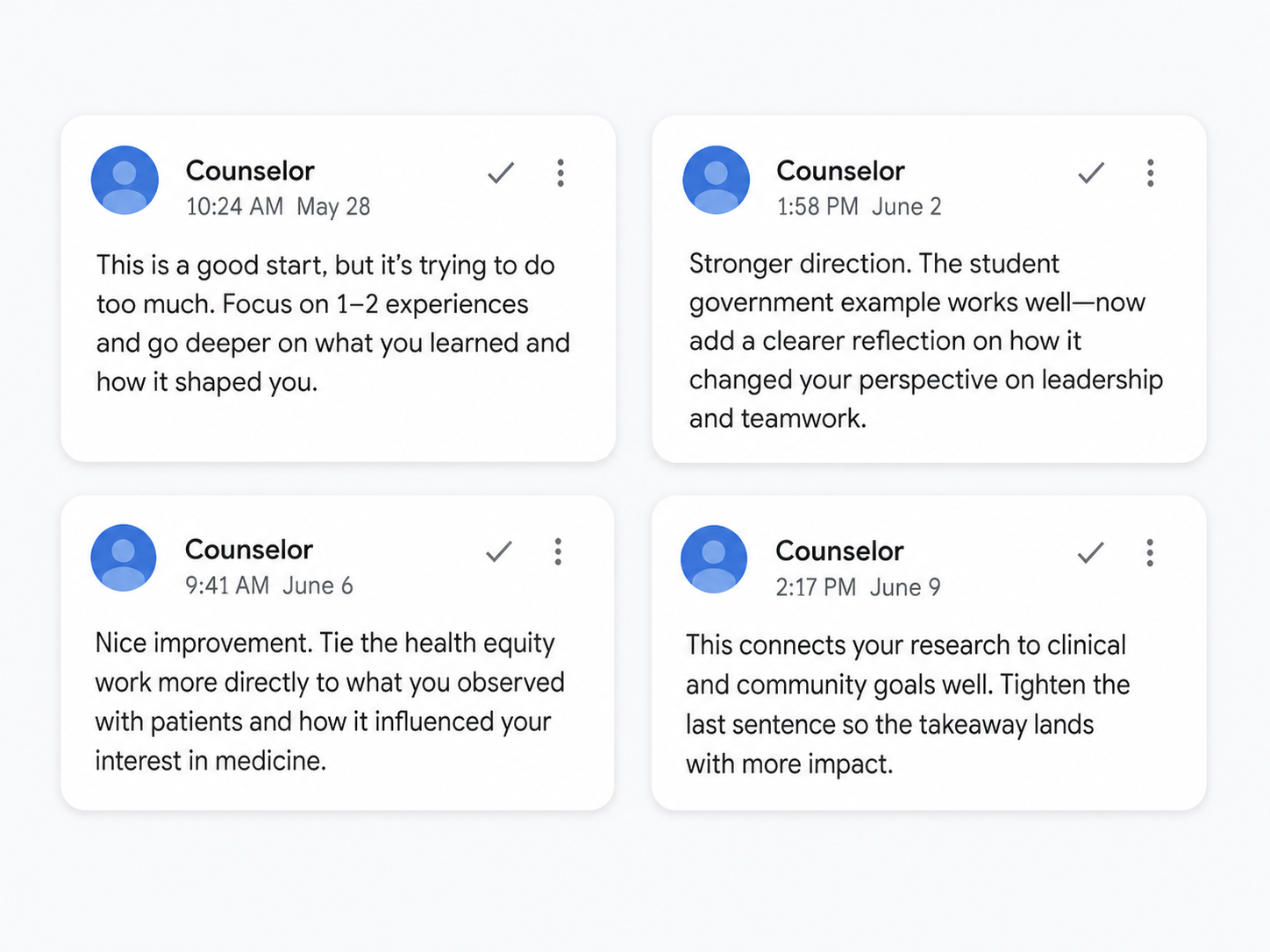
In an initial call with Maya, she told us that she needed blunt, honest feedback to keep her motivated. That became especially important once secondaries started coming in, since they also required several rounds of revision. Her ideas were strong, but some of her early drafts tried to fit too many experiences into a single response and didn’t have enough reflection.
One essay asked her about a time she built a relationship with people with different opinions than her. Her first draft moved from growing up in a diverse school system to a campus hobby club, to student government, to volunteering at a free clinic, and, finally, to her hospital work. There was clearly too much going on in one 2,000-character essay, and her reflection, the most important part of an essay, was getting buried beneath all the examples.
By the third draft, we had narrowed the essay around two qualities, authenticity and reliability, and two main experiences instead of four. Instead of just saying she connected well with different people, we wrote about how she earned the trust of other students by listening to their concerns and following through on initiatives. She then used her clinical experiences to show the same qualities in a completely different setting, including adapting how she communicated with patients who had limited health literacy or spoke another language.
Here’s a look at a compilation of some of the feedback our counselor gave her throughout the process:
For the University of Chicago Pritzker School of Medicine, where Maya ultimately enrolled, the challenge was different. Pritzker specifically asked how her experiences had prepared her to work in its diverse clinical environment.
We built the response around experiences that were directly relevant to the patients she could serve at Pritzker. Maya wrote about her experience working with underinsured patients at a free clinic, communicating across language barriers, studying how neighborhood-level inequality affects health, and caring for patients at a safety-net hospital.
Instead of just saying she cared about health equity, the essay showed that she already understood and personally witnessed some of the transportation, access, trust, and socioeconomic barriers that affect patients in underserved communities.
We took the same approach with Pritzker’s research essay. Maya had two interests that sounded disconnected at first: translational research and community health. Her counselor helped her bring them together. She connected her laboratory work studying disease-related vision loss to the patients she met at a free clinic who were managing many of those same conditions without adequate resources. That gave her a much clearer reason for wanting to pursue both research and community-based medicine at Pritzker.
That same framework was applied to each of the 10 secondary essays we worked with her on: fewer broad claims, fewer examples that seemed to just be competing with each other, and a much clearer reason for why each story mattered.
We also made sure the essays worked together. Her research, clinical care, community service, and advocacy experiences repeatedly reinforced the same larger picture of the physician Maya wanted to become.
Results: Two Acceptances to Top Chicago MD Programs
Maya ultimately earned acceptances from two medical schools in the city she had been determined to stay in, Pritzker School of Medicine and the University of Illinois College of Medicine. She chose Pritzker, one of her top-choice programs.
Maya already had the numbers. What she needed was a strategy that made every other part of the application work just as hard: a carefully built school list, five rounds of activities revisions, highly tailored secondaries, and a clear explanation of why her experiences made her a great candidate at these top Chicago med schools.
Maya’s story is a great reminder that even the best academic credentials don’t automatically result in acceptance. By the end of the process, admissions committees weren’t just seeing a high GPA and MCAT score. They were seeing the wonderful physician Maya was working toward becoming.



.svg)


