Get in touch: +1 888 453 5021


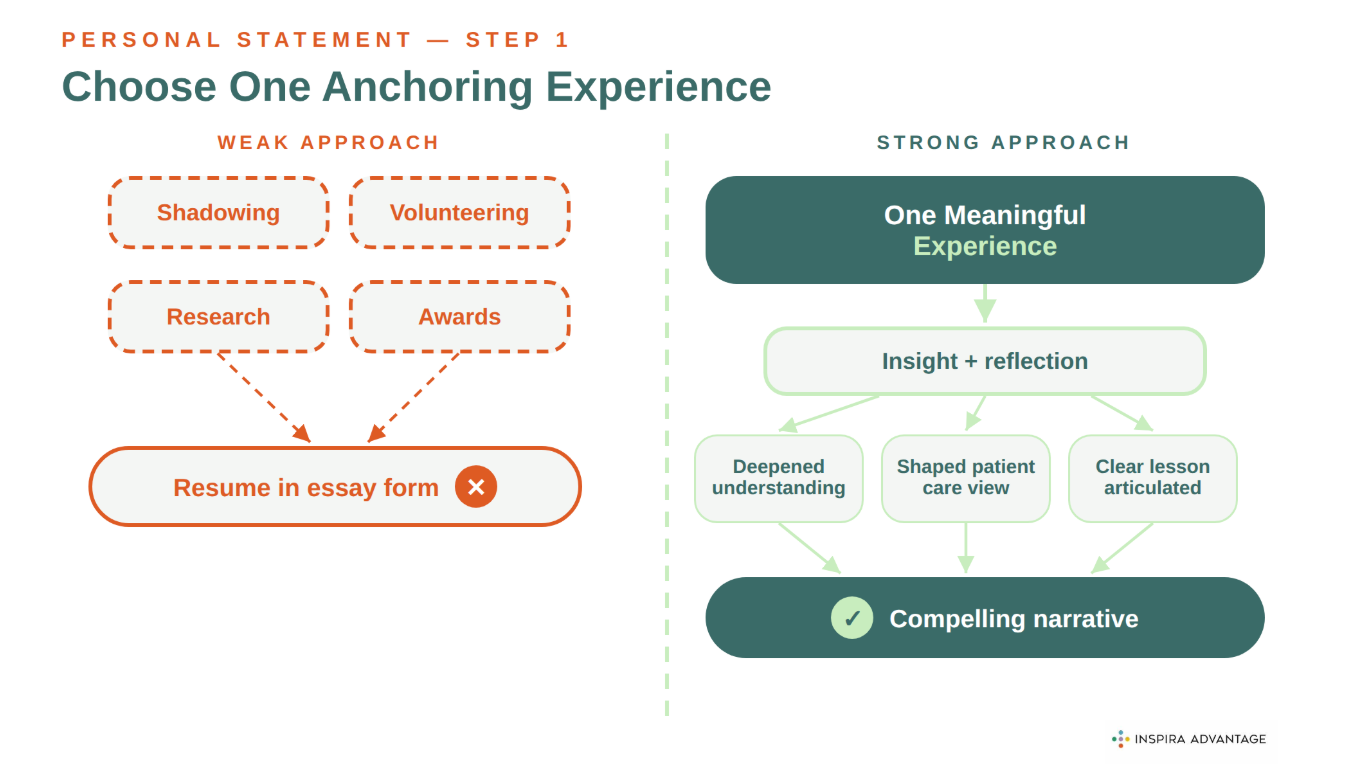
The strongest dental school personal statements focus on one meaningful experience that explains why you chose dentistry. Many applicants try to mention every shadowing opportunity, volunteer activity, or research project they completed. This approach often weakens the essay because it turns the personal statement into a resume summary.
Admissions committees want to understand what moment or experience shaped your decision to pursue dentistry and how your interest developed afterward.
That experience might come from shadowing a dentist, volunteering in a community clinic, or interacting with a patient whose oral health challenges affected their daily life. The activity itself is not what makes the essay strong. What matters is the insight you gained about the profession through the activity or experience.
Once you identify that central experience, use it to anchor your essay. A simple test can help you choose the right topic. Ask yourself:
If the answer is yes for all three questions, you likely have a strong foundation for your personal statement.
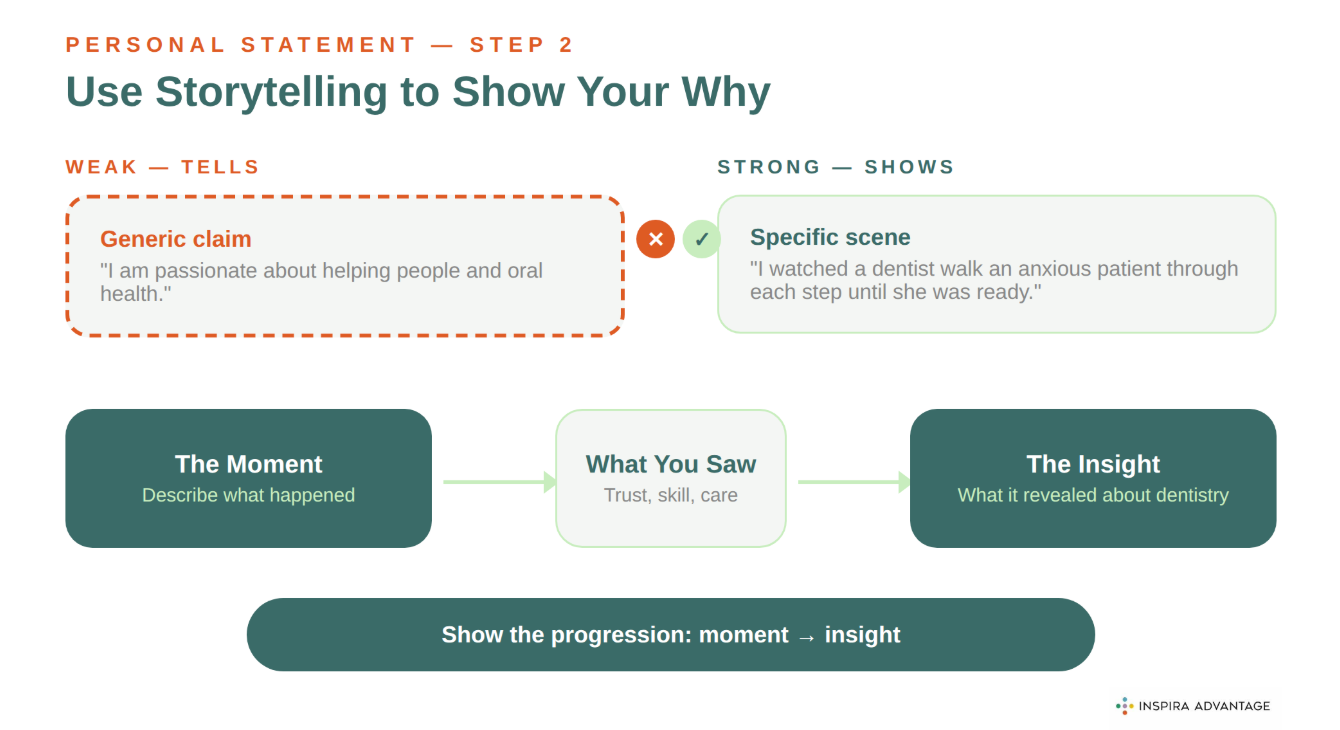
Once you identify the experience that anchors your essay, your next task is to help the reader see the moment clearly. Admissions committees read hundreds of personal statements each cycle. Essays filled with general statements like “I enjoy helping people” or “I am passionate about oral health” rarely stand out because they do not show how that motivation developed.
Instead, describe what actually happened. For example, you might recall watching a dentist guide an anxious patient through a procedure, explaining each step until the patient felt comfortable continuing treatment. Observing that interaction can reveal how communication, trust, and technical skill work together in dentistry.
Moments like these help admissions committees understand how you experienced the profession firsthand. After describing the moment, briefly explain what you took away from it. The goal is not to dramatize the event but to show that the experience helped you better understand the responsibilities and impact of dentistry.
Strong essays allow readers to follow the progression from observation to insight. In other words, the reader should be able to move naturally from “This is the moment that sparked my interest in dentistry” to “This is what that moment helped me understand about the profession.”
You can learn more about how to create a strong, cohesive dental school narrative here:
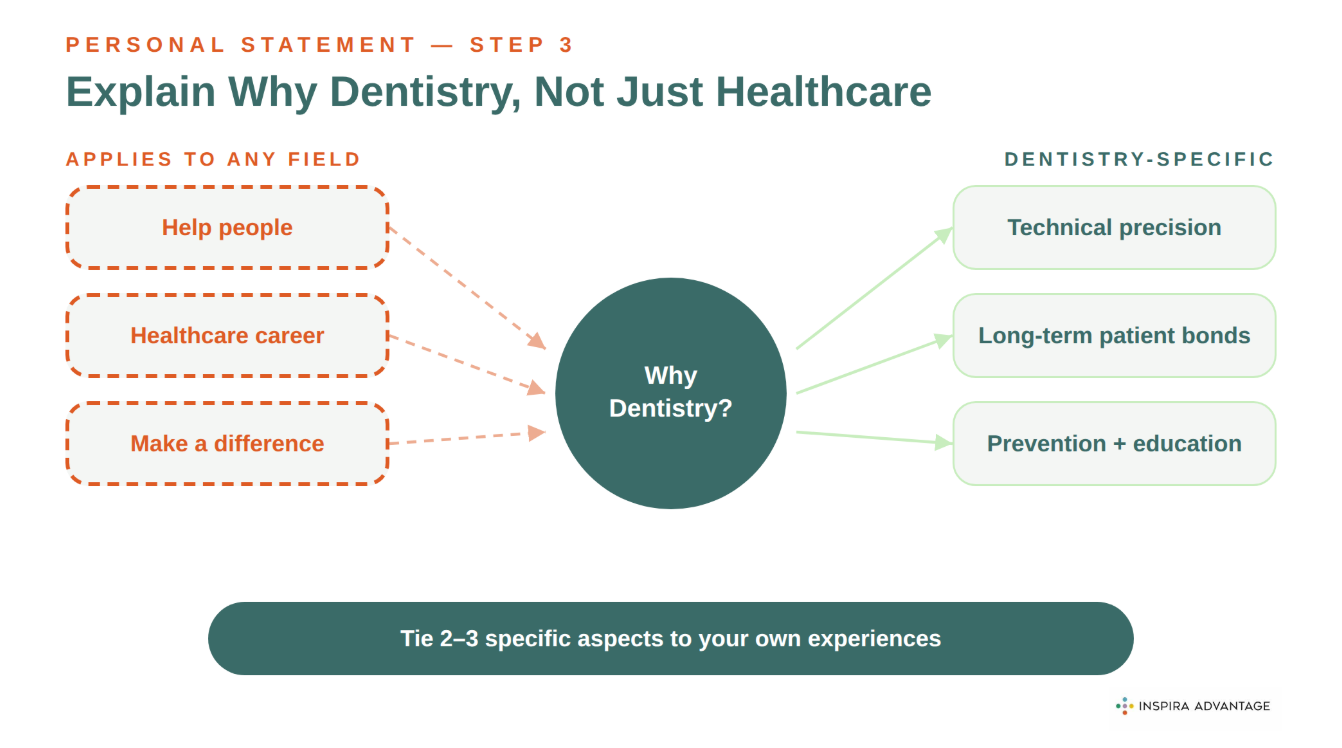
After describing the experience that sparked your interest, your essay should answer an important question admissions committees always ask:
Why dentistry specifically?
Many applicants say they want a healthcare career or that they want to help people. Those motivations apply to many professions, including medicine, nursing, and public health. Admissions committees want to see that you explored dentistry intentionally and understand what makes the profession unique.
Dentistry combines several elements that attract applicants to the field. Dentists:
Your essay should connect your experiences to these aspects of the profession.
A useful approach is to identify two or three specific aspects of dentistry that resonated with you and tie them directly to experiences you had while shadowing, volunteering, or working in a clinic. For instance, you might explain how observing restorative procedures showed you the technical side of the profession, while interacting with patients helped you appreciate the importance of communication and trust.
This kind of reflection shows admissions committees that your decision to pursue dentistry is based on informed experience and a clear understanding of the profession.
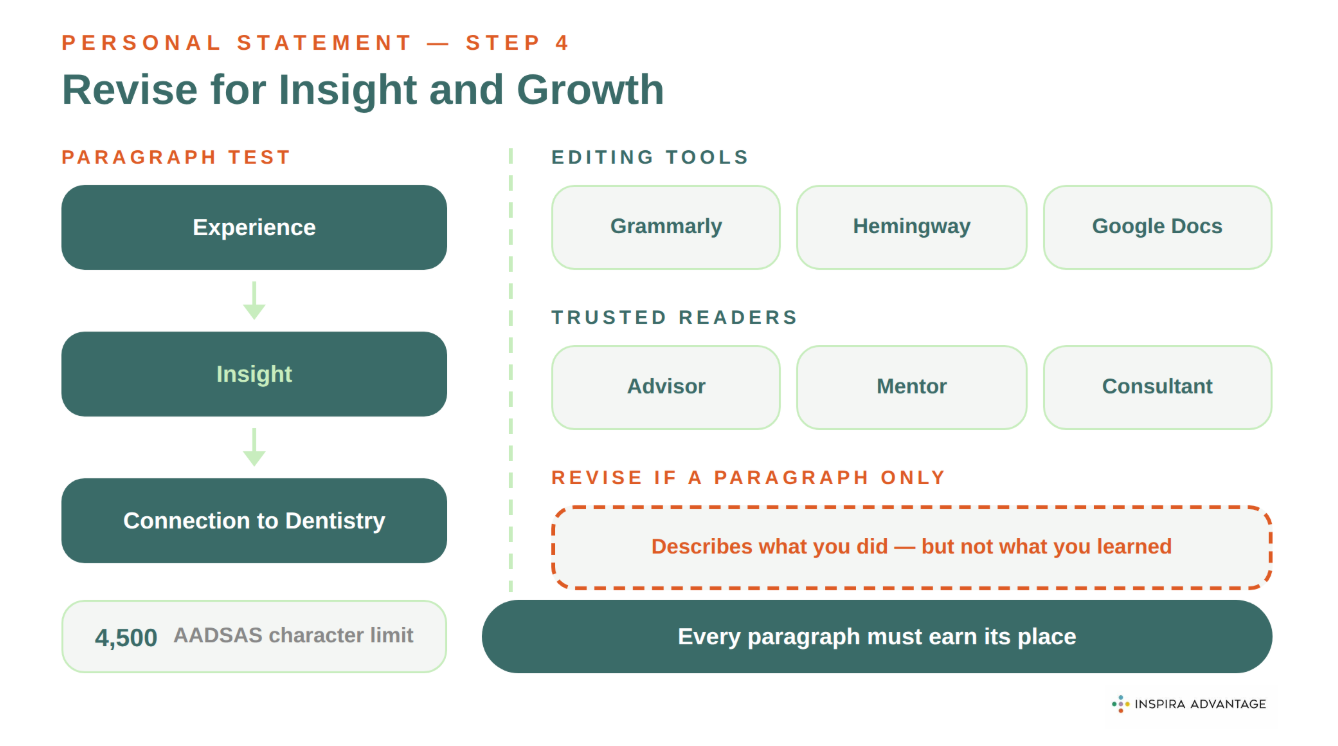
Strong dental school personal statements almost always require multiple rounds of revision before submission.
The Associated American Dental Schools Application Service (AADSAS) personal statement allows up to 4,500 characters, which means space is limited. So, every paragraph should help explain how your experiences led you to pursue dentistry. Revision is where you refine your message, strengthen your reflection, and remove anything that doesn’t support or confuses your central narrative.
When revising, evaluate each paragraph using a simple test:
Experience → Insight → Connection to Dentistry
If a paragraph only describes what you did without explaining what you learned, it needs revision.
The editing process should also focus on clarity, structure, and grammar. Tools like Grammarly, Hemingway Editor, or Google Docs’ built-in grammar checker can identify awkward phrasing, grammar issues, and sentences that are difficult to read. However, these tools should support your editing process rather than replacing thoughtful revision.
Finally, ask trusted readers to review your essay. Advisors, mentors, dentists you shadowed, or experienced admissions consultants can often identify places where the essay feels unclear or where deeper reflection would strengthen your message.
AI writing tools can be helpful during the editing and brainstorming stages, but don’t use them to generate your entire dental school personal statement.
Dental school admissions committees expect essays to reflect an applicant’s authentic experiences, reflections, and motivation for pursuing dentistry. Essays written primarily by AI often sound polished but generic. They tend to rely on vague phrases about helping people or improving oral health rather than describing the real experiences that shaped your interest in dentistry.
Admissions readers are very familiar with these patterns. Many programs also use plagiarism detection tools or internal review processes to identify essays that appear overly formulaic or AI-generated.
If you choose to use AI tools, treat them like an editing assistant rather than an author. For example, AI can help you organize ideas, improve sentence clarity, or catch grammar issues. However, the experiences and reflections that explain why you chose dentistry should always come directly from you.
The table below shows appropriate and inappropriate ways to use AI when preparing your dental school personal statement.
Admissions committees use the personal statement to answer one question: Who are you when your GPA and DAT scores are removed from the conversation?
Grades and test scores establish academic readiness. The personal statement establishes everything else:
It’s the first time reviewers hear you speak in your own voice.
Application reviewers are not looking for a summary of your activities or extracurriculars in your personal statement. Those details already exist in other parts of your application. What they want to see is evidence that you reflected on those experiences and arrived at something meaningful.
The difference between a forgettable essay and a strong one is not what you did, but what you understood because of it.
Helina Tessema, a Tufts University School of Dental Medicine admissions committee member and counselor at Inspira Advantage, says it well: The personal statement is your only opportunity to sound like a person instead of a robot.
In our webinar on the dental school application process, she explains that the personal statement allows you to show your personality before the interview, where you can move beyond the recitation of grades and hours and let reviewers understand who you actually are.
Another Inspira Advantage admissions expert, Harsh Chheda, who’s also a dental student at Columbia University College of Dental Medicine, makes a similar point in another dental school application webinar. He explains that strong applicants use the personal statement to "connect the dots" between their undergraduate experiences and broader goals.
Rather than describing what happened during a clinical rotation or shadowing visit, they explain what it revealed about dentistry and why it deepened their commitment to pursuing it.
Both perspectives point to the same standard: Admissions committees value authentic voices, reflective thinking, and a clear, grounded answer to the question of why you chose dentistry specifically.
To write a strong dental school personal statement, you need to grab the admissions committee’s attention immediately, build a narrative with a clear structure, and represent yourself as more than a list of credentials.
Here’s a closer look at how to achieve these three goals in your personal statement:
Every paragraph in your personal statement should have a clear job. If a reviewer has to pause and ask, "Why is this here?", then the structure has already failed.
Chheda recommends treating your essay as a timeline with deliberate waypoints:
The hook is your most important sentence. It does not need to be dramatic, but it needs to be specific. Drop the reader into a moment, an observation, or a question that only you could have written. From there, each body paragraph should describe a meaningful experience and explain what it revealed to you about dentistry or yourself.
Your conclusion should not restate your introduction or list everything you covered. Instead, use it to show how your experiences collectively point toward a clear sense of professional direction. Committees read dozens of essays. The ones that end with purpose, rather than a summary, leave a stronger impression.
Admissions committees read the same phrases hundreds of times per cycle:
These phrases are not just unremarkable. They actively signal that you have not thought deeply about your motivation.
In one of our webinars, Herchel Patel, an admissions counselor at the University of Michigan School of Dentistry and advisor at Inspira Advantage, urges applicants to think of it this way: Reviewers reading their 51st personal statement of the day are scanning for something that makes them "jump out of their chair."
Cliches produce the opposite effect. As soon as a reviewer spots familiar phrasing, they glaze over. And that disengagement is nearly impossible to reverse.
An essay that loses a reviewer in the first paragraph rarely earns their full attention back.
The deeper problem with cliches is not that they sound generic; it’s that they replace real thinking. "I want to help people" is not a unique or authentic motivation. Admissions committees want to understand the specific moment, relationship, or experience that made dentistry feel like the right path for you.
That answer is different for every applicant, and that difference is exactly what reviewers are looking for. Audit every sentence in your draft and ask whether another applicant could have written it. If the answer is yes, rewrite it with a specific detail, observation, or experience that belongs only to you.
The goal is not to be clever or unconventional for its own sake. The goal is precision. Precise language is what makes an essay feel personal rather than templated. And personal essays are the ones that get remembered when the committee sits down to make decisions.
Most applicants filter their application through one question: Does this look clinical enough? That filter removes some of the most valuable material in your profile.
Chheda included Yelp food reviewing as one of his listed activities. Not because it connected to dentistry, but because it reflected something real about who he is. He emphasizes that those minor activities that you do not think to add will always contribute to your narrative.
Admissions committees aren’t just evaluating your clinical exposure. They’re deciding whether they want you in their program for four years. Personality, curiosity, and range matter. Use these thought frameworks to identify what belongs in your personal statement and what can be left out:
If you want a second opinion on how your personal statement holds up against these criteria, our admissions experts, including former dental school applicants and admissions committee members, can review your draft and tell you exactly where it stands.
Open your personal statement with a specific moment, observation, or experience that only you could have written. Avoid statements of intent, generic motivation, or anything a reviewer has likely read before. Your first two sentences determine whether a fatigued admissions committee member reads your essay with full attention or scans it looking for a reason to move on.
The most common mistake is opening with a statement of intent: "I have always wanted to be a dentist" or "Ever since my first dental visit, I knew this was my calling." These openers signal immediately that the essay will follow a predictable path.
Think about what made you choose dentistry over every other path available to you. There was likely a specific moment, a patient you watched, a procedure that surprised you, a conversation with a dentist that reframed what the profession actually involves. That moment itself is your opening. Not a summary of it, but the moment itself, written with enough detail that the reader can picture it.
Your first paragraph should drop the reader into that experience and orient them toward the question your essay will spend the rest of its pages answering. Admissions committees need to feel that they are following a specific person with a specific perspective within the first few sentences.
One practical test to use as you draft your personal statement is to cover your name and read only your first two sentences. If they could belong to any other applicant, rewrite them until they could not.
"The patient in chair four had not seen a dentist in eleven years. He was a construction worker in his mid-fifties, and the decay had spread far enough that Dr. Osei had no choice but to extract the upper left molar. I watched from the corner of the operatory, gloved and silent, expecting the man to look relieved when it was over. Instead, he sat up slowly, ran his tongue along the gap, and said: 'I finally feel like myself again.' I had spent two years shadowing in that clinic thinking dentistry was about fixing teeth. That afternoon, watching a man recover something I could not quite name, I started to understand it was about something else entirely."
This introduction does not begin with "I want to be a dentist." It opens inside a specific experience, with a specific patient whose history the reader can feel in a single detail: 11 years, a construction worker, decay advanced enough to require extraction. The reader does not need to be told this man had been avoiding care out of fear, cost, or circumstance; they can infer it.
The applicant's reaction and the quiet realization that their understanding of the profession had just shifted gives the reader a reason to keep reading. An application reviewer who reaches that final sentence wants to know what the applicant figured out — and how the rest of their experiences built on that moment. That is exactly the tension a strong opening is designed to create.
Close your personal statement by synthesizing your experiences into a clear sense of professional direction, not by summarizing what you already covered. A strong conclusion connects your opening to where you are now and leaves the reviewer with a precise understanding of the dentist you are working to become.
Most applicants treat the conclusion as a formality, restating their motivation and closing with a generic sentence about their excitement for dental school. Reviewers have read that conclusion hundreds of times, and it never leaves a lasting impression.
Chheda describes a strong conclusion as “wrapping your narrative up in a bow". Return to your opening moment with new context. Show how your journey reframes that experience, or how it clarifies the kind of dentist you intend to become. That circularity gives your essay a sense of intention that summaries cannot.
Avoid closing with vague ambition. "I look forward to making a difference in my patients' lives" is filler. Be specific about what you understand now that you did not before, and what that means for how you will approach your training and career.
"When I watched Dr. Nguyen place that implant three years ago, I thought dentistry was about restoring function. After two years of shadowing, research, and working with underserved patients at the free clinic, I understand now that it is about restoring confidence. That is the dentist I am training to become."
This conclusion is specific, it closes a loop, and it leaves the reader with a clear picture of who the applicant is and where they’re headed.
The dental school personal statement examples below show the same applicant's story told two ways: one that buries the narrative in generic phrasing, and one that earns the reader's attention from the first sentence.
The example below demonstrates the most common mistakes applicants make: opening with a generic statement of intent, using vague emotional language in place of specific detail, and listing experiences without explaining what they revealed.
“To say that becoming a dentist is my dream is a textbook understatement. The arts and sciences of dentistry align with my passions for service, healthcare, and education, and the first door to making my dream a reality is getting into dental school.
It all began 30 years ago in a small town where I grew up in a conservative family. While I am very thankful for the childhood my family provided, I was raised to believe that my worth was determined by being a superior wife, mother, and homemaker. Education was not given much value in my culture, and for a young girl especially, it seemed as if I would never break the curse of traditionalism.
We all have earth-shaking events that profoundly shape our stories and paths. For me, losing my grandmother when I was 10 years old had a significant impact. The void left in my heart ignited my interest in healthcare, especially in areas where limited access to care is a silent killer. As I began high school, I discovered dentistry and was drawn in by my community's significant need for dental care. The ability to directly impact patients through my skills and knowledge was a compelling alternative to the traditional role expected of me.
Despite my interest in dentistry, I was married at 19 and had my first child shortly after. Family and faith have always been the foundation of my life. Yet when I reflected on my life, I still felt that void. I knew there was more to my life than what I was living.
Ten years into marriage, I finally had the opportunity to return to school. I started at a community college, initially pursuing dental hygiene. I transferred soon after, graduating with a remarkable GPA while upholding my duties as a wife and mother.
Beyond the support of my family, the communities I have been part of have greatly influenced my personal growth. From predental organizations to volunteer work with orphanages and medical clinics abroad, each experience has played an important role in my journey. Around the dental office, the doctors and staff members I shadowed fed my hunger to learn more about dentistry. Seeing doctors demonstrate exceptional chairside manners revealed how these small details can profoundly impact patients' lives.
Though I have explored orthodontics, pediatrics, endodontics, and general dentistry, I find myself particularly drawn to endodontics. My meticulous nature and attention to detail suggest that I would excel in this specialty. As I prepare to enter dental school, I am committed to excellence and know that achieving success will require significant effort. I am at my best when I can support and uplift those around me, helping them succeed. This dedication will enable me to be the best wife, mother, student, and classmate, ultimately shaping me into a skilled and compassionate dentist and a valued member of society.”
The rewritten version below takes the same applicant's story and restructures it around specific moments, earned insights, and a narrative that builds toward a clear professional identity.
“The summer I turned 10, my grandmother died of jaundice in a town where the nearest hospital was two hours away, and a dentist was a luxury most families never accessed. I did not understand then what an untreated infection could do to a body, or how far a disease could travel before anyone intervened. I only understood that she was gone, and that something about the way she died felt preventable.
That question followed me for 20 years. Through a marriage at 19, through raising children while quietly shelving the idea of school, through a culture that measured a woman's worth by how well she maintained a household rather than how far she pushed her own ambitions. I never stopped thinking about it. What would it mean to be the person who showed up before it was too late?
Ten years into my marriage, I enrolled at community college intending to study dental hygiene. Within a semester, a conversation with my own dentist, who had navigated a path not unlike mine, reoriented everything. I transferred, finished my degree with a strong GPA, and began building the clinical foundation I had been working toward since that summer in my grandmother's town.
Shadowing across four specialties clarified what I had suspected: I think in fine detail. Endodontics pulled me in because the margin for error is narrow and the stakes for the patient are immediate. A missed canal is not an abstraction. It is a patient who returns in pain, or does not return at all. That precision appeals to me not as a performance of competence but as an extension of what brought me here: the belief that the difference between adequate care and exceptional care is the attention a provider brings to what everyone else overlooks.
I have volunteered in Moroccan orphanages and sat across from patients in underserved clinics who had been managing tooth pain with over-the-counter medication for years because a dentist was never within reach. Those experiences did not teach me that access to care matters — I already knew that. They taught me what it looks like when someone finally receives it: the specific way a person's posture changes when the pain stops, or when a dentist takes the time to explain what is happening in their mouth instead of just working around them. That is not a minor detail of practice. It is the difference between a patient who returns and one who disappears for another decade.
Thirty years ago, my grandmother died in a town that had no one to intervene in time. I have spent most of my life trying to understand what it would mean to be that person for someone else. Dental school is not the beginning of that answer; It is where I go to finish building it.”
The table below breaks down the specific problems in the weak version and how the strong version addresses each one directly.
You can review 15+ personal statement examples in our free database!
A dental school personal statement should be 4,500 characters or fewer. That is the limit AADSAS set. That translates to roughly 650 to 700 words. Do not treat that limit as a target. Treat it as a ceiling. A focused, well-structured essay that uses 600 words effectively will outperform a padded one that reaches the maximum. Every sentence should earn its place.
Avoid cliches, vague motivation statements, and activity summaries in your dental school personal statement. Specific phrases to avoid include: "I have always wanted to help people," "dentistry combines art and science," and any variation of a childhood dental visit as the origin of your passion.
Beyond language, avoid structuring your essay as a chronological list of experiences. Reviewers are not looking for a timeline; they are looking for reflection, and reflection requires you to explain what each experience revealed, not just when it happened.
Yes, every AADSAS-participating dental school receives and reads your personal statement as part of your application. How much weight each program places on it varies, but no school ignores it. In many programs, the personal statement is the deciding factor between two applicants with similar academic profiles.
Your personal statement should be specific enough that it could only belong to you but focused enough that every detail connects back to your path toward dentistry. You don't need to disclose anything you're uncomfortable sharing. What you do need is at least one concrete, personal experience that explains why dentistry specifically, not healthcare generally.
The applicants who write the most memorable essays are not necessarily the ones with the most dramatic or personal stories. Memorable essays reflect honestly on what their experiences actually taught them.
Don't reuse a personal statement from a previous cycle without significant revision. AADSAS does not carry your personal statement forward automatically, and the system itself cannot flag recycled writing. However, schools can see that you are a reapplicant, and some programs retain applications from prior cycles.
Whether or not a reviewer compares the two versions directly, submitting an unchanged essay signals that nothing meaningful has evolved since your last application. You're likely a different candidate than you were a year ago. Your clinical hours may have grown, your understanding of the profession has likely deepened, and your reasons for applying have likely sharpened.
A reapplication is an opportunity to show a committee what changed, what you learned from the gap year, and why you are a stronger candidate now. Your personal statement should reflect that directly, not recycle the argument that didn't work the first time.
No, don't mention specific dental schools in your personal statement. Because you submit one personal statement to all AADSAS schools simultaneously, naming specific programs will either require you to write a generic statement or create an awkward fit for every school you're planning on applying to.
Keep your personal statement focused on your story, your motivation, and your professional direction. If a specific program has qualities that align with your goals, address that in your secondary application or interview, where you can speak to it directly and accurately.
Orthopaedic Surgery Resident Physician
Lewis Katz School of Medicine at Temple University


.svg)


