Get in touch: +1 888 453 5021


The American Dental Education Association Associated American Dental Schools Application Service (ADEA AADSAS) is the centralized application service that all U.S. dental schools (except for Texas dental schools) use to collect and evaluate applicants.
Instead of submitting a separate application to every school on your list, you complete one standardized application. AADSAS distributes it to every program you designate. Once AADSAS receives your application and materials, it verifies them before sending them to your selected programs.
If you’re earlier in the process and still mapping out your full path to dental school, understanding where AADSAS fits into the broader application timeline will help you sequence every step correctly.
The dates below reflect the official 2026-27 ADEA AADSAS cycle.
Stay on top of every deadline with a comprehensive overview of your dental school application timeline.
The video below explains the complete dental school application process, with expert advice from a Tufts University School of Dental Medicine graduate.
Setting up your AADSAS account takes about 10 minutes. Visit the ADEA AADSAS portal, click "Create Account," and enter your:
You'll verify your email, set up security questions, and land on your applicant dashboard. From there, you can begin filling out each section of the application, which we’ll help you with below.
Create your AADSAS account as soon as the portal opens on May 12, 2026. You can’t submit your application until June 2, but the soft open period is your window to build, review, and refine every section without pressure.
Your DENTPIN (Dental Personal Identification Number) is an eight-digit identifier issued by the American Dental Association. It replaces Social Security Numbers for dental testing, applications, and education systems. AADSAS requires it to create your account.
If you've already taken the DAT, you have a DENTPIN. Log in to your American Dental Association (ADA) account to retrieve it.
If you haven't taken the DAT yet, register for a DENTPIN before opening AADSAS. Do not register for a second DENTPIN if you already have one, as duplicate registrations cause processing problems that delay your entire application.
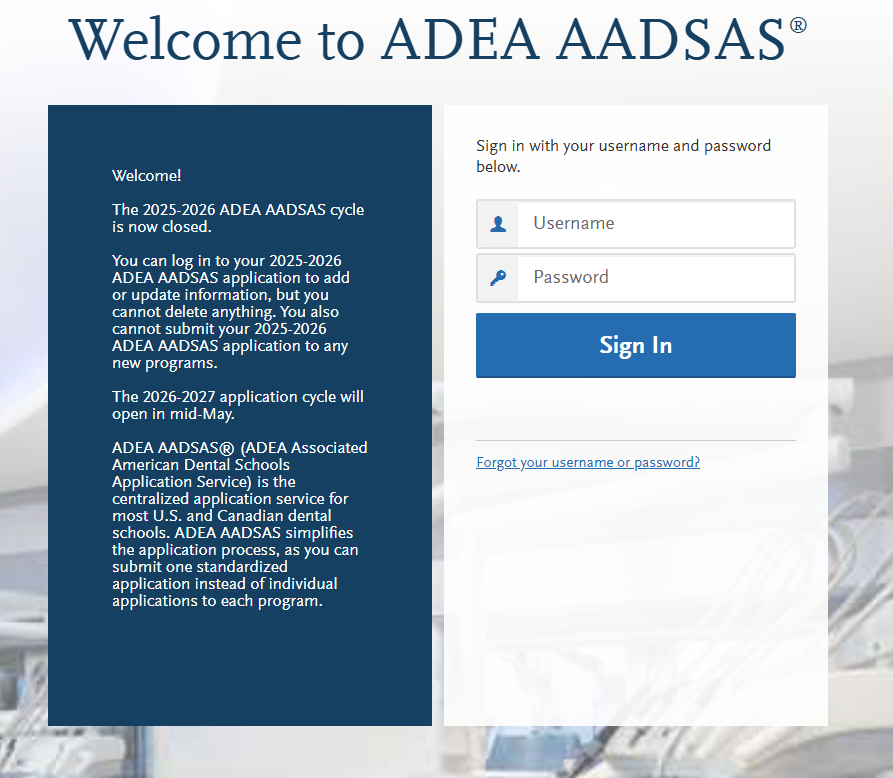
On the login page, select "New User" to begin account creation. Have your DENTPIN, a permanent email address, and your legal name exactly as it appears on official documents ready before you start.
Use an email address you check daily. AADSAS and dental schools communicate entirely through email, and a missed message about a missing transcript or incomplete supplemental can cost you an interview.
Fill in your legal name, date of birth, and contact details. Your phone number must match the one you used when you created your account. When prompted, enter your DENTPIN twice.
Your mailing address goes here, too. Keep this section up to date as you complete and submit your application. If you anticipate a change of address, enter the date through your current valid address.
Create a strong password and complete any security verification steps. Check your email immediately after registration, as AADSAS sends a confirmation email to activate your account. If it doesn't appear within a few minutes, check your spam folder and add support@adeaaadsas.myliaison.com to your contacts. Missing system emails is one of the most common and preventable reasons applications are delayed.
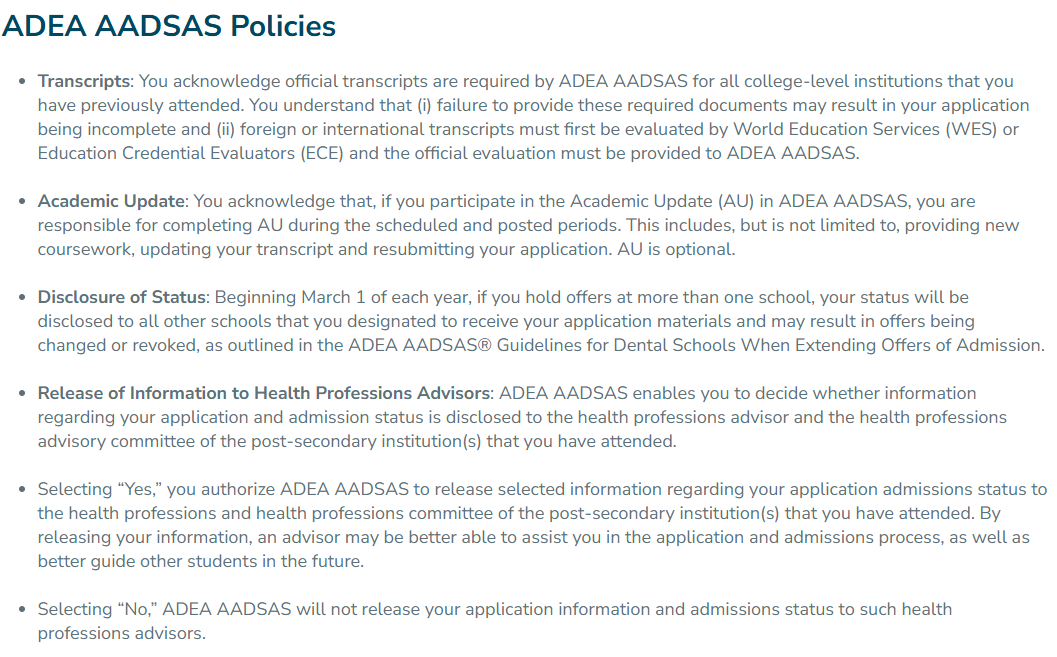
The ADEA AADSAS Applicant Agreement Statement is a contractual agreement between you and ADEA AADSAS. Specifically, it covers four things:
You have to agree to these terms to submit your application.
Once you create your account, AADSAS assigns you a CAS ID number. Save it. Re-applicants keep the same CAS ID from the previous cycle, so this number sticks with you throughout your dental education journey. Schools and AADSAS customer service will ask for it whenever you need support.
The AADSAS application has four core sections:
Work through each section carefully. Errors discovered during verification result in an "Undelivered" status, which can add weeks to your timeline.
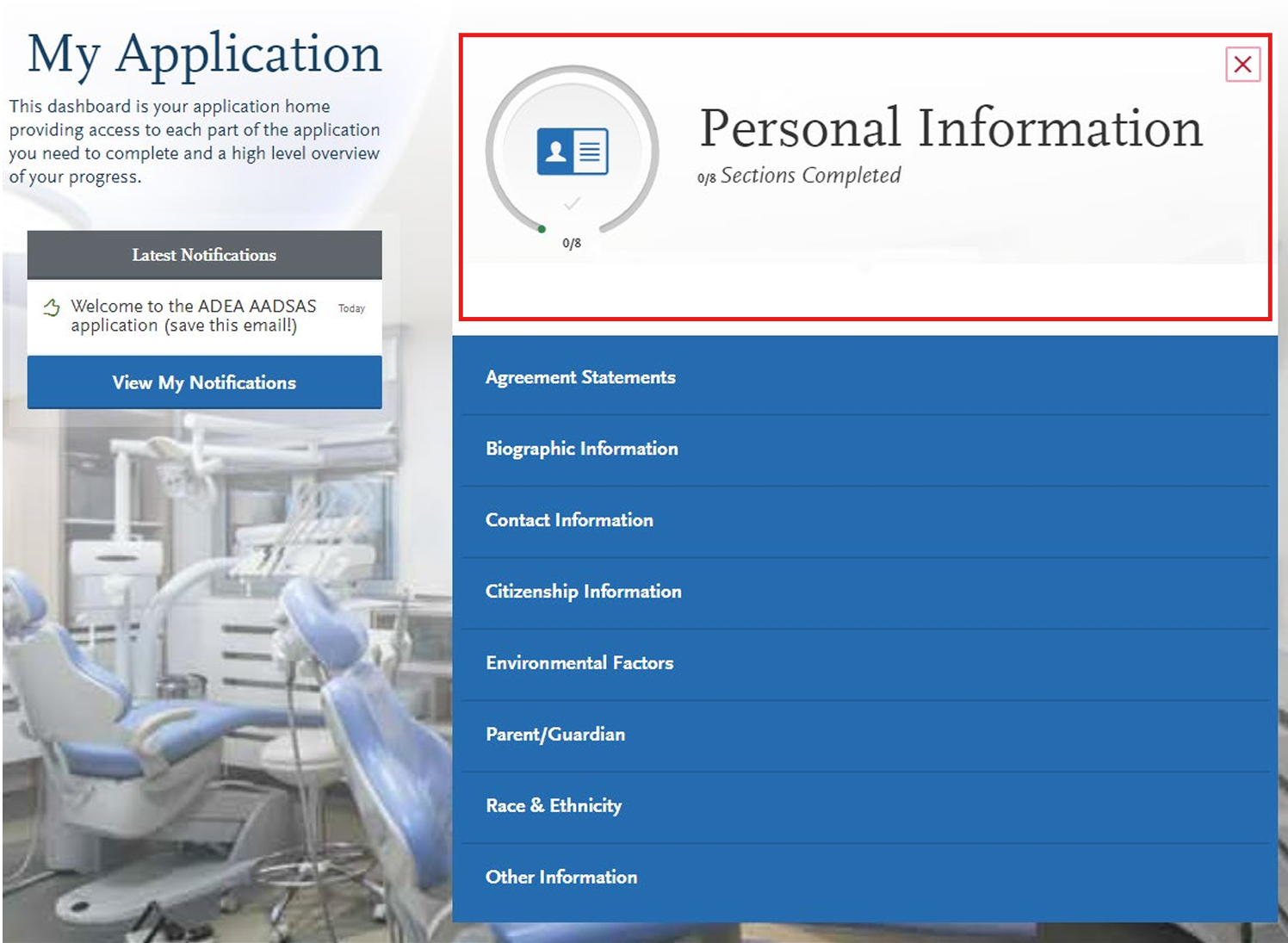
The Personal Information section serves as the foundation of your application, requiring:
Fill out every field exactly as it appears on your official documents. Name mismatches between your application and your transcripts are one of the most preventable causes of processing delays.
Read every agreement statement before clicking anything. These statements are a contractual agreement between you and ADEA AADSAS. You have to agree to the terms to submit your application. Once you submit, you can’t edit your responses.
The statements also cover whether you authorize AADSAS to release your information to health profession advisors at schools you previously attended. You can authorize it as it does not affect how programs evaluate you, and it helps future applicants who go through the same advisor.
Enter your legal name, date of birth, and gender exactly as they appear on government-issued identification. Your phone number is pulled from the information you entered when you created your account, so verify it here. Any discrepancy between your application name and your transcript name can delay matching and stall verification.
Use a permanent email address you check daily, not a university email that expires at graduation. AADSAS and dental schools communicate exclusively through email. A missed message about a missing document or supplemental requirement can cost you an interview. Enter the address where you want to receive mail correspondence and keep this section up to date. If you anticipate a change of address, enter the date through which your current address is valid.
Report your citizenship, residency, visa status, and DACA status in this section. Some dental schools have restrictions on international applicants or on applicants with certain visa types, and misrepresenting your status can result in your application being rescinded. Check each program's requirements directly if you hold a non-citizen or non-permanent resident status before adding them to your school list.
Use this subsection to provide context for anything in your background that affected your academic journey, such as
Admissions committees consider these factors in your application. A well-written environmental factors entry can reframe a difficult semester in your favor far more effectively than leaving reviewers to draw their own conclusions from a GPA decrease.
Enter your parent or guardian information as requested. This section is used for demographic research purposes. It does not factor into how programs evaluate your application.
ADEA updated its race and ethnicity categories for the 2026-27 cycle. The seven categories are
Subcategories and write-in responses are not included. Select every category that applies to you. This data is used for institutional reporting and does not disadvantage any applicant.
A new question was added for the 2026-27 cycle: "Please explain any other responsibilities you may have outside of being a student." Dental schools use this field to understand your full context, including caregiving responsibilities, part-time work, and family obligations. It can strengthen your application by demonstrating maturity and time management in the face of constraints you faced.

The Academic History section is where you record:
Accuracy here determines how AADSAS calculates your GPA and whether your application moves through verification without delays. Pull up an unofficial copy of every transcript before you begin and work from it directly.
Enter your high school name and dates of attendance. If you completed university-level courses while in high school, report those under the college or university that awarded the credit, not under your high school. This section is relatively straightforward, but do not skip it. A blank field here indicates that your application is incomplete.
List every post-secondary institution you attended, including:
Report each school only once, regardless of the number of degrees earned or gaps in attendance dates. Leave out any school, and AADSAS will treat it as a misrepresentation. Even a single course at a community college counts. If a dental school discovers the omission after you've been accepted, they can withdraw your offer. Every institution you list requires a corresponding official transcript, so order them all at once.
Request your transcripts as soon as the portal opens in May. AADSAS won’t process applications until it receives all official undergraduate transcripts, both paper and electronic. Every institution you attended requires a separate transcript, including community colleges, summer programs, and schools where you only took one class.
Download a Transcript Request Form for each institution and ensure it is addressed to ADEA AADSAS. Electronic transcripts are only accepted from Parchment and the National Student Clearinghouse. If your school uses a different service, ask them to mail the transcripts instead.
Monitor your application to ensure AADSAS receives each transcript. You will not be notified for any missing transcripts, so check your Check Status tab regularly, especially in the first two weeks after requesting your transcripts.
Enter every course you’ve ever taken at a post-secondary institution here. Pull up an unofficial copy of each transcript before you start and enter courses exactly as they appear. Add the same course names, same credit values, same grades.
Applicants with a large volume of coursework can opt into the Professional Transcript Entry (PTE) service. By selecting PTE, you allow Liaison to enter and verify all coursework on your behalf.
The process begins once ADEA receives all of your official transcripts and can take up to 10 business days to complete. PTE costs $85 for one to three transcripts. But it can remove a major source of entry errors for applicants who attended multiple institutions.
Report your DAT scores in the Academic History section. AADSAS receives official scores directly from the ADA, so don’t send them yourself. Enter your test date, and AADSAS will match the scores once they arrive.
If your scores are not yet available when you submit your application, you can still submit it. Some schools will accept an unofficial score report to begin reviewing your application. Your application moves through verification independently of your DAT scores, so a pending score does not delay your submission.
Plan your DAT timeline around the full application calendar. Scores take two to four weeks to post after your test date. To submit on day one of the cycle and have verified scores ready for schools by mid-June, take the DAT no later than mid-April.

The Supporting Information section is where your application shifts from academic record to professional profile. It covers your:
Record every meaningful experience in the Experiences subsection, such as dental shadowing, community service, research, employment, and leadership roles. Be specific about hours, dates, and your actual role. Vague entries like "helped in a dental office" tell admissions committees nothing. Write descriptions that show what you observed, what you contributed, and what you learned.
AADSAS does not collect documentation for the experience sections. If any dental schools require documentation, submit it directly to them. Do not leave out experiences because you lack paperwork. List them accurately and be prepared to verify details if asked.
AADSAS allows you to submit up to four letters of evaluation. Most dental schools will not review your application until ADEA receives your evaluations, which means a slow reviewer can delay your entire application cycle.
Ask your evaluators for their letters before the application opens in May. Give them your personal statement, resume, and a brief note on your shadowing experiences so they have the context to write something specific and compelling. A letter that says you're "hardworking and punctual" does nothing for your application. A letter that describes how you handled a specific clinical situation tells an admissions committee something they won’t get anywhere else in your application.
Once ADEA receives a completed evaluation, it can’t be removed or replaced.o choose evaluators who know you well and will deliver them without hesitation.
ADEA added a structured rating component to the evaluation process this cycle. Evaluators now rate applicants on 10 attributes:
Each attribute is rated as:
Evaluators who have not written dental school letters before may not realize they need to complete the rating scale in addition to uploading their letter. Tell your evaluators about this new change before they begin.
Try to ask for letters of evaluation from these individuals:
But check each school's Program Materials section for evaluator requirements before sending any requests. Requirements vary by program.
If your undergraduate institution offers a predental committee letter, pursue it. A committee letter counts as one of your four evaluation slots, meaning you can submit one committee letter and up to three additional individual evaluations. Or just the committee letter with one individual evaluation alongside it. Dental schools that see you bypassed an available committee letter will notice.
AADSAS does not accept resumes, so use the Experiences section to provide detailed information about:
For each entry, include:
A description like 'shadowed a general dentist for 100 hours' wastes your most persuasive opportunity. Instead, describe the specific procedures you observed, the patient interactions that surprised you, and the moment your understanding of clinical dentistry shifted.
Enter any relevant professional or academic achievements, such as:
Focus on achievements over the last 10 years, at the collegiate level and above. You can mark up to four as most important using the star icon. Mark the achievements that speak most directly to your academic excellence, leadership, and commitment to dentistry.
List every relevant professional license and certification you hold, such as:
Add the required documentation if AADSAS requests it. Keep digital copies of all certificates accessible throughout the cycle. Some programs request official verification later in the admissions process. You don’t want to be tracking down paperwork after receiving an interview invitation.
Your personal statement is a one-page essay of no more than 4,500 characters, including spaces, that gives dental schools a clear picture of who you are and why you want to pursue a career in dentistry. Every school on your list sees the same version. Write it as if it needs to work for all of them, because it does.
Your GPA and DAT score determine whether schools open your application. Your personal statement determines whether you are invited to interview.
Start with a specific moment, not a broad statement about your love of dentistry. Admissions committees have read thousands of essays that open with "Ever since I was young, I knew I wanted to help people." That approach signals a lack of self-awareness. A visual scene will set you apart from the first sentence, such as:
Additionally, AADSAS removes all formatting from your statement. You can use paragraph breaks, but do not expect bold, italics, or indentation to carry over.
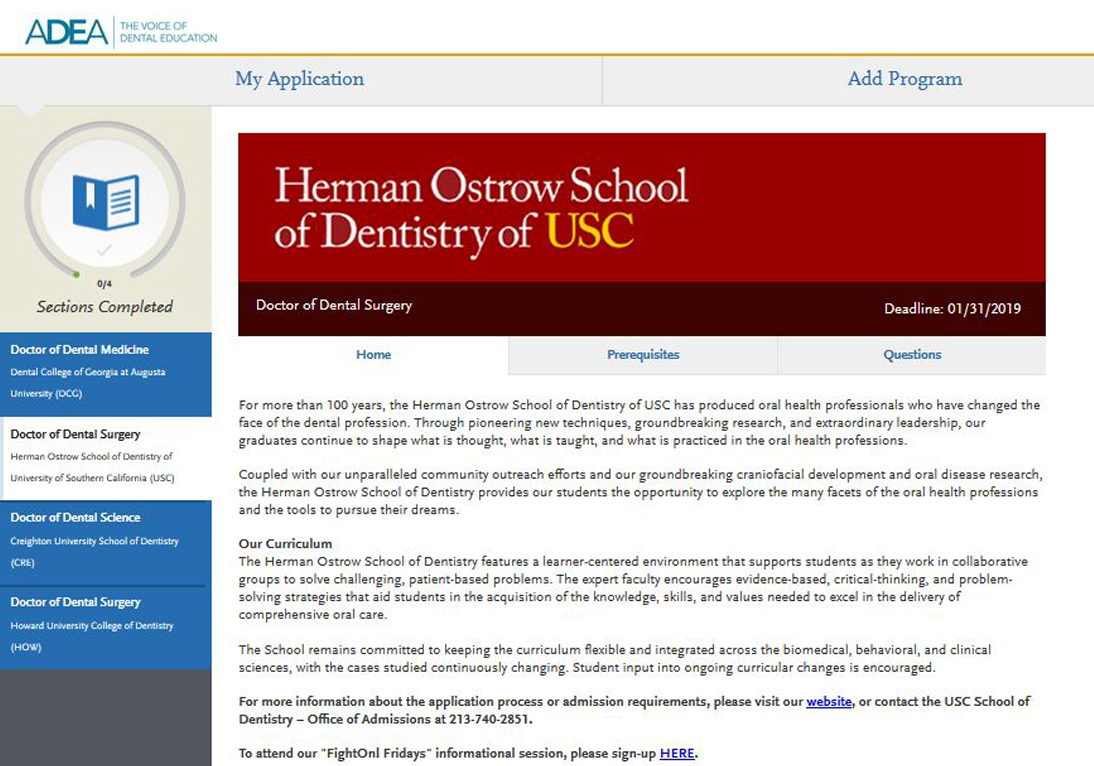
Program Materials is the most overlooked section in the entire application — and the one most likely to leave your application incomplete without you realizing it.
If the specific programs you are applying to have additional application requirements, use this section to provide the requested information. You can also view important information about each program, including deadline requirements.
Some schools embed their supplemental questions directly inside AADSAS rather than sending a separate secondary application. If you skip a required field in Program Materials, your application is considered incomplete for that school, even if your primary application is fully verified and submitted.
Check every program's Program Materials tab individually before submitting to that school. Do not assume the requirements are the same across programs. They aren’t.
For guidance on completing each step without costly mistakes, meet with one of our experts for admissions advice. They'll work through your application with you from Personal Information to Program Materials and make sure it's ready to submit.
Your school list determines your odds before a single admissions committee reads your personal statement. Build a strategic school list using your GPA, DAT score, residency status, and program-specific prerequisites. AADSAS will not send your application to a school if it receives your application after that school's deadline. So finalize your list before you submit, not after.
Start by selecting the programs you want to apply to. Then submit a single application that includes all required materials. Once AADSAS receives your application, it verifies your materials before transmitting them to all your selected programs.
To add schools, navigate to the Add Program tab inside your application. Search by school name, state, or program type. Each program listing shows its deadline, so check it before adding any school to your list.
Once you select a program and submit your application, that decision is permanent. You cannot substitute or remove submitted programs after submission. And ADEA AADSAS doesn’t offer refunds for selections made in error or transfer payments to another program.
Review your full program list carefully before clicking submit. Adding a school by accident is an expensive mistake with no quick fix.
Most applicants apply to around 10 schools, but your number will depend on your stats, goals, and budget. Each additional school adds application and often supplemental fees.
Applying to just two or three schools is risky, especially if they’re competitive. Rolling admissions means seats fill progressively from June onward, and a small school list gives you very little margin for error. At the same time, applying to 20 or more schools without a strategic rationale wastes significant money and time on supplemental applications you are unlikely to complete well.
A well-balanced list of 10 to 15 schools gives most applicants a competitive chance without overextending their budget or their attention.
Organize your list into reach, target, and safety programs before you add any of them to AADSAS. Reviewing acceptance rates by program before you start gives you a realistic idea of where your stats are competitive.
The AADSAS application fee for your first dental school is $264. Each additional school costs $115. Supplemental fees charged directly by each school typically range from $50 to $125 per program.
Applying to 12 schools costs roughly $1,500 in AADSAS fees alone before a single supplemental is paid. Budget this before you finalize your list, because running out of funds mid-cycle delays even the strongest applicants.
AADSAS offers fee assistance to applicants who demonstrate extreme financial need. The Fee Assistance Program opens April 15, 2026, for the 2026-27 cycle. Each fee waiver covers the cost of the first three dental school applications, valued at $494, and is awarded on a first-come, first-served basis.
Texas dental schools and foreign dental schools don’t use AADSAS. If you want to apply to both Texas public programs and schools in other states, complete both applications separately and manage two independent timelines.
Foreign-educated dental graduates seeking advanced standing programs at U.S. dental schools must apply through the ADEA Centralized Application for Advanced Placement for International Dentists (CAAPID).
Confirm each school's application requirements on its website before adding them to your list.
Submit your application as early as possible. The portal opens for submissions on June 2, and applicants who submit in the first two weeks land in the earliest verification batches.
However, if you aren’t able to submit your application in early June, don't panic. Rolling admissions means schools review applications as they arrive, so a complete and polished application submitted in July still beats a rushed one sent in June. Focus on getting every section right rather than rushing.
Your application reaches "Complete" status only when three conditions are met:
You do not need your letters of evaluation in hand before you submit. You can submit your application before your transcripts and evaluations are received, but AADSAS will not review your application until all transcripts, payments, and evaluations are received.
Submit your application as early as possible. Then actively track the arrival of every outstanding document through your Check Status tab.
Navigate to the Submit Application tab at the top of your application. Review your full program list one final time because, once you submit, you cannot remove any school from your list. And AADSAS does not issue refunds. Click Submit. Or to submit to more than one program at once, click Submit All. Complete the payment page to finalize your submission.
AADSAS sends a confirmation email acknowledging your submission. If you do not receive it within a few minutes, check your spam folder immediately. Do not assume your application went through without that confirmation.
After you submit, your application moves through a sequence of statuses:
After AADSAS receives your application, fee payment, and official transcripts, it usually takes about four to six weeks to process. Verification runs in chronological order, meaning applicants who submit in June move through the queue before those who submit in August. Submit early, and your application reaches schools while they still have the majority of their seats available. Submit late, and you compete for the remaining spots.
Some dental schools can take four to six weeks to review applications after AADSAS sends them. An application you submit in early June can realistically reach a school's review queue by mid-July. An application you submit in September may not reach review until November, after many schools have already filled the bulk of their class.
After you submit your AADSAS application, you cannot:
However, you can:
AADSAS sends your application to programs electronically as soon as you pay and submit. Programs choose when to review it. Do not contact schools asking for confirmation immediately after submission. Monitor your Check Status tab, and respond promptly to every email from your programs. And check your spam folder daily throughout the cycle.
Ordering your transcripts and having AADSAS receive them are two different things. Some applicants order transcripts, assume everything went through, and submit their application, only to discover weeks later that one institution sent to the wrong address, used the wrong format, or forgot to include the Transcript Request Form.
AADSAS does not notify you if you’re missing any transcripts. Monitoring falls entirely on you.
Check your Check Status tab after ordering a transcript from every institution. If a transcript has not been posted within 10 business days of your school sending it, contact the registrar first, then AADSAS. Submit early enough that you have time to fix problems before your target schools begin reviewing applications.
The most expensive mistake in rolling admissions is waiting. Applicants who submit in September are not competing against the same pool as applicants who submitted in June. By September, many schools have already issued a significant number of interview invitations.
Submit your application, complete and accurate, on day one of the cycle. Use the weeks that follow to complete supplemental applications. A strong application submitted in June beats an exceptional application submitted in August in a rolling admissions system every time.
The AADSA personal statement is the section where most applicants fall short. The most common version of this mistake is writing a summary of experiences rather than a story about what those experiences revealed.
Harsh Chheda, a former member of the admissions committee at Columbia University College of Dental Medicine and expert counselor at Inspira Advantage, provided expert advice during our dental school application webinar:
"Definitely don't boast ... also don't just list out things that you want to be mentioned about why dentistry,” he says. “You really want to make sure that you have stories in your personal statement ... listing things will always just be very, very boring for the application reader."
Admissions readers have to parse dozens of applications per day. A personal statement that opens with a list of shadowing hours and research positions tells them nothing they can’t already see in your Experiences section. Use the 4,500 characters to show them who you are through a specific moment, a patient interaction, or a decision that confirms why dentistry, not something else.
Writing an AADSA personal statement that relies on stories but lacks a strong foundation can also leave readers uninterested. Sentences that circle back on themselves, paragraphs without a clear purpose, and transitions that do not connect one idea to the next force the reader to reconstruct your meaning from your prose. Admissions committees do not do that work for you. They move on.
Herchel Patel, a student at the University of Michigan School of Dentistry and an admissions counselor at Inspira Advantage, describes what reviewers actually experience in the dental school application process during our webinar:
"The last thing this person wants to see is something where they have to sort of dig through your personal statement and try to find a meaning or try to find something that you're trying to tell them," he says.
Write a clear opening that establishes your direction, develop it through specific evidence, and close with a forward-looking statement that connects your past to your goals. Read every draft aloud. If you lose your argument at any point, the admissions reader will, too. Have at least two people who know the dental school process well provide written feedback before you finalize and submit.
The application cycle causes significant anxiety, and that anxiety pushes applicants toward checking forums, reading blogs, measuring their school list, and comparing their DAT scores against their classmates. Before you fall into that trap, it helps to understand how selective the process actually is, and why that selectivity makes a focused, authentic application far more valuable than one built around what everyone else is doing.
Helina Tessema, a dental student at Tufts University School of Dental Medicine and admissions counselor at Inspira Advantage, offers clear advice on this in our dental school application process webinar:
"If you get caught up looking at what your classmates are doing, what other peers are doing, what these blogs talk about, you're gonna set yourself up for failure,” she says. “You can only be the better version of yourself than you were yesterday — and that's honestly all that really matters."
Build your school list around your actual GPA, DAT, state of residency, and genuine interest in each program. Write a personal statement that reflects your specific path to dentistry, not a version of what you think admissions committees want to read. Applicants who earn early acceptances tend to submit applications that are authentically their own.
The 2026-27 AADSAS application opens on May 12, 2026, and you can submit your application starting June 2, 2026. The portal opens three weeks before submissions begin. Use that window to build your application, finalize your personal statement, confirm your evaluators have received their requests, and verify your transcripts are in transit.
Yes, but you can only change specific fields. Most of your application locks permanently on submission. Review your personal statement, coursework entries, and existing experience descriptions, as you can’t change these once AADSAS receives your application.
Yes, you can submit your application before your transcripts and evaluations arrive. You can edit your contact information, update your profile settings such as username and password, add programs with deadlines that have not yet passed, add new evaluations if you have not yet reached the maximum of four, and add new entries to certain areas of the Academic History and Supporting Information sections where applicable. However, you can’t change your personal statement, coursework entries, and existing experience descriptions once AADSAS receives your application.
For most U.S. dental schools, the AADSAS application opens May 12, 2026, with submissions accepted starting June 2, 2026. Texas public dental schools use the TMDSAS, a separate application that opens May 1.
AADSAS verification takes four to six weeks after your application reaches Complete status. Complete status requires your submitted application, your fee payment, and all official transcripts received and posted. The time does not start until all three are confirmed.
International students who completed their undergraduate education at an accredited U.S. or English-speaking Canadian institution can apply through AADSAS. Your citizenship status does not determine which application service you use.
Foreign-educated dental graduates seeking advanced standing programs at U.S. dental schools must apply through the ADEA Centralized Application for Advanced Placement for International Dentists (CAAPID). CAAPID is a separate application service designed specifically for dentists who trained outside the United States and want to complete an advanced standing program to practice in the U.S.
The AADSAS personal statement limit is 4,500 characters, including spaces, carriage returns, numbers, and letters. That translates to roughly 700 to 750 words, depending on your sentence length.
Write in an application like Notepad before pasting into the application. Preview the final version in the portal before submission, because what looks clean in a Word/Google doc can become a wall of text without manual line breaks.
AADSAS is the required primary application for all U.S. dental schools, except Texas dental schools. Texas residents applying to Texas dental schools must apply through the Texas Medical and Dental Schools Application Service (TMDSAS). If you want to apply to both Texas public programs and out-of-state schools, complete both TMDSAS and AADSAS as entirely separate applications with independent timelines, fees, and requirements.
Dr. Jonathan Preminger was the original author of this article. Snippets of his work may remain.
Orthopaedic Surgery Resident Physician
Lewis Katz School of Medicine at Temple University


Get 15+ free dental school personal statements written by our succcessful applicants free of charge. No strings attached.


.svg)

