Get in touch: +1 888 453 5021



Key Findings at a Glance:
We surveyed 328 respondents across different age groups, income levels, and education stages to understand who takes gap years, why they do it, what holds others back, and how social media and employer perception factor into the decision. Here's what we found.
Nearly half of the 328 students and recent graduates we surveyed have either taken a gap year or are currently in one. And the reason most of them took it is for work experience, not travel.
The notion that a student goes backpacking through Southeast Asia before freshman year? That’s not what's actually happening.
The students in our survey are working real jobs to save for tuition, logging clinical hours to strengthen their med school applications, and stepping away from school to recover before they can move forward.
Just as striking is what keeps the other half from taking a gap year. Financial pressure tops the list, but fear of falling behind is another big concern. Many students told us they felt like stopping, even briefly, would cost them precious time they’d never get back.
Survey Methodology:
Inspira Education Group conducted a cross-sectional, self-administered online survey of 328 US-based students and recent graduates between June 3 and July 15, 2026, examining attitudes and experiences around gap years, career readiness, financial pressure, and the changing labor market. Respondents were recruited through Inspira Advantage’s email subscribers, website, and social media.
Our 328 respondents were predominantly female, post-college, and from middle- and lower-income backgrounds, which shapes the data around financial motivations and barriers throughout the survey.
Note: 42.7% of respondents come from lower-middle or lower-income households.
Gap years aren't the outlier decision they used to be. Nearly half of our respondents have either completed a gap year or are currently in one. Add in the students actively planning or seriously considering one, and that number increases to 73.5%. Only 16.8% said they've never even thought about it.
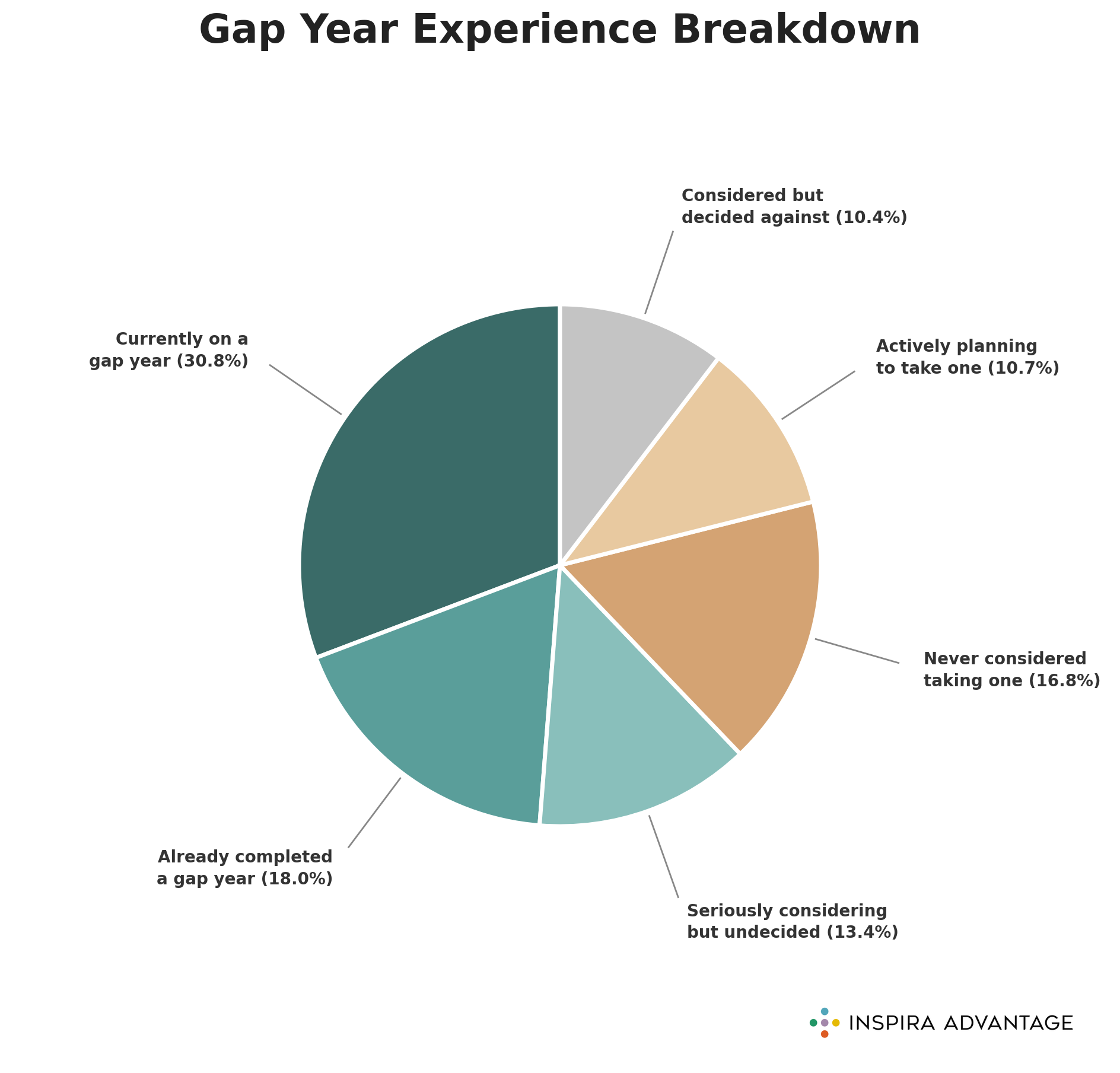
The 10.4% who considered a gap year but ultimately said no weighed the pros and cons, and chose to keep going anyway. A lot of them still aren't sure they made the right call.
That hesitation suggests students think taking any time off is a gamble. Medical school has tight application windows, financial aid timelines, and peers are posting acceptances online. Even when a student knows they'd benefit from time off, the surrounding infrastructure pressures them to keep moving forward. The decision to forgo a gap year is more a reflection of how little room the system leaves for taking at least one year off.
The number one reason students take a gap year is to gain work experience, according to our survey’s findings. That alone should change how admissions committees, employers, and parents think about time off.
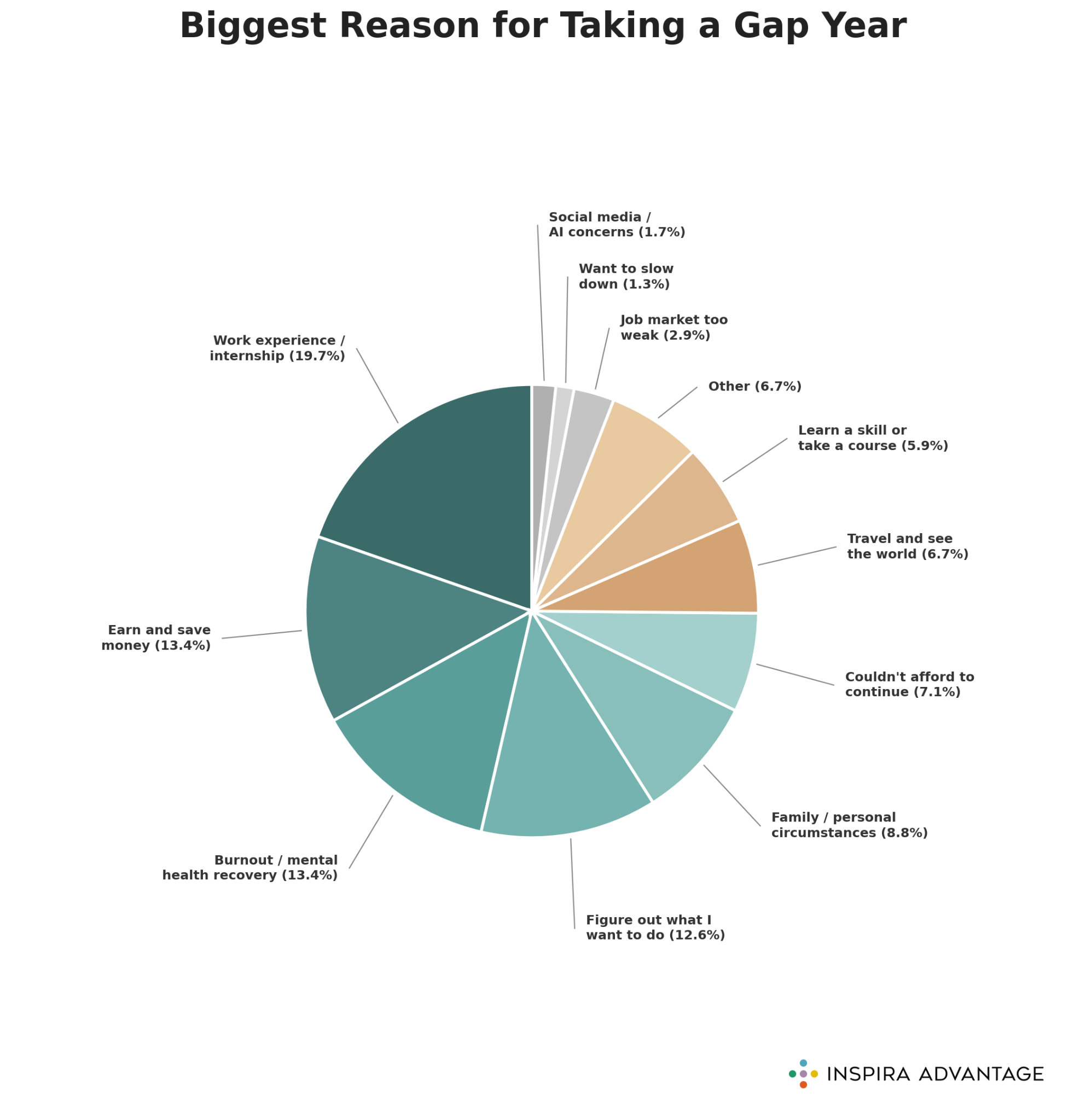
Three motivations are right behind work experience. Earning and saving money ties with burnout and mental health recovery at 13.4% each, and career clarity ("figuring out what I actually want to do") follows close behind at 12.6%. Together, these four reasons account for nearly 60% of all responses.
Interestingly, only 0.8% said social media influence was their primary motivation, and fewer than 1% said AI-related career anxiety. This means that gap year decisions in 2026 are still led by practical, tangible needs rather than viral videos posted online.
We also asked respondents to rank six core motivations from most to least important:
Career clarity and financial motivations consistently ranked among the top two. Travel and escaping pressure almost always ranked last. Mental health and skill-building fell in the middle for most respondents, suggesting students see them as important but secondary to the more urgent questions of direction and money.
"The biggest misconception I hear from families is that a gap year indicates a lack of direction. In our experience, the opposite is usually true. Students who take a gap year to work, gain clinical exposure, or figure out their goals tend to write stronger personal statements and interview with more conviction than applicants who rushed through the process. The ones who worry me are the students who kept applying without a true calling to medicine." – Arush Chandna
Calling it a single gap year usually doesn’t tell everyone’s story. For nearly 4 in 10 respondents, the gap actually lasted longer than 12 months, and another 31.0% took 6-12 months off.
The short gap year of a single summer or semester? Only 13.3% of students went that route.
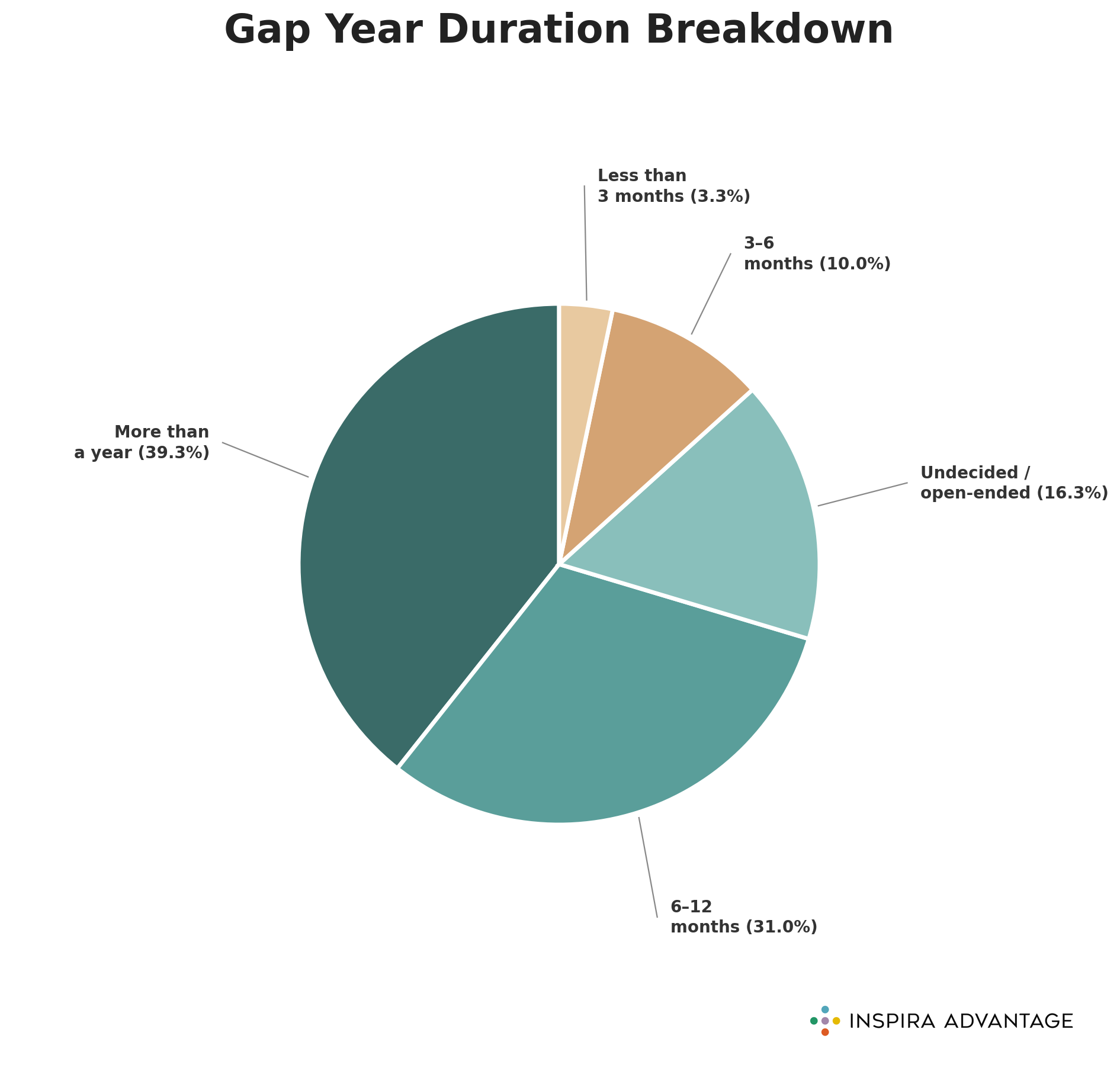
The data makes more sense when you look at it next to motivation. If most students are taking gap years to work, save money, or recover from burnout, none of those goals get resolved in six months. Saving enough to cover a year of tuition takes time, building a meaningful clinical or professional track record takes time, and recovering from burnout takes time.
Gap years often fit the need behind them. Students are working toward a financial target or a readiness threshold, and most come back when they’ve reached it.
The "undecided/open-ended" group provides really interesting data. These students stepped away without an exact return date, and that can go one of two ways. Some of them are being genuinely flexible, adjusting their timeline based on how their work or savings goals play out. But others might not have any return date planned just because they can’t break out of their new cycle.
The difference between those two outcomes almost always comes down to structure. A student who takes time off with specific goals in mind usually returns to their typical application schedule.
A gap year without that framework can often become something more permanent. For students in this group, the most important question isn't "when am I going back?" It's "what do I need to feel ready to go back?"
The most common reason students don’t take a gap year is finances. When we asked students who decided against a gap year to name their single biggest barrier, financial pressures topped the list at 16.9%. But that also doesn’t tell the full story, because the second most common response wasn't financial at all. It was "not interested/it's not for me" at 15.7%, followed by competitive-field anxiety at 12.4%.
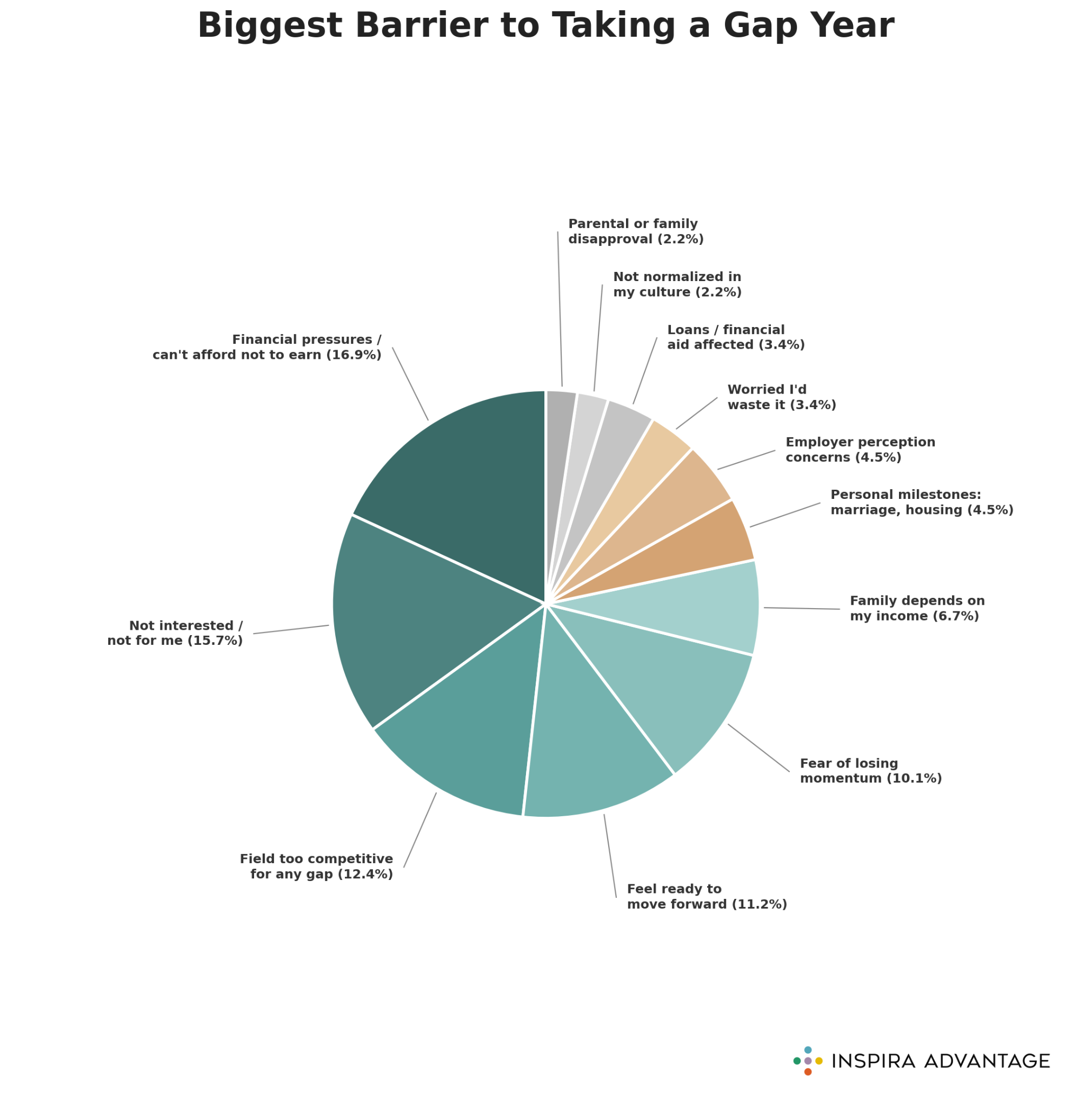
The financial barrier shows up in at least three ways across the data. Some students can't afford to stop earning an income, while others worry about losing scholarships or financial aid. A separate group depends on their income to support family members. Add those together and roughly 27% of students who said no to a gap year highlighted some version of lack of affordability.
That number means something more when you remember that 42.7% of our survey respondents come from lower-middle or lower-income households. For those students, a gap year is a question of significant income loss, not personal preference.
Financial pressure ranks first among primary barriers, but when students name their second biggest concern, fear of losing momentum jumps to the top at 20.2%. Meanwhile, worry about employer perception sits near the bottom of both lists at 4.5%.
Students are afraid of what’ll happen to their own motivation if they take a year off. Anyone who’s taken an extended break from school or work knows how hard it can be to get back into a routine, relearn the discipline, and the sense of urgency that kept them moving forward. The question students are really wrestling with isn't "will a gap year hurt my resume?" It's "if I stop, will I be able to start again?"
That psychological weight explains why 10.4% of respondents considered a gap year and ultimately decided against it. For many of them, the need for a break was enticing. But the fear of what the break might cost them was more devastating.
"I've worked with students who pushed through applications exhausted, underprepared, and running on fumes because they were terrified of losing a year. And I've worked with students who took that year, came back with more experience, and got into programs they never would’ve gotten into the first time around. The fear of falling behind is real, but it's almost always worse than the reality. A weak application submitted on time does more damage to your trajectory than a strong one submitted just one cycle later." – Arush Chandna
Students who skip the gap year aren't just doing nothing. Internships, part-time work, and volunteering are the three most common alternatives, followed by research opportunities and student organizations. Study abroad programs round out the list.
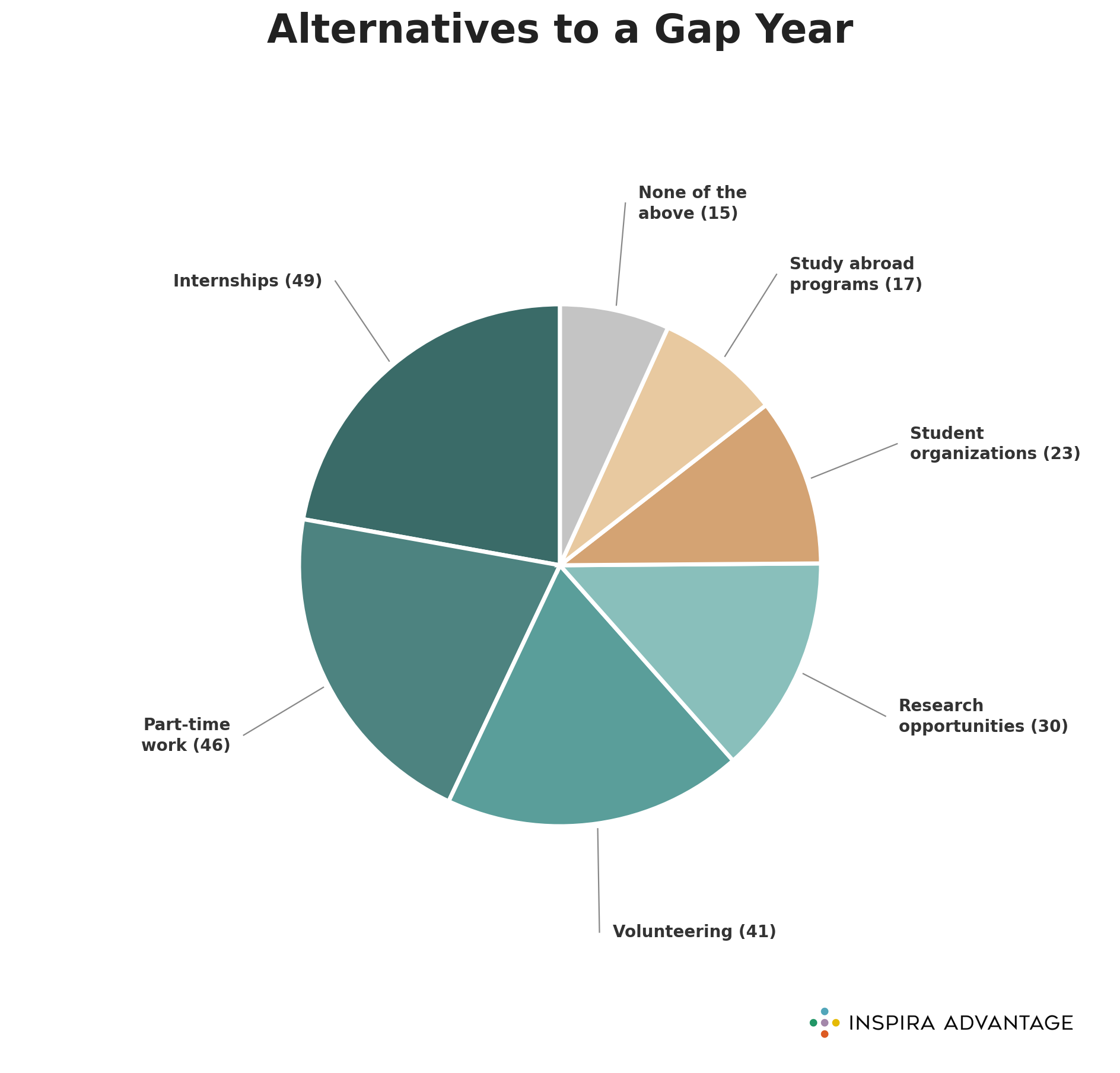
A student juggling 15 credit hours, a part-time job, and a weekend volunteer commitment is technically checking the same boxes as someone who spread those experiences across a gap year, but they're doing it exhausted. The quality of a clinical shadowing experience changes when you're squeezing it between an 8 AM organic chemistry lecture and a closing shift at work.
None of this means gap years are automatically better than the alternative. But the data suggests that students who skip the gap year aren't actually avoiding the workload. They're just engaging with it differently, and often taking on more of it at once.
Only 15 respondents said they decided against a gap year and also aren't pursuing any structured alternative. That's a small group, but it raises a question the rest of the data can't answer: Are these students so confident in their application that they don't feel the need for extracurricular experience, or have they fallen into a different category where neither option feels accessible?
More than half of students who decided against a gap year say they feel very confident in that choice. On the surface, that sounds decisive. But roughly 27% sit somewhere between neutral and very unsure, which means more than 1 in 4 students who said no to a gap year haven't fully made peace with their decision.
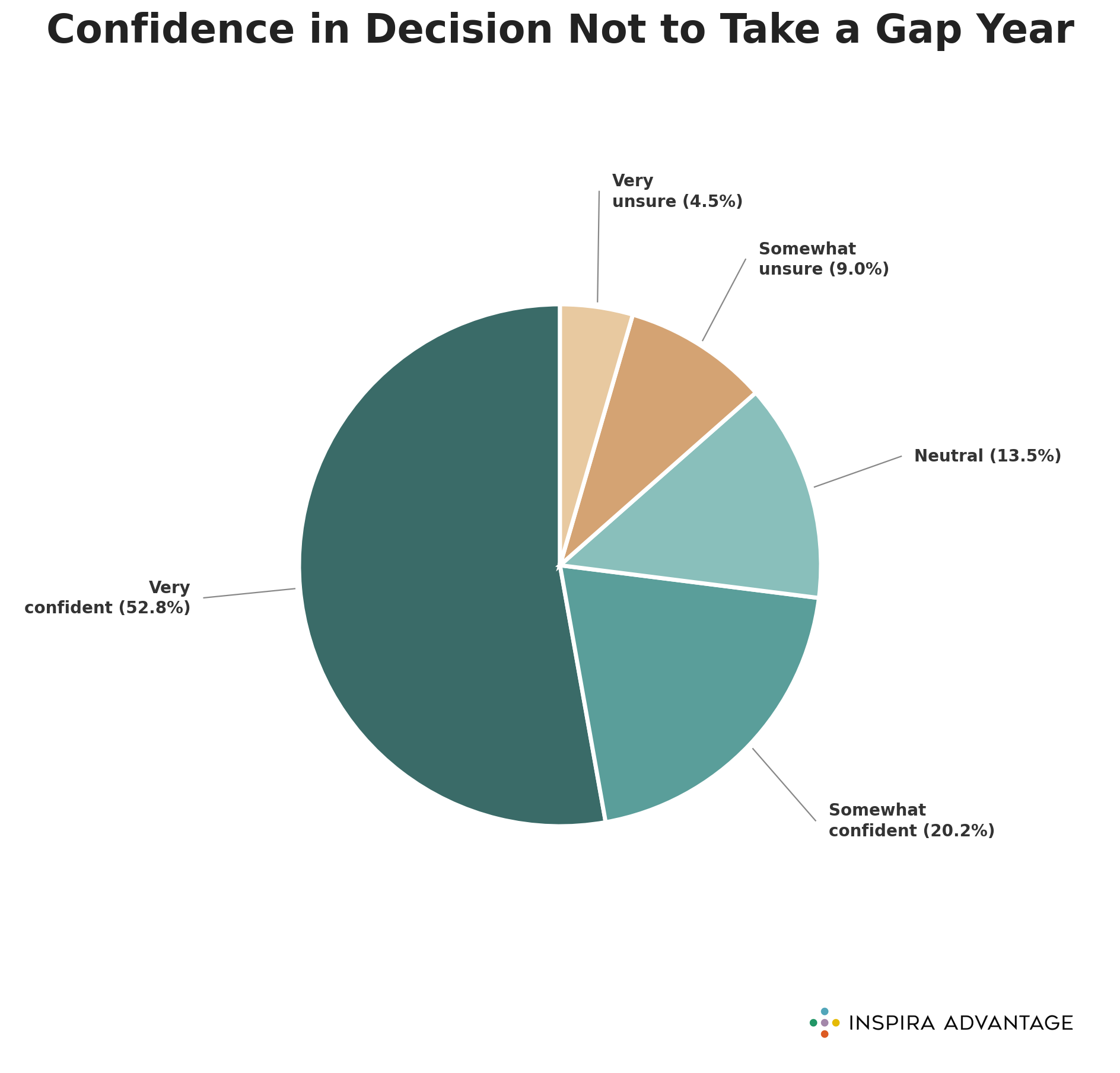
That lingering doubt connects directly to the fear of loss of momentum. These are students who chose to keep moving, but many still wonder whether stopping would have been the smarter decision. Confidence and certainty aren't the same thing. You can feel confident enough to keep going while still carrying the sense that you made a trade-off you didn't fully understand at the time.
Most students don't think a gap year will lower their career prospects. Over half say employers view gap years neutrally, and another 18.9% think employers see them positively. Only 17.4% expect a negative reaction. The anxiety around employer perception, while real, is far less common than the anxiety around losing momentum or running out of money.
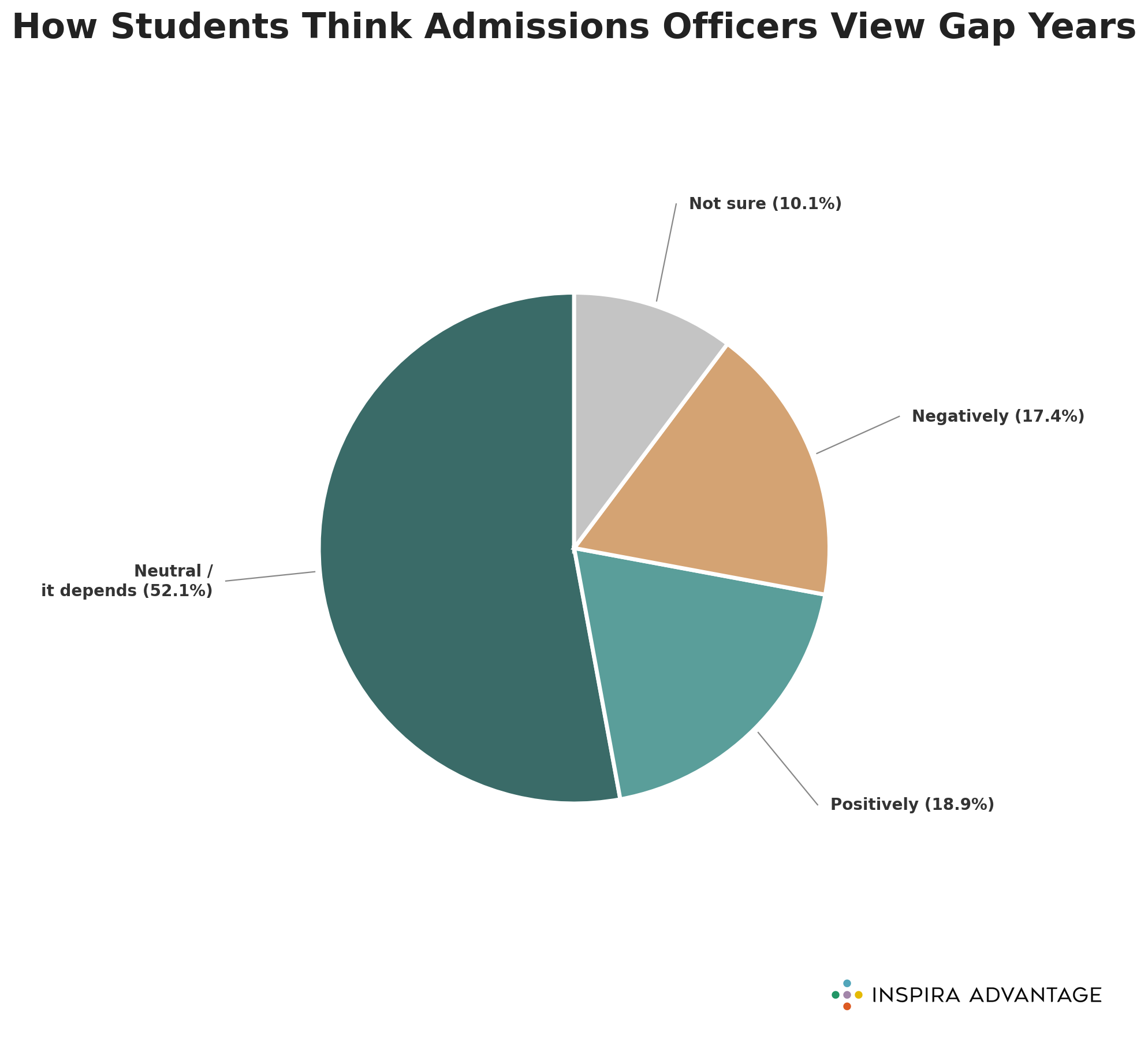
The "it depends" qualifier baked into that 52.1% is doing a lot of work. Students recognize that an employer reading "took a year off to complete a medical scribe position and earn EMT certification" has a very different reaction than an employer reading "took a year off." The gap isn't the problem, but the blank space is.
That level of awareness is encouraging, but it also puts pressure on students to turn their gap year into a performance. Every month off needs a justification, and every experience needs to translate into an impressive bullet point.
For students from lower-income backgrounds who spent their gap year working a job that paid the bills but didn't connect directly to a career narrative, that pressure can make the gap year feel like a liability, even when it was the most responsible choice they could have made.
Only 1 in 10 respondents selected "not sure," and that group points to a gap in advising rather than in employer attitudes. These students just don't know. Nobody has told them how a gap year will be received, which means they're making one of the biggest decisions of their early career with incomplete information.
That's a problem schools and career centers could address relatively easily. Most employers and admissions committees have differing views on gap years that never make it into the advising conversation. Students hear "don't fall behind" far more often than they hear "here's how to frame a gap year so it works in your favor." The result is a number of students making decisions based on assumptions rather than actual data.
"I tell every student the same thing: Admissions committees don't penalize gap years. They penalize gaps they can't make sense of. When someone walks into an interview and explains that they took a year to work as a medical scribe because they wanted to confirm emergency medicine was the right fit, that story is more compelling than most things any other applicant can offer. The students who run into trouble are the ones who can't connect what they did during the gap year to where they're headed next. It's always about whether you can explain why you took the time off." – Arush Chandna
Social media might have several influencers, but it isn’t influencing most gap year decisions. Over half of respondents say it has had zero effect on their decision. For most students, the gap year choice is still rooted in personal finances, career goals, and mental health rather than in what they see on their social media feeds.
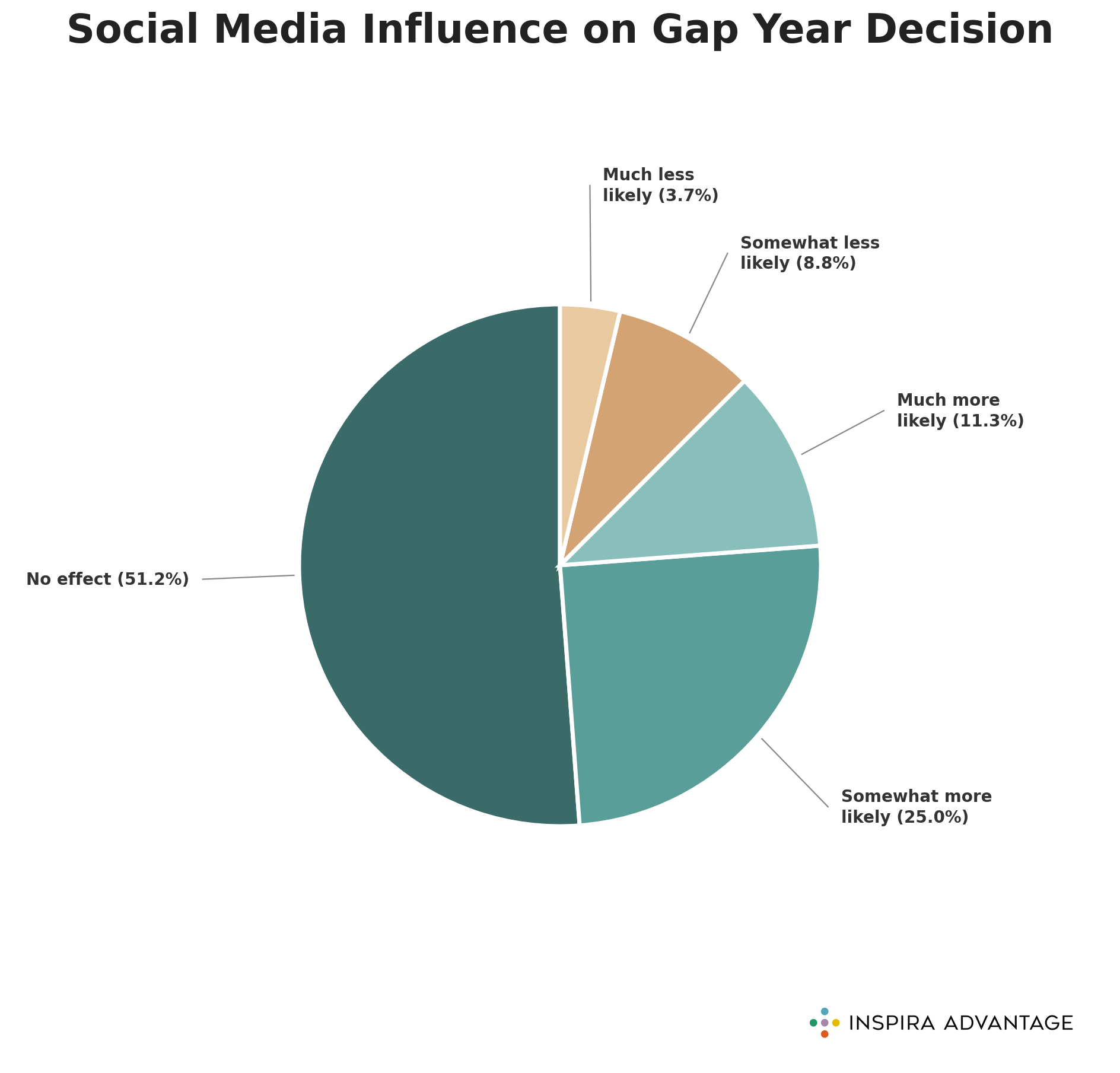
That said, 36.3% of respondents say social media has made them more likely to consider a gap year. A third of students feeling some draw from what they see online is pretty significant, but "more likely to consider" and "actually took a gap year because of social media" are very different things. When we asked students to name their single biggest reason for taking a gap year, only 0.8% pointed to social media influence.
So what's possibly happening is a student sees a gap year vlog or a peer posting about their year abroad and thinks "maybe that's something I could do." But by the time they sit down and actually make the decision, the factors that matter are the same ones that have always mattered: Can I afford it, will it set me back, and what will I actually do with the time?
The gap year in 2026 doesn't look like it did 10 years ago. Students aren't daydreaming about a year of travel. They're calculating whether they can afford to stop, weighing how much momentum they're willing to risk, and trying to figure out what they want from their career before they commit to the next expensive step.
The biggest takeaway is that whether you take a gap year or not, make the choice based on what you actually need rather than what you think you're supposed to do. A gap year with clear goals will almost always serve you better than a rush through applications you're not ready for. And pushing forward with purpose will always serve you better than taking time off without a plan.
The worst version of this decision is the one you make out of fear alone.
Inspira Advantage Research Team
Inspira Advantage Research Team


.svg)


