Here are the 10 easiest Physician Assistant (PA) schools to get into, along with their acceptance rates, average GPAs, and average GRE scores (if required):
PA Program
Acceptance Rate
Average Overall GPA
Average GRE Score
Lipscomb University Physician Assistant Program
Approx. 67.70%-74.00%
3.90
Not required
Miami Dade College (MDC) Physician Assistant program
Approx. 55.00%
3.50
Not required
Missouri State University Physician Assistant School
Approx. 52.00%
3.70
Verbal Reasoning: 151.0 Analytical Writing: Not disclosed Quantitative Reasoning: 151.0
The AdventHealth University Physician Assistant Studies Program
Approx. 34.00%
3.82
Not required
Mercer University Master of Medical Science in Physician Assistant Studies
Approx. 31.00%
3.73
Not required
University of Lynchburg Master of PA Medicine Program
Seton Hill University Master of Science in Physician Assistant
Approx. 20.00%–31.00%
3.73
Not required
Saint Louis University Physician Assistant Program
Between 20.00% and 31.00%
3.78
Not required
South University in Savannah Master of Science in Physician Assistant Studies
Approx. 20.00%-30.00%
3.70
Not disclosed
Barry University Physician Assistant Program
Below 20.00%
3.40
Not required
Acceptance rates are approximate since many PA programs do not publish exact data each year. Average GPA and GRE scores (for programs that require the GRE) are based on available matriculant data from the Centralized Application Service for Physician Assistants (CASPA) PA Explorer.
Methodology We Used to Find the Easiest PA Schools to Get Into
We identified these programs based on the factors that most directly reflect accessibility for a broader range of applicants:
Acceptance rate: Every program on our list accepts a high share of applicants (20.0%-74.0%).
Holistic review over stats: Programs like Lipscomb University and Missouri State use mission alignment and personal interview performance as heavily weighted factors, meaning a strong overall profile can outweigh a lower GPA or test score
Lower Minimum GPA Thresholds: Because academic floors can be high, a lower GPA minimum (like 2.75 or 2.80) ensures your application reaches a human reviewer rather than being auto-rejected by software.
Seat-to-Applicant Ratio: The list includes "high-volume" programs that offer multiple campuses or larger-than-average cohort sizes (75–100+ seats), which statistically increases the likelihood of a "Yes" compared to smaller, boutique programs.
No GRE requirement: The majority of programs on this list do not require the GRE, removing a barrier that screens out many otherwise competitive applicants
Find More PA Schools With Easy Requirements
While our list of the easiest PA schools to get into provides a strong foundation, every applicant has a unique "sweet spot" based on their specific balance of GPA, GRE scores, and Patient Care Experience.
You can instantly narrow down the field and find a PA school tailored to your specific interests with our interactive selection quiz.
Instead of guessing where your 3.2 GPA or 2,000 clinical hours will carry the most weight, our interactive quiz analyzes current 2026 admissions trends to match you with programs that actively admit students with your profile.
Privacy guaranteed. No spam, ever.
List of 30 Easiest PA Schools to Get Into Without the GRE
A.T. Still University of Health Sciences (Central Coast) Physician Assistant Program
Augsburg University Physician Assistant Program
Augusta University Master of Physician Assistant Program
Chatham University Master of Physician Assistant Studies
East Carolina University Master of Science in Physician Assistant Studies
Franklin Pierce University Master of Physician Assistant Studies
Hofstra University Physician Assistant Studies Program
Ithaca College Master of Science in Physician Assistant Studies
King’s College Master of Science in Physician Assistant Studies
Le Moyne College Physician Assistant Program
Lipscomb University Physician Assistant Program
Loma Linda University Master of Physician Assistant Program
Marquette University Physician Assistant Studies Program
Marshall B. Ketchum University Master of Medical Science in PA Studies
Northwestern University Feinberg School of Medicine Physician Assistant Program
Pace University-Lenox Hill Hospital Physician Assistant Program (NYC)
Pace University Physician Assistant Program (Pleasantville)
Philadelphia College of Osteopathic Medicine Physician Assistant Studies Program
Rocky Vista University Master of Physician Assistant Studies
Rosalind Franklin University Master of Science in Physician Assistant Studies
Slippery Rock University Master of Science in Physician Assistant Studies
Southern Illinois University Physician Assistant Program
Thomas Jefferson University Physician Assistant Program (New Jersey Campus)
University of Colorado Physician Assistant Program (CHA/PA)
University of La Verne Physician Assistant Program
University of New England Master of Science in Physician Assistant
University of North Dakota Physician Assistant Program
University of South Dakota Physician Assistant Studies Program
University of the Cumberlands Master of Science in Physician Assistant Studies
University of Utah Physician Assistant Program (UPAP)
The admissions landscape for 2026 is shifting rapidly. Some schools that were previously GRE-optional or didn't require the GRE now require the PA-CAT (Physician Assistant College Admission Test) or the Casper situational judgment test.
The schools listed above have no standardized testing requirements at all, making them among the most accessible programs for applicants who prioritize their clinical experience and academic GPA over test scores.
Privacy guaranteed. No spam, ever.
List of 25 Easiest PA Schools to Get Into with a Low GPA
Below we’ve listed the 25 programs that are statistically more likely to accept applicants with lower GPAs, based on matriculant data from the CASPA PA Explorer. The table is sorted by the lowest average overall GPA, with the average science GPA used as the tiebreaker.
PA Program
Average Overall GPA
Min. Overall GPA
Average Science GPA
Min. Science GPA
A.T. Still University of Health Sciences (Central Coast)
3.40
3.00
3.20
3.00
Barry University Physician Assistant Program (Main Campus)
3.40
3.00
3.50
3.00
Brenau University Master of Science in PA Studies
3.40
2.75
3.30
2.75
Barry University Physician Assistant Program (St. Petersburg Campus)
3.40
3.00
3.40
3.00
Alvernia University Physician Associate Program
3.41
2.80
Not disclosed
3.00
Indiana State University Master of Science in PA Studies
3.50
3.00
3.40
3.00
University of the Cumberlands Master of Science in PA Studies (Northern Kentucky)
3.50
3.00
3.32
3.00
South College Master of Health Science in PA Studies (Asheville)
3.54
2.75
3.42
2.75
South College Master of Health Science in PA Studies (Orlando)
3.54
2.75
3.42
2.75
Miami Dade College (MDC) Physician Assistant program
3.50
3.00
3.50
3.00
Rosalind Franklin University Master of Science in PA Studies
3.56
2.75
3.51
2.75
Samuel Merritt University Physician Associate Program
3.57
3.00
3.55
3.00
Franklin Pierce University Master of Physician Assistant Studies (Texas)
3.58
3.00
3.53
3.00
Lincoln Memorial University Master of Medical Science in PA (Harrogate)
3.60
2.80
3.50
2.80
West Coast University Master of Science in PA (Texas)
3.60
3.00
3.50
2.80
Franklin Pierce University Master of Physician Assistant Studies (Texas)
3.63
3.00
3.66
3.20
Pace University Physician Assistant Program (Pleasantville)
3.64
3.00
3.58
3.00
Franklin Pierce University Master of Physician Assistant Studies (New Hampshire)
3.64
3.00
3.62
3.20
West Coast University Master of Science in PA (California)
3.65
3.00
3.57
3.00
Lincoln Memorial University Master of Medical Science in PA (Knoxville)
3.61
2.80
3.51
2.80
Franciscan Missionaries of Our Lady University PA Program
3.62
3.00
3.50
3.00
University of New England Master of Science in PA
3.61
3.00
3.53
3.00
Philadelphia College of Osteopathic Medicine PA Program
3.69
3.00
3.75
3.00
Missouri State University Physician Assistant School
3.70
3.00
3.60
2.00
Rocky Vista University Master of Physician Assistant Studies
3.70
3.00
3.50
3.00
Please note that the average GPAs reported by the CASPA Pa Explorer refer to matriculant GPAs, not the average GPAs of all admitted students.
Privacy guaranteed. No spam, ever.
Should I Apply to PA Schools With a Low GPA or Low GRE Score?
Yes, you should still apply to PA schools with a low GPA and/or low GRE scores, but you must be strategic. The majority of PA programs have phased out the GRE, making your GPA, personal statement, and clinical experience the primary pillars of your application.
In a field where elite programs prefer a 3.7+, a "low" GPA doesn't mean you are disqualified; it just changes your target list. To determine if a program is a realistic target for you, use these benchmarks to evaluate your chances:
If your GPA is 0.2–0.3 points lower than the school's average GPA: You should still apply if you have a compensating strength, such as 3,000+ hours of high-quality PCE or a clear upward academic trend in your last 60 credits.
If your GPA is more than 0.5 points lower than the school's average: Even with significant extracurriculars and 3,500+ hours of PCE, you are unlikely to be accepted. Competitive programs receive thousands of applications and use these averages to filter for academic "safe bets." Limit your applications to these "reach" schools.
If your GPA is sub-3.0: We recommend you avoid applying this cycle. Even with 4,000+ hours of PCE and strong letters of recommendation, a 2.9 or lower is a major red flag. You could limit yourself to the very few schools with GPA requirements less than 3.0, but even those rarely admit students with sub-3.0 GPAs.
Privacy guaranteed. No spam, ever.
How to Get Into PA Programs With Higher Acceptance Rates and Lower GPA Thresholds
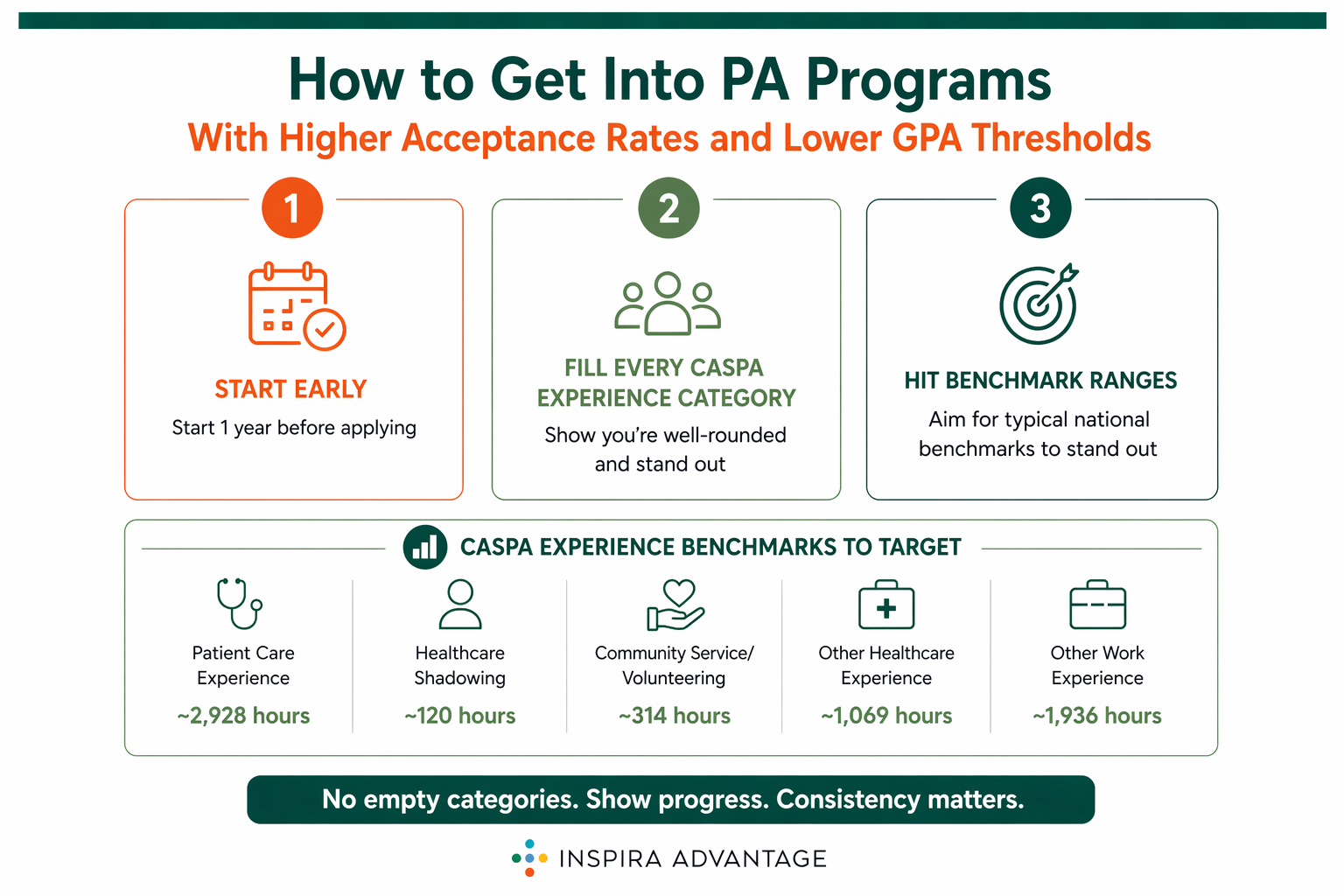
You can improve your chances of getting into PA schools with higher acceptance rates and lower GPA thresholds by starting at least one year before applying, pursuing diverse activities to fill each category on the CASPA application, and partnering with experts who can maximize your chances of admission.
Here’s a closer look at each of these strategies:
Start Your PA School Preparation at Least One Year Before Applying
If you have a lower GPA or limited clinical hours, time is your biggest advantage, even for schools with higher acceptance rates. You should begin your application at least a year before the cycle opens to give yourself enough time to identify gaps and fill them before the cycle opens.
Map your application against every CASPA experience category a year before your application is due: patient care, non-healthcare employment, extracurriculars, leadership, research, shadowing, teaching, and volunteer work. Mark each one as strong, developing, or empty.
Any category marked empty needs a concrete plan with a timeline attached to it. If you discover in March that you have zero volunteer hours and the application opens in April, you cannot fix that gap. Discovering it 12 months earlier means you can log meaningful hours without rushing.
Build a reverse timeline from your target submission date. Work backward to set monthly benchmarks for PCE hours, shadowing hours, prerequisite courses, and letter of recommendation requests.
Applicants who submit early in the CASPA cycle get reviewed first at programs with rolling admissions, so every month of lead time translates into a tangible advantage.
Fill Every CASPA Experience Category to Show You Are a Well-Rounded Applicant
Borgman encourages every applicant to have at least one entry in each CASPA experience category. A complete profile signals range and depth that clinical hours alone cannot demonstrate, especially at schools where many applicants have similar GPAs.
Here is what a complete profile can look like, with median benchmarks from the Physician Assistant Education Association (PAEA)'s first-year class data. These benchmarks represent what is typical for accepted students nationally.
However, at higher-acceptance-rate and lower-GPA programs, reaching these benchmarks can actually help you stand out, since many applicants in these pools fall below them:
Summer research assistant, semester faculty project
N/A
Teaching
Tutoring freshman students, mentoring new hires
N/A
How to Interpret These CASPA Experience Benchmarks
These benchmarks are not “elite” targets. Hitting these numbers means you are meeting what is “typical” nationally, but in the context of ‘easy’ PA programs, it can position you above many applicants with similar GPAs but weaker experience profiles.
If you can approach these benchmarks, you are not just competitive; you are differentiated.
If you cannot hit every benchmark, focus on two things:
Make sure no category is completely empty
Show progress and consistency in the areas where you are weaker
At schools with higher acceptance rates, applicants often look similar academically. A complete CASPA profile is what helps you stand out.
Get Expert Guidance on Your PA School Application Strategy
Preparing for PA school with a lower GPA or a "non-traditional" profile requires more than just checking boxes. It requires a strategy that keeps your application from being auto-rejected by a GPA filter. When your stats are near the minimum thresholds, knowing exactly which programs offer a true holistic review and how to frame your clinical hours for the highest return is the difference between an interview and a rejection.
Our PA school admissions consulting team specializes in helping "high-potential" applicants build a competitive edge from the ground up.
Whether you are struggling to explain a low science GPA or trying to make 1,000 hours of PCE stand out against applicants with double that, our advisors provide the "insider" perspective you need.
Want a quick assessment on where you stand right now? Take our free PA School Admissions Calculator to get personalized feedback on your chances of acceptance and specific recommendations for improving your profile before you apply.
Privacy guaranteed. No spam, ever.
FAQs
Can I Get Into PA School With a Low GPA?
Yes, you can get into many PA schools with a low GPA. Here are some schools that have the lowest average matriculant GPAs:
A.T. Still University of Health Sciences Central Coast Physician Assistant Program (average overall GPA of 3.40; average science GPA of 3.20)
Barry University Physician Assistant Program (average overall GPA of 3.40)
Brenau University Master of Science in PA Studies (average overall GPA of 3.40; average science GPA of 3.30).
These programs have the lowest average matriculant GPAs. You will also have a better chance of getting into programs with lower GPA minimums. Several programs set their GPA minimums at 2.75-2.80:
Brenau University Master of Science in PA Studies
Rosalind Franklin University Master of Science in PA Studies
South College Master of Health Science in PA Studies (Asheville and Orlando campuses)
Lincoln Memorial University Master of Medical Science in PA
Alvernia University Physician Associate Program
Most PA programs set their floor at 3.0, so these programs offer a wider entry point for applicants with lower GPAs.
Can I Get Into PA School With a Low GRE Score?
Yes, you can get into PA school with a low GRE score because most PA programs no longer require the GRE. The broader trend across PA education has moved decisively away from the GRE, with many programs replacing it with the PA-CAT or Casper, while others have dropped testing entirely.
If a program on your list does require the GRE and you have a low score, retake the exam or remove that program from your list.
How Hard Is It to Get Into PA School?
Getting into PA school is difficult. While the overall PA school acceptance rate for the past five years has been around 38.1%, the most selective programs accept fewer than 3%. According to the PAEA End-of-Cycle Reports, the 2024 to 2025 application cycle saw over 34,600 applicants competing for roughly 13,200 seats, meaning more than 21,000 qualified applicants walked away without an acceptance.
Several factors drive the difficulty. Applicant volume has grown faster than available seats, tightening competition each cycle. Admitted student benchmarks keep rising: the median admitted student brought approximately 2,928 PCE hours and 120 hours of PA shadowing in a recent admissions cycle. These numbers are only going to climb as application volume grows and competition increases.
What PA School Is the Easiest to Get Into?
The easiest PA school to get into is the Lipscomb University Physician Assistant Program, which reports the highest acceptance rate among accredited programs at approximately 67.7% to 74.0%.
What Are the Least Competitive PA Schools in Florida?
The least competitive PA schools in Florida are Miami Dade College Physician Assistant Program (approximately 55% acceptance rate), AdventHealth University Physician Assistant Studies Program (approximately 34%), and Barry University Physician Assistant Program (below 20%).
Which PA Schools Do Not Require Patient Care Hours?
Several programs do not require but recommend patient care hours, including the following:
A.T. Still University of Health Sciences Central Coast Physician Assistant Program
AdventHealth University Physician Assistant Studies Program
Baylor College of Medicine Physician Assistant Program
Duquesne University Physician Assistant Program
Marshall University Joan C. Edwards School of Medicine Physician Assistant Program
UT Southwestern Medical Center Physician Assistant Studies Program
However, ‘not required’ does not mean not expected. The median admitted PA student nationally brings approximately 2,928 PCE hours. Applying with zero hours puts you at a severe disadvantage. If you have limited PCE, target programs that explicitly do not require it, bring a high GPA to compensate, and use your personal statement to explain what alternative experiences prepared you for clinical work.
Are Online PA Programs Easier to Get Into?
No, online PA programs are not easier to get into. Admission requirements for hybrid PA programs match their traditional on-campus counterparts, including GPA minimums, prerequisites, and clinical hour expectations.
Fully online PA programs are extremely rare. Most "online" options are hybrid models requiring in-person clinical rotations and campus immersions.
Arush Chandna is the Co-Founder of Inspira Advantage and a nationally recognized expert on graduate school admissions. Arush has used his 12+ years of experience in higher education to help 10,000+ applicants get into their dream graduate programs.







.svg)


