Get in touch: +1 888 453 5021



Submit your CASPA application in May or June of your application cycle. Submitting between May and June increases your chances of landing interviews because many programs use rolling admissions and fill seats as applications arrive.
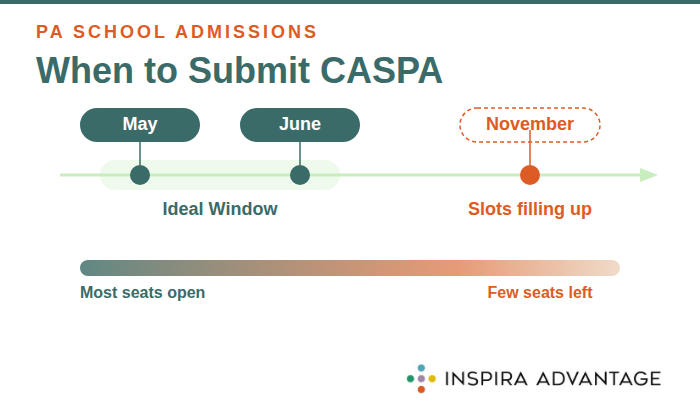
The majority of top-tier PA programs review applications and extend interview invites as they receive them, meaning that by the time a November deadline rolls around, a program may have already filled a significant portion of its interview slots.
The video below explains the best PA application timeline to maximize your admissions odds.
Here’s a comprehensive table compiling all the key dates and events from the 2026-2027 CASPA Cycle Timeline.
PA programs will extend interview invitations to competitive candidates. You must prepare for your interview, as this is when admissions committees get to see who you are, beyond numbers. Following the interview, the admission committee will complete its final rounds of evaluation and release its decisions.
Once you’ve received your application letter, you can weigh your options and decide which PA program you’d like to attend.
Once you complete all your prerequisites, you can submit your Central Application Service for Physician Assistants (CASPA) application.
This is the first step to becoming a PA is submitting your CASPA application. Your CASPA application includes your:
CASPA also verifies and recalculates your GPA using its own formula, which means your CASPA GPA may differ from what appears on your transcript. Programs see both your institutional GPA and CASPA's recalculated version, so expect that discrepancy and don't panic when you notice it.
CASPA typically opens for new applications in late April and begins accepting submissions by early to mid-May. The exact dates shift each year slightly, so check the CASPA website in March for confirmed cycle dates.
Most competitive applicants submit within the first two to four weeks after the cycle opens, since many PA programs use rolling admissions. Submitting in May or early June puts your application in front of reviewers before interview slots fill up.
Program-specific deadlines vary widely. Some close as early as September, while others accept applications through March of the following year. CASPA lets you search individual program deadlines within the portal, so map out every program's cutoff date before you start.
CASPA charges a fee for your first program designation and a reduced fee for each additional program. For the 2026–2027 admissions cycle, the first program costs $185, and each additional program costs $66.
Fee assistance is available through CASPA's Fee Assistance Program (FAP) for applicants who meet income eligibility requirements. Apply for FAP before you submit your application, as the discount applies at the time of payment.
CASPA verifies your application before sending it to programs. Verification takes approximately four to six weeks during peak submission periods in May and June. Once verified, each program on your list receives your complete application and handles its own review timeline independently.
Some programs require supplemental applications in addition to CASPA. Watch your email closely after submitting, as supplemental requests often arrive within days and come with their own deadlines.
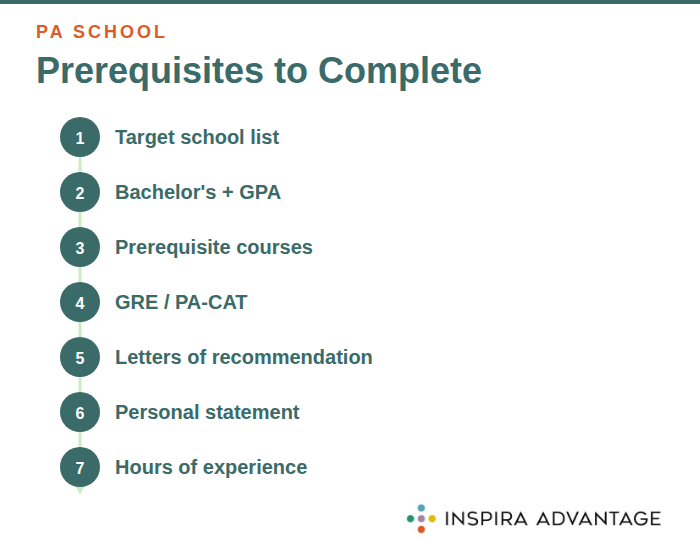
Different PA schools tend to have different requirements. But in general, you should complete the following before you can apply:
Before you apply to every PA school out there, you should consider your school priorities and create a list of target schools. Consider factors such as location, size, program length, and school culture.
If you find it difficult to narrow down your choices, use our interactive PA school selection quiz tool below to help you find the right PA schools for you.
For additional application support for PA admissions, get professional help from counselors with over 15 years of experience to strengthen your strategy.
PA programs require students to acquire a bachelor’s degree before they can apply. While there aren't any particular specifications about the subject of your degree, many students pursue a science-related major to meet the handful of prerequisite courses that must be completed by the time of application.
PA schools also have minimum GPA requirements for admission, which vary by school. You can find this information on the PA school's official website. It's important to keep this requirement in mind as you pursue your undergraduate degree.
You must complete several college-level courses to be eligible to apply. Common prerequisite courses for PA school application include:
These courses are designed to ensure that applicants have a solid foundation in the medical and science fields.
Many PA programs no longer require the GRE. As of May 2026, only 78 PA programs require the GRE. This means roughly 23% of all PA programs still require the GRE.
Build your school list first, then decide on the GRE. If even one program on your target list requires scores, plan to take the exam so you don't eliminate options late in the cycle.
Some programs require the GRE, some list it as optional, and some have removed it entirely. Check each program's admissions page and CASPA listing individually rather than relying on aggregated lists, because requirements shift between cycles.
The PA-CAT (Physician Assistant College Admission Test) is a specialized exam designed to assess prerequisite science knowledge that PA programs consider critical for student success.
Unlike the GRE, the PA-CAT covers nine core science subjects:
If those subjects look familiar, they should. They reflect the prerequisite coursework most PA programs require, which makes the PA-CAT a direct measure of whether you absorbed what those courses taught.
Check each program on your list to see where the PA-CAT fits within its requirements. If none of your target schools use it, you can skip it. If even one requires it, incorporate study time into your timeline.
To support your academic credentials, submit three to five recommendation letters from a professor, instructor, or healthcare professional with whom you’ve worked.
Choosing the right recommenders is key to a successful PA school application. Look for individuals who know you well, both personally and professionally, such as past professors, instructors, or supervisors. Make a lasting impression during your undergraduate studies and maintain contact to ensure they can provide a strong letter of recommendation.
A PA personal statement is your opportunity to let the admissions committee know more about:
Before you start writing, think about your motivations, goals, and past achievements. Include why PA school is valuable to you and what career you hope to attain from your education.
Most PA programs require direct patient care experience (PCE) before you apply, and the number of hours you need depends on where you're aiming. Program minimums range from 500 to 2,000 hours, but minimums and competitive totals are two very different numbers.
According to PAEA data, accepted PA students had a median of 2,928 hours of patient care experience. That number shows what actually gets people admitted, not what the program website lists as the minimum.
Most top PA schools require at least 1,000 hours of direct patient care. Aim for at least 3,000 hours to position yourself as a competitive applicant at the widest range of programs.
CASPA verification typically takes two weeks once your application reaches "Complete" status, but it can take up to four weeks during peak periods. Peak season runs from June through August, when the strongest applicants submit. Plan for the full four-week window in your timeline rather than hoping for a faster turnaround.
CASPA will return your application if significant mistakes are found during verification. The most common errors are problems with transcript entries. Frequent causes include failing to report a college or university where you earned credit, listing all courses under one semester instead of dividing them by term, missing or incorrect department prefixes and course numbers, vague or incorrect course titles, and missing courses like non-credit labs, PE courses, withdrawn courses, or repeated courses.
No, it’s not too late to apply to PA school in August, but you've lost the early advantage at rolling admissions programs. CASPA allows schools to choose deadlines ranging from June 15 to April 1 of the following year, and most schools set their deadlines in the fall. Plenty of programs will still accept and review your application.
It can take PA programs anywhere from a few weeks to several months to review your application. Every school has its own reviewing process, so the timeline varies. There is no universal review period because the answer depends on whether a program uses rolling admissions, when in the cycle you submitted, and how that specific program structures its review process.
To increase your chances of acceptance to PA school, apply to eight to 12 programs, submit early in the cycle, and make sure every component of your application exceeds minimums rather than just meeting them. Don’t apply to programs where your numbers fall below the admitted class averages. Review each school's average GPA, healthcare experience hours, and GRE requirements. If your statistics are below the program averages, your chances of admission are lower.


.svg)


