Get in touch: +1 888 453 5021





I’ve seen hundreds of applicants with eight or nine CASPA entries who can't explain what any single experience taught them about becoming a PA. That’s because most pre-PA students build their extracurricular profile backward. They fill their schedule with as many activities as possible and then figure out the story later.
The difference between a competitive profile and a forgettable one almost always comes down to whether your activities tell a cohesive story that proves to admissions committees you've already built the clinical awareness, leadership, and interpersonal skills the profession demands. The guide below breaks down which activities carry the most weight and how to position each one so your application reads like a future PA rather than just a busy student.
The best extracurriculars for PA school build clinical awareness and demonstrate you can handle the interpersonal demands of patient care.
PA admissions committees care far less about the quantity of activities on your Centralized Application Service for Physician Assistants (CASPA) application and far more about whether those activities show something meaningful about how you'll function as a provider.
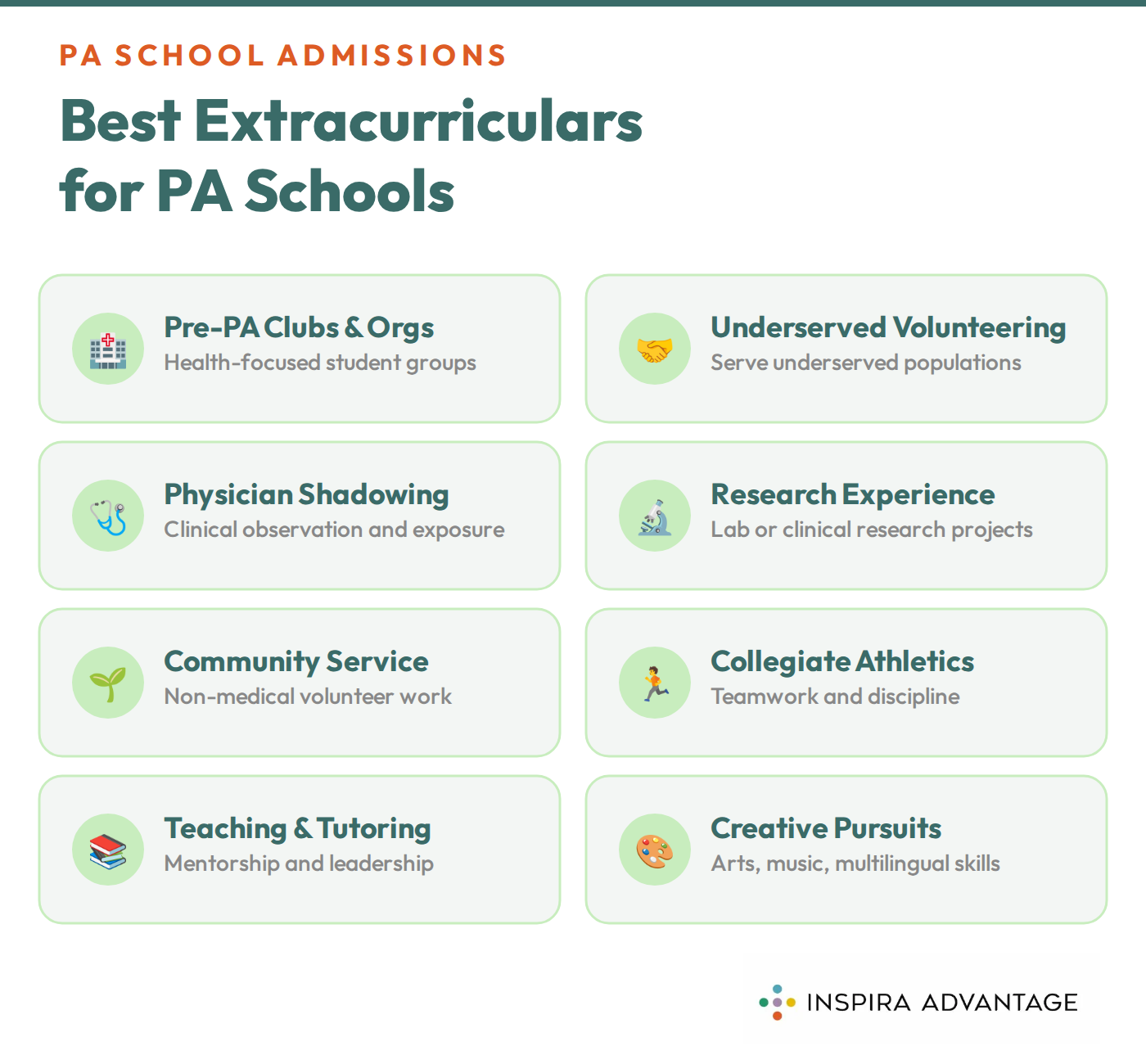
Joining a pre-PA club or pre-health society is one of the best ways to show your commitment to becoming a PA. Health-focused student organizations can differentiate your application from other candidates, such as:
If your school doesn't have one, starting a club demonstrates leadership and initiative.
What matters most is what you do within the organization. Here are some examples of how these activities affect your skills and abilities:
PA schools look for candidates who are dedicated to helping others. And volunteer work with underserved populations is one of the strongest ways to showcase your commitment to healthcare and community impact.
Volunteering at a free clinic, food bank, or community health fair demonstrates that your interest in medicine extends beyond earning a degree.
Admissions officers notice when your volunteer work aligns with the populations PAs most frequently serve. For example, these volunteering experiences all simulate real PA practice environments:
You don't need to record thousands of hours at a place you think looks good. You want to show consistent, longitudinal, and meaningful involvement over time.
Shadowing a practicing PA is one of the few extracurriculars that directly prove you understand what the job actually looks like day to day. To be competitive, aim for at least 180 hours before you apply. Anything less makes it hard to discuss the profession with the specificity that admissions committees expect.
Shadowing is a passive activity, meaning you observe a healthcare professional interacting with patients and making clinical decisions rather than providing direct care yourself. The value of shadowing lies in what it teaches you about the PA role and how it refines your "why PA" narrative for your personal statement and interviews.
Shadow across multiple specialties whenever possible. Spending all 180 hours in one family medicine clinic gives you only one perspective of the profession. Splitting up your time between primary care, surgery, and emergency medicine shows admissions committees that you've explored the breadth of PA practice and made an informed decision about pursuing the career.
Continue logging three to four shadowing hours per month, even after you reach your target. And keep going until you're accepted. Ongoing shadowing demonstrates sustained interest in the profession rather than a one-time checkbox, and it gives you new observations to reference in interviews months after you submit your CASPA.
PA programs value applicants who understand evidence-based practice. You don't need a published paper. Programs want to see that you can think critically about clinical questions and contribute to a team working toward answers.
For example:
The key is your ability to articulate what you learned and how the experience connects to your understanding of patient care.
If you're short on time, look for faculty-led research projects at your university that need undergraduate assistants. Many of these roles require only five to 10 hours per week.
Even a single semester of involvement gives you meaningful interview talking points that can leave a good impression. However, always aim for longitudinal involvement.
PA admissions committees like to see applicants with diverse interests because involvement in non-medical extracurriculars shows you're a well-rounded individual who can handle multiple responsibilities. Tutoring, mentoring youth, coaching a sports team, or volunteering at an animal shelter all tell a different part of your story.
In our PA application process webinar, Inspira Advantage counselor Taylor Hayes, a physician assistant and assistant professor at Emory University School of Medicine, provides her insight on non-medical experiences:
"Your admissions committee really wants to see someone who has interest outside of just being a PA,” she says. “They want to see your hobbies and the things that you're interested in. Having an interest and outlets outside of PA school really helps you to become a good clinician and also helps you to not get so burnt out."
Non-medical volunteering shows skills that clinical hours alone can't capture.
For example:
The mistake most applicants make is treating these activities as filler. Choose one or two non-medical commitments you care about and describe the real impact they had on you.
Admissions committees can spot performative volunteering instantly.
Being a student-athlete teaches discipline, teamwork, and time management, all of which are important skills in a healthcare setting. If you balanced a competitive sports schedule with pre-PA coursework, that time management ability speaks directly to your readiness for the intensity of PA school.
Varsity, club, and intramural sports all count here. The level of competition matters less than what you can say about the experience. A club rugby player who organized team logistics and managed a roster of 30 athletes has a stronger CASPA entry than a varsity swimmer who only lists "competed in meets."
Focus your description on:
Those are the skills that translate to clinical rotations and team-based care.
Teaching experience demonstrates both communication skills and subject mastery. CASPA lists teaching experience as one of the nine types of experience on your application, so listing it here won't compete with your other extracurricular entries for space.
Peer tutoring in anatomy, physiology, or organic chemistry is the most directly relevant option. With this, you're reinforcing the exact foundational knowledge that PA programs expect you to have while demonstrating that you can explain complex concepts clearly.
You could also list:
If you've done any patient education during clinical work, that experience bridges teaching and healthcare in a way admissions committees love to see.
Explaining discharge instructions to a patient, walking a family through a new medication regimen, or leading a diabetes education group at a community center all demonstrate the communication skills PAs use every single day.
Artistic pursuits like writing, painting, and music strengthen a PA application because creativity plays an important role in medicine.
A published short story or a photography portfolio won't replace clinical experience. But it does add a new layer to your profile, making you memorable in a stack of applications that all emphasize the same clinical milestones.
Translation skills, international travel experience, and multilingual ability are also significant advantages, as hospitals consistently need staff who can communicate with diverse patient populations.
If you speak a second language fluently or have studied abroad, frame that experience in terms of how it prepared you to serve patients from different cultural backgrounds.
Programs with missions focused on health equity and access will find that kind of experience especially relevant. Even basic conversational ability in Spanish or Mandarin gives you a practical edge that many competing applicants lack.
I’ve spoken with our top PA advisors, who have reviewed hundreds of CASPA applications, and the most common problem isn't a lack of activities. It's redundancy.
Students stack three or four clinical experiences that all demonstrate the same skill, then leave entire CASPA categories empty. It’s like writing the same sentence five different ways and calling it an essay.
Imagine an applicant who spent two years as a CNA and then added hospital volunteering and clinical shadowing in the same specialty. They built a profile that says "I can work in a healthcare setting" three times without ever demonstrating leadership, cultural competency, or community engagement.
Selecting extracurriculars strategically means identifying what your application doesn't say yet and choosing the activity that says it.
To help here, I’ve put together tips for choosing the right extracurriculars for PA school:
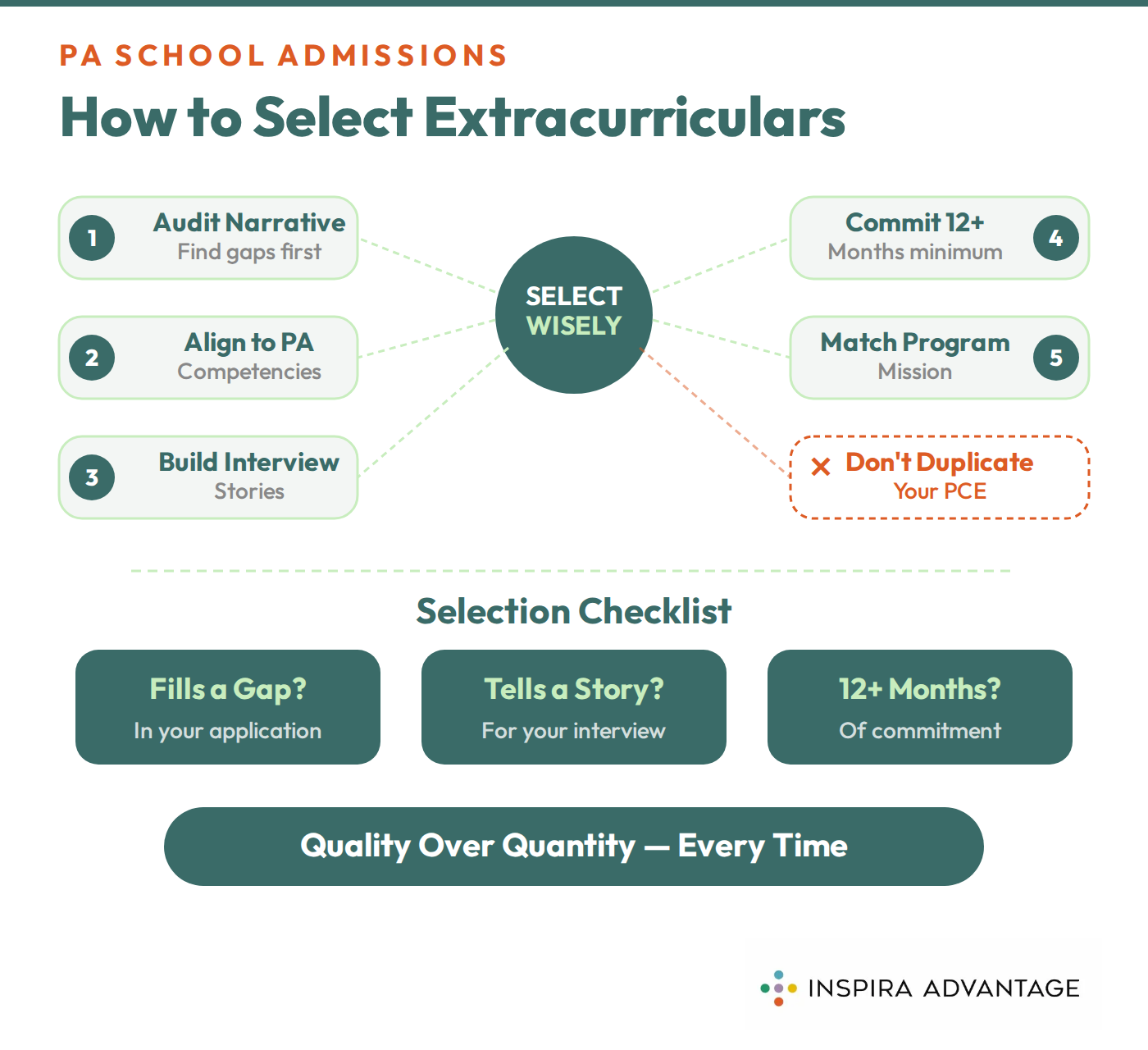
Open a blank document in Microsoft Word or Google Docs and list every experience you plan to include on your CASPA application. Write one sentence next to each entry describing the primary skill or quality it demonstrates. Look at the list as a whole and ask yourself what's missing.
Most pre-PA applicants end up with a profile heavy on clinical competence and light on everything else. You'll likely see plenty of evidence that you can work in a healthcare setting and follow protocols. What you probably won't see is evidence of:
Use those gaps as your roadmap. If your application shows no leadership experience, join an organization where you can advance to an officer role within a year. If you have no community-facing service, find a volunteer commitment that connects you with underserved populations.
Selecting extracurriculars without first identifying what's missing leads to poorly optimized entries.
Connect every extracurricular you're considering to one of PAEA's six core competencies before you commit your time. If an activity doesn't clearly connect to at least one, it's not strategic enough to pursue.
These seven competencies represent the foundational skills and professional qualities that every PA is expected to carry across specialties, settings, and career stages.
Before adding each extracurricular activity to your list, ask yourself which competency the activity lets you demonstrate.
For example:
Connecting extracurriculars to competencies also makes your CASPA descriptions much easier to write. When you know exactly which quality an experience is supposed to demonstrate, your 600-character description stays focused and specific instead of wandering through a list of tasks you performed.
Admissions interviews reward applicants who can tell specific, detailed stories about real experiences. Generic answers like "I'm passionate about helping people" get forgotten within minutes. A cohesive story about a specific moment during a specific activity stays with an interviewer.
Choose the extracurriculars with a high likelihood of producing those moments. Roles that put you in direct contact with people, especially in situations involving problem-solving or emotional complexity, give you the strongest material.
Running a tutoring program for first-generation college students will give you better interview stories than attending monthly meetings for a pre-health honor society.
Ask yourself a simple question before committing to any activity: Will I be able to describe a single moment from this experience that changed how I think about patient care, teamwork, or my own limitations? If the answer is no, keep looking.
Sustained involvement shows a clear dedication. A semester-long stint in a club tells admissions committees you showed up for a while. But two years of consistent engagement with increasing responsibility tells them you're the kind of person who commits and grows.
You should keep a detailed record of your experiences as you go, including all hours, role descriptions, and reflections about each experience. Tracking your involvement in real time ensures you can accurately describe your progress when it's time to fill out CASPA. Months later, trying to reconstruct a timeline from memory always results in vague, underwhelming descriptions.
Plan your extracurricular involvement with your application timeline in mind. If you're applying in June 2027, activities you start in fall 2025 give you nearly two years of material. Activities you start in spring 2027 give you a few months of surface-level participation that admissions committees will immediately recognize as last-minute padding.
Not every PA program values the same things. Some programs emphasize primary care in rural communities. Others focus on urban underserved populations. Your extracurriculars should reflect the priorities of the programs you're actually applying to.
Find the mission statements of your top five target PA programs and highlight the themes that appear most frequently. This is a great task to ask AI tools to help you with, which can save you time.
If three of your target schools mention serving medically underserved communities, volunteer work at a free clinic or a rural health outreach program becomes a strategic priority rather than just a nice addition.
If a program emphasizes interprofessional collaboration, leadership in a multidisciplinary student organization carries more weight than solo research.
In our PA school application webinar, Madison Borgman, an Inspira Advantage counselor and graduate of UT Southwestern Medical Center’s PA program, explains more about leadership in your application:
"Leadership is something that most every single school is going to be looking for, so that's one of the sections on that experience profile that you absolutely want to have something filled out for,” Borgman says. “Choose a few meaningful experiences because leadership is a quality that all of us have to have to be good clinicians."
Tailoring your extracurricular profile to align with specific program missions gives you excellent talking points for essays and interviews in which programs ask, "Why our school?" Applicants who can connect their experiences directly to a program's stated values demonstrate a level of intentionality generic applicants can't match.
Patient Care Experience (PCE) and healthcare experience are by far the most important CASPA categories, and other experiences matter only insofar as they speak to a particular PA quality. If your PCE already demonstrates clinical competence and patient communication, selecting extracurriculars that reinforce those same qualities is a waste of an opportunity.
An applicant working as a CNA who then volunteers as a hospital greeter is stacking two healthcare-adjacent experiences that tell a similar story. Replacing that volunteer role with youth mentoring, a leadership position in student government, or community organizing adds an entirely new dimension that the CNA hours can't provide.
Think of your CASPA application as a portfolio. Each entry should show something the other entries don't. If two experiences overlap significantly in the skills they demonstrate, cut the weaker one and replace it with something that broadens your profile.
Admissions committees reviewing 2,000+ applications remember applicants who showed range, not applicants who proved the same point five different ways.
Inspira Advantage experts can help with your PA school applications. Work with an advisor who has 15+ years of experience helping students get into PA school with the right extracurricular activities.
You need at least five strong extracurricular activities and a combined total of 7,260 average hours on your CASPA application. With nine experience categories on CASPA, anything less leaves too many gaps for admissions committees to notice.
Here’s a look at each CASPA extracurricular experience category.
In our PA school webinar, Borgman shares her advice on listing experience in each category:
"I really encourage all the students that I work with personally to try to have something in all of those categories,” she says. “Having something in each one of those sections really showcases how you're a well-rounded applicant. They wouldn't have those headers on there unless it was somewhat important to them to see that in certain students."
Borgman advises filling as many sections as possible with meaningful activities to give your application more depth. You need to convince the admissions board why you’d make a great candidate for their PA program.
The Physician Assistant Education Association’s (PAEA) latest program report outlines the number of extracurricular hours to aim for in each experience category, shown in the table below.
Extracurriculars are important in PA school applications because they’re the part of your CASPA application where you start proving you belong in the profession.
In the 2024-2025 application cycle, 34,625 applicants competed for 12,636 seats. That translates to roughly a 36.49% overall PA program acceptance rate in the U.S. Considering that many highly academically qualified candidates didn’t get in, having the right extracurriculars can help set them apart.
Your extracurricular activities tell the admissions committee how you choose to spend your free time and whether you've built the experience and skills required to become a good PA.
Every strong PA school personal statement needs specific stories that show who you are and why you chose the PA path. Extracurriculars give you a second pool of material beyond clinical work to draw from.
For example, an applicant who can reference a leadership challenge in a pre-PA club, a shift in perspective during community volunteering, and a clinical encounter from PCE work has three distinct narrative threads. An applicant who only draws from clinical experience has one.
In your PA interview, your interviewer will likely ask about:
Your non-clinical experiences often give you more compelling answers because the stakes were personal rather than professional.
Think about the difference between "I disagreed with a coworker about a patient handoff" and "I led a fundraiser that fell apart two weeks before the event and had to rebuild the plan from scratch." Both show problem-solving. The second one describes character in a way that's harder to fake and easier to remember.
For more information on the entire PA school application process, watch the video below:
PA schools want applicants who have diverse interests because involvement in non-medical extracurriculars demonstrates that you're a well-rounded individual who can handle multiple responsibilities.
Extracurriculars also show your core values. For example:
Non-clinical experiences help demonstrate that you've developed the personal traits and qualities necessary to provide comprehensive patient care as a PA.
Admissions reviewers know that clinical skills can be taught during the program. Empathy, initiative, and the ability to connect with people across different backgrounds are much harder to develop in a classroom. Extracurriculars are where you prove those qualities already exist.
Start building your extracurricular profile during your first year of college. Admissions committees want to see sustained involvement and growth over time.
The timeline below maps extracurricular milestones to each academic year so you can plan around your coursework and PCE accumulation simultaneously.
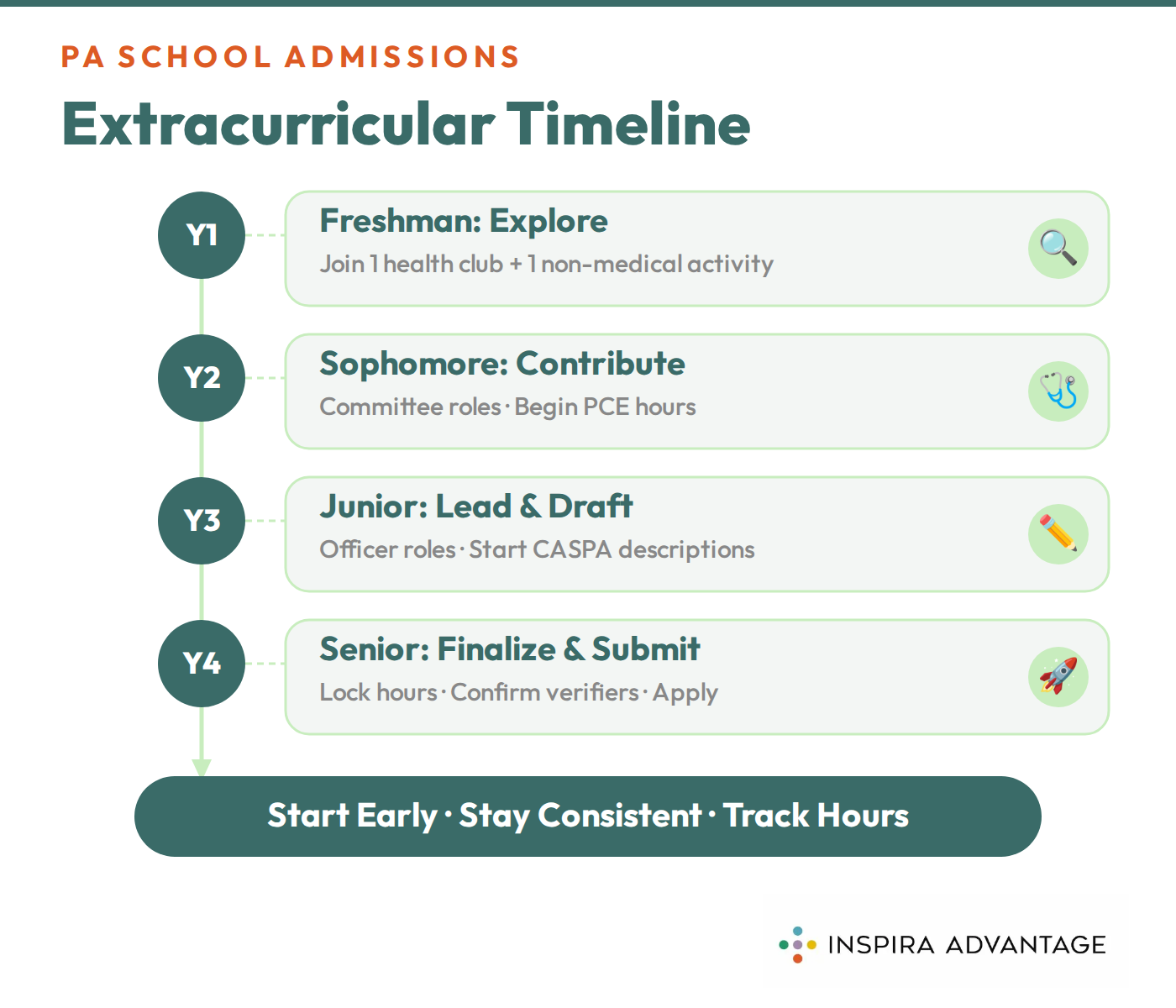
Use your first year to explore broadly and identify the activities worth committing to in the long term. Attend club fairs, sit in on meetings for pre-PA or pre-health organizations, and try a few volunteer opportunities with low weekly time commitments. You're not building your CASPA profile yet. You're figuring out what resonates.
Join at least one health-related student organization and one non-medical activity that interests you. The health-related club builds your professional network and exposes you to PA-specific mentorship early. The non-medical activity adds dimension to your application and prevents your entire profile from reading like a single-track clinical checklist.
Start a simple tracking system before you accumulate anything worth tracking. Keep a detailed record that includes all:
A spreadsheet with columns for activity, date, hours, and a one-sentence reflection takes five minutes per week and saves you from reconstructing years of involvement from memory when CASPA opens.
Don't overcommit. Three or four exploratory activities during freshman year is plenty. You're also adjusting to college-level coursework and possibly beginning your prerequisite science sequence.
Narrow your involvement to two or three activities and shift from showing up to contributing. Volunteer for committee work, propose new initiatives, or take on coordination roles that give you responsibility beyond attendance. The goal during sophomore year is to build credibility within an organization that positions you for leadership later.
Sophomore year is also when most applicants begin accumulating PCE hours through CNA, EMT, or medical assistant work. Balance your extracurricular commitments against that clinical schedule.
Dropping an extracurricular to prioritize PCE hours is a fair tradeoff. But don't abandon everything outside of clinical work. Maintaining at least one consistent non-clinical activity preserves the breadth of your application.
Document specific moments and outcomes as they happen. Write down:
These notes serve as the basic material for CASPA descriptions that will read like real reflections rather than generic task lists.
In your junior year, pursue leadership roles within the organizations where you've built a track record. Apply for officer positions, board seats, or project lead roles. If you hold a leadership position within any extracurricular activity, classify those hours under CASPA's leadership experience category to strengthen your application.
Formal titles aren't the only way to demonstrate leadership. You can demonstrate leadership through:
What matters is your ability to point to a specific outcome you drove and explain the decisions you made along the way.
Junior year is when your extracurricular profile should start telling a cohesive story. Step back and evaluate whether your activities collectively demonstrate the qualities PA programs care about:
If a major gap exists, you still have time to add one strategic activity before your application cycle.
Begin drafting CASPA experience descriptions during the spring semester of junior year if you plan to apply the following summer. Use clear active verbs to describe your role, quantify achievements when possible, and connect each activity to skills relevant to being a PA. Writing early gives you months to revise instead of days.
Senior year strategy depends entirely on when you plan to submit CASPA. If you're applying during senior year, follow these steps:
If you're planning a gap year, senior year becomes your opportunity to deepen existing commitments and add one final high-impact experience.
Maintain your extracurricular involvement through the application cycle regardless of your timeline. An activity that shows an end date months before your submission makes it look like you dropped it once it served its purpose.
CASPA allows you to add new experiences after submission, though programs will only see those updates if they haven't already downloaded your application for review.
For gap-year applicants, plan how your extracurriculars will continue outside a college campus. Campus-based clubs and organizations won't be available to you, so find community-based alternatives before graduation.
Transition your volunteer work to a local nonprofit, join a professional organization such as your state's PA association, or find a community health initiative that aligns with the service themes already present in your application.
PA schools prefer clinical experience over volunteering when evaluating the core requirements of your application. Volunteering doesn't replace your clinical hours, but it serves a different and complementary purpose on CASPA. Admissions committees search for candidates dedicated to helping others, and volunteer work with underserved populations is one of the strongest ways to showcase that commitment. Build your PCE hours first; then add in volunteering to round out your profile.
Patient care experience counts for PA school when the role involves direct, hands-on interaction with patients under the supervision of a healthcare provider. Entry-level roles that commonly qualify include EMT, CNA, medical assistant, phlebotomist, dental assistant, and physical therapy aide, while higher-level roles like nurse, paramedic, and physical therapist also qualify. Roles that don’t qualify include hospital volunteering without direct patient care duties, medical scribing, administrative medical assistant work, research without patient contact, and shadowing.
Virtual healthcare experiences can count for PA school, but only if they are structured, legitimate, and properly documented. Pre-PA students considering virtual shadowing should check with the programs they're applying to and confirm they accept that type of experience. Most PA programs prefer in-person shadowing and will give it greater weight during review. Virtual shadowing works best as a supplement to in-person hours rather than a replacement, especially for applicants who want to explore specialties they can't access locally.
You can technically get into PA school without healthcare experience, but your odds increase significantly with it. The PA profession was originally designed around applicants with significant clinical backgrounds, and that expectation remains deeply embedded in most programs' admissions criteria. Applying without any healthcare experience puts you at a serious competitive disadvantage.
Dr. Jonathan Preminger was the original author of this article. Snippets of his work may remain.


.svg)


