Get in touch: +1 888 453 5021




Below is a list of the top 20 PA schools in the USA, their acceptance rates, average GPAs, average GRE scores (for those schools that require it), and 5-year first-time Physician Assistant National Certifying Examination (PANCE) pass rates.
Acceptance rates are approximate, as many PA programs do not publish exact data each year. Average GPA and GRE scores (for programs that require the GRE) are based on available matriculant data from the Centralized Application Service for Physician Assistants (CASPA) PA Explorer.
We ranked these programs based on the factors that shape your actual education and career outcomes:
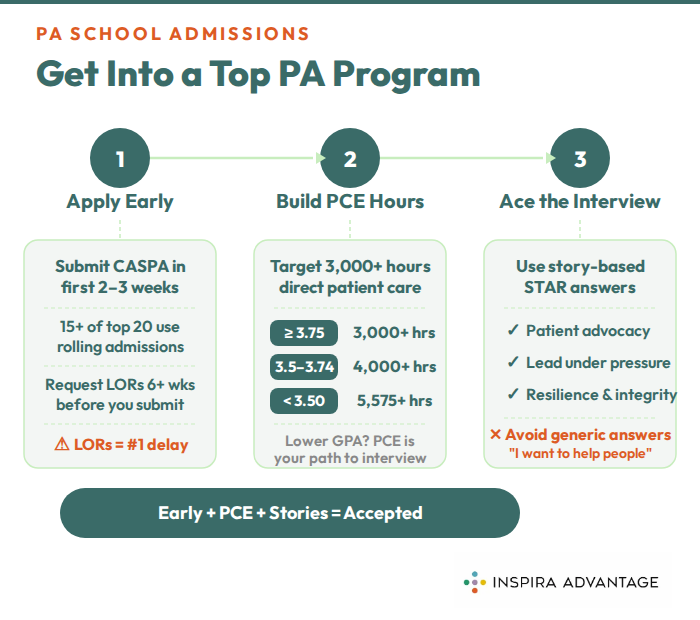
Getting accepted to a competitive PA school requires early preparation, 3,000+ hours of Direct Patient Care Experience (PCE), and a strong interview that involves story-based answers.
Here’s a closer look at these tips:
We recommend you submit your CASPA application within the first two to three weeks after the cycle opens. This is why one of our expert PA admissions consultants advises students to apply as early as possible:

At least 15 of the top 20 PA programs use rolling admissions, meaning they review applications and fill interview slots as applications arrive.
Programs with rolling admissions review and fill seats in real time, so submitting your application two months after the cycle opens puts you at a structural disadvantage compared to someone who submitted theirs two weeks after it opened.
The biggest bottleneck is letters of recommendation (LORs). Request them at least six weeks before you plan to submit and follow up weekly, because slow LOR submissions are the most common reason applications get held up.
Prepare your supplemental essays in advance by saving every essay you write and adapting responses across applications.
Ensuring your clinical hours complement or even make up for a lower GPA is one of the most effective ways to differentiate your application.
In our webinar on PA applications, Borgman notes that top-tier programs now frequently expect more than 2,500 hours of PCE. Relying on a high GPA alone is a risky strategy; when 2,000 applicants are fighting for 50 seats, "good grades" are simply the entry fee.
To actually secure an interview, you need clinical depth that proves you can handle the transition from a classroom to a high-pressure clinic.
And, if you have a lower GPA, these hours become your primary path to an interview. Fortunately, even the most prestigious PA schools with the lowest acceptance rates admit students with lower academic stats if their clinical experience demonstrates exceptional maturity and skill.
Use these benchmarks (based on PAEA 75th and 90th percentile data) to determine how many hours you need to stay competitive:
Your PA interview is not about your academics. The interviewer already knows your GPA, GRE, and experiences. Instead, they want to learn who you are, who you plan to be as a future clinician, and whether you fit their school's mission.
To stand out, you need to go beyond generic answers and show the person behind your application through specific, memorable stories.
Generic answers like “I want to help people” won’t work at this level. These programs are looking for future professionals who can:
Your stories should clearly demonstrate those traits. To prepare your interview note cards, do the following:
Here’s what a weak answer to the question “tell me about a time you advocated for a patient” would look like:
“I always try to advocate for patients by listening to them and making sure they feel heard. For example, during my clinical experience, I made sure to communicate well with patients and support them when they had concerns.”
Here’s what a strong, story-based answer looks like:
“During my time as a medical assistant, I worked with a patient who kept returning with uncontrolled hypertension despite being prescribed medication. During one visit, I noticed she seemed hesitant when the physician asked about adherence. After the appointment, I asked if she had any concerns, and she shared that she couldn’t afford her medication and had been rationing doses.
I brought this to the physician and suggested we explore lower-cost alternatives and connect her with a patient assistance program. We adjusted her prescription and coordinated with a social worker. At her follow-up, her blood pressure had improved, and she expressed relief that she could finally follow the treatment plan consistently.
That experience taught me that advocacy isn’t just about speaking for patients but about identifying barriers they may not feel comfortable sharing and taking initiative to address them.”
This answer is stronger because it walks through a specific, real situation, shows clear initiative and decision-making, and demonstrates how the applicant identified a hidden barrier and acted on it. It also ties actions to a concrete patient outcome and ends with reflection, showing clinical maturity rather than just describing the experience.
Getting into a top 20 PA program requires more than meeting minimum requirements. When most top PA schools accept fewer than 10% of applicants, the margin between an interview invitation and a rejection often comes down to how strategically you positioned your application. Our PA school admissions experts specialize in helping applicants target competitive programs.
Our advisors understand how admissions committees evaluate applications in real time and can help you determine the optimal submission window, identify which programs align with your profile, craft supplemental essays that speak directly to each program's mission, and prepare interview narratives that go beyond your CASPA experience section.
Want a quick read on where you stand before building your school list? Use our free PA School Admissions Calculator to get personalized feedback on your acceptance odds at competitive programs and specific recommendations for strengthening your profile.
You should aim for a 155 or above in both Verbal and Quantitative Reasoning and a 4.2 or above in Analytical Writing to remain competitive at the top PA schools that still require the GRE.
Most top US PA schools no longer require the GRE. Among the top 20, only a handful still require it:
Yes, you can get into elite PA programs with a low GPA, but only if you offset that weakness with exceptional strength in other areas. The average admitted GPA at top 20 programs ranges from 3.5 to 3.8, so anything below 3.5 puts you below the class average at most competitive schools.
A GPA below 3.2 makes admission to elite programs extremely unlikely without a compelling compensating factor, such as having substantial patient care experience.
PAEA data shows the median admitted student brings 2,928 PCE hours, but competitive applicants at top programs often exceed 4,000. If your GPA sits between 3.2 and 3.49, aim for the 75th percentile at 4,000 hours or above.
Pair your PCE with strong PA shadowing (120+ hours) and a clear upward grade trajectory in your most recent coursework.
Elite programs also value mission alignment. If your application’s narrative aligns with a program's stated mission and you can demonstrate that alignment through your experiences and personal statement, admissions committees have a reason to look past a GPA that falls below the class average.
A competitive applicant for the best PA schools in the country combines strong academics, deep clinical experience, and a compelling application narrative that connects their background to the PA profession. No single metric guarantees competitiveness. Admissions committees at top programs evaluate the full picture.
Here is what competitive looks like at elite programs:
No, PA school rankings do not reliably predict PANCE pass rates. Some of the highest-ranked programs post PANCE first-time pass rates around 90%, while less selective programs consistently achieve 98% to 100%.
The national average first-time PANCE pass rate has declined to approximately 92% in recent years, which means even well-regarded programs can fall below expectations in a given cycle.
PANCE pass rates reflect curriculum quality, faculty effectiveness, and student support during the didactic and clinical phases of a program. Rankings, by contrast, often weight factors like research output, institutional reputation, and selectivity, none of which directly determine how well a program prepares you for the licensing exam.
Evaluate PANCE performance using five-year trends rather than a single year's snapshot. One cohort can skew results in either direction.
Yes, most elite PA schools require patient care experience, but a few notable exceptions exist. Baylor College of Medicine Physician Assistant Program and UT Southwestern Master of Physician Assistant Studies Program do not have hard PCE minimums.
On the other hand, General healthcare experience (HCE) is not necessary for PA school admission. However, applying without PCE or HCE hours is a high-risk strategy, as the majority of applicants you’re competing against will have some.


.svg)


