June 4, 2026
May 8, 2026
8 min read

Does Undergrad Matter for Med School?

Author
Reviewer

Privacy guaranteed. No spam, ever.

How Much Does Your Undergraduate Experience Influence Med School Admissions?

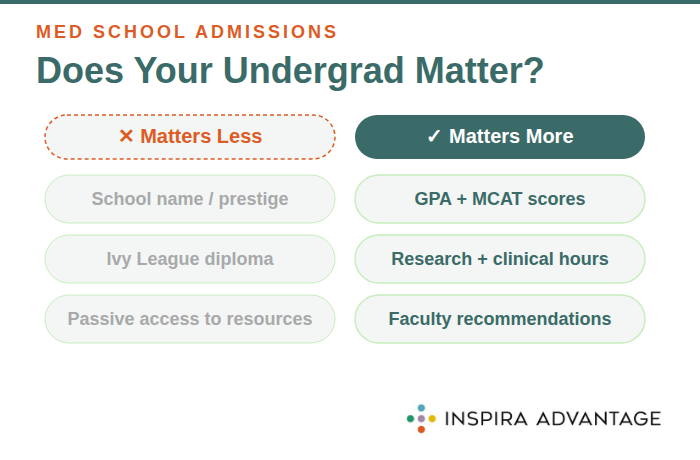
Infographic comparing what matters less versus what matters more in medical school admissions when it comes to undergraduate experience.

Your undergrad matters far less for the name on the diploma and far more for what you did while you were there. GPA and MCAT scores remain the two most important data points admissions committees use to evaluate foundational competitiveness. A 3.9 from a state school with a 520 MCAT will outperform a 3.5 from an Ivy with a 508 almost every time.

Where your undergrad does influence outcomes is through the opportunities it presents you. Schools affiliated with hospitals and medical programs create easier access to clinical experience, research positions, and faculty mentorship. Prestigious programs often provide stronger research facilities and extracurricular infrastructure that help students build competitive applications. 

But access and outcome are not the same thing. A student who seeks out research, builds clinical hours, and earns strong faculty recommendations at a lesser-known school will outcompete a passive student at a top-ranked university. Admissions committees care about what you produced during undergrad, not where you consumed it.

Does Undergrad Prestige Matter for Med School?

Prestige carries only limited weight in the initial review process for medical school admissions. The name on your diploma can give your application a slight boost, but it’s a small factor in the overall admissions decision. Treat it like a tiebreaker, not a ticket.

Private medical schools tend to weigh undergraduate selectivity more heavily than public medical schools, which prioritize state residency above almost everything else. So the impact of prestige depends partly on where you're applying. A student targeting top-five private programs will see a bigger difference than someone applying broadly to state schools.

Some admissions committees do pay attention to elite undergraduate programs like Stanford, Harvard, and Princeton because those schools already filter for high-achieving students. Surviving a rigorous academic environment signals something about your ability to handle medical school coursework. But that signal fades quickly when paired with a mediocre GPA or a below-average MCAT score.

Focus your energy on the variables you can control:

  • High GPA
  • A good MCAT score
  • Meaningful clinical hours
  • Extensive research experience
  • Excellent letters of recommendation
  • Extracurricular activities
  • A personal statement that highlights your academic growth and passion for studying medicine.

Those carry many times the weight of a school’s prestige on your application.

Does Undergrad Major Matter for Medical School?

Your undergraduate major typically doesn’t affect your medical school acceptance chances. Medical schools will consider any major, as long as you’ve completed your prerequisites.

However, your major can definitely influence your odds if you enrolled in a major you were very passionate about. And you can speak to this in your personal statement.

For example, say you had a passion for sociology and chose it as your major while completing your premed prerequisites on the side. During this time, you:

  • Spent three years studying health disparities in underserved communities
  • Wrote a senior thesis on access to preventive care in rural populations
  • Volunteered at a free clinic where you saw those disparities firsthand

Now compare that to a biology major who chose the degree because it had the most prerequisites in common. Both applicants checked the same boxes on paper, but the sociology major walks into an interview with a story that connects academic work, lived experience, and a clear motivation for pursuing medicine.

Roughly 60 percent of medical school applicants major in biological sciences, which means the applicant pool is saturated with similar academic profiles. A non-traditional major paired with genuine depth and a strong narrative can actually help you stand out in a crowded field.

Choose the subject that energizes you, complete your prerequisites with strong grades, and let your personal statement connect the dots.

Inspira Advantage provides expert help for your medical school application. We have 20+ years of experience helping students perfect their applications and gain admission to medical school.

Privacy guaranteed. No spam, ever.

What Factors Do Medical Schools Consider?

Every medical school runs its own admissions process with different priorities. The vast majority use holistic review, which balances your experiences, personal attributes, and academic metrics together rather than relying on any single number.

Infographic listing eight factors medical schools consider during admissions.

Knowing how each factor functions helps you spend your time where it actually matters.

GPA and Academic Performance

Your GPA is one of the two most important data points admissions committees use to measure baseline competitiveness. A strong GPA proves you can handle the volume and pace of medical school coursework.

Many competitive applicants land at a 3.70 or above, but committees also value upward trends. A rough freshman year followed by three semesters of near-perfect grades tells a recovery story that resonates. Aim for a high GPA above almost everything else on your application.

MCAT Score

The MCAT is the great equalizer across undergraduate institutions. A student from a small regional college and a student from Duke University sit on the same playing field once the scores are posted.

Your MCAT validates or undermines your GPA, so approach prep with the same intensity you'd give a full course load. A high score from a lesser-known school can absolutely override any perceived prestige gap.

Extracurricular Activities and Volunteerism

Extracurriculars reveal who you are when no one is grading you. Clinical volunteering, research, leadership roles, and community service each demonstrate a different dimension of your readiness for medicine. Depth beats breadth every time.

 A student who spent two years in one research lab and can speak fluently about findings will outshine someone who padded six activities across a single semester. Admissions committees spot surface-level involvement quickly. Pick the work that aligns with your actual interests and stay long enough to produce real results.

Personal Statement and Secondary Essays

Your medical school personal statement and secondary essays deliver something GPA and MCAT scores never can: context. A compelling narrative explains why you want medicine, threads your experiences into a coherent story, and shows how you think about service and patient care.

Write about specific moments that shaped your decision. Vague statements about "wanting to help people" won't separate you from the other 50,000 applicants in the cycle. The strongest essays make readers feel like they already know you before the interview.

Learn how to craft the perfect personal statement by watching the video below.

Letters of Recommendation

Strong letters of recommendation go far beyond confirming your GPA. They offer a third-party perspective on your intellectual curiosity, work ethic, and collaboration. Mentorship plays a significant role in whether students successfully navigate the path to medical school.

Grow relationships with professors and clinical supervisors early enough that they can write detailed, specific endorsements. A generic letter from a well-known professor carries far less weight than a vivid one from someone who watched you grow over two years.

The video below explains how to request the best letters of recommendation to improve your admissions odds.

Clinical Experience

Meaningful clinical hours prove you've seen what a career in medicine looks like beyond the textbook. Admissions committees want evidence that you witnessed the hard, unglamorous parts of patient care and still chose to move forward.

Schools affiliated with hospitals and medical programs provide built-in access to clinical rotations and shadowing opportunities, but students at any institution can build these hours through local hospitals, free clinics, and community health centers. Aim for sustained involvement rather than a one-week shadowing sprint.

In the video below, two of our top admissions experts explore how to secure meaningful clinical hours for your application.

Research Experience

Research experience shows you can think analytically, design questions, and tolerate ambiguity. Not every medical school requires it, but competitive programs expect it.

Students who pursued meaningful research and built close faculty relationships consistently stood out in the admissions process, regardless of institutional prestige. You don't need a publication to benefit. Being able to articulate your methodology, explain your findings, and describe what you learned from failure carries just as much value in an interview setting.

Interview Performance

The interview is where strong applications become acceptances and where paper-perfect candidates fall apart. Some schools weigh interviews so heavily that a poor showing can override a 520 MCAT score. 

Admissions committees use interviews to assess communication skills, empathy, ethical reasoning, and whether you'd be someone they want on their wards. Prepare by practicing behavioral questions, running mock interviews with advisors, and studying each school's specific format.

MMI stations, traditional panels, and open-file formats all require different preparation strategies.

Privacy guaranteed. No spam, ever.

What Admissions Committees Don’t Consider (and Why It Doesn’t Matter)

Premeds spend enormous energy worrying about factors that barely register with admissions committees. Understanding what doesn't matter frees you to focus on what does.

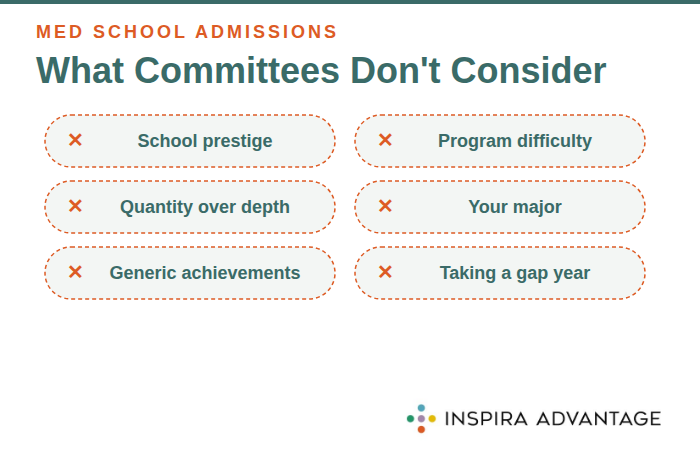
Infographic listing six things medical school admissions committees do not consider.

Undergraduate School Prestige

A high GPA and strong MCAT score will catch an admissions committee's attention even if you come from a tiny, nearly unknown college.

Admissions committees care about what you produced during your four years, not the logo on your sweatshirt. A driven student at a mid-tier state school with strong clinical hours, research, and a compelling narrative will beat a passive Ivy League grad who coasted on the brand name.

How ‘Hard’ the School or Program Is

Students at notoriously difficult programs sometimes expect admissions committees to grade on a curve. They don't. A 3.40 GPA from a brutal engineering program still reads as a 3.40 GPA on your application.

Some admissions committees recognize that prestigious programs have self-selecting, high-achieving student populations, but that recognition won't save a low GPA. Pick a school and program where you can genuinely excel rather than one designed to impress on paper.

Number of Extracurriculars (Without Depth)

Listing 15 clubs and three volunteer stints in a single semester suggests resume padding rather than commitment. Admissions committees see through quantity-over-quality approaches immediately.

A student who held one meaningful leadership role for two years and can articulate exactly what they learned will always outperform someone who joined everything and led nothing. Stop collecting line items and start investing in experiences that actually shape how you think about medicine.

Major (in Most Cases)

Roughly 60 percent of medical school applicants major in biological sciences. But choosing biology doesn't necessarily give you an admissions edge. Admissions committees don't favor one major over another as long as you complete the required prerequisites with strong grades.

A philosophy major with a 3.80 GPA and a 518 MCAT is just as competitive as a biochemistry major with the same numbers. In many cases, a non-traditional major makes an application more memorable because it breaks the pattern admissions committees see thousands of times each cycle.

Minor Awards or Generic Achievements

Dean's list, honor society memberships, and departmental certificates rarely matter to admissions officers. They expect competitive applicants to have earned these distinctions as a baseline. 

Listing them takes up space that could be devoted to describing experiences with real depth and personal significance. Save your application space for the work that shaped your understanding of medicine and your readiness to practice it. If an award didn't change how you think or what you pursued next, it doesn't deserve a featured spot.

Whether You Took a Gap Year

The AAMC's holistic review framework evaluates the full context of your educational journey, including time spent outside the classroom. Many successful applicants take one or two years after undergrad to strengthen clinical hours, complete research, or gain work experience that adds maturity to their application.

Admissions committees often view gap-year applicants as more self-aware and better prepared for the demands of medical training. Never rush your application timeline out of fear that waiting will hurt you.

Privacy guaranteed. No spam, ever.

Key Situations Where Your Undergrad Choice Gives You an Advantage

Your undergraduate institution matters most for the environment it creates around you, not for the name it puts on your diploma. Schools affiliated with hospitals and medical programs open doors to clinical rotations, research positions, and faculty mentorship that students at other institutions may need to seek out independently. The advantage isn't prestige. The advantage is proximity to the experiences that build a competitive application.

Access to Clinical Opportunities

Some schools make clinical exposure almost effortless. Universities affiliated with hospitals allow undergraduates to gain hands-on patient experience through:

  • Nearby rotations
  • Shadowing programs
  • Internships with affiliated medical centers

A student at one of these schools can start accumulating clinical hours during the sophomore year without having to navigate cold emails or long waitlists. Students at schools without hospital affiliations can absolutely build the same hours, but the logistics require more initiative.

If you're choosing between two schools and one sits next to a teaching hospital, that access alone can save you months of effort.

Availability of Research Opportunities

Prestigious research universities often provide:

  • Superior lab facilities
  • Funded research positions
  • Faculty who actively recruit undergraduate assistants

Landing a meaningful research role at a large R1 university can be as simple as showing up to office hours and expressing interest.

At smaller schools or institutions without major research funding, you may need to look off-campus or pursue summer research programs at other universities. Neither path is better or worse for admissions, but one requires significantly less legwork to get started.

Strength of Pre-Med Advising and Mentorship

Mentorship has a significant influence on whether students successfully gain admission to medical school. Some undergraduate programs assign dedicated pre-med advisors who:

  • Track your coursework
  • Help you build a four-year timeline
  • Connect you with alumni in medicine

Others leave you to figure out the process on your own. Strong advising doesn't just keep you on track academically. It prevents costly mistakes that derail applications, such as taking the MCAT too early, skipping a prerequisite, or applying to the wrong mix of schools.

Committee Letter Support

Many undergraduate institutions offer a committee letter, which bundles your individual recommendations into a single, comprehensive package that admissions committees prefer over standalone letters.

Schools with established pre-med pipelines typically produce polished committee letters that frame your candidacy. Not every school offers one, and some committees are better resourced than others.

If your school provides a committee letter process, use it. If it doesn't, plan early to secure strong individual letters from faculty who know your work well.

Proximity to Medical Schools and Teaching Hospitals

Universities that house their own medical schools give undergraduates extensive access to research and clinical experiences before they ever submit an application. Proximity creates informal advantages, such as:

  • Attending grand rounds
  • Meeting medical students who can advise you
  • Building familiarity with a program that may eventually review your application

Some medical schools also show a preference for applicants from their own undergraduate institution simply because those students already understand the culture and have demonstrated they can thrive in that environment.

Peer Community and Academic Culture

The students around you shape your habits more than most premeds realize. A school with a strong pre-med culture creates:

  • Built-in study groups
  • Shared resources
  • A community that normalizes the grind of organic chemistry and MCAT prep

A school where very few students pursue medicine can feel isolating during the hardest semesters. Neither environment guarantees success, but surrounding yourself with peers who share your goals makes the four-year process significantly more sustainable.

Privacy guaranteed. No spam, ever.

FAQs

Do Medical Schools Prefer Their Own Undergraduates?

Yes, some medical schools prefer students from their affiliated undergraduate programs. Attending the affiliated undergrad program gives you built-in access to the medical school's research labs, clinical settings, and faculty network. That familiarity can work in your favor when admissions committees review your application. However, most medical schools fill the majority of their seats with students from unaffiliated institutions. So attending elsewhere is far from a dealbreaker. 

Are Undergrad Grades Important for Med School?

Your undergraduate grades are one of the most important factors in your medical school application. GPA is one of two primary data points admissions committees use to evaluate your foundational competitiveness. A strong GPA demonstrates that you can manage the academic intensity of a medical school curriculum. Committees also pay attention to grade trends, so a consistent upward trajectory can offset a weaker first year. 

Can I Get Into Medical School with a Community College Undergrad Degree?

You can get into medical school after attending community college, though the path requires intentional planning. Successful applicants come from public schools, community colleges, and international programs across the country. Most students who start at a community college transfer to a four-year institution to complete their bachelor's degree and remaining prerequisites. Strong MCAT scores, clinical experience, and compelling essays can more than compensate for a non-traditional academic background. 

Do Med Schools Consider the Difficulty of Your Undergraduate Program?

Medical schools may acknowledge the rigor of your undergraduate program, but they won't adjust your GPA to account for it. Some committees recognize that elite programs attract self-selecting, high-achieving students, which can provide a subtle context for your transcript. A 3.50 GPA from a notoriously difficult engineering program still reads as a 3.50 GPA on your AMCAS application. Choose a program where you can perform at your best rather than one designed to impress at the expense of your grades. 

Do Medical Schools Prefer Applicants from Top Universities?

Medical schools do not broadly prefer applicants from top-ranked universities. A high GPA and strong MCAT score will catch an admissions committee's attention even if you graduated from a small, relatively unknown college. Private medical schools tend to weigh undergraduate selectivity slightly more than public medical schools, but even at the most competitive programs, your performance and experiences carry far more weight than institutional prestige. Focus on building the strongest possible application wherever you are, rather than transferring for a brand name. 

Dr. Jonathan Preminger was the original author of this article. Snippets of his work may remain.

Privacy guaranteed. No spam, ever.
Dr. Akhil Katakam

Dr. Akhil Katakam

Orthopaedic Surgery Resident Physician

Lewis Katz School of Medicine at Temple University

Add us as preferred source on Google

Schedule A Free Consultation

Plan Smart. Execute Strong. Get Into Your Dream School.
Get Free Consultation
image of dots background

You May Also Like

Don’t forget your FREE personal statements!

Get 25+ free medical school personal statements written by our succcessful applicants free of charge. No strings attached.

Claim Your Free PS Examples Now