Get in touch: +1 888 453 5021





It’s no secret that personal statements are one of the most important parts of your PA school application. Students know this. But what many feel less certain about year after year is how to write a personal statement that actually resonates with admissions committees and stands out.
I spoke with several PA school admissions experts on my team who have served on admissions committees to gain their perspective on what it takes to write a strong PA statement. They shared their insights on how to write a statement from beginning to end, what PA schools actually look for, and their top tips for standing out. You can find all of those insights and more in this guide.
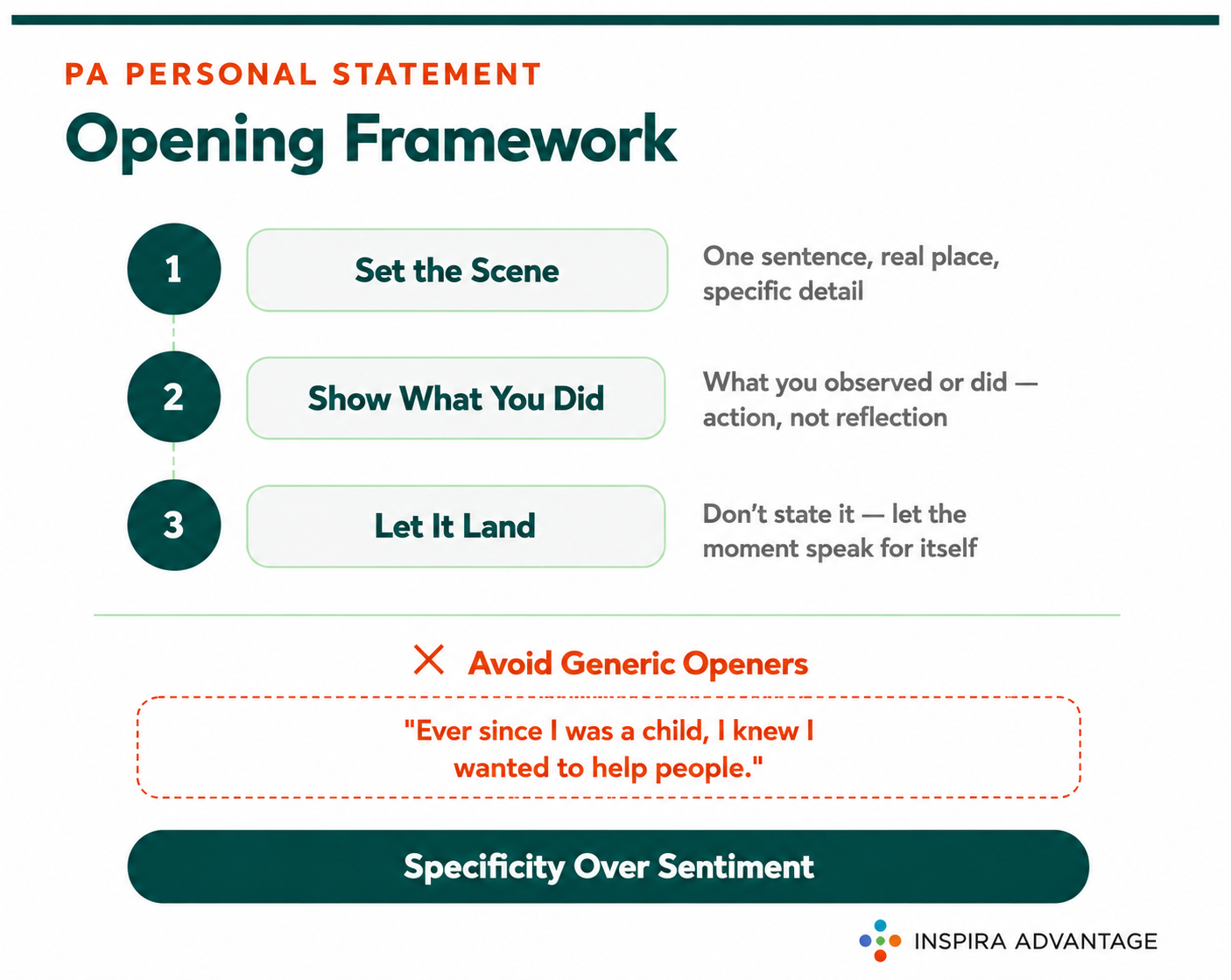
I’ve reviewed far too many personal statements that began with something along the lines of “I have always wanted to help people,” followed by a resume rehash of their clinical experiences and a conclusion that summarized what I had just read.
The best, most memorable essays I’ve read open completely differently. They open in the middle of a scene, with a moment in a clinic, like a patient interaction or critical decision point. Strong PA personal statements don’t start by explaining motivation. They start by showing it.
Open with a specific moment. A clinical scene usually works best here because it immediately signals that your interest in the PA profession is backed by real experience. But the moment doesn’t have to be clinical. It can be personal, as long as it connects directly to your path to becoming a PA.
Here’s a strong opening framework with examples:
The opening shouldn't explain everything; its purpose is to keep the reader engaged and interested in reading on.
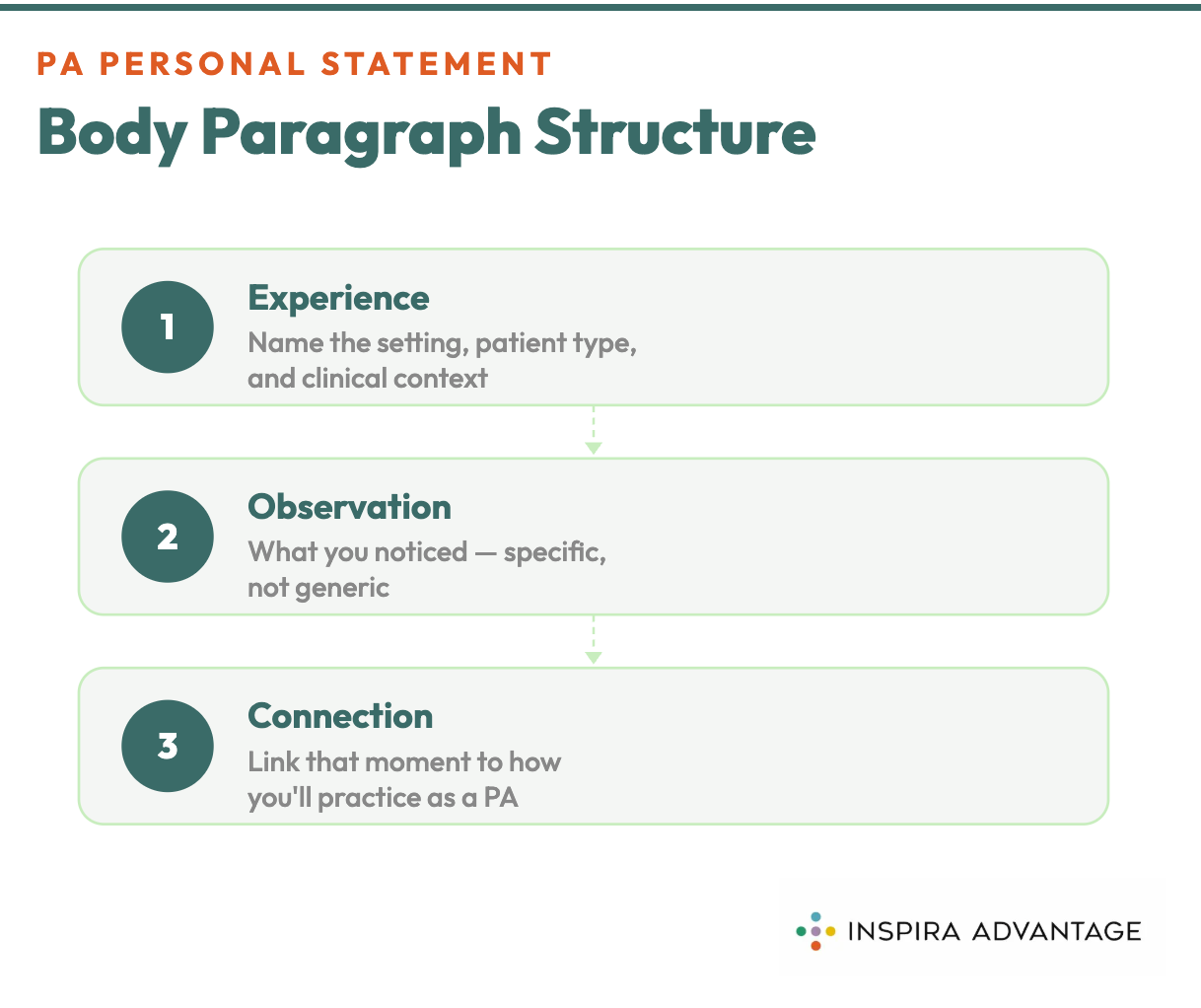
Each body paragraph should connect a specific experience to a specific insight about the PA profession. Two to three body paragraphs are typically enough, but you can use more if they’re shorter and aren’t repetitive.
Aim to focus on two to four meaningful experiences throughout your statement so you have enough room to describe each one in detail and reflect on what you learned.
Choose experiences that show what the admissions committee can't already learn from your CASPA application. As Madison Borgman explains in our webinar on Everything You Need to Know About PA School:
"This is the chance that you have a voice to show them things that they're not going to be able to just find by reading your experience section,” she says. “This is something, a unique experience that maybe showcases how you were a good advocate."
Borgman also recommends showing your qualities through specific examples rather than simply telling the committee you're compassionate or a strong communicator. A specific moment where you demonstrated those qualities gives the reader a reason to believe you.
Use this structure for each paragraph:
At least one paragraph should clearly demonstrate why you want to become a PA specifically, rather than another type of healthcare professional. Don't just write "I like working with a team" or "I want to help people." Draw on what you've observed during shadowing or clinical work to explain what interests you about working alongside physicians, caring for different types of patients, or having the flexibility to work in different specialties.
First, give the reader a sense of closure. One strong option is to circle back to your opening scene for cohesion. If returning to your opening scene doesn’t seem to fit naturally, you can also close by briefly explaining the throughline of your essay into a forward-looking statement about the type of PA you plan on becoming.
Second, name what you bring to the profession using language that connects directly to what you showed in the body. Don’t restate the experience; distill it. If your body paragraphs showed two years working as a medical interpreter in a pediatric clinic, your conclusion shouldn’t recap that. It should land the takeaway: that you understand how to communicate across language and literacy barriers in a clinical setting and that you’ll bring that into your practice as a PA.
Third, end on your career, not your application. For example, saying, “I want to work in emergency medicine in underserved communities and help patients overcome language barriers” tells the committee much more about your goals than “I hope your program will help me become a great PA.” Admissions committees want to see that you’ve thought about the kind of PA you want to become and the patients you hope to serve. End on where you’re headed, not where you’ve been. Name the type of PA you intend to become, the patient population you want to serve, or the clinical setting where you plan to practice.
PA schools look for three qualities:
Madison Borgman, an admissions consultant at Inspira Advantage and a former Interview Co-Chair for the University of Texas Southwestern Medical Center's PA program, frames the stakes directly in our webinar on Everything You Need to Know About PA School:
“The statement isn't just going to be about your story, but it's also going to be about who you are and why they should take a chance on you versus another applicant," she says.
Think of it in three layers:
The strongest statements share qualities that can’t be proven through transcripts, like patient sensitivity, professional judgment, and genuine commitment.
Generic enthusiasm is the most common failure. Committees read hundreds of essays about "a passion for helping people." Every claim you make needs to be grounded in evidence.
Here are three examples of real PA personal statements that got students accepted to top PA programs:
A twenty-two-year-old female presents today with a chief complaint of unexplained weight gain. She reports living an active lifestyle as an active-duty Corpsman, maintaining a moderate diet, occasional drinker, and a non-smoker. Denies knowledge of any family history of metabolic and cardiovascular diseases. I wish I could say that this note was one that I wrote about a patient, but as fate would have it, that patient was me. In military medicine, this is considered an unusual case in a population of healthy young adults who are at their peak physical form. Leading up to that appointment, I had seen multiple clinicians with this complaint, only to leave with advice on dieting and exercise. The final stop was an appointment with a Physician Assistant whose treatment inspired me to pursue the arduous path I took to prepare for a career as a Physician Assistant of his caliber.
What made this final appointment so special to me was that the Physician Assistant remained non-judgmental and believed that I was not living a sedentary lifestyle; he became my advocate. He investigated the root cause of my symptoms, leveraging his background in research. After some exploratory diagnostics, we discovered that I had a genetic metabolic disease that causes insulin resistance with subsequent weight gain. The time my Physician Assistant spent with me felt like a friendly visit with a charismatic sports coach; he took the time to recommend resistance training routines to augment my new medical regimen. Always regarding me warmly and encouraging me, the most therapeutic remedy I gained from our visits was hope. For the first time in my medical history as a young adult, I had felt hope that my condition was not a mystery with no treatment nor a malady born of poor life choices, but a genetic disease with effective treatment options. That was when I realized that medicine extends beyond the formulary; we affect patient outcomes through compassionate patient education and sincere advocacy.
In addition to describing why I am enthusiastic about serving my community as a Physician Assistant, I would like to add a note on my academic record. It is worth noting that my passion for my topics of biomedical research has impacted my undergraduate academic performance. I worked full-time in my research labs throughout my degree program. Additionally, many of my courses were those of high attrition and are not necessary for Physician Assistant school (i.e., quantum mechanics, calculus, physics for engineers, etc.). Although I could have set myself up for greater odds of success by choosing a less quantitatively focused degree, I am profoundly proud of my successful completion of my Bachelor of Science in biochemistry, as well as my published contributions to the advancement of medical and scientific research. I do not regret having to struggle to achieve those ends.
Forging a solid scientific background was intentional. I believe that competent care is rooted in resilience despite complexity and relative comfort in challenging situations. Thus, I committed to a rigorous biochemistry program. My intellectual curiosity carried me as far as engaging in exciting fat cell research at the [University Laboratory] and later at a biotech startup because I was determined to learn more about fat as a complex organ. I believe my background empowers me to excel in topics highly relevant to primary care because metabolic and cardiovascular diseases are becoming more prevalent among American patients and have become a major health crisis despite advances in medicine over time.
Following my research experience, my interest expanded to working with the underserved populace in rural communities after volunteering as a medical assistant in my local community clinic. Having lived in my rural community for over a decade, I have seen the struggles of my fellow citizens through a unique kaleidoscope of multiple lenses through my various roles in community outreach programs. My experience as a Corpsman, coupled with my robust experience working with underserved populations, has solidified my interest in serving my community as a Physician Assistant. As I have researched the Physician Assistant profession and the roles that many of them serve in various environments, I have become more resolute about this career choice. What excites me every day when I march along this challenging path is the potential to serve in leadership roles as a Physician Assistant to improve access to medical care and introduce innovative ways to improve quality of life in my community, both for patients and students interested in becoming a Physician Assistant. Just like the Physician Assistant who treated me, I intend to leverage my strong research background to critically review medical research to better understand patient complaints and treatment options and help patients be a part of their treatment plan.
“The broiling heat causes beads of sweat to dance down my neck. The itchy fabric of my purple swimsuit digs into my shoulders—but that is the least of my worries. As I trot to the edge of the pool for the season’s final race, I glance beyond the glassy water and find my mother, face flushed, cheering my name from underneath her baseball cap. She too endures the heat but is dressed in long clothing from head to toe. It has been years since I swam competitively, but I will forever be grateful that my mother attended nearly every single race despite her battle with skin cancer. During our vacations, she couldn’t bask in the sun’s warming rays, even when slathered with 100+ SPF. Meanwhile, I watched her undergo countless treatments and removal procedures that left her with scars that diminished her confidence. This opened my eyes to the impact that disease can have on one’s life and instilled compassion within me for those facing illness. This was the spark that ignited my desire to pursue a career in healthcare.
My first personal experience working in healthcare came in the form of a medical scribe position. As time progressed and my medical knowledge accumulated, I became captivated by the clinical decision-making process. I began to theorize the plan, whose orders would be placed by the physician, and potential diagnoses. Each medical case resembled a puzzle, which I became determined to solve by piecing together the fragments. Scribing created a strong foundation of medical knowledge, but I was unable to engage and interact with patients in the way I truly desired. This led me to become a medical assistant for a reconstructive plastic surgeon who specializes in transgender surgeries. Although I found the complex procedures fascinating, what I cherished the most was observing each individual patient’s journey.
As I conversed with patients who were under the care of the plastic surgeon I worked for, I noticed a common theme in the stories they shared with me—after beginning their transition, the support from their family and friends often vanished. For many, it also became difficult to make new friends and form romantic relationships. This broke my heart. Then one day, I had the opportunity to make a difference. While looking at the schedule, my coworkers and I noticed that one of our transgender patients happened to have an appointment scheduled on his birthday. We thought it would be fun to decorate the office break room, have a cake, and sing "Happy Birthday." To our office, this was nothing extraordinary, just a simple act of kindness, but the patient was in absolute shock when he walked in. Tears trickled down his cheek. He shared that not a single person had wished him a happy birthday in over a decade, ever since the start of his transition. I was moved by how a simple gesture could make such a significant impact. Analogous to the way I felt helping my mother, I had much experience with strong gratification when helping these particularly vulnerable patients. This reinforced my desire to pursue a career where I have the ability to support, help, and advocate for others.
The compassion and empathy I felt for my mother steered me in the direction to enter the healthcare field. I was further drawn to it by the intellectual challenge medicine presented and the analytical nature of the diagnostic process. However, after actually being immersed in the field, I discovered that most of my fulfillment came from an entirely different source. It came from working directly with patients, establishing a true connection, and gaining their trust. Collectively, my experiences have led me to pursue a career as a physician assistant, where I will be able to directly interact with others, work both independently and as a team, explore different realms of medicine, and be mentally engaged in problem-solving. My hope is that one day, I will become a PA whose patients won’t dread coming to appointments anymore, but instead, they will leave feeling empowered with knowledge and clarity of their disease state, diagnostic strategy, and treatment plans. And, perhaps more importantly, they’ll leave knowing that they are more than a number or a chart—they are a fellow human being who is being treated by someone who truly cares.
"There aren't many options left besides amputation," the physician assistant explained as he examined my father's foot. My heart sank as my family sat in silence. I noticed that the PA remained calm and compassionate, explaining our options and answering all our questions. He made sure my father understood the situation and what recovery would look like. Hearing him combine medical knowledge with clear communication and empathy showed me the importance of guiding patients through difficult, life-changing decisions. Before that appointment, my family had no idea what would happen next, but we left feeling supported.
Three years later, I watched him undergo a kidney transplant and receive care across nephrology, surgery, and post-transplant teams. Seeing providers collaborate around my father's case showed me how team-based care supports long-term outcomes. They combined expertise from different specialties in a coordinated, comprehensive way. My father no longer needed dialysis, and we returned to normal family activities like traveling. I came to really appreciate the PA profession through that experience, and understand that at its core, it's built on communication, teamwork, and patient-centered care.
After witnessing collaboration in medicine firsthand, I sought my own clinical experience. Working as a CNA in oncology allowed me to contribute to the wider care team and learn across specialties. One moment stands out: a patient with uncontrollable abdominal pain. Recognizing something was wrong, I immediately communicated my concerns to the nurse, who contacted the provider. I stayed at the bedside, checking vitals and blood glucose. Screaming in pain, she clung to my arm and said, "Please don't let me die." Multiple teams worked together to reassess, and further evaluation revealed a bowel perforation requiring urgent intervention. I learned how meaningful it is to advocate for patients in high-risk situations and to take their word seriously. Experiences like that confirmed my desire to expand my role and develop the clinical decision-making skills needed to treat and guide patients as a physician assistant.
As a CNA, I also learned adaptability by floating to different units, including the burn ICU, hematology, bone marrow transplant, and surgical transplant. Each shift required me to adjust to unfamiliar routines, different patient needs, and new team dynamics while maintaining high-quality care. One night in the burn ICU, I was assigned to a 6-year-old patient. I asked the nurse about her expectations and what tasks needed to be done throughout the shift. My role was to provide comfort and reassurance. As the patient became comfortable with me, she opened up about her family, and I realized that healing goes beyond treatment. A compassionate presence can make a profound impact. These experiences reinforced my commitment to a career where flexibility, collaboration, and adaptability drive patient-centered care.
I value the way physician assistants collaborate with physicians while maintaining the ability to assess patients, educate families, and manage treatment plans. The PA role aligns with the provider I strive to become: adaptable across specialties, a meaningful contributor to a healthcare team, and someone who builds trust with patients through direct, compassionate care.”
For more tailored PA school application support, work one-on-one with an admissions expert who can ensure each part of your application stands out.
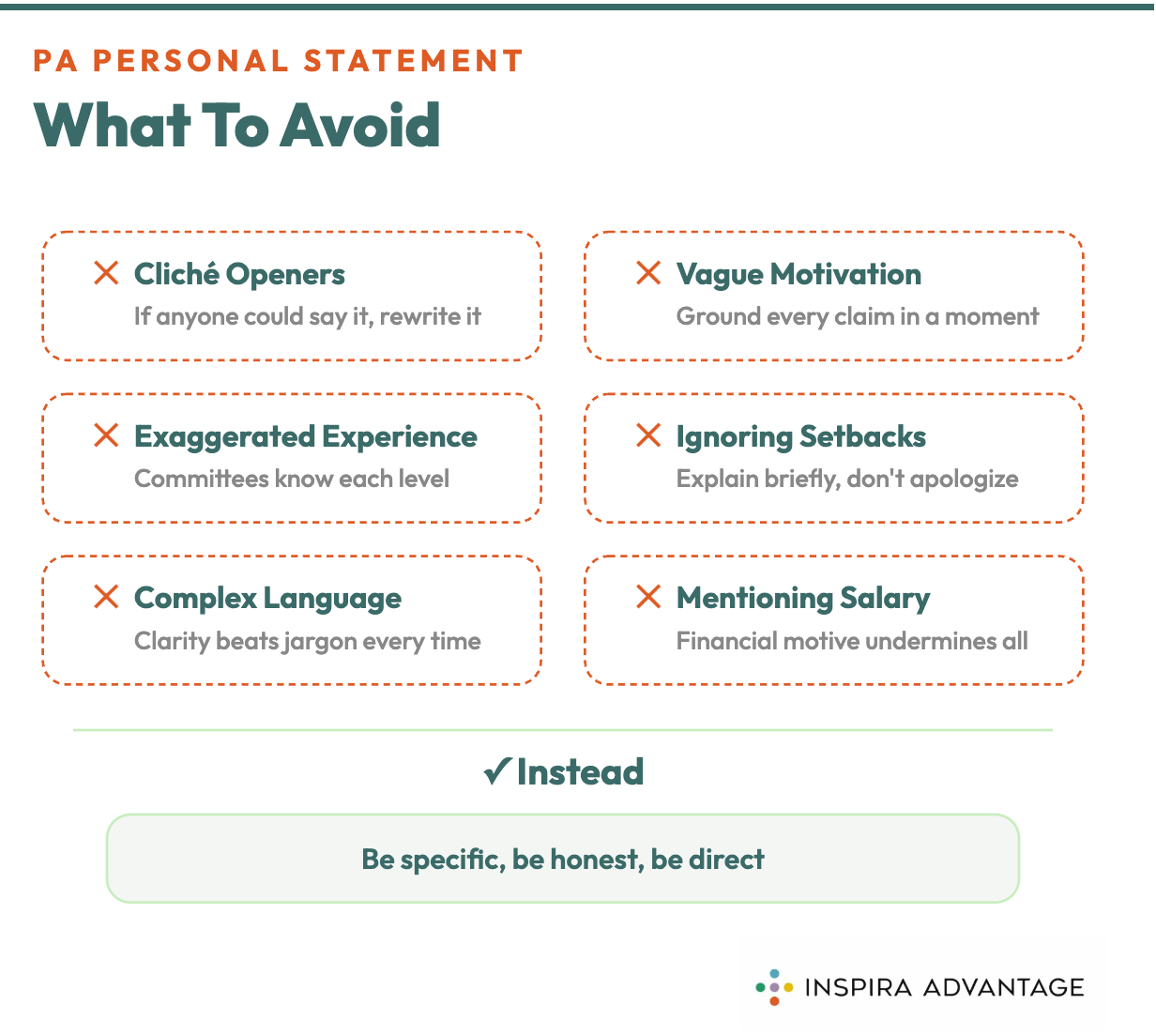
You write a unique personal statement for PA school by grounding every paragraph in moments that only you experienced. Most applicants write about the same themes, like a passion for helping people. Those work fine as a foundation, but they need more specificity. Include specific interactions with as much detail as you can and reflect on them, providing clear evidence you’ve carefully thought about the profession and explaining why you’re determined to join it.
A PA school personal statement should be 5,000 characters or fewer, including spaces. That comes out to roughly 700-850 words. CASPA sets that limit for all applicants, and most programs that use CASPA don’t accept supplemental personal statements beyond it. Most students go over this limit in their first draft, so start your personal statement early enough in your PA school application timeline to allow for multiple rounds of revision.


.svg)


