Get in touch: +1 888 453 5021





We gathered a list of 20 medical schools that cover the full tuition amount, shown in the table below.
Merit-based free tuition rewards academic, artistic, or athletic excellence regardless of your family's income. Need-based free tuition covers costs solely because your family can't afford to pay. Both can eliminate tuition entirely, but they evaluate completely different criteria and serve different institutional goals.
Merit-based programs evaluate the quality of your:
Many programs that offer merit-based scholarships don't require you to fill out additional financial paperwork. Your academic record and overall candidacy determine whether you qualify, and most schools automatically consider all admitted students through the regular admissions review process.
Need-based programs evaluate your family's income and assets through the Free Application for Federal Student Aid (FAFSA) and sometimes the College Scholarship Service (CSS) Profile.
Some schools use a mix of both merit-based and need-based scholarships. For example, Washington University School of Medicine provides need-based scholarship support as part of its financial aid award while also offering merit-based scholarships, generally covering full tuition, to entering students. That means a strong applicant from a middle-income family could technically qualify for both types of scholarships.
Free tuition medical schools are worth it when your goals already align with the program's structure. For example, if you want a military medical career, USUHS pays you a salary while covering your tuition in full. If you plan to practice primary care in an underserved area, an NHSC scholarship or Geisinger's program funds a career path you would have chosen anyway.
Universal programs like NYU Grossman, Albert Einstein, and Cleveland Clinic Lerner offer the easiest return on investment because they don’t have any other service commitments or specialty restrictions. The trade-off at those schools is simply the intensity of getting accepted.
Evaluate each program by asking three questions:
If all three answers work in your favor, a free tuition medical school can save you $250,000 or more and give you the freedom to choose your specialty and practice location based on passion rather than debt.
Here are some other things to consider when evaluating if free tuition schools are worth it.
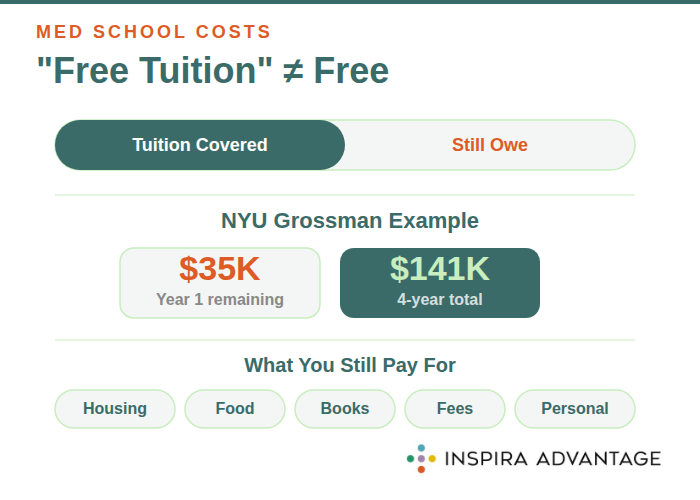
Tuition is only one factor in the total cost of attendance. At NYU Grossman, remaining costs after the full-tuition scholarship and health insurance subsidy total $35,258 in the first year alone, covering fees, housing, food, books, and personal expenses.
Over four years, that adds up to $141,032 in expenses you still need to fund. Many schools that offer free tuition refer specifically to tuition and fee waivers, meaning upfront academic costs may be covered, but living expenses are not.
Some programs close more of that gap than others. For example, Johns Hopkins covers living expenses for students with family incomes below $175,000. Weill Cornell replaces all loans with scholarships for students demonstrating financial need.
At many free tuition schools, you have to cover rent and groceries on your own, so you still have to pay out of pocket.
Not all free tuition programs let you pursue any specialty. For example, National Health Service Corps (NHSC) students must match into primary care residencies.
Entering a residency program that the NHSC does not approve (such as emergency medicine, surgery, radiology, neurology, etc.) can put you in breach of contract. If you discover a passion for one of these specialties during your clinical rotations, you have to either forfeit that future or face severe financial penalties.
Cleveland Clinic Lerner takes the opposite approach with a five-year research-intensive track designed to produce physician-investigators. No specialty is off-limits, but the program adds a full year to your education, meaning another year of a delayed MD salary.
Find out if you need to specialize post-graduation before you commit to any program that funds your education in exchange for a specific career path.
Free tuition attracts the strongest applicant pools in the country. For example, NYU Grossman School of Medicine received 8,271 applications in the 2025-2026 admissions cycle and admitted only 104 students. Since every student admitted to the MD program receives a full-tuition scholarship, it’s no surprise that the school has an incredibly low acceptance rate of 1.26%.
Applying to schools just because they have free tuition means you’re not optimizing your strategic school list. Your goals or profile may not align with the requirements of these programs, meaning your time and energy would be better spent by applying to other programs with a reasonable cost of attendance.
Service-based free-tuition programs carry the heaviest trade-offs. For example, USUHS F. Edward Hébert School of Medicine (USUHS) students must commission as active-duty officers and owe a minimum of seven years of service commitment after residency for the Army, Navy, Air Force, and Coast Guard, or 10 years for the Public Health Service.
Add four years of medical school and three to seven years of residency training, and you're looking at a minimum 14-year timeline before you can practice independently as a physician.
Attending USUHS is not a financial decision alone. You have to factor in:
So, if your long-term goal is private practice in a specific city or a non-primary-care specialty, a military obligation could directly conflict with that plan.
The table below ranks the most affordable medical schools for in-state students. Tuition rates are sourced from each school’s official tuition and fees page. Acceptance rates come from the Association of American Medical Colleges (AAMC) 2025 Facts Sheet. Median GPA and MCAT scores come from the Medical School Admission Requirements (MSAR) database.

Below is a list of the cheapest medical schools for out-of-state students, along with their admissions statistics, as reported in the AAMC 2025 Facts Sheet and the MSAR.
Below is a list of the cheapest public medical schools for students, along with their important admissions data reported in the AAMC 2025 Facts Sheet and MSAR.
Here are the six cheapest private medical schools and their admissions data from the AAMC 2025 Facts Sheet and MSAR.
Below is a list of the cheapest DO medical schools for students, along with their average GPA and MCAT scores. We used the Choose DO Explorer database to find the average GPA and MCAT scores and the Applicants & Matriculants by COM sheet for acceptance rates.
To ensure you get into one of these medical schools, or for scholarship support to make your med journey more affordable, work with an Inspira Advantage admissions expert.
We identify the medical schools with the lowest tuition across every category: in-state, out-of-state, public, private, and DO programs. Separating these categories matters because the cost landscape looks completely different depending on your residency status and the type of program you pursue.
Beyond tuition, we also considered the general cost of attendance when evaluating overall affordability. All cost and tuition data are sourced directly from each medical school's published figures for the current academic year.
Most premeds only think about tuition-free schools or FAFSA-driven aid. They completely miss the scholarship pages on individual medical school websites that fund students based on:
Dr. Katherine Munoz, an expert advisor at Inspira Advantage and a former University of Wisconsin-Madison School of Medicine and Public Health admissions officer, says in our medical school selection webinar:
"Medical school websites usually have sections on available scholarships and the criteria for those scholarships. Some are just like 'interested in and have experience with underserved populations' or 'interested in pediatrics.' There's certainly some non-need-based scholarships available, and you should be able to find those on each school's website."
Create a spreadsheet during your premed years and keep adding to it as you find more scholarships. For every school on your application list, visit the financial aid and scholarships page and catalog each award by:
You can't apply for funding you don't know exists.
Most premeds treat their acceptance letter like it’s the last point of communication between them and the school. It's not. The acceptance opens a negotiation window that most students never use because they assume financial aid offers are final.
Dr. Chiamaka Okorie, a former admissions officer at the Geisel School of Medicine and expert counselor at Inspira Advantage, reframes how accepted students should think about negotiations:
"It's a contract you're going to enter into with an institution, and I think we need to think of ourselves as professionals. You really are a professional, and you're entering a contract. I would just keep that in mind. It's hard for a medical school who knows that they're going to put you in $200,000 of debt to reject your offer because you're asking for a little help. So I wouldn't be afraid to do that."
If you hold acceptances from multiple schools, use the stronger financial aid package as leverage with the school you actually want to attend. Contact the financial aid office, explain that another institution offered more support, and ask if they can revisit your award. No admissions committee will rescind your acceptance because you politely asked for more scholarship money. The worst outcome is they say no, and your original offer stays the same.
You probably think that choosing the most prestigious medical school on your acceptance list is the best decision. Think again. Where you graduate from certainly matters, but not as much as you think. The more realistic concern is the debt you’ll have post-graduation.
Dr. Okorie, who navigated this decision as an international student funding her own medical education, highlights what your primary focus should be in our medical school experience webinar:
"Money, money, money. In my mind, I feel like that should be number one when you get all your acceptances. Look at who gives you the most financial aid. The accrediting body in the United States for medical schools is so strict that if you're an MD, they accredit you based on certain things that every med school has to give your students. At the end of the day, you're going to end up becoming a physician regardless of if you go to Harvard, Yale, UCSF, or Northwestern. It's an interesting choice to make because you will have to pay off that debt and that money, and if you don't have to, I think it's something to really consider."
According to the Association of American Medical Colleges (AAMC), the median four-year cost of medical school attendance for the class of 2025 was $286,454 for public schools and $390,848 for private schools.
That means a student who chooses a lower-ranked school with a full-tuition scholarship over a top-10 program with no financial aid can save a quarter of a million dollars and enter residency with:
Financial aid offices operate on limited institutional funds. Early submissions get first consideration. Late submissions get whatever remains. Treat your FAFSA submission date with the same urgency you give your primary application timeline.
Many need-based, tuition-free programs like those at Johns Hopkins and Columbia don't require a separate scholarship application. They use information from your FAFSA data. So, if you submit your application late, submit incomplete documentation, or fail to respond to verification requests promptly, you can miss out on funding opportunities.
The medical students who graduate debt-free don't just have stronger academic profiles. They treat the financial side of medical school admissions with the same discipline and attention they bring to their entire medical school application.
No, tuition price and education quality have almost no correlation in medical education. Every medical school accredited by the Liaison Committee on Medical Education (LCME) must meet the same rigorous standards for curriculum, faculty qualifications, clinical training, and student outcomes. Accreditation is the quality floor, and it sits high regardless of what a school charges.
Several of the most affordable programs on our list match or outperform expensive private schools on USMLE Step 1 and Step 2 pass rates, residency match rates, and research output. UT Health San Antonio's Long School of Medicine reported a 100% match rate for its Class of 2025, with placements at programs like Yale and Vanderbilt.
Price reflects funding models and state subsidies, not quality. What actually determines the quality of your medical education comes down to the variety of clinical rotations, access to research mentorship, and how well the school supports residency preparation.
You can evaluate all three of those factors independently of cost. Look at each program's affiliated hospital network, published match lists, and student-to-faculty ratios, rather than assuming a higher price tag buys a better experience.
The cheapest medical schools in the US are NYU Grossman School of Medicine and Albert Einstein College of Medicine, both of which offer tuition-free education.
You can lower your medical school costs by attending a public medical school in your home state. In-state tuition is the single biggest cost-saving measure, often saving $30,000 or more per year.
Health Professions Scholarship Programs (HPSP) let you attend any accredited medical school in the country on the military's allowance. The Army, Navy, and Air Force each offer the same core benefit:
The key difference between HPSP and USUHS’s service commitment is the level of flexibility. HPSP recipients attend medical schools and learn alongside their classmates. You pick your school, and the military pays for it.
The active-duty obligation is one year for each year of scholarship support, with a minimum of two years. Compare that to USUHS, which forces you to serve seven years after residency.
HPSP works best for students who already plan to serve but want the traditional medical school experience. From a purely financial standpoint, the calculation depends heavily on your specialty since high-earning specialists sacrifice more income during their service years than lower-earning primary care physicians.
Compare the numbers for your target specialty before fully committing to this option.
The federal SLRP provides grant funding to states and territories to develop their own loan-repayment initiatives for primary medical, mental health, behavioral health, and dental clinicians working in provider shortage areas.
Award amounts and terms vary significantly by state. California's SLRP offers up to $50,000 for a two-year service commitment in a Health Professional Shortage Area, with the practice site matching the award dollar-for-dollar. However, Maryland's program extends eligibility to medical residents in their final year of training, giving you a head start on securing loan repayment before you even finish residency.
Start by visiting the NHSC State Loan Repayment Program page, which lists every participating state and territory. From there, find your state's administering agency (usually the state health department or a university-affiliated rural health office) and check:
Some states, like Oregon, run continuous application windows until funds are exhausted, while others open on fixed dates. Pairing a state program with the federal NHSC loan repayment can eliminate six figures of debt without requiring you to attend a specific medical school.
A med school’s cost of attendance typically includes tuition, fees, health insurance, books, supplies, equipment, room and board, transportation, and personal living expenses. Schools calculate this figure to represent the total annual cost of being a full-time student. Use each school's published cost of attendance, not just tuition, when comparing affordability.
No, some of the most affordable programs are among the hardest to get into. NYU Grossman School of Medicine, which offers full-tuition scholarships to all students, has an acceptance rate of just 1.18%.
Many affordable state flagship schools also attract massive applicant pools because of their low in-state pricing, which drives acceptance rates down
No, tuition price and education quality have almost no correlation in medical education. Every medical school accredited by the Liaison Committee on Medical Education (LCME) must meet the same rigorous standards for curriculum, faculty qualifications, clinical training, and student outcomes. Accreditation is the quality floor, and it sits high regardless of what a school charges.
Several of the most affordable programs on our list match or outperform expensive private schools on USMLE Step 1 and Step 2 pass rates, residency match rates, and research output. UT Health San Antonio's Long School of Medicine reported a 100% match rate for its Class of 2025, with placements at programs like Yale and Vanderbilt.
Price reflects funding models and state subsidies, not quality. What actually determines your medical education quality comes down to clinical rotation variety, research mentorship access, and how well the school supports residency preparation.
You can evaluate all three of those factors independently of cost. Look at each program's affiliated hospital network, published match lists, and student-to-faculty ratios instead of assuming a higher price tag buys a better experience.
Dr. Jonathan Preminger was the original author of this article. Snippets of his work may remain.


Get 25+ free medical school personal statements written by our succcessful applicants free of charge. No strings attached.



.svg)

