Get in touch: +1 888 453 5021



.jpg)
New York, NY — December 3, 2025 — A new Inspira Advantage survey of 224 aspiring and current medical students finds that 54.3% would commit to practicing in rural or underserved communities if tuition were reduced or forgiven.
This willingness to practice in rural communities becomes far more significant when placed in the context of the current U.S. physician shortage.
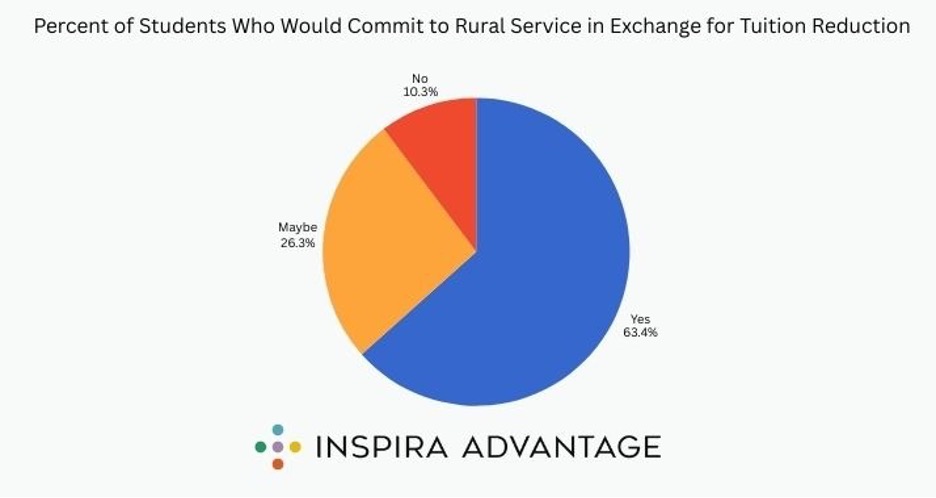
The survey findings come at a time when rural healthcare access is at an all-time low. The Association of American Medical Colleges projects a nationwide shortage of 13,500 to 86,000 physicians by 2036. This shortage is not evenly distributed. More than 60 million Americans live in Health Professional Shortage Areas, where access to primary care, mental health, and dental care is already strained. Despite the need, only 10% of U.S. physicians practice in rural areas even though nearly 20% of Americans live there.
This context dramatically amplifies the meaning of your survey result: if even half of future doctors are open to rural service when financial barriers are addressed, the potential impact on access to care is substantial. Even a small increase in rural placement could help reduce workforce shortages in areas struggling the most.
The cost of medical school continues to rise, and many students view incentive-based rural programs as one of the few viable ways to offset this burden. According to the AAMC, the median cost of attending four years of medical school is now $276,000 at public institutions and $375,000 at private schools.
These figures help explain why students in the survey consistently tied rural service to financial relief:
For policymakers designing rural workforce programs, these findings highlight a clear opportunity. Students are open to serving, but only if doing so doesn’t jeopardize their long-term stability.
For students who would consider rural or underserved service, several motivations stood out:
Still, challenges remain. Nearly 49.6% of students worried about limited specialty opportunities, and 42.1% cited heavier on-call responsibilities as a concern.
Even among students willing to serve, uncertainty remains high. Only 27.0% of respondents reported any meaningful exposure to rural or underserved clinical rotations during their training. Without visibility into what rural practice actually looks like, it becomes harder for students to imagine a long-term future there.
This issue mirrors national training patterns. Fewer than one-third of U.S. medical schools require rural rotations, leaving most students to train in large academic medical centers in urban environments.
Unsurprisingly, 48.2% of survey respondents said they were unsure whether rural medicine aligns with their goals simply because they have never experienced it.
Taken together, the survey results point to a workforce opportunity hidden within a nationwide crisis. Students are willing to serve underserved communities, but they need exposure, guidance, and financial support that aligns with the realities they face.
“There is a motivated pipeline of future physicians,” Arush Chandna, CEO of Inspira Advantage, said. “The next step is building pathways that make rural service both accessible and sustainable.”
Dermatology Resident Physician
The George Washington University School of Medicine and Health Sciences


.svg)


