Get in touch: +1 888 453 5021





I spoke to several experts on my team to find out what pre-meds are constantly asking about. One of the top answers was how many extracurricular hours they should have to be competitive. Students want exact targets to aim for and to know which types of extracurriculars to prioritize.
Below, I answer those questions based on our experts’ insights, breaking down how many clinical experience, physician shadowing, research, volunteering, and leadership hours you should aim for in 2026, along with the important factors to consider beyond the numbers.
Here are the five main extracurricular activities medical school admissions committees look for in competitive applicants, as well as the hour requirements for each:
*Please note: These hour recommendations span your entire four years of undergraduate study and may extend into any gap years you take. The more gap years you have, the more experience medical schools will expect to see, as they anticipate you’ll make full use of your time.
These figures represent general guidelines for most applicants, but highly competitive programs tend to expect even greater levels of involvement.
Students looking to become competitive applicants at highly competitive medical schools should aim for the higher end of these ranges. For example, an applicant with 80 hours of clinical experience might be considered more competitive than a candidate with only 50 hours of clinical experience.
However, these numbers don’t mean you have to just complete activities to reach a specific number of hours. Medical school admissions committees prioritize depth over breadth of experience.
In Inspira’s How Admissions Officers Review Med School Applications webinar, Dr. Katherine Munoz, an admissions officer at the Virginia Commonwealth University School of Medicine and an expert admissions consultant at Inspira Advantage, provides insight on depth vs. breadth:
“Depth over breadth benefits applicants much more: to do one or two things for a longer period of time. For me, extracurricular depth is more meaningful than someone who does 30 hours in a month and never does that thing again.”
Your medical school extracurriculars should:
The table below shows how many extracurricular hours you should ideally aim to acquire during your freshman, sophomore, junior, and senior years:
Please note: These hour recommendations are strategically distributed across your freshman, sophomore, junior, and senior years of undergraduate study to demonstrate a progression from exploratory experiences to deep, sustained commitment.
Medical school admissions committees prioritize the depth of your experience over the sheer number of hours. While meeting the suggested total hours is important for competitiveness, the quality of your involvement (meaningful engagement, sustained commitment, demonstrated responsibility, and the insight you gain) is what truly matters.
As the experts on my team shared, it's better to have activities that you've been working in or involved in for the entire duration of your undergrad experience. You don't want all of your activities to start your senior year. But also, it's not realistic to have all of your activities start your freshman year. Just try to start them as early as possible and be consistent and dedicated to all those activities through the application.
In Inspira’s How to Navigate Med School Application Timelines webinar, Dr. Austin Johnson, a graduate of Stanford University School of Medicine and admissions counselor at Inspira Advantage, highlights that it’s more important to aim for longitudinal experience rather than numbers:
“We like to see stories from activities that you’ve had longitudinal experiences in or [that] connect to the overall theme of your application … show how your experiences … shaped your journey to becoming a doctor — this can help create a cohesive narrative highlighting your medical school readiness.”
Dr. Johnson reinforces that applicants can still be considered competitive candidates even if they have only 180 hours of clinical experience by the end of their senior year. However, applicants must connect their extracurricular involvement to the overall theme of their application. Applicants who demonstrate how these previous experiences connect to their passion for studying medicine stand out to admissions officers.
Applicants should have a realistic number of hours for extracurricular involvement — but with a few caveats.
Shadowing multiple physicians gives you a greater understanding of a physician’s daily life and introduces you to medical specialties that may interest you.
In Inspira’s Plan Ahead: Your Medical School Application Timeline webinar, Dr. Gupta advises pre-meds on what makes an impactful shadowing experience:
“Shadowing is an important part of showing that you understand the realities of medicine. It’s not just about exposure; it’s about showing that you’ve taken initiative in seeking out this experience to deepen your understanding of the field.”
Shadowing at least two physicians should provide you with enough experience to request a meaningful letter of recommendation. These shadowing positions should show that you understand the field of medicine, especially if there’s a particular area you’re interested in.
If you’re applying to a top-tier medical school, you should ideally aim for 400-1,000 hours of research experience to demonstrate your commitment to advancing medical education, treatments, and technology. Conducting undergraduate research across all four years of college can help you gain more responsibility in the lab, provide an opportunity to have your research published, and allow you to network with research supervisors who can write glowing recommendations for medical school.
Dr. Munoz highlights how applicants should approach research experience in their applications:
“Research experience is very important, especially if you are applying to schools that have a strong emphasis on scientific inquiry. It demonstrates that you can think critically, analyze data, and approach problems with a scientific mindset — all skills that will serve you well as a physician.”
Even if you aren’t applying to a research-intensive school, it can be a great opportunity for you to connect your application narrative with your passion for studying medicine.
For example, if you claim that you want to help underserved populations in your personal statement due to your background, it would look great to have research on why your city should provide more medical resources to support a certain population demographic. If you have a stellar recommendation from a physician who reviewed your work, then that’s an even better way to stand out.
If you’re applying to a top-tier medical school, you should ideally aim for 300-600 hours of community service and volunteer experience. Admissions committees at top medical schools expect students who will contribute on campus, in the surrounding community, and to their student cohort.
In Inspira’s How Admissions Officers Review Med School Applications webinar, Dr. Munoz provides more insight into the value of community service for medical school applications:
“Community service is a vital part of your application because it demonstrates your commitment to service and your ability to connect with diverse populations. Medicine is about helping people, and volunteer work shows that you’re already living out this value, even before becoming a physician.”
Strategically addressing your community service experience is a great way to show your passion for supporting a specific demographic. For example, if you mention in your personal statement that you’re passionate about public health, volunteering for a soup kitchen can be a great way to show where you learned this passion.
In Inspira Advantage’s How Admissions Officers Review Med School Applications webinar, Dr. Aryaman Gupta, an admissions counselor at Inspira Advantage who graduated from Johns Hopkins School of Medicine and is a former admissions officer at Duke University, provides insight into the importance of extracurricular activities:
“It’s also really important to show that you are engaging in extracurriculars that provide more breadth to your application. Show that you are able to take on leadership and are volunteering in a clinical setting and really gaining experience to foster your development as a future medical student.”
Extracurricular activities for medical school applicants are yet another opportunity for applicants to demonstrate why they would make a great physician.
One of the counselors I spoke with brought up another important point: extracurriculars can make or break your application. For example, if everything else is equal with two applicants and one has more significant research experience, admissions committees are going to take the person who they think is going to be able to contribute to research productivity at their institution.
That said, you should only be engaging in extracurricular activities you’re truly passionate about. These extracurricular activities should align with your overall application narrative. For example, if an applicant’s personal statement highlights their passion for public health, they should also have public health volunteering as part of their extracurricular activities.
Harvard Medical School is one of the top medical schools in the U.S. According to data from Medical School Admission Requirements (MSAR), an average of 91% of matriculants had medical/clinical community service, physician shadowing, or volunteer experience in their application.
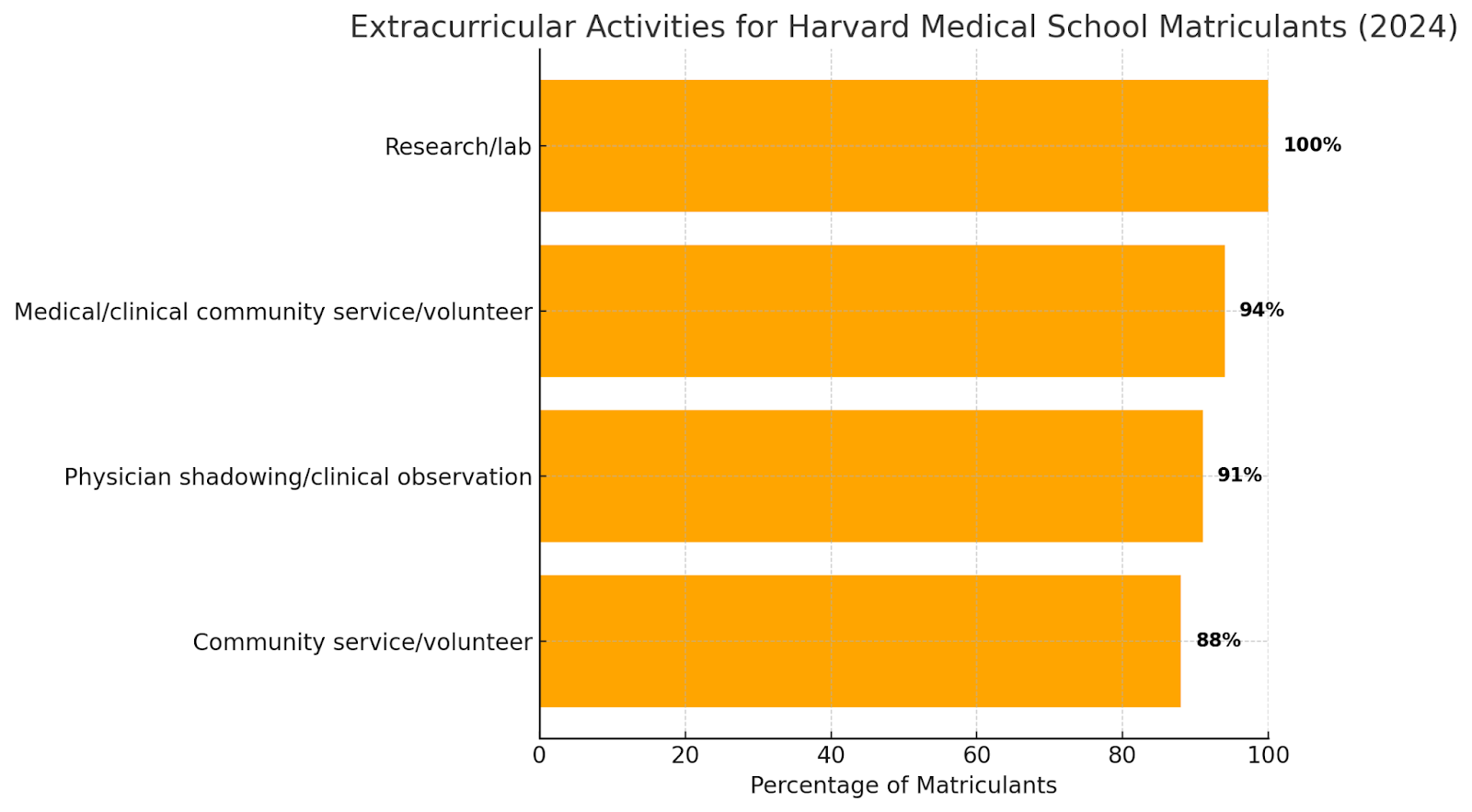
That means roughly 9% of matriculants on average applied to Harvard Medical School without extracurricular involvement, and all applicants applied with research experience. Based on this data, it’s clear that applicants should have at least some form of extracurricular involvement when applying to medical school to stand out as a competitive candidate.
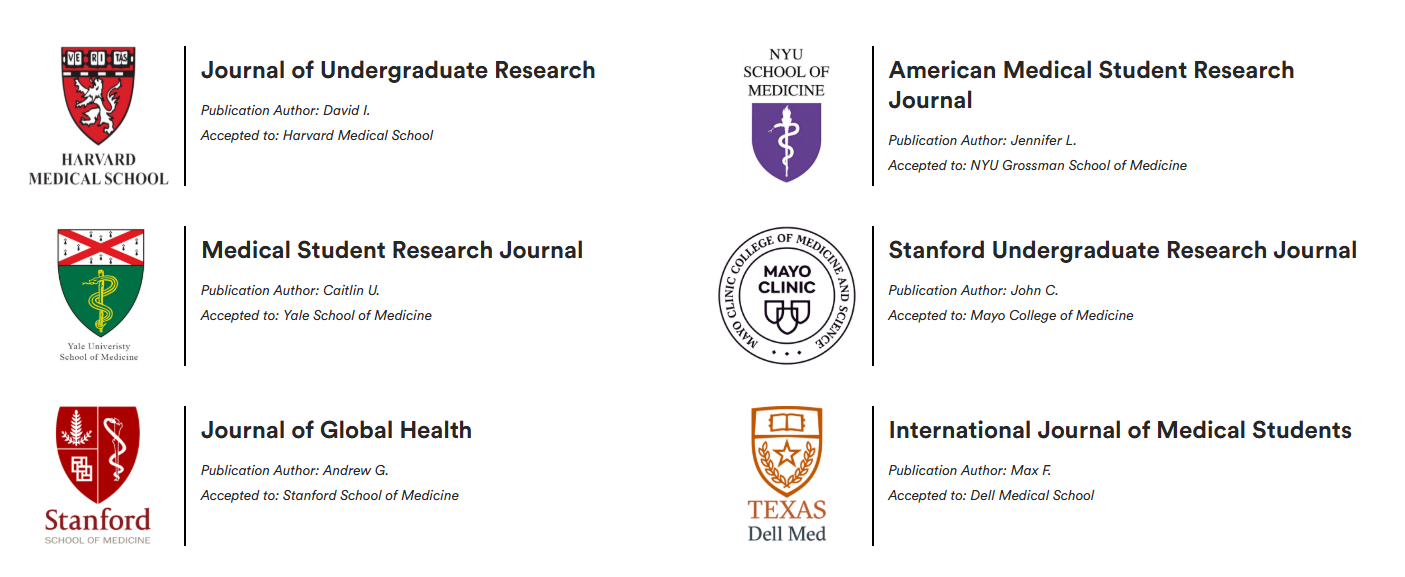
Inspira’s medical research paper support services can help you find the perfect research experience to improve your medical school profile. We’ve helped thousands of students publish cutting-edge research for the Journal of Undergraduate Research at Harvard Medical School, Medical Student Research Journal at Yale University School of Medicine, Journal of Global Health at Stanford School of Medicine, American Medical Student Research Journal at NYU School of Medicine, the Stanford Undergraduate Research Journal, and the International Journal of Medical Students at Texas Dell Medicine.
For example, Inspira Advantage helped Ojas explore the role of humanin as a potential preventative and therapeutic agent in Alzheimer's disease. Here’s what Ojas had to say:
"Inspira paired me up with the perfect mentor, who helped me turn my ambitions of doing research in biology into a reality. The program schedule was extremely flexible, and helped me create two separate projects in our time together. Inspira and my mentor helped me create concrete projects around my passions and have empowered me to keep pushing the boundaries of science.”
Inspira Advantage has the nation's largest team of former admissions officers who can help you plan your pre-med timeline, get access to exclusive opportunities, and do everything possible to ensure your application gets accepted. Book your free consultation today to get started.
Here is a list of helpful resources to help applicants choose the perfect extracurriculars:
Inspira Advantage specializes in helping students at every stage of their pre-med journey get access to exclusive clinical, volunteering, and research experiences. We offer tailored support for:
Our pre-med advising programs allow you to choose from 100+ profile-building activities to get a competitive edge over tens of thousands of other medical school applicants.
Paid roles are going to be a lot more impressive because they mean that you've done training and that you have been given the responsibility to work with patients. However, all that really matters is that you get meaningful exposure to patients, healthcare professionals, and the realities of clinical care. The strongest clinical experiences, paid or unpaid, give you real responsibilities and something substantive to discuss in your application.
There isn't an official maximum for extracurricular hours, but unusually high numbers can raise questions if they don't appear realistic. Admissions committees can consider your activities alongside your coursework, employment, and other commitments, so the hours you report should make sense within your overall timeline.


.svg)


