CASE STUDY
How We Helped a Reapplicant Stand Out and Get Accepted to Her Top-Choice Medical School
GPA
3.92
MCAT
510
NC
ACCEPTED
University of North Carolina School of Medicine

Written By:
Arush ChandnaDate Published:
August 14, 2026
We changed the details below to protect our client’s privacy. However, we made no changes to the guidance, insights, and level of support she received.
Inspira Advantage helped Michelle, a reapplicant, get accepted to her top-choice school in the next cycle.
Michelle initially applied in the 2024-2025 admissions cycle with a strong application, but she wasn’t accepted to any school. She was waitlisted at one, but never heard back with an acceptance offer. She was devastated, and she didn’t know how to move forward.
She reassessed her candidacy for the next admissions cycle and knew she needed an expert’s opinion. That’s why she came to Inspira Advantage for support. She knew her strategy needed an expert’s perspective to strengthen her application and reduce mistakes.
Here’s a look at exactly how we helped Michelle get accepted to her number one medical school:
Michelle faced one of the biggest challenges all re-applicants endure: self-doubt. After being waitlisted and not hearing back from a school in the previous admissions cycle, Michelle began to lose hope of getting into any medical school, let alone her dream one.
When Michelle applied initially, her application was fairly strong. She had above-average stats, applied broadly, and pursued meaningful activities. However, she couldn’t submit all her secondaries within the two-week timeline and never got first-hand interview experience.
Michelle decided to take a gap year to strengthen every aspect of her application. She contacted us to make sure she was making the right calls during her time off. She wanted an expert’s perspective on her personal statement, support throughout the secondary essay stage, and mock interview preparation since it was still unfamiliar territory for her. We matched her with one of our application experts, and they both got to work immediately.
We spoke with Michelle’s counselor about how she helped get her accepted. Here’s what she had to say about her experience working with Michelle:
“Michelle’s application was an interesting case, because she looked very competitive on paper. However, her application just needed that extra push forward. Leadership experience further diversified her skill set, and her interview confidence also contributed to her eventual acceptance. She also needed help getting her secondary essays in on time. After getting to know Michelle more personally, I knew exactly what she needed to set her apart from other applicants.”
Michelle’s top-choice school was the University of North Carolina School of Medicine, as it aligned with her goals as a future physician. However, she was determined to get into at least one medical school, so she applied broadly to 15 schools in total:
Michelle felt confident that she’d at least make it to the secondary essays phase again this time around, but she still felt nervous. She didn’t want to make any mistakes and jeopardize another year of delayed education.
Since Michelle was a reapplicant, we knew she needed an expert’s perspective on her application. Thankfully, our admissions consultants work with reapplicants every day, so we matched her with one of our top consultants who has a track record of helping reapplicants get into medical school.
Here’s exactly how we helped Michelle after she contacted us:
Michelle’s application was already fairly impressive, but we knew she needed additional experiences to help her stand out even more. What was missing was some longitudinal leadership experience she could also include as part of her clinical roles.
Thankfully, Michelle had already laid the groundwork. Her supervisor wanted her to take on more leadership responsibilities in a new role, but she didn’t feel fully prepared. Michelle’s admissions consultant helped her build confidence, plan for a new role, and advocate for herself by explaining why she felt ready to take on new responsibilities.
With her counselor’s support, Michelle felt confident asking more questions on the job, talking to people in the role she’d eventually take on, and asking for more hands-on responsibilities. In just a few months, Michelle felt ready to finally take on the Clinical Care Technician role, which ended up looking very impressive on her resume.
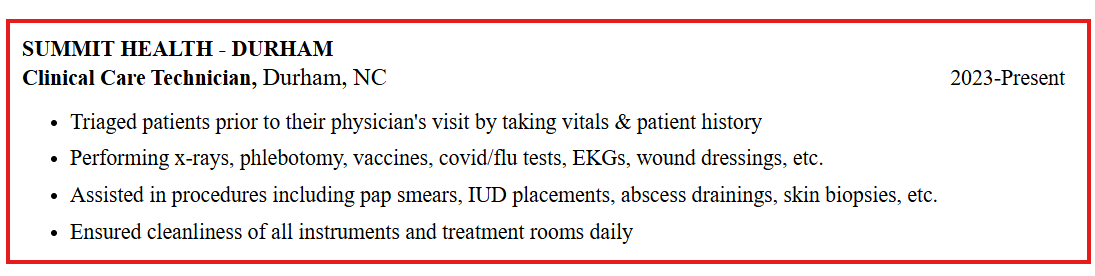
Michelle’s application was already relatively strong. She had an excellent 3.97 GPA, a strong MCAT score of 510, and impressive volunteer and research experience. However, she needed to apply broadly again this cycle to maximize her chances.
Michelle really wanted to attend the University of North Carolina School of Medicine, especially since she was an in-state applicant. We prioritized this school because our consultant said she had the best chance of acceptance there. We also prioritized Brody School of Medicine because Michelle’s background matched what the admissions committee looks for.
To ensure Michelle was accepted to at least one school, our counselor helped her organize and select 15 of the best medical schools where she had a realistic chance of admission. We helped Michelle build a complete spreadsheet of all the schools she planned to apply to, including their full requirements. This helped Michelle stay on track with every element of her applications and submit them early.
Here’s an example of the spreadsheet Michelle used to help her apply to 15 schools:
.png)
Michelle had already started her AMCAS application before coming to us, but she was stuck on the personal statement section. She wanted each element of her application to stand out this time around, especially since she wasn’t accepted in the previous cycle.
We got to know Michelle through our extensive assessments and questionnaires, which helped us understand her strengths, weaknesses, experiences, and passion for studying medicine. With her counselor's support, Michelle wrote an extremely effective personal statement that helped her stand out from thousands of other applicants.
In her personal statement, Michelle emphasized her passion for serving underserved communities, which aligned with each school's mission. She also connected her research, volunteer, and medical experience to her future as a physician. We helped Michelle emphasize the “why medicine” in her personal statement so that no admissions officer would have to wonder why she wanted to become a doctor right now.
In the previous admissions cycle, Michelle couldn’t submit her secondary essays within the two-week window. Our consultant noted that this likely contributed to Michelle not getting accepted.
Knowing this, our counselor got to work and helped Michelle write extremely specific secondary essays for each school. She submitted them all on time with the support of a former admissions officer. Her counselor helped her prioritize the secondary essays for the schools she really wanted to attend.
Michelle was extremely honest in her secondary essays. She admitted up front that she lacked the clinical experience to perform well as a medical assistant.
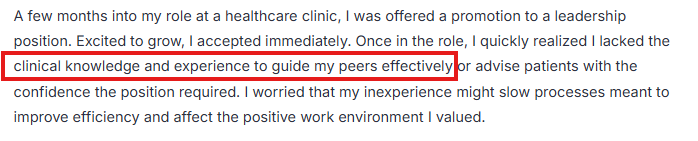
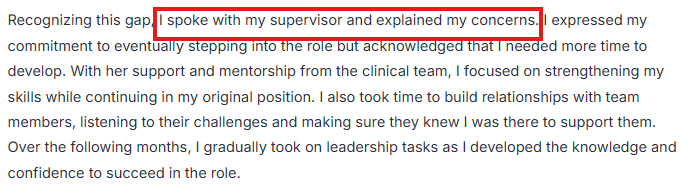
However, she also took accountability and explained exactly what she did to strengthen this weakness. Michelle asked her supervisor for additional training before fully stepping into the role.
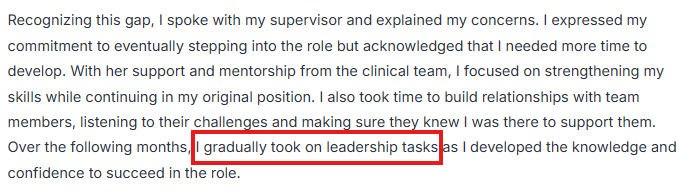
She built relationships with current medical assistants and took on additional leadership tasks, eventually succeeding in the role.
Writing an essay that admits your faults might feel vulnerable, but for Michelle, this was exactly what the admissions committee wanted to hear, especially as a re-applicant. Admissions officers are less interested in your shortcomings and more interested in how you overcame them. We helped Michelle turn adversity into an application differentiator.
After helping Michelle write extremely specific, honest secondary essays, we moved on to mock interviews. Michelle hadn’t made it to the interview stage last time she applied, so we were determined to change that.
Michelle’s consultant helped her with three mock interviews. Each time, they worked on improving something different:
The graphic below shows the full interview support Michelle received for traditional, one-on-one, panel, MMI, hybrid MMI/traditional, and structured interview formats, including how ready she felt after each mock interview:
Each mock interview built on the skills they learned in the last session, and Michelle walked into her interview extremely confident. This was extremely important for Michelle, since she was really nervous about not knowing how to answer difficult questions.
Walking into an interview nervous and unsure what to say can be one reason you’re not accepted. Plus, Michelle had no interview experience before working with us, so we knew we needed to help her prepare properly with an expert who has interviewed candidates.
With the help of her Inspira Advantage consultant, Michelle was accepted to both the University of North Carolina School of Medicine and the Brody School of Medicine, with UNC as her top pick. Michelle was initially discouraged and overwhelmed after a failed application, so she turned to an admissions expert for support with her next attempt.
By working with Inspira Advantage, Michelle got:
Admissions officers look for resilience in the face of adversity, passion for studying medicine, and ownership of your strengths and weaknesses. We made sure Michelle demonstrated all of these qualities throughout her application to show she was ready to become a physician.
Just one cycle earlier, Michelle didn’t get accepted to any school. This time, she had two acceptances, including her dream school. The difference wasn’t her GPA or her MCAT score. It was a school list built around where she could actually get in, secondaries that told her story more honestly, and interview prep that gave her the confidence to deliver it. Most reapplicants never get a second shot at their first choice, but with Inspira Advantage's help, Michelle did.


.svg)


