Get in touch: +1 888 453 5021


.jpg)
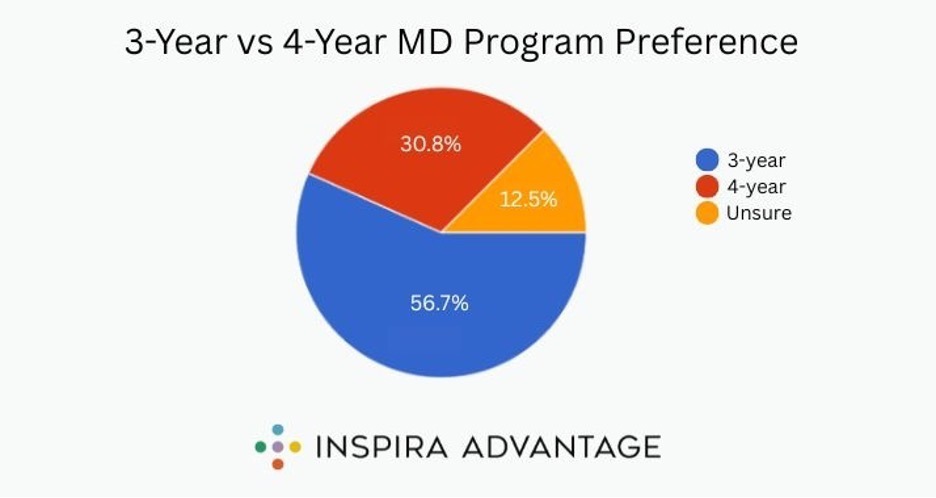
February 4, 2026, New York, NY — A new survey of 244 aspiring and current medical students by Inspira Advantage, a medical school application advising firm, found that 56.7% of aspiring medical professionals would prefer a 3-year medical school program over the traditional 4-year route.
The driving force behind this shift is student debt.
Inspira Advantage is a med school admissions consulting firm that helps students navigate the med school application process. Their team of former admissions officers and admissions experts from top med schools has over 15 years of experience.
The survey found that of those who preferred a 3-year MD, 82% cited cost and debt reduction as their top reason. The preference toward accelerated pathways comes at a time when medical students are facing unprecedented financial pressures.
Starting in July this year, the federal government will impose new limits on graduate student borrowing:
According to the New York Times, in 2025, the median cost of four years of medical school reached more than $297,000 at public schools and surpassed $400,000 at private schools.
According to our survey, 66.5% of respondents said these new federal limits make them more likely to consider a 3-year MD program, if given an option. Among those influenced by the loan cap, nearly two-thirds (65.1%) prefer a 3-year MD. Currently, there are more than 30 medical schools, such as NYU Grossman School of Medicine and Wayne State University School of Medicine that already offer three-year programs in the U.S.
“Students already feel crushed by the price of becoming a doctor. When you add federal borrowing caps and eliminate the only loan that covers full tuition, it pushes students toward accelerated programs that cut debt and get them working sooner,” said Arush Chandna, co-founder of Inspira Advantage.
The med school pipeline is already showing signs of financial strain. Among the current medical students in our survey, 44% reported more than $100,000 in debt, and 22% reported over $200,000. With the federal government capping medical school loans at $50,000 per year and $200,000 total, many future students will face tighter borrowing limits than ever before.
Debt-related burnout is also a major concern. Research shows physicians with $250,000 to $350,000 of debt are 24% more likely to experience burnout symptoms, and those with more than $350,000 are 47% more likely.
While it is too early to know how students will ultimately adapt, our survey suggests that preferences are already shifting. Accelerated programs that may once have been perceived as niche or unconventional are now seen by many students as a practical, financially sound alternative to the traditional four-year track.
“The move toward 3-year MD programs reflects both financial reality and student demand. What matters most is designing programs that maintain clinical rigor, support student wellness, and prepare future physicians to thrive, regardless of how long the degree takes,” said Dr. Aanika Warner, a physician and admissions expert at Inspira Advantage.
While cost and debt reduction was the top driving force behind a fast-track MD, students also cited other reasons as below:
These responses suggest accelerated training could help reduce burnout, allow earlier family planning, and shorten the decade-long path to practicing medicine.
Further, a 3-year accelerated MD program can address the shortage of physicians in the country by making more physicians available sooner. According to a 2024 Association of American Medical Colleges (AAMC) report, the U.S. will face a shortage of up to 86,000 physicians by 2036.
Orthopaedic Surgery Resident Physician
Lewis Katz School of Medicine at Temple University


.svg)


