All of the details in this guide have been modified to protect the student’s privacy.
Mohammed had a clear goal in mind: to attend a top-ranked medical school in a big city. But, as a student with a non-science major, little research experience, and three missing prerequisites, Mohammed needed help convincing admissions committees at top schools he was still a competitive candidate.
Inspira Advantage was able to help Mohammed submit a strong application that earned them an acceptance to the University of Miami Medical School, the high-energy, big-city school he was chasing.
Mohammed’s Biggest Challenge: An Unclear Narrative
Mohammed came to us feeling like his med school application came across as unfocused and unusual compared to the “typical” med school applicant.
He had strong stats, but some concerns about the soft factors the rest of their application portrayed. Like many premed students, Mohammed had taken a gap year to gain professional experience before attending medical school. However, unlike most applicants, he pursued work that was completely unrelated to medicine.
With an interest in data science, Mohammed decided to pursue a tech internship during his gap year. This in itself wasn’t a major red flag to the Director-Level Advisor Mohammed was paired with. Students who pursue unusual experiences during their gap year actually tend to stand out, so long as they can adequately explain how these experiences either gave them transferable skills that can be applied to medicine or solidified their true passion for medicine.
Mohammed already had some solid clinical experience as a patient care technician and a volunteer in a pediatric clinic, so pursuing an interest instead of a resume booster during his gap year wasn’t hard to explain. But the major gap in Mohammed’s application was a research project he had pursued for several months before it stalled, and he ultimately walked away from it.
Another cause for concern was that Mohammed was missing three prerequisites that a lot of med schools strongly prefer: psychology, genetics, and biochemistry.
So, despite having a 515 MCAT score that would be strong enough to compete at top schools, Mohammed’s incomplete prerequisite list and research project with no tangible outcomes could still raise an important question for admissions committees: Does Mohammed actually understand what he’s signed up for, or did he decide on medicine hastily?
Take a look at this interactive diagnostic of Mohammed’s application profile to see his strengths and weaknesses:
Applicant Profile Diagnostic
Mohammed
Strong stats, unconventional path — where do the gaps really lie?
Mohammed vs. the typical competitive applicant
MCAT Score
515
Clinical Hours
Good
Research Output
Weak
Prerequisites
3 gaps
Gap Year Story
Mixed
Overall Narrative
At risk
Competitive
Needs framing
Gap / risk
Click each factor to explore
📊
MCAT Score — 515
83rd percentile
Strong▼
472Average matriculant: ~511.9528
515
A 515 is competitive for most top-30 schools. This is Mohammed's biggest asset — it opens doors the rest of the application needs to keep open.
🏥
Clinical Experience
Patient care tech + pediatric volunteer
Strong▼
Paid, hands-on work as a patient care technician plus pediatric clinic volunteering — exactly what committees want. This also helps justify the unconventional gap year: Mohammed wasn't avoiding medicine, he'd already logged meaningful clinical time.
💻
Gap Year — Tech Internship
Data science, unrelated to medicine
Needs Framing▼
Not automatically a red flag — unusual experiences can actually stand out. But committees will ask: why tech instead of more clinical time? With strong clinical hours already logged, this is defensible — it just needs a clear narrative connecting it back to medicine.
🔬
Research — Incomplete Project
Months invested, no publication or tangible outcome
Red Flag▼
MohammedTypical competitive applicant
0
Publications / Posters
vs
1–3
Publications / Posters
The issue isn't the research — it's the lack of any tangible outcome. Competitive applicants typically show at least a poster or co-authorship. Mohammed invested months and walked away with neither.
📋
Prerequisites — 3 Missing
Psychology, genetics, biochemistry
Red Flag▼
✗ Psychology
✗ Genetics
✗ Biochemistry
These aren't just checkboxes — biochemistry and genetics are foundational to years one and two of med school. Missing all three, combined with abandoned research, suggests to committees that Mohammed may not have fully scoped what's ahead.
The questions this application raises
"Do they know what they signed up for?"
A 515 says yes academically. Three missing prerequisites say maybe not.
"Why tech instead of more medicine?"
Without framing, the gap year reads as indecision — not exploration.
"Where's the follow-through?"
Months of research with no output. Committees notice.
The core problem wasn't Mohammed's stats — it was that nothing else on the application tied the story together.
Turning a Missing Research Record Into a Story That Would Impress Any Admissions Committee
Since Mohammed’s research project only lasted five months and he eventually quit, his initial instinct was to avoid including it in his application altogether.
His counselor thought otherwise and believed there was a much more impressive story hidden in that experience. Mohammed had walked into a wet lab with no biology background; he taught himself enough machine learning to build a predictive model anyway, and could actually explain why it stalled. That story was far more interesting than simply stating he had no research experience. Framed in the right way, this experience would clearly show any admissions committee that Mohammed knows how to problem-solve, adapt, and work through uncertainty.
So, instead of ignoring the experience, we did the exact opposite. We made it the anchor as one of Mohammed’s most meaningful experiences on AMCAS and the foundation for several secondary essays that asked about problem-solving.
The counselor carried this narrative throughout Mohammed’s secondary essays, showing how his data science background gave him a different approach to solving problems.
For the University of Miami Med School secondaries specifically (which is where Mohammed ultimately enrolled), the counselor really leaned into Mohammed’s data science identity. Mohammed’s essay explained how debugging code and diagnosing a patient can involve similar principles. In both cases, much of the work happens before the fix, as the person traces the problem or symptom back to a root cause that may have been overlooked at first.
The counselor also ensured that Mohammed connected his experience working in a Spanish-speaking clinic to UMiami Med’s location in a large, diverse city. Mohammed could clearly articulate his comfort working with different cultures and an interest in serving a large patient population he’d actually serve in Miami.
Addressing the Missing Prerequisites Before a School Could Ever Ask
Mohammed and his counselor both flagged the three missing prerequisites as the biggest gap in Mohammed’s application. The first step for the counselor was to look into schools that didn’t have hard prerequisite requirements so they could help Mohammed build a better school list. Together, they were able to come up with a balanced list of 18 schools that were more lenient with missing prerequisites or didn’t specifically require the ones Mohammed was missing.
When it came to secondary essays that asked about academic readiness, Mohammed’s counselor helped them state the issue plainly instead of hoping admissions committees wouldn’t notice. The counselor helped Mohammed draft secondaries that named the courses that were missing and why Mohammed couldn’t complete them: a demanding data science major that left no room for additional prerequisites.
Writing Mohammed’s Personal Statement: 7 Drafts to Perfection
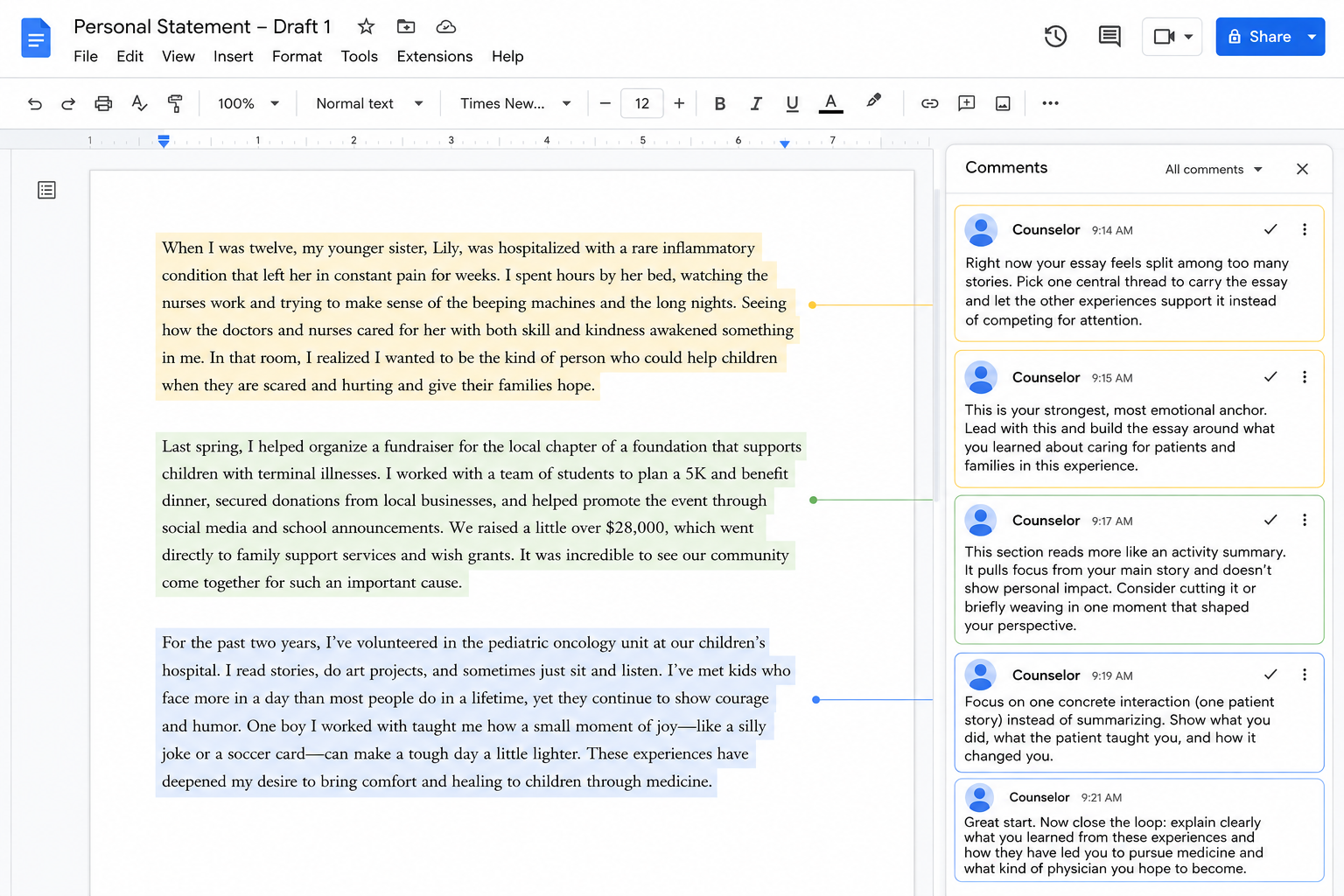
Mohammed’s personal statement required seven rounds of editing before it was submission-ready. His first draft had far too many narratives and read as unfocused, which is exactly what he needed to avoid in his application. Mohammed walked the reader through three different transformative experiences in his life:
Their sister’s hospitalization
A fundraising event for children with terminal illnesses
Volunteer work with children with cancer
With the first draft, the counselor helped Mohammed narrow the focus of his personal essay down to one central theme—his keen interest and personal investment in working with children. He had experienced his younger sister’s illness and spent much of his free time advocating for and working with sick children.
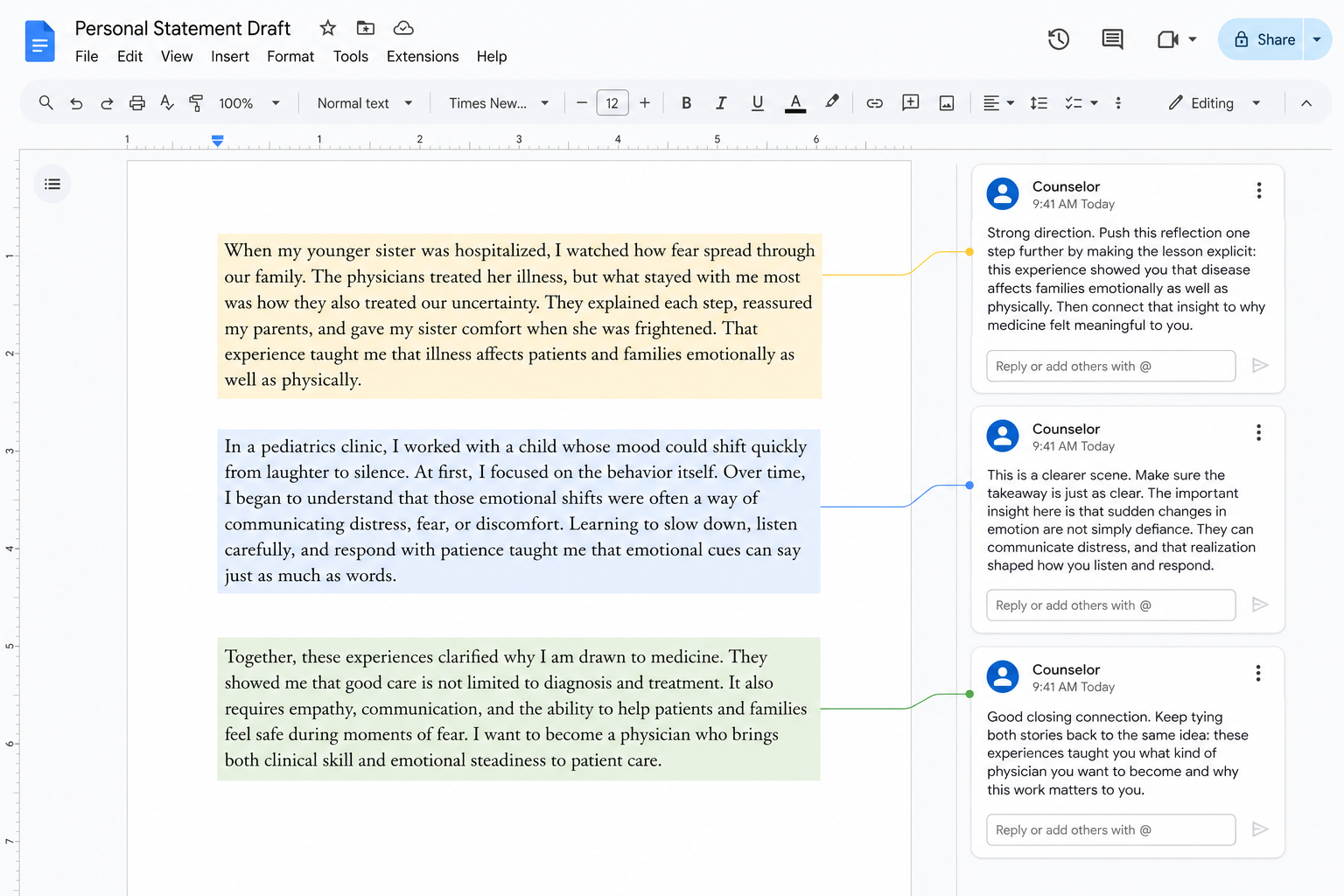
The next two rounds of edits focused on identifying specific stories and developing them with enough detail to hold an admissions reader’s attention. Mohammed decided on a story about his sister’s hospital stay and a child he worked with that was laughing one minute and frozen in fear the next.
The final drafts focused on following these two stories through to some sort of realization. The main question the counselor wanted Mohammed to answer was what they had learned through these experiences and how they pushed him toward medicine. The counselor made suggestions on what those lessons may be.
Ultimately, Mohammed showed how his sister’s hospital stay taught him how disease is just as emotional as it is physical. His interaction with the child whose mood changed so quickly taught him that emotions can communicate what someone may not yet be able to express in words, making it just as important to observe as it is to listen.
Both reflections helped connect the stories to the kind of physician Mohammed hopes to become.
Results
Mohammed’s counselor helped him build a compelling application around aspects most premed students would treat as red flags. He had a non-science major, a gap year pursuing a completely different career, and an incomplete transcript. His counselor was able to turn each of these red flags into green flags that proved Mohammed was ready for medical school and brought a distinct perspective that few other premeds could.
They were admitted to the University of Miami Miller School of Medicine, the program they’d named as their goal in their very first consultation call.
Arush Chandna is the Co-Founder of Inspira Advantage and a nationally recognized expert on graduate school admissions. Arush has used his 12+ years of experience in higher education to help 10,000+ applicants get into their dream graduate programs.


.svg)


