Get in touch: +1 888 453 5021



Three science sections test your ability to apply foundational science knowledge to unfamiliar scenarios. However, memorizing facts won't automatically help you ace the exam. You need to synthesize information across disciplines, interpret experimental data, and reason through problems that combine concepts from multiple subject areas.
Rather than testing science content, CARS measures how well you can read complex passages from the social sciences and humanities, identify core arguments, and draw logical conclusions from the material.
The MCAT includes four main sections:
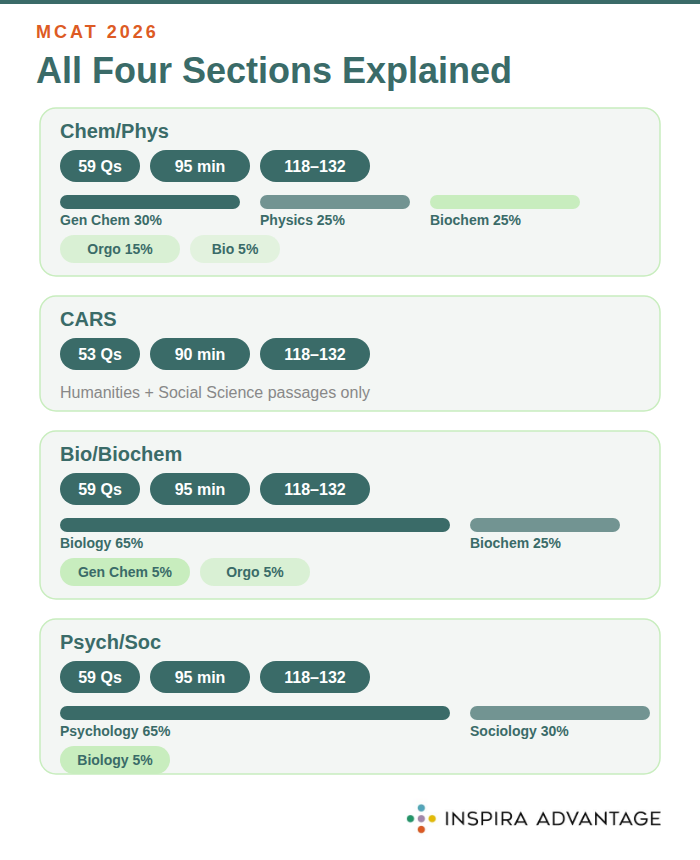
Three of the four MCAT sections are science-based. Each of those combines passage-based question sets with 15 standalone discrete questions. Those passages present research studies, experiments, or scenarios you've never seen before. Your job is to pull from multiple subject areas simultaneously to interpret the data and answer questions.
For example, a Chem/Phys passage might describe a biological system and ask you to apply physics equations to it. A Bio/Biochem passage could require knowledge of organic chemistry to make sense of a metabolic pathway.
However, CARS is like a traditional verbal reasoning test and draws exclusively from humanities and social science passages. No science content appears in CARS, and no outside knowledge helps you. You're tested purely on your ability to understand dense, unfamiliar writing and reason through arguments.
MCAT questions increasingly reward your ability to interpret unfamiliar research passages rather than pull definitions from memory. Spend more time practicing passage analysis and less time memorizing definitions. For a quick way to put that into practice, you can work through a fresh MCAT-style question and detailed explanation every weekday.
Each MCAT section is scored between 118 and 132. And those four scores combine to produce your total MCAT score on a scale of 472 to 528. There are also unscored field-test questions that the Association of American Medical Colleges (AAMC) evaluates for future exams. The unscored items don't affect your final score.
Work with an expert at Inspira Advantage to map out your path to a competitive MCAT score. With our support, you’ll be ready to ace the MCAT in just a few months.
The video below provides expert tips on how to ace the MCAT, led by Dr. Aditya Khurana, one of Inspira’s top MCAT tutors.
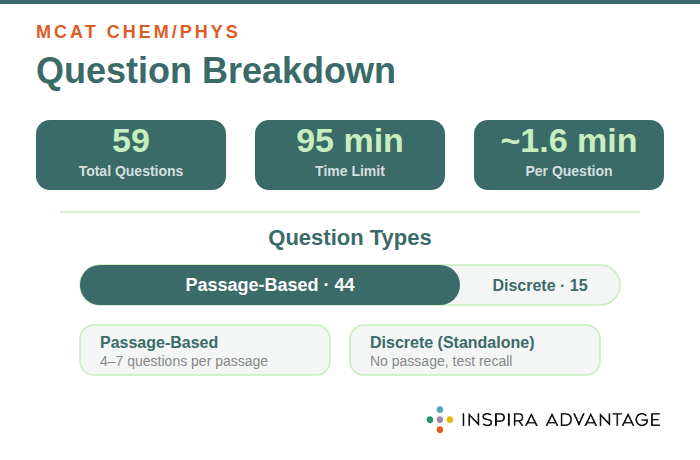
Chem/Phys is the first section you'll encounter on test day. It's the most calculation-heavy part of the entire exam. You won't have access to a calculator or equation sheet, so your ability to perform mental math quickly and recall key physics formulas from memory determines how efficiently you move through passages.
However, the AAMC doesn't test each subject in this section in isolation. A single passage might describe an experiment involving enzyme kinetics (biochemistry) and then ask you to calculate the energy of a photon emitted during a reaction (physics).
Invest your initial study time in understanding why each equation works, rather than just memorizing it. When you understand the relationships between variables, you can derive what you need under pressure instead of blanking on a formula you crammed the night before.
You can also watch our MCAT Bites video series for quick, targeted breakdowns of high-yield Chem/Phys topics. With 190+ videos covering every corner of the exam, you can fill specific gaps without rewatching hour-long lectures.
For example, in our Mastering the 6 Chemical Reaction Types for General Chemistry video, Bretton Baddonach, a tutor at Inspira Advantage who scored in the 99th percentile, breaks down everything you need to know.
CARS often catches most premeds off guard. Every other part of the MCAT rewards content knowledge you built in undergraduate courses. CARS doesn't. No particular prerequisite courses or materials will help you here. And no outside knowledge gives you an advantage.
You're tested purely on how well you can read a dense, unfamiliar passage and reason through its arguments under time pressure.
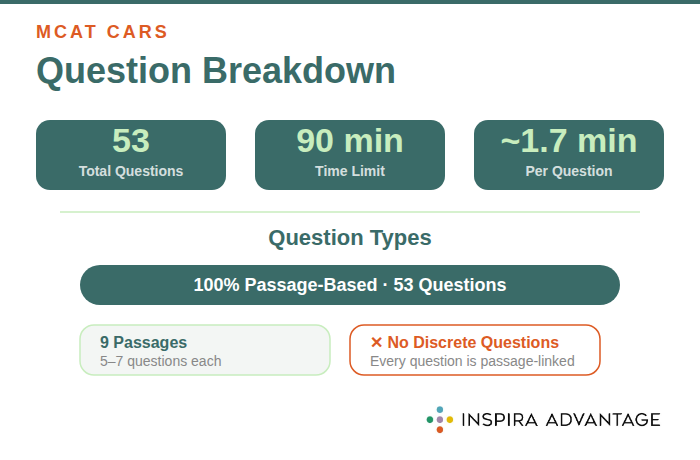
The CARS section consists entirely of passage-based questions with no discrete ones. Every single point requires you to engage with a passage first.
You'll work through nine passages drawn from the social sciences and humanities, covering topics like:
The subject matter changes with every passage, so you might go from analyzing an argument about economic policy to interpreting a critique of postmodern architecture within the same section.
The question types break down into three categories:
Nearly half the section asks you to go beyond what the author explicitly states. You'll need to infer assumptions, predict how the author would respond to new information, and evaluate how outside evidence strengthens or weakens the passage's central argument.
Most students struggle with reading comprehension and timing. Reading too carefully the first time takes too long, yet rushing through a passage leads to misreading the author's position on a key point. Practicing with CARS tips can help you master this difficult section.
Bio/Biochem covers more tested content than any other MCAT section.
The biology content spans everything from molecular biology and genetics to organ systems and physiology. Expect passages built around research experiments that describe a study design, present data in tables or figures, and then ask you to interpret results or predict what would happen if a variable changed. The AAMC wants to see that you can think like a scientist, not just recall textbook definitions.
High-yield concepts like enzyme kinetics, molecular biology, and organic reaction mechanisms appear frequently on the AAMC’s practice exams. Prioritize the concepts that show up most often before filling in the gaps.
The Bio/Biochem section emphasizes a deep understanding of key scientific concepts rather than memorization of discrete facts. For example, a question about DNA replication might present a mutation in that enzyme and ask you to predict downstream effects on protein synthesis.
Bio/Biochem is the third section on test day, so you'll sit down to tackle it after Chem/Phys and CARS, and after a lunch break. Cognitive fatigue and burnout are common at this point.
Students who don't practice with full-length exams under realistic conditions often see their Bio/Biochem scores drop compared to their section-only practice scores. Train your endurance alongside your content knowledge.
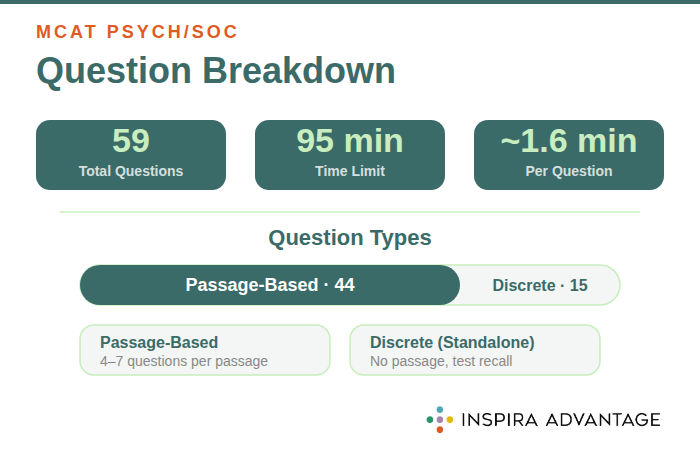
Psych/Soc is the section most premeds underestimate. The sheer volume of terminology and theoretical frameworks you need to understand is more than in any other section on the exam.
The Psych/Soc section tests how well you integrate concepts from psychology, sociology, and biology to understand how patients' behavior, mental health, and social environment affect their overall health. A future physician needs to understand:
Psychology questions cover mental processes, behavior, and the biological underpinnings of psychological functions. Expect topics such as:
Sociology questions focus on:
The biology component typically appears as questions about the nervous system or biological mechanisms underlying psychological processes.
A typical Psych/Soc passage might describe a study on implicit bias in healthcare settings and ask you to identify which sociological theory explains the observed results. Another might present neuroimaging data and ask you to connect brain activity patterns to a specific psychological concept.
Many Psych/Soc questions rely on whether you can distinguish between closely related terms. Knowing the difference between discrimination and prejudice, or between assimilation and acculturation, often determines whether you pick the right answer or fall for a trap choice.
The MCAT’s format and what it tests don’t change often. Since its creation in 1928, the exam has undergone just five major revisions, with decades passing between each overhaul. The AAMC launched the current version of the MCAT in April 2015, replacing a format that had been in use since 1991. Major revisions happen only when the landscape of medical education shifts enough to warrant a fundamentally different test.
That said, the AAMC does make smaller administrative adjustments each testing year. The MCAT Essentials guide is updated each year to reflect changes in registration policies, test-day procedures, and scheduling logistics. None of these adjustments affects the actual content or format of the exam itself.
MCAT questions increasingly reward your ability to interpret unfamiliar research passages rather than pull definitions from memory. Spend more time practicing passage analysis and less time memorizing definitions.
The most challenging MCAT subjects are CARS questions. This is because you can't study content to improve at CARS the way you can for the science sections. No specific material prepares you for it, which leaves many premeds feeling lost when their score doesn’t improve. Score improvement comes from dedicated daily practice with passage analysis and answer elimination.
No, you don’t need to take any prerequisites to register for the MCAT. However, you should have at least some coursework in biology, chemistry, physics, and biochemistry before sitting for the exam, but nothing stops you from signing up without completing those courses.
That said, walking into the MCAT without the foundational coursework probably won’t result in a good score. The science sections assume you've completed introductory-level courses in all seven tested subjects. Students who skip prerequisites must teach themselves entire disciplines while also learning MCAT-specific reasoning skills, and that combination stretches most study timelines past the breaking point.
Yes, there’s a lot of math on the MCAT. However, you’re not allowed to use a calculator, and you won’t get a formula sheet, so you need to handle quantitative problems with mental math and memorized equations. You won't encounter calculus, advanced statistics, or complex algebra. The math stays at the level of arithmetic, ratios, proportions, logarithms, and basic algebra.
Yes, every one of the 230 MCAT questions is multiple-choice with four answer options. There are no fill-in-the-blank, true/false, or free-response questions anywhere on the exam.
No, you won't see a dedicated anatomy section or questions asking you to label bones and muscles on a diagram. The MCAT tests anatomy indirectly through its biology and biochemistry content, where understanding organ systems and basic physiological structures helps you interpret passages and answer questions about how the body functions.
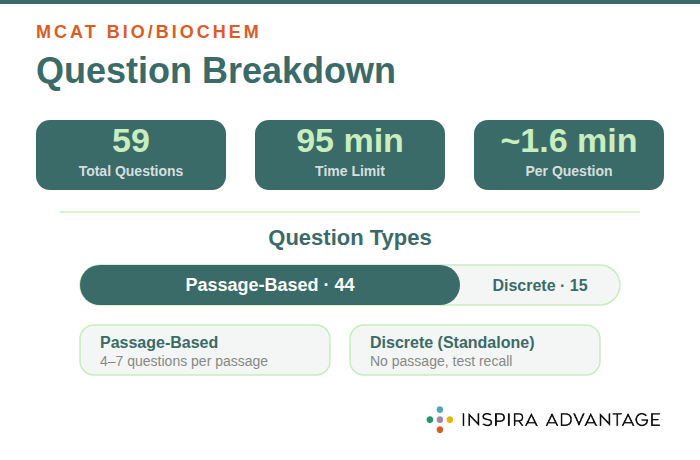
The MCAT has 230 multiple-choice questions split across four sections. The first three sections each contain 59 questions, and CARS contains 53. Each science section pairs 44 passage-based questions (spread across 10 passages) with 15 standalone discrete questions. CARS is entirely passage-based with 53 questions across nine passages and no discrete questions at all.
Orthopaedic Surgery Resident Physician
Lewis Katz School of Medicine at Temple University


We’ll send you a 100+ page MCAT practice test created by one of our expert 99th percentile tutors. No strings attached.

.svg)

