Get in touch: +1 888 453 5021




Medical schools interview applicants to get to know them as individuals beyond their application materials. Interviews are an important aspect of many medical and dental school application processes.
The interview is also a chance for you, the candidate, to learn more about the school you’re applying to. If you ask good questions, you can get a window into what life at that school would be like, which may help you make an easier decision.
Preparing for your medical school interview is one of the best ways to ease pre-interview jitters. Once you know the interview’s format, you can effectively practice.
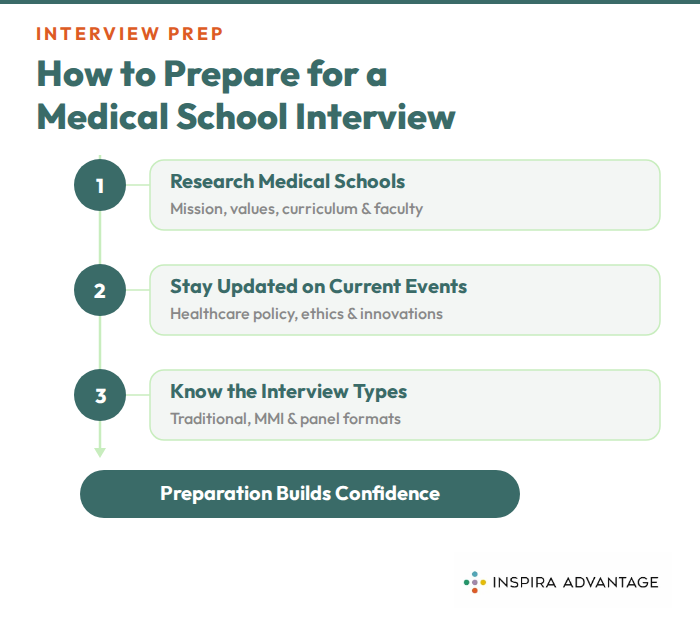
Here are some tips to help you prepare for your interview.
Every medical school is unique; each specializes in different medical areas and has individual mission statements, so understanding each medical school you’ll be interviewing at is a great place to start.
Begin by looking at the mission statement for the medical school of your choice. You want to find a medical school with a similar outlook to yours. It will show you what the school is looking for in candidates and if its goals align with your pursuits.
In your interview, reference the medical school’s mission statement and include key phrases to show interviewers you’ve done your research. Show them how the university’s mission aligns with your goals by using your supporting evidence.
Another topic to review is a medical school’s achievements. This requires a little more research, but discussing specific achievements in your interview will show the admissions committee you have put in the work to learn whether the school is a good fit for you.
Interviewers often ask why you chose to apply to their school in particular. Tying your medical school knowledge to your desire to pursue medicine will impress the admissions committee more than a general statement of your willingness to attend their university.
You’ll likely encounter at least one question regarding current events in medicine, so keeping up with what’s happening in the world is crucial to your success. Keep up with political issues, especially those related to healthcare.
Platforms such as the Association of American Medical Colleges (AAMC) and the American Medical Association (AMA) are great resources for staying up to date on health issues. Researching scholarly articles and books is also a great way to expand your knowledge. The Journal of the American Medical Association (JAMA) is an excellent resource, publishing original research, reviews, and other content on medicine.
Bioethics, innovative technologies, and medical policies are other great topics to read up on. When you discuss a current event during your interview, elaborate on the topic provided. Interviewers want to see that you know more about your topic than meets the eye.
Some topics may be highly controversial, such as marijuana use and abortion, and it’s very likely you’ll be asked to give your stance on these issues. Interviewers are interested in your knowledge of these topics and your responses.
Don’t generalize your answer. You must fairly represent both sides of a topic, then choose your stance and defend it. As usual, you want to be honest. If you’re unsure how to respond, ask questions based on what you already know to expand further upon the prompt.
Each medical school has a different interview format, and knowing how to prepare for these formats can help you tailor your interview preparation.
The one-on-one format is a traditional interview style. Candidates will have one interview with a single interviewer. The one-on-one interview format can take 30 minutes to two hours to conduct. Therefore, you only have one chance to make a first impression.
Take a look at the video below to learn how to prepare for a traditional medical school interview.
The panel interview is another common interview format for medical school. Candidates are asked questions by a group of interviewers during a single interview. Unlike one-on-one interviews, you have one chance to make a first impression on multiple admissions committee members.
Panel interviews can take 30 minutes to a few hours, depending on the medical school.
The Multiple Mini Interview (MMI) format consists of several mini-interviews, each focusing on a specific topic or scenario. Candidates will participate in a set of short interviews designed to gauge their verbal and nonverbal communication skills. Each interview is conducted at a separate station.
You’ll be presented with a prompt outside of each station before being taken into the interview room, where you’ll have anywhere from five to ten minutes to answer the prompt or complete the task. The goal of the MMI format is to assess your abilities, such as problem-solving skills and critical thinking.
Unlike one-on-one interviews, the MMI format allows you to make multiple first impressions. If you feel you didn’t do well on one question, you can redeem yourself with the next interviewer.
The video below explains how to perform well in your MMI.
Interviewers are either open-file or closed-file. With open-file interviews, interviewers have access to your application materials. You might be asked questions related to your documents. This could include your MCAT score, your resume, or your personal statement.
A closed-file interview is when the assessors have not reviewed your application materials. Therefore, you’ll be interviewed as though they know nothing about you except your name. If your interview is closed-file, you’ll want to ensure you highlight your background, passion, and experiences while answering questions.
By now, you’re most likely familiar with Skype and Zoom. Both services are free and are popular for live interviews. You can download Skype and Zoom and create an account to sign up.
Formerly known as Google Hangouts Meet, Google Meet is easy to use and a good option for hosting large meetings or group interviews.
The main advantage of using Google Meet is its connection to the rest of Google’s services, such as Google Docs, Drive, and Calendar. This relationship makes it easy for users to plan meetings and update event information.
Google Meet is simple to navigate and free to use. Do not use the Gmail account you created in 5th grade for your Google meeting.
Often used within medical companies due to its high security, Microsoft Teams is another free video conferencing platform. Because of its integration with Microsoft software, any company that relies on other Microsoft extensions will likely gravitate toward Teams for meetings.
Teams offers chat functionality and can host up to 10,000 members. While we promise you won’t be in a video interview with 9,999 other applicants, this capacity means a quick interface with a stable connection.
Another great feature of Teams is its mobile compatibility, making it easy to participate in an interview anywhere.
Loom is a free, lesser-known Chrome browser extension that has grown in popularity over the last few years. If you’re sending a pre-recorded interview that hasn’t specified which service to use, this could be an excellent option!
Loom allows users to record videos of their screen, face, or both simultaneously. It comes with an easy-to-use editing tool to crop sections of your video. When you attach a Loom to an email, you can see when the recipient opens your video, which is a unique feature that gives this service a leg up over others.
Important note: These services are compatible with Chrome, but not all are compatible with Safari, Firefox, or other browsers. Ensure whichever online interviewing service you use is compatible with your browser.
Responding to this question feels deceptively simple because the prompt is so open-ended. Treat it as a two-minute highlight reel of who you are, what drives you, and why medicine is the logical next step. Many strong answers open with a brief personal anchor (where you're from, what shaped you) before moving into what you're doing now and where you're headed.
The biggest mistake applicants make here is turning it into an autobiography. Nobody needs your full life story from age five. Focus on the last few years: the experiences that confirmed medicine, the skills you built, and the thread that connects them.
Interviewers already know you have weaknesses. The question tests whether you have enough self-awareness to name one and enough maturity to show you're actively working on it. Pick a real weakness that is relevant to academic or professional settings, not a humble brag disguised as a flaw.
Avoid the classic traps: "I'm a perfectionist" and "I work too hard" sound rehearsed and signal that you're dodging the question. Equally risky is choosing something so fundamental to medicine (like "I struggle with empathy") that the interviewer questions your fit for the profession.
Every applicant sitting in that interview chair wants to be a doctor. The question is really asking: What is your specific, personal reason for becoming a physician? Interviewers have heard thousands of versions of "I want to help people," so your answer needs to go deeper than altruism. Anchor your motivation to a concrete experience or moment that made medicine feel inevitable rather than just appealing.
The strongest answers connect an authentic personal catalyst to a sustained pattern of action. A single shadowing experience isn't enough. Interviewers want to see that your motivation has withstood the realities of medicine: the long hours, the emotional weight, the years of training still ahead.
Your answer here proves whether you've done your homework or submitted the same generic response to every school on your list. Interviewers can tell immediately. The only way to answer well is to cite specific programs, opportunities, or institutional values that connect directly to your goals and interests.
Vague praise doesn't work. "Your school has a great reputation," or "I love the location," tells the interviewer nothing about why you belong at their institution. You need to name something the school offers that few or no other schools replicate, and then explain exactly how you would engage with it.
Medical schools aren't asking you to rank yourself against other applicants. They want to hear how you've reflected on what you bring to a medical school class and why your particular combination of experiences, skills, and perspective would add something the school needs.
The key distinction here is contribution over competition. Don't tear anyone else down. Instead, focus on what makes your profile distinct and how the school would benefit from admitting you specifically.
Always prepare questions to ask your interviewer. When the interviewer asks if you have any questions (and they will), saying "no" signals that you're either unprepared or uninterested. Prepare at least three questions for every interview, and make sure none can be answered with a quick Google search.
The strongest questions demonstrate that you've already researched the school and want to go deeper. Ask about something specific to the institution, something that shows curiosity about the learning environment, or something that invites the interviewer to share their own experience.
Medical schools use ethical scenario questions to evaluate your judgment, professionalism, and understanding of patient safety principles. The correct instinct here is always to prioritize patient safety. No relationship with a colleague, no fear of confrontation, and no institutional hierarchy should override the need to protect the patient.
The mistake interviewers see most often with these questions is when applicants jump straight to reporting without acknowledging the human dynamics involved. Real clinical environments require you to balance directness with professionalism.
Ethical scenarios involving minors test your ability to navigate patient autonomy, confidentiality, legal requirements, and the well-being of a vulnerable patient. There is no single "right" answer, but strong responses demonstrate that you understand the complexity and can reason through it systematically.
The trap here is defaulting to a rigid position without acknowledging nuance. Saying "I'd just tell the parents" ignores confidentiality protections for minors in many states. However, saying "I'd never tell the parents" ignores situations where the patient's safety might require it.
Health Insurance Portability and Accountability Act (HIPAA) violations are among the most obvious ethical scenarios you'll encounter in a medical school interview. Unlike questions with genuine ethical tension (like the minor consent scenario above), posting patient information on social media is an unambiguous breach of patient privacy and federal law. Your answer should reflect that clarity while still demonstrating professionalism.
The nuance here isn't about whether the action is wrong. It is, full stop. The nuance is in how you handle the interpersonal and institutional dimensions of the situation.
Boost your confidence and stand out with medical school interview coaching. Get personalized guidance, expert feedback, and proven strategies to shine during your interviews and impress admissions committees.
Medical schools use interviews to assess:
By the time you sit down for an interview, the admissions committee already knows your stats. The interview is where they decide if you belong in their class.
The admissions interview plays a vital role in assessing applicant fit, especially by evaluating competencies that may not be easily assessed through other components of the admissions process, such as the application, MCAT scores, or GPA. Think of it as the one part of the process where you stop being a file and start being a person.
The AAMC's premed competency model outlines 17 competencies across three categories: professional, thinking and reasoning, and science. Your coursework and MCAT score cover the science and reasoning competencies. The interview is where admissions committees evaluate professional competencies, which determine whether you'll function well in clinical environments with patients and colleagues.
You don't need to memorize all 17 competencies. What you do need to recognize, however, is that every interview question maps back to one or more of those competencies.
When an interviewer asks about a time you failed, they're assessing resilience and self-awareness. When they pose an ethical dilemma about a colleague's mistake, they're evaluating ethical responsibility and oral communication simultaneously.
Recognizing which competency a question targets helps you give answers that actually address what the interviewer is scoring.
Receiving advice from a current medical school student can reassure prospective students. Medical school student John Williams of Ross University School of Medicine offers a few med school interview tips to elevate your performance:
Review some med school interview sample questions and use them as a starting point. This will give you an idea of how you’ll shape your responses. For scenario-type questions, it’s important to remain nonjudgmental, explore all possibilities, and keep any vulnerable parties in mind while you’re answering.
Interviewers want a thorough response and an understanding of your thought process, so it's important to prepare in advance to structure your answer effectively.
Practicing for an interview in front of a mirror is the best way to check your nonverbal demeanor. Small gestures or tics can signal your nervousness, so you want to identify them early and manage them before the real interview. It will also show you how you are coming across to your audience.
Maintain eye contact with your interviewer as much as possible. With such a time range for interviews, it’s no surprise you can sometimes get distracted. Your gaze may wander away from the interviewer to something else in the room. Don’t let that happen.
If you find yourself getting distracted, focus on what the interviewer is saying and repeat it back to them in your own words. This will not only keep you focused but also make sure you understand their question. If you’re practicing at home, use an inanimate object as your “interviewer” and focus on it as you practice.
Seek help from professionals who know what admissions committees seek in candidates during the interview portion. They’ll conduct medical school mock interviews and provide expert feedback on how to perform your best during the real thing.
Mock interviews are a great way to get an unbiased opinion on how you present yourself at an interview and where your strengths and weaknesses lie.
Our number one med school interview tip is to be yourself. Interviewers want to see who you are beyond the grades and MCAT scores. Show them you’re a real person with the qualities they desire in their candidates.
Be authentic and don’t make anything up. Whether your interview is in an open or closed-file format, you must be honest.
Know your entire application inside and out, as you may be asked questions about it. Your application includes the AMCAS application, secondary application, MCAT scores, academic records, and letters of recommendation.
It’s no secret that med school interviews are stressful and nerve-wracking, and it’s okay to feel that way. However, you don’t want to give your interviewers the impression you’re nervous or worried. Maintain a positive demeanor and speak with confidence.
Maintaining a clean, polished look, both internally and externally, goes a long way during interviews. It sounds cliché, but smiling also makes a difference. Smiling can help calm you down and put your interviewers at ease. Never underestimate the power of a smile.
If you need even more advice, medical school admissions consulting could be your ticket into med school. Our expert counselors have over 15 years of experience helping students gain admission to competitive programs with great success.
Medical school interviews typically last 30-60 minutes for one-on-one sessions and 1.5-2 hours for MMIs overall. The interview day lasts between four and eight hours.
Prepare for at least four to six weeks before your first medical school interview. The first two weeks should focus on researching each school's specific programs, mission, and curriculum so you can tailor answers rather than deliver generic responses. Weeks three and four should shift to structured mock interviews with a pre-med advisor, mentor, or physician who can give you honest feedback on your delivery. The final stretch is to refine your answers based on that feedback and practice out loud until your responses sound conversational rather than memorized. Applicants who cram interview prep into a few days almost always sound rehearsed or underprepared, and interviewers can tell the difference immediately.
You stand out during a medical school interview by giving answers that are specific to your experiences and specific to the school. Many applicants rely on broad statements about wanting to help people or being passionate about science, which makes them sound identical to everyone else in the waiting room. The candidates who leave an impression are those who can name a specific patient interaction, research finding, or clinical moment that shifted their understanding of medicine, and explain exactly why it mattered. Connecting those experiences to something concrete at the school you're interviewing at (a research center, a clerkship model, a community health initiative) signals that your interest is informed rather than performative. Interviewers remember applicants who offer something they haven't heard from the previous ten candidates.
Never say anything that shows you haven't researched the school, haven't reflected on your own experiences, or can't handle uncertainty. Answering "why this school?" with praise about rankings or reputation tells the interviewer you didn't bother looking beyond a quick Google search. Claiming you have no weaknesses or disguising a strength as a weakness ("I just care too much") signals a lack of self-awareness that raises red flags for admissions committees. Avoid making negative comments about other applicants, other schools, or previous supervisors because admissions committees interpret those as warning signs about how you'll behave as a colleague.
Start preparing for medical school interviews as soon as you submit your secondary applications. Most schools extend interview invitations on a rolling basis between September and February, and early applicants can receive invitations as soon as four to six weeks after submitting secondaries. Starting your prep early gives you time to schedule mock interviews, research each school's unique features, find the right interview prep resources, and build confidence speaking about your experiences out loud.
You should express sincere gratitude for the opportunity in your thank-you letter after your med school interview. You can keep it brief and professional, but you should still personalize it. The primary goal is to genuinely thank your interviewer for their time and express appreciation for the conversation. You can also subtly reinforce why you are an ideal candidate, but that should come as the secondary purpose.
Wear professional business attire to an in-person medical school interview. A well-fitted suit in a neutral color (navy, charcoal, or black), a collared shirt or blouse, and closed-toe dress shoes are the standard. Avoid flashy accessories, strong fragrances, or overly casual footwear because anything that distracts from the conversation works against you. Make sure your clothes are pressed and fit comfortably, as you may be walking across campus, sitting through multiple interview sessions, and attending group activities over several hours. Lay everything out the night before so you aren't making last-minute decisions on interview morning when your focus should be on your preparation, not your wardrobe.
Wear the same professional attire for a virtual medical school interview that you would wear in person, at least from the waist up. A blazer or suit jacket with a solid-colored collared shirt or blouse reads well on camera and signals that you're treating the interview with the same seriousness as an in-person visit. Avoid busy patterns and bright white tops because they can create visual noise or blow out your image on a webcam. Choose a solid, neutral background and position your camera at eye level so you appear engaged rather than looking down at a laptop screen. Test your full setup (clothing, lighting, camera angle, and audio) at least 48 hours before the interview so you have time to fix any issues without adding stress on interview day.
Orthopaedic Surgery Resident Physician
Lewis Katz School of Medicine at Temple University


.svg)


