Get in touch: +1 888 453 5021





We looked at every medical residency program in the nation to find the top 10 shortest ones.
*We used the National Resident Matching Program (NRMP) Charting Outcomes™: Characteristics of U.S. MD Seniors Who Matched to Their Preferred Specialty: 2024 Main Residency Match to determine these match rates.
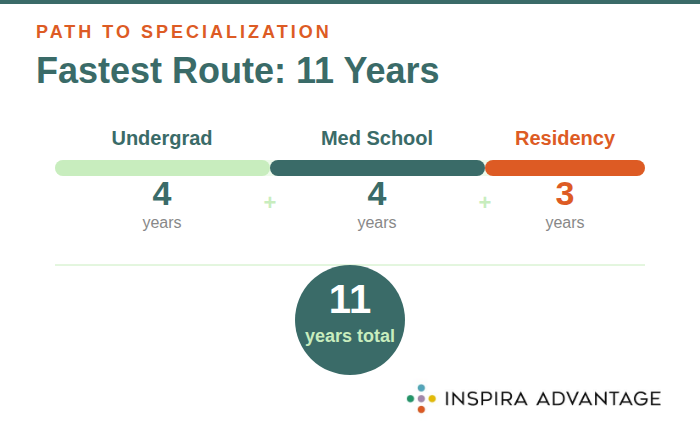
The fastest path to specializing in medicine takes 11 years after high school:
You can reduce the total time by a year or two through an accelerated BS/MD program, and you could start seeing patients on your own by age 28 or 29.
However, that timeline only applies to the three shortest residencies:
All three specialties require only three years of post-medical school education, excluding a pre-residency fellowship.
Inspira Advantage counselors can help you craft your residency application. Our experts have supported thousands of students in writing effective residency personal statements, preparing for interviews, and submitting competitive applications.
Family medicine, internal medicine, and pediatrics are the shortest residencies, lasting three years. All three are primary care specialties that allow you to practice independently immediately after training without a mandatory fellowship. Emergency medicine and PM&R also offer three-year tracks, though some programs in those specialties run four years.
Family medicine is consistently the ‘easiest’ and least competitive residency to match into. It has the lowest mean Step 2 CK score among matched applicants (244), the lowest ratio of US MD seniors per position (0.28), and a 2024 fill rate of just 87.8%, meaning over 12% of spots went unfilled during the Match.
A family medicine physician or general pediatrician can begin independent practice in 11 years after high school. Students who enter an accelerated BS/MD program can reduce the undergraduate and medical school timelines to six or seven years, reaching independent practice in as few as nine to 10 years.
Yes, a three-year residency in family medicine, internal medicine, or pediatrics fully qualifies you to sit for board certification, obtain an unrestricted medical license, and practice independently. You are a fully credentialed attending physician upon completion of those three years. Fellowship training beyond residency is optional for these specialties and only necessary if you want to subspecialize in a specific area like cardiology, gastroenterology, or neonatology.
Anesthesiology has the highest average post-residency compensation of $523,277, followed by dermatology at $508,401. Both require four total years of residency education. Emergency medicine ranks third at $411,133 with just three to four years of residency.


.svg)


