Get in touch: +1 888 453 5021



We used the latest data available from the American Board of Emergency Medicine and the Association of American Medical Colleges (AAMC)’s Residency Explorer Tool.
We structured these rankings by weighing five data points that reflect both program quality and competitiveness. Here's what we looked at and why each metric matters.
Faculty-to-Resident Ratio and Mentorship Culture: The ratio of attendings to residents directly affects how much teaching happens in practice. But you want programs where faculty actively mentor residents through fellowship applications, career planning, and professional development, not just supervise them on shift.
Choosing an emergency medicine residency goes far beyond reputation and name recognition. You need real data points that show how a program actually positions residents to practice emergency medicine after match day.
A residency program's entire purpose is to produce competent, board-certified emergency physicians. When a program has 97-100% first-time board pass rates, it signals an environment that systematically prepares residents for independent practice.
Median USMLE Step 2 CK scores reveal the academic caliber of the residents training alongside you. In a field where you learn as much from your peers as from your attendings, matching into a program with median scores in the 250s means you'll be surrounded by driven, high-performing colleagues. That environment pushes you clinically and academically in ways a lower-scoring cohort simply won't.
Don't just look at how many people applied. Divide the number of ERAS applicants by positions filled. A program with 650 applicants and 12 spots is far more selective than one with 1,342 applicants and 21 spots, even though the second program looks more competitive at first glance. Running this ratio yourself gives you a realistic picture of your odds and helps you build a smarter rank list.
Emergency medicine residents work some of the most demanding schedules in graduate medical education. Higher-paying programs tend to invest more broadly in resident wellness, resources, and infrastructure. Salary alone won't define your training, but it often reflects how much a program prioritizes the people doing the work.
No single metric can tell you how good a residency program is. A program with a perfect board pass rate but low applicant demand might lack the clinical diversity or reputation that attracts top talent nationally. Evaluate every program across multiple data points, weigh what matters most to your career goals, and use numbers as a reference point to help you make the right decision.
Getting into an Emergency Medicine residency is very competitive. According to the most recent National Resident Matching Program (NRMP)’s Charting Outcomes, only 1,246 U.S. MD seniors matched into Emergency Medicine out of 2,980 applicants. That means your odds of matching into Emergency Medicine are roughly 2 in 5.
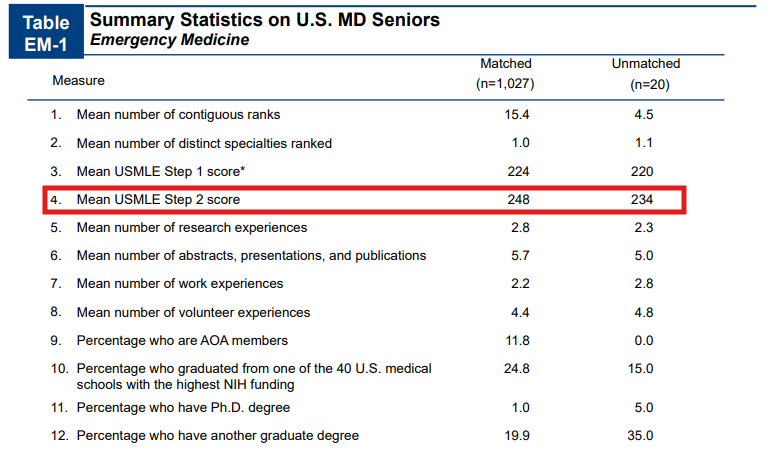
Aim for at least a USMLE Step 2 CK score of 248 to match into emergency medicine. In the last match cycle, matched U.S. MD seniors reported an average USMLE Step 2 CK score of 248, while unmatched applicants averaged 234.
If your USMLE Step 2 CK score falls below 247, compensate with honors-level clerkship evaluations—the grades you earn during your third- and fourth-year clinical rotations, based on attending evaluations, shelf exam scores, and observed clinical performance. Pair those with meaningful research activity and strong letters of recommendation from emergency medicine attendings who can vouch for your clinical ability firsthand.
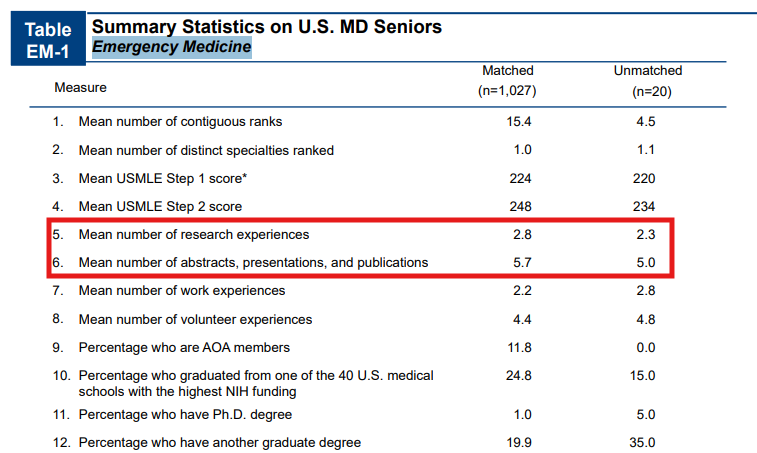
You don't need a massive research portfolio to be competitive, but having three or more research experiences with a handful of tangible outputs signals academic engagement that program directors notice.
Indeed, according to this study, about 40% of program directors said meaningful research participation would become more important after Step 1 went pass/fail. In the last match cycle, matched applicants averaged 2.8 research experiences compared to 2.3 for those who didn't match. Matched candidates reported a mean of 5.7 abstracts, presentations, and publications versus 5.0 for unmatched applicants.
Inspira Advantage’s residency consulting services can help you match into a top emergency medicine program. Work with an expert to find the best emergency medicine program and set realistic goals to ensure you match.
High board pass rates and competitive Step 2 CK medians matter, but they only scratch the surface. Learn more about the clinical volume and patient acuity at the program's primary training site. Emergency medicine is a pattern-recognition specialty, which means the more high-acuity cases you manage during residency, the better your decision-making becomes as an attending. Programs based in Level 1 trauma centers or large urban safety-net hospitals expose you to the sickest patients and the widest variety of pathology.
Pay attention to faculty-to-resident ratios and how accessible attendings are on shift. Programs where attendings actively teach at the bedside produce stronger clinicians than those where residents run the department with minimal oversight. Ask current residents how often they get real-time feedback during shifts, not just at quarterly evaluations.
Explore what the program offers beyond clinical training. Ultrasound fellowships, simulation labs, dedicated research time, and wilderness or toxicology electives signal a program investing in well-rounded emergency physicians. Also, look at where graduates end up. Programs that consistently place graduates into competitive fellowships or desirable academic and community positions are delivering training that the broader emergency medicine community respects.
The NRMP lists 292 emergency medicine residency programs across the country.
Emergency medicine ranks among the more sought-after specialties in the Match. With 2,980 U.S. MD seniors applying for 1,246 spots in the most recent cycle, demand consistently outpaces available positions. Out of 48 residency specialties nationwide, emergency medicine accounts for 292 programs, or roughly 5.22% of all available specialties.
Most emergency medicine residencies run three to four years, depending on the program structure. Three-year programs get you into practice faster, while four-year programs typically offer additional training time in areas like research, ultrasound, administration, or subspecialty exposure.


.svg)


