Get in touch: +1 888 453 5021




Below is a list of the top 10 international medical graduate (IMG)-friendly residency programs in the United States, along with key admissions data to help you evaluate your chances.
A U.S. IMG is a U.S. citizen or permanent resident who attended medical school outside the United States or Canada.
A non-U.S. IMG is a non-U.S. citizen who completed their medical education outside the United States or Canada.
We sourced this data from the Association of American Medical Colleges’ (AAMC) Residency Explorer Tool, which provides program-level insights such as interview rates and USMLE score ranges for both U.S. and non-U.S. international medical graduates (IMGs).
Updated on May 11, 2026.
Please note that the median USMLE Step 2 CK scores represent invited applicants, not necessarily those who matched. Also, while some programs provide specific scores for IMGs, others only publish a single overall median for the entire interview pool.
We identified IMG-friendly residency programs by combining AAMC Residency Explorer data with real-world factors that reflect how programs evaluate and accept international medical graduates (IMGs).
We focused on:
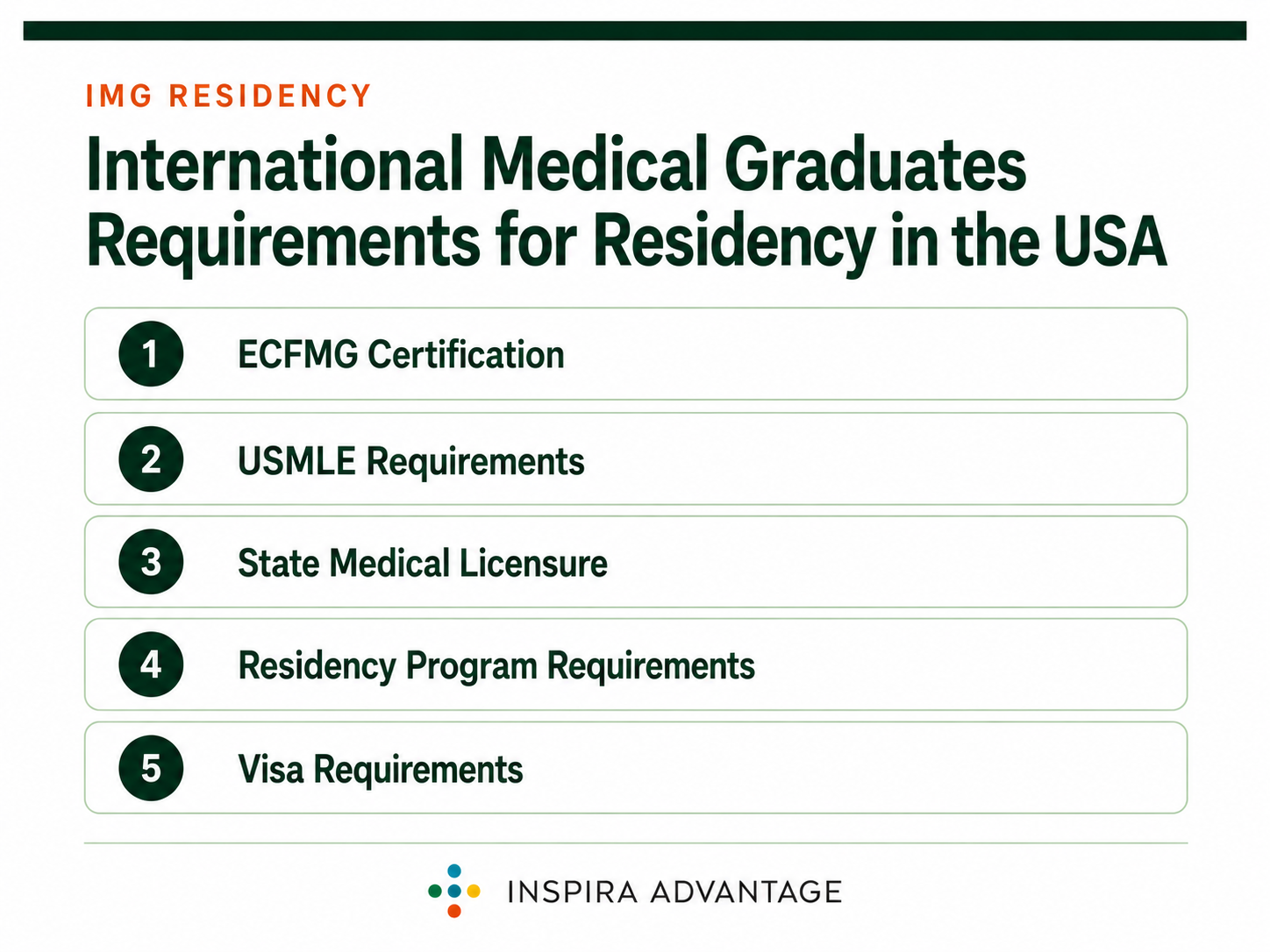
To practice medicine in the U.S., every IMG must meet four core requirements: Educational Commission for Foreign Medical Graduates (ECFMG) certification, USMLE passage, state medical licensure, and visa authorization.
Each requirement has its own process, timeline, and governing body. Understanding all four before you apply prevents costly delays.
ECFMG certification is the non-negotiable first step. The Educational Commission for Foreign Medical Graduates evaluates your medical education credentials, clinical competency, and English proficiency to confirm you’re ready for ACGME-accredited training. No ACGME residency program will consider your application without it.
To apply, complete the online application through ECFMG's Interactive Web Applications (IWA). You will need to confirm enrollment or graduation from a World Directory-listed medical school with ECFMG eligibility and then submit a notarized Certification of Identification Form (Form 186) through NotaryCam. Both the online application and the notarized form have to reach ECFMG before processing begins.
Passing all required USMLE steps is part of the ECFMG certification process. Programs screen heavily on Step scores, particularly Step 2 CK. Each residency program sets its own minimum score thresholds and limits on the number of attempts. Know your numbers before you build your program list.
Every U.S. state governs its own medical licensure independently. Requirements differ on postgraduate training hours, exam attempt limits, and which international medical schools they recognize as eligible. Review the Federation of State Medical Boards (FSMB) website for the specific rules in each state where you plan to practice.
Each program sets its own eligibility criteria beyond ECFMG certification. These requirements typically cover your medical school graduation year, total clinical experience, USMLE scores, and which visa types the program accepts. Review every program's requirements directly on their website before applying through ERAS.
Non-U.S. citizens entering residency training need either an H-1B (Temporary Worker) or J-1 (Exchange Visitor) visa. Most IMG residents use the J-1. The ECFMG sponsors J-1 visas directly, acting as the liaison between you, your residency program, and the U.S. Department of State. Some programs sponsor visas independently. Confirm sponsorship availability before you invest time in any application.
Here is a list of residency specialties in the USA known for being IMG-friendly, along with their U.S. and Non-U.S. match rates, as reported in the Advanced Data Table: 2026 Main Residency Match data, the most current cycle data available reflecting actual match outcomes across every specialty for the 2026 application cycle, and average USMLE 2CK scores, based on data from the NRMP Charting Outcomes in the Match: International Medical Graduates.
Updated on May 11, 2026.
These are the top 25 IMG-friendly states in the U.S. based on the number of total IMGs in their residency programs:
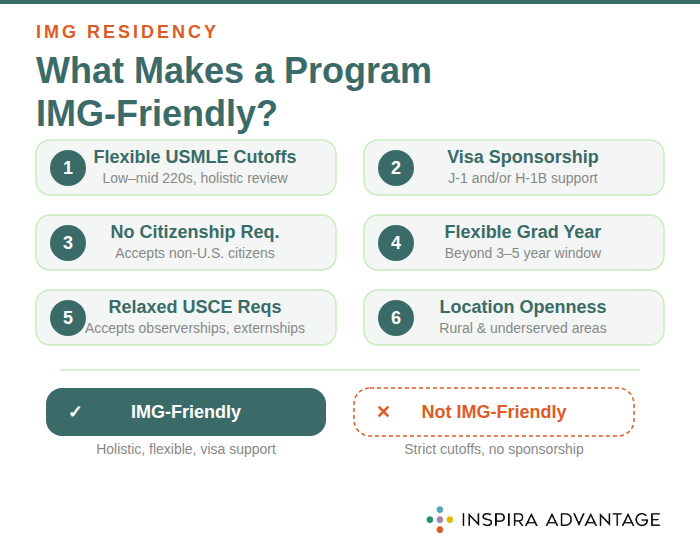
A residency program is considered IMG-friendly if it consistently interviews, accepts, and supports international medical graduates through flexible requirements, visa sponsorship, and realistic expectations.
Here are the exact factors that determine whether a residency program is IMG-friendly:
IMG-friendly programs use flexible USMLE screening thresholds rather than strict cutoffs.
In practice, this means:
These programs are more likely to review applications holistically, considering clinical experience, letters, and overall fit, not just test scores.
Visa support is one of the clearest indicators of IMG-friendliness. Programs that sponsor J-1 visas and, in some cases, H-1B visas, are more accessible to non-U.S. IMGs. If a program doesn’t sponsor visas, it will effectively exclude many international applicants.
Some programs prefer or require applicants to be U.S. citizens or permanent residents. Programs that explicitly accept non-U.S. IMGs without these restrictions are generally more IMG-friendly. Always check whether citizenship status impacts eligibility.
Many programs use a graduation-year cutoff (e.g., within three to five years of medical school). IMG-friendly programs tend to be more flexible, allowing applicants who graduated earlier, especially those with continued clinical or professional experience.
U.S. clinical experience is often expected, but requirements vary.
More IMG-friendly programs:
Strict USCE requirements can make a program less accessible for IMGs.
Location plays a major role in IMG accessibility.
Programs in less competitive regions and underserved rural areas are often more open to IMG applicants, while highly competitive urban programs may be more selective.
You can identify IMG-friendly residency programs by looking beyond just interview rates and focusing on how programs actually evaluate and support IMGs.
Focus on:
Don’t rely on a single metric. The strongest signal is consistency: programs that regularly accept, support, and graduate IMGs year after year.
You should pursue a specialty that balances your competitiveness with your long-term goals, not just one that’s considered IMG-friendly.
Here’s how to decide:
The strongest strategy is to choose a specialty where you are both competitive and genuinely committed; then apply broadly to programs that align with your profile.
If you’re unsure which path gives you the best chance of matching, working with our residency app specialists can help you assess your profile, refine your strategy, build a targeted school list, and maximize your chances of matching into your top program.
You can also download our comprehensive guide on residency applications to understand how many programs to target, how to prioritize your list, and how to build an application strategy that reflects your strengths as an IMG.
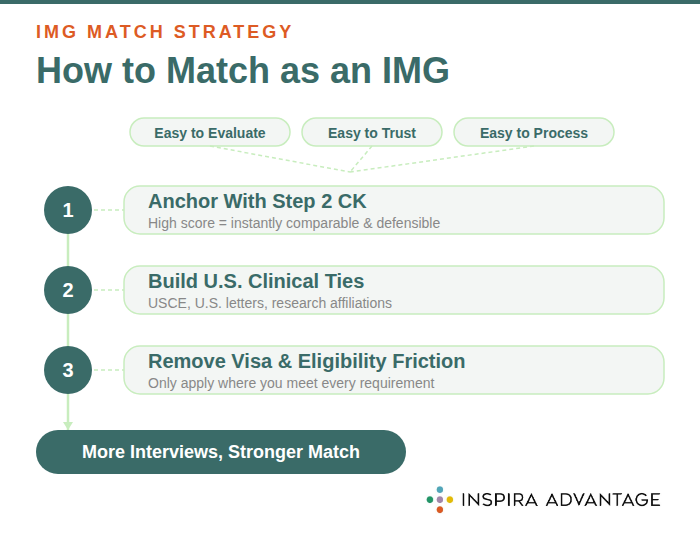
You can match into an IMG-friendly residency of your choice by making your application easy to evaluate, easy to trust, and easy to process for admissions committees.
Here’s how to build an application that meets all three criteria:
You should treat your Step 2 CK score as the anchor of your application.
Residency programs often cannot interpret how rigorous your international medical school was. As Dr. Nakia Sarad, a General Surgery Resident at New York-Presbyterian/Queens - Weill Cornell and admissions expert at Inspira Advantage, explains in our webinar, standardized exams give programs a consistent way to evaluate applicants who come from institutions they aren’t familiar with.
In reality, this means your score does more than show knowledge. It answers a key question for programs: Can this applicant perform at the level of a U.S.-trained MD?
A higher score reduces hesitation and increases the chance your application is reviewed. On the other hand, a borderline score forces programs to rely on other signals, which many will not do at the screening stage
For instance, an IMG with a 252 Step 2 CK and average experiences can still receive more interviews than an applicant with a 228 and strong extracurriculars because programs can quickly “place” the higher score.
Your goal is not just to pass a cutoff; it’s to make your application immediately comparable and defensible during screening.
You should create direct exposure within the U.S. system so programs can evaluate you in a familiar context.
As Chiamaka Okorie, an Inspira Advantage advisor and admissions committee member at Dartmouth’s Geisel School of Medicine, notes in our webinar, having institutional ties makes programs more confident that your credentials are valid and comparable.
Programs are not just asking, “Is this applicant qualified?” They’re asking, “Have we seen them perform in our system or something close to it?”
In practice, this means:
This is why even short, targeted U.S. experiences can significantly shift your outcomes. They turn your application from “unknown” to validated.
Clinical electives and Sub-Internships (Sub-Is) at U.S. institutions carry the most weight for IMGs:
Prioritize experiences that produce a named U.S. evaluator who can speak directly to your clinical performance.
You should only apply to programs where you meet every requirement upfront, including visa status. As Okorie highlights, visa and administrative barriers are some of the most common reasons IMGs are filtered out early.
From a program’s perspective, this isn’t just a paperwork issue. It’s a resource decision.
Applying broadly without checking visa sponsorship may lead to dozens of silent rejections before your application is reviewed, no matter how strong it is. In contrast, targeting programs that clearly sponsor your visa immediately increases your interview yield.
There is no single “easiest” IMG residency program, but the Akron Children’s Program has one of the highest IMG interview rates (47% for U.S. IMGs and 63% for Non-U.S. IMGs).
Programs in fields like family medicine, internal medicine, pediatrics, and pathology tend to offer the highest number of positions and IMG match opportunities overall.
Yes, most IMG applicants need U.S. clinical experience (USCE) to be competitive. Many programs either require or strongly prefer USCE, such as externships or hands-on rotations. Strong clinical experience helps demonstrate familiarity with the U.S. healthcare system and strengthens your letters of recommendation.
COMLEX or USMLE scores, especially Step 2 CK, are one of the most important factors for IMG applicants. Programs often use scores as an initial screening tool. A higher Step 2 CK score can significantly improve your chances of receiving interviews, particularly in more competitive specialties.
Yes, strong letters of recommendation are essential for IMG applicants. Programs prefer U.S.-based letters from physicians who have directly supervised you. These letters help validate your clinical skills, professionalism, and readiness for residency.
The Step 2 CK score IMGs need depends on the competitiveness of the specialty:
Higher scores improve your chances, but programs still consider your full application.


.svg)


