Get in touch: +1 888 453 5021





The first thing most pre-dental students do when they decide to study for the DAT is download some random user’s study schedule and think it’ll work for them. They find a three-month plan on Reddit or copy what a friend used, start following it on day one, and wonder three weeks later why they're so behind.
The problem isn’t the schedule itself. It's that the schedule wasn't built for them. A student who finished organic chemistry last semester with an A needs a completely different plan than someone who took it two years ago and scored below the 50th percentile on a diagnostic.
I spoke with our 99th-percentile DAT tutors and built the perfect study plan templates below that you can tailor to your diagnostic scores, weekly availability, and how recently you completed your prerequisite coursework.
Here are four different DAT study schedule templates. Each study plan covers everything you need to know for the exam.

A one-month DAT study plan is only realistic for students who recently completed Biology, General Chemistry, and Organic Chemistry with strong grades and can dedicate eight to 10 hours per day to focused preparation.
The American Dental Association (ADA) requires a 60-day wait between testing attempts, so if you score below your target on a tighter timeline, you lose two months before you can retest. Factor that risk into your decision before committing to a one-month schedule.
In this study plan, we focus on diagnostic testing, high-yield content review, and full-length exam simulations over four intensive weeks, requiring daily discipline with almost no margin for falling behind.
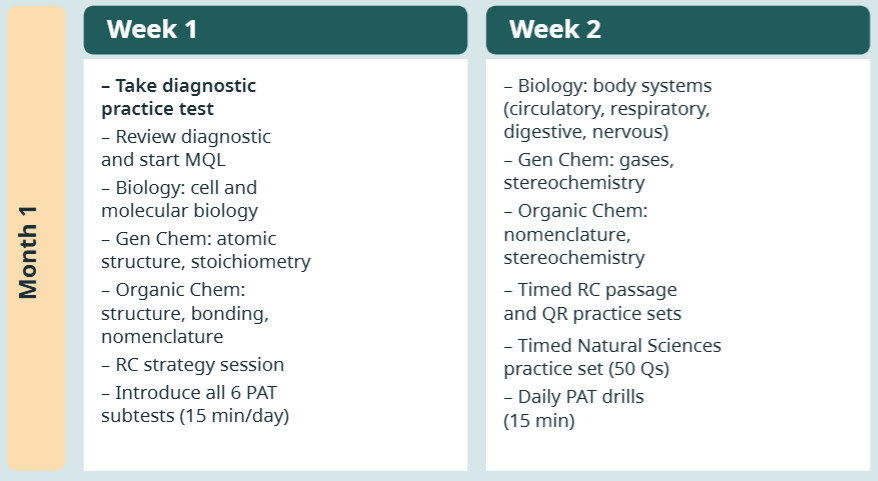
A two-month DAT study plan works well for students who’ve completed all prerequisite coursework within the past year and can commit four to six hours of studying per day. Your diagnostic practice test should confirm that your science foundations are good enough before you commit to this timeline.
Two months gives you enough time to divide your preparation into a content-heavy first phase and a practice-heavy second phase without a significant risk of burnout.
In this study plan, I built a structured progression from foundational science and PAT skill-building, through timed mixed-section practice, to repeated full-length DAT simulations over eight weeks.

A three-month DAT study plan suits most pre-dental students and offers a good balance of thorough preparation and sustained focus. This study schedule will help you study for three to four hours per day across 12 weeks to put you in the 200-250 total hours range that the average pre-dental student needs.
Choose this timeline if you need to rebuild weaker science areas, want enough room to take and thoroughly review at least five full-length practice exams, or are balancing prep alongside a part-time job or summer coursework.
In this study plan, I dedicated the first six weeks primarily to content review with weekly timed sections, then shifted the final six weeks toward practice-dominant preparation with full-length simulations, missed-question log analysis, and targeted review of weak areas.
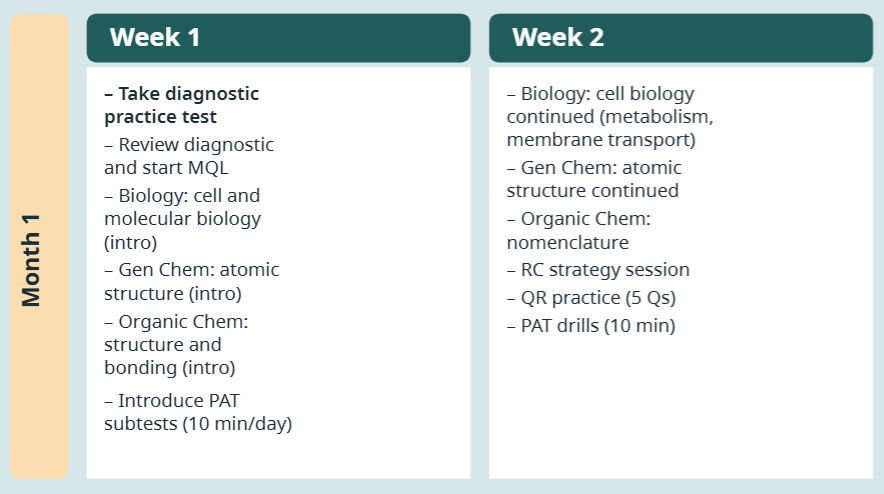
A six-month DAT study plan suits students who are still completing prerequisite courses during their prep window or can only dedicate one to two hours per day due to academic, work, or personal commitments.
Keep in mind that with longer timelines, you might start to forget the material you studied in the first month by the fifth month. That’s why you need to continue reviewing this material after learning it.
In this study plan, I built a low-intensity weekly rhythm that cycles through all four DAT sections from the start, gradually increases the volume of timed practice as your test date approaches, and uses recurring review blocks to prevent retention loss over the longer preparation window.
The perfect DAT study schedule depends on how much time you have before your test date, how many hours per week you can realistically commit to studying, and how strong your science foundations are right now.
Take a full-length diagnostic practice exam before you commit to any schedule. Your scores across Biology, General Chemistry, and Organic Chemistry tell you whether your prerequisite knowledge is strong enough for an accelerated plan or whether you need a longer timeline to rebuild your weaker areas.
A student who finished Organic Chemistry last semester with an A and scores above the 60th percentile on a diagnostic can realistically consider a one- or two-month schedule. A student who took General Chemistry two years ago and scores below the 40th percentile needs the content review time that a three- or six-month plan provides.
Write out all of your weekly commitments (classes, work, clinical hours, recurring obligations) and subtract the total number of hours from your available waking hours.
The number you land on should direct you to your perfect study plan:
In our dental school application webinar, Dr. Helina Tessima, an Inspira Advantage expert and graduate of Tufts University School of Dental Medicine, shares her insights on knowing how much time you have.
"Make sure it's a time that you can focus on and can remove all distractions,” she says. “I knew I wouldn’t focus if I tried to study during the holiday season ... I waited until January or February, and that was my dedicated test time."
Overestimating your daily capacity leads to missed sessions within the first week, so build around your busiest week rather than your lightest one.
The ADA enforces a 60-day waiting period between DAT attempts. A tighter schedule doesn’t leave you with much time to retake the test if your score falls short because you lose two full months before you can retest.
Students with flexible application timelines can take that risk more comfortably. Students applying in the current cycle with a hard submission deadline should consider a longer schedule that includes enough practice exams to confirm scoring trends before test day.
Choosing a three-month plan over a two-month plan costs you four extra weeks of preparation but buys significant insurance against needing a retake during a window when you can't afford one.
Solo learners who thrive with independent study can adapt any of the four schedules to their own pace. Students who need the structure of a study group or regular tutoring sessions should factor those commitments into their weekly plan and choose a timeline that accommodates them.
One-on-one tutoring sessions work especially well alongside tighter timelines because they add checkpoints that keep you on track. A two-month plan paired with weekly tutoring gives you the pacing benefits of a shorter timeline with a built-in safety net against falling behind.
Finishing your content review a week early is a better problem than realizing you need two more weeks of practice with no time left. A slightly longer schedule gives you room to take additional practice exams, revisit weak areas, and arrive at test day confident rather than rushed.
In our dental school webinar, Dr. Tessima provides her expertise on preparing for the DAT.
"It can be very daunting to sit down and try to plan how to study for the day,” she says. “It’s a long process. It’s about endurance — this is not a sprint."
Choose the schedule that fits your diagnostic scores, your real weekly availability, and your application timeline. Then adjust the internal pacing based on your practice exam data to show where you need more or less time.
Take our free DAT practice quiz to help you figure out which study schedule you need:
Here are the highest-yield subjects you should include in your DAT study schedule.
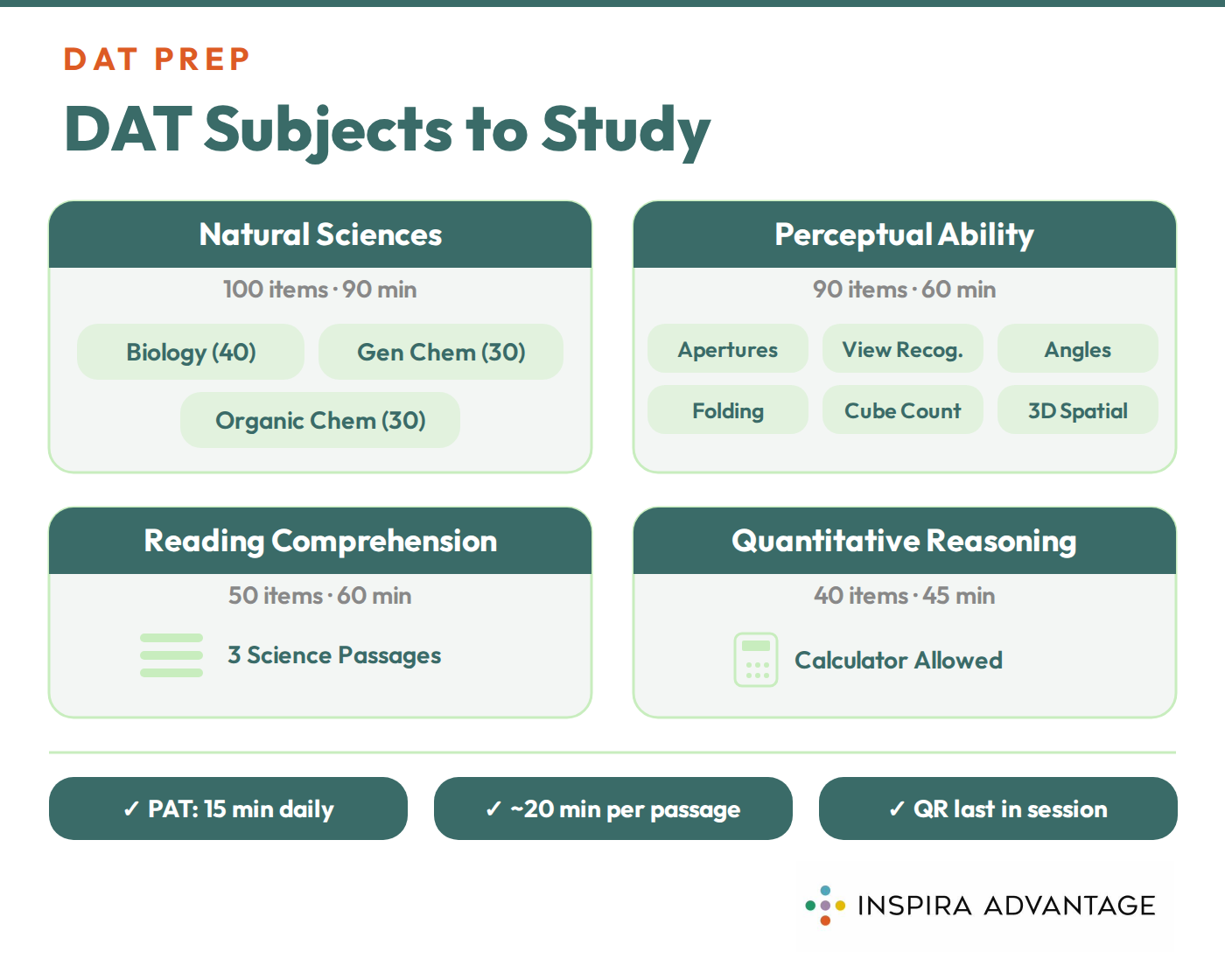
Survey of the Natural Sciences is the largest and most content-dense section on the DAT, with 100 multiple-choice items in 90 minutes. It covers three sub-disciplines:
Biology alone requires more questions than the entire Quantitative Reasoning section.
You can encounter everything from signal transduction pathways to population ecology in a single sitting. Prioritize body systems and cell biology early in your schedule since these topics appear most frequently across practice exams and overlap with dental school coursework.
For General Chemistry, focus your study time on acids and bases, chemical equilibria, and thermodynamics. These categories require both conceptual understanding and calculation speed under pressure.
The ADA released new Organic Chemistry test specifications in April 2026 with reorganized topic categories and more detailed subtopic listings. Your study plan should factor in this new structure, which groups content into five categories:
Check the ADA DAT website before you start studying to confirm any additional changes to the test format.
The PAT is unlike anything you encountered in your prerequisite coursework. It tests spatial reasoning and visual manipulation across six subtests:
You face 90 items in 60 minutes, which gives you roughly 40 seconds per question.
No amount of biology or chemistry review prepares you for PAT. Treat it as a separate skill that requires dedicated daily practice from the start of your study schedule.
Short, frequent PAT sessions (15-20 minutes daily) build spatial reasoning faster than longer sessions. That’s because the skill depends on pattern recognition, which strengthens with repetition.
Many students underestimate PAT because it feels less academic than the science sections. But that instinct backfires. PAT scores factor into your Academic Average, and dental schools pay close attention to spatial reasoning ability because it directly relates to clinical hand skills.
Review the PAT instructions on the DAT website before test day, so you spend as little exam time as possible trying to figure out what each subtest asks you to do.
Reading Comprehension presents three scientific passages with 50 total questions in 60 minutes. You don’t need prior knowledge of the passage topics. The section tests your ability to read, analyze, and draw conclusions from unfamiliar scientific material under time pressure.
Reading Comprehension requires almost no content memorization. Your preparation should focus on developing a consistent passage-reading method and practicing under timed conditions.
Experiment with approaches during your first two weeks of prep. Some successful students read the full passage before looking at the questions. Others skim the passage and reread it after they know the questions. Both methods work, so learn what works for you early on in your prep.
Spend roughly 20 minutes per passage (reading plus questions). If you consistently run over that pace in practice, your reading method needs to change before you add more passages.
Quantitative Reasoning covers 40 items in 45 minutes and includes:
You get access to an on-screen calculator for this section only.
Most pre-dental students struggle with pacing on the Quantitative Reasoning section. Applied word problems require turning narrative setups into equations under time pressure, and data sufficiency questions test whether you can identify what information you need without actually solving the problem.
Schedule Quantitative Reasoning practice in the final time slot of your study sessions. On the actual DAT, Quantitative Reasoning comes last, so you’ll be tired after four-plus hours of testing. Simulating that fatigue during practice builds the endurance you need to maintain accuracy in the section that closes out your exam.
Use expert DAT study strategies to ensure you’re understanding each section of the exam.
I asked our DAT tutors what they notice first when a student comes to them mid-prep, and their score isn’t improving. Every tutor said something similar: They ask to see the student's study log, and within five minutes, they can tell exactly what went wrong.
The most common pattern is a student who spent the first three weeks reviewing biology for four hours a day because it felt productive, skipped PAT entirely because it seemed like something they could cram later, and never once reviewed a practice exam after taking it. By the time they reach out for help, they've burned through a third of their prep window, while the sections that needed the most work sat untouched.
Even well-structured study schedules fall apart when students repeat the same planning and execution errors. The mistakes below are the ones we see most often, and each is preventable if you know what to look out for.
Students who skip a diagnostic practice exam build their entire schedule on assumptions about what they know and what they don't. Those assumptions are almost always wrong.
In our dental school webinar, Dr. Tessima explains the proper way to dedicate your time when studying for the DAT.
"You should live, eat, and breathe the DAT when studying for it,” she says. “I used question of the day when I was waiting for the train, or if I was waiting for my food to microwave."
By immersing yourself in DAT content, you can identify your strengths and weaknesses. A student who feels confident in General Chemistry might find out that their acid-base and equilibrium skills have worsened more than they expected, while a subject they dreaded turns out to need far less review time.
A diagnostic exam takes about 4.5 hours. Skipping it to save time costs far more hours down the line when you realize halfway through your schedule that your study priorities could’ve been more organized.
PAT doesn't test content you learned in a classroom, so many students push it to the final weeks of their schedule or ignore it entirely. But spatial reasoning develops through consistent repetition rather than cramming. Short daily sessions (15-20 minutes) build the pattern recognition PAT requires far more effectively than occasional long blocks of studying.
Reviewing subjects you already score well on feels productive because the material comes easily and reinforces your confidence. But an extra five percentile points on your strongest section moves your composite score far less than closing a 20-point gap on your weakest one.
Focus only on your strengths to reinforce the content, not on relearning it. Redirect those hours toward the sections where your diagnostic and practice exam scores show the largest room for improvement. Check your score distribution after every practice exam and resist the urge to study material you’re already comfortable with.
A full-length practice exam only improves your score if you spend serious time reviewing your results afterward. Students who take test after test without reviewing missed questions build stamina but never close the knowledge gaps that cause their errors.
Block three to four hours the day after every practice exam for a thorough review session. Log every question you missed or guessed on, record the correct answer, and write a short explanation of why each answer choice is right or wrong. Patterns in your missed-question log reshape your study priorities more effectively than any pre-built topic list because they reflect your actual weaknesses in real time.
Practice exam scores are the best way to know if your DAT study schedule is working, but that’s not the only option. A good study schedule leads to measurable improvement and helps you achieve a score good enough for dental school. Knowing what to track and when to adjust prevents you from following a broken plan all the way to test day.
Your full-length practice exam scores should trend upward over the course of your preparation. A single dip after a tough exam doesn't mean there’s a problem, but plateauing or declining scores across two consecutive practice tests mean something in your schedule needs to change.
Break your score review down by section rather than relying on your composite alone. A rising composite can hide a dropping section score that will hurt you on test day.
If your Biology score jumps five points but your Organic Chemistry score drops three, your schedule is working for one subject and failing another. Reallocate hours accordingly before your next practice exam rather than waiting to see if the pattern corrects itself.
A productive study schedule changes the types of questions you miss over time:
If your missed-question log shows the same content gaps appearing week after week, your review method for those topics isn't working. Switch your approach before adding more hours to your study schedule.
Rereading notes that didn't stick the first three times won't produce different results the fourth time. Try active recall, practice problems, or a tutoring session focused specifically on the recurring weak spot.
Strong untimed accuracy paired with significantly lower timed scores tells you that you know the material but can't access it fast enough under exam conditions. A good study schedule closes that gap gradually as you increase the proportion of timed practice in your weekly plan.
Measure the difference between your untimed section accuracy and your timed section accuracy after every practice exam. A gap of more than 10-15% in any section means you need more timed drilling in that area before your next full-length simulation.
If the gap stays constant despite adding timed practice, the issue is likely content fluency rather than time management. You may need to revisit foundational concepts, so retrieval becomes faster at the source.
Data drives the big decisions, but your experience during study sessions matters, too. A schedule that consistently leaves you mentally exhausted before you reach your daily target is unsustainable, regardless of what the calendar says. A schedule that feels too easy probably isn't challenging you enough to produce real improvement.
Look for a steady rhythm where sessions feel demanding but completable. You should finish most study days tired but not burned out, and you should feel like you learned or reinforced something specific during each session.
If you dread opening your materials every day, something about the schedule's structure or intensity needs to be adjusted before you burn out entirely.
Not every bad practice session means your schedule is bad. Score improvement on the DAT is rarely linear. Occasional plateaus are a normal part of the process, especially during the transition from content-heavy review to practice-heavy preparation.
Adjust your schedule when two consecutive flat or declining practice exams, persistent content gaps in your missed-question log, or a timed-versus-untimed accuracy gap that isn't improving. Trust your schedule when you see upward trends, when your missed-question patterns shift toward higher-order errors, and when your timed accuracy gradually aligns with your untimed performance. The goal is steady directional progress, not a perfect score on every practice test.
You should study for the DAT between two and six hours per day, or 12 to 36 hours per week, depending on your timeline. Students on a two-month plan need four to six daily hours to reach the 250-350 total hours competitive scores typically require. Students on a three- or six-month timeline can spread that volume across fewer daily hours without sacrificing coverage.
One month is enough to study for the DAT only if you recently completed all prerequisite coursework with strong grades and can dedicate eight to 10 hours per day to focused preparation. However, the ADA's 60-day retake waiting period makes a tighter timeline risky because a below-target score locks you out of retesting for two full months.
You can study for the DAT in two months if you commit four to six hours per day and your diagnostic scores confirm solid science foundations. Two months gives you enough room to split preparation into a content-heavy first phase and a practice-heavy second phase without the burnout risk of a one-month sprint.
You should start taking full-length DAT practice tests after completing your first two to three weeks of content review. Starting too early yields discouraging scores, but waiting until the final weeks leaves too little time to act on the patterns your results reveal.
You should adjust your study schedule after every full-length practice exam, which typically means every two to three weeks. Use your section scores and missed-question log to reallocate hours toward persistent weak areas. Avoid making changes after a single bad study session since short-term dips are normal and don't automatically indicate a structural problem with your plan.
You should study each subject once a week after you move past the early content review phase of your schedule. Dedicating more time to your weakest sections while keeping brief weekly review sessions for stronger areas helps prevent retention loss across subjects you haven't touched in weeks. Even 30 minutes of maintenance practice per week on a strong section keeps that material fresh without pulling significant time from higher-priority topics.
Dr. Jonathan Preminger was the original author of this article. Snippets of his work may remain.


.svg)


