Get in touch: +1 888 453 5021




.jpg)
Some students hear “write your own letter, and I’ll sign off on it,” and completely run away. Other students automatically write their own letter without asking their professor first. I see it all the time: Students don’t follow specific directions and end up sending a bad letter of recommendation — or worse, something the recommender didn’t sign off on.
You were likely asked to write your letter of recommendation because your recommender is short on time, wants to make sure everything is accurate, or wants you to highlight the right experiences and sign off on it.
Many students aren’t aware that you actually can write your own letter of recommendation, and this happens often. Physicians lead busy lives, and they’re probably being asked by a lot of other students for a recommendation. The question really comes down to whether you can write a strong letter of recommendation for yourself.
In this guide, I’ll give you expert tips on how to approach this situation if it comes your way. If you get to write your own letter, it’s a great way to really hone in on your strengths, as you have more control here.
When a recommender asks you to write a letter of recommendation (LOR) yourself, your goal should be to write an honest but strong reflection on actionable tasks you’ve experienced that your recommender can confidently review and approve.
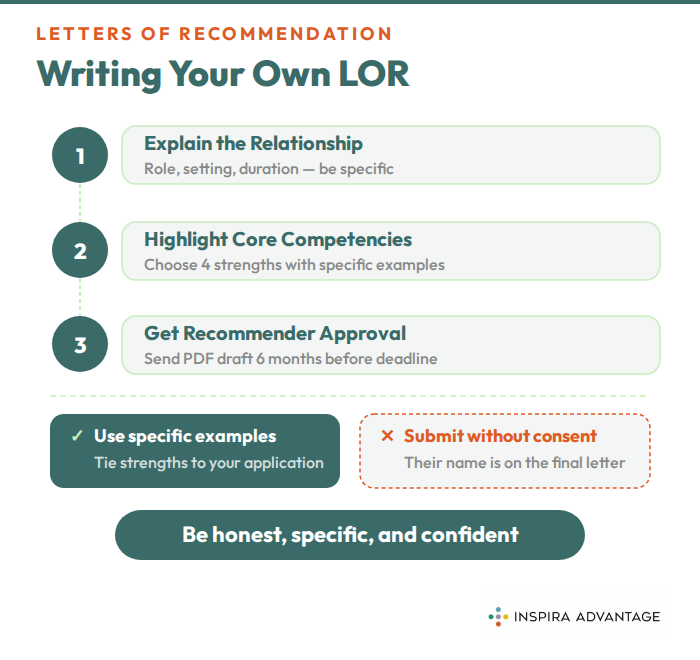
Clearly outline how your recommender knows you, highlight your strongest competencies (especially if they align with the 16 pre-med competencies), and use specific examples of how they observed you.
The opening paragraph should be about what your relationship is to the recommender and how long they’ve known you. Highlight where you worked with them (research lab, lecture hall, clinic, etc.), and your responsibilities. Your tone should be warm but professional, closer to how a colleague speaks about a junior colleague than how a friend speaks about a friend.
Don’t be vague. Instead of saying, “I’ve known Timothy for several years now,” say, “Timothy has worked as one of my clinical assistants at Fairmont Family Health Clinic for three years now. He started his role with a shadowing experience, but grew to be a member of the team just one year later.”
If your writer supervised you in multiple roles, state each role and timeline up front. For instance:
"I've known Maya Chen for two years, first as a student in my Introduction to Human Physiology course and then as a research assistant in my cardiovascular imaging lab at UC Davis. In the lab, she ran weekly echocardiogram screenings for our study cohort, managed intake scheduling for 40 participants, and trained two incoming undergraduates on our data entry protocol."
Your opening paragraph should end with a look at how these responsibilities will benefit you as a physician. Close the opening paragraph by connecting those duties to the kind of physician you’ll become. Example:
"Coordinating that many participants while keeping her records clean built the kind of steady, unhurried attention that patients notice in a doctor, and I expect she'll carry it into every exam room."
Your body paragraphs are the main substance of your recommendation letter. Your recommender should refer to specific actions you took while working alongside them. It’s important to be specific here, as verifiable claims are always better than vague statements. A strong example:
"When our imaging software began dropping timestamps midway through the study, Maya spent a Saturday cross-referencing 118 scan files against our paper logs and rebuilt the missing metadata by hand. She caught the pattern and brought it to me before it reached our analysis."
Start each paragraph outlining what you did, how it contributed to the overall team, and what you learned from that experience. Quantify your actions with numbers whenever possible to be more specific. To write objectively and avoid sounding arrogant, use specific examples instead of bold claims. Replace every adjective you can with an action. If you can't attach a specific example to a trait, it probably doesn’t belong.
Another effective body paragraph ties a specific action to a measurable result and a shift in perspective:
"Maya took over participant follow-up calls in her second semester and raised our retention rate from 71% to 94% over eight months, which kept our sample large enough to publish. She's told me since that those calls changed how she thinks about adherence. She stopped treating missed appointments as a scheduling issue and started asking people what was actually getting in the way."
The best conclusions use comparative language that speaks to your credibility. For example, if you rank in the top 10% of your class, your recommender should say that. Ranking that high shows that you performed better than 90% of your other classmates, which admissions officers like to see. For example:
"Of the roughly 60 undergraduates who have worked in my lab over the past 14 years, Maya is one of three I would trust with an unsupervised protocol change. She also ranks in the top 5% of her graduating class of 812."
Keep the conclusion short, straightforward, and forward-looking. End with a statement that shows the recommender would be happy to see you as a physician. Your entire recommendation letter should be one page, which usually works out to 400 to 600 words across three or four paragraphs. Here’s an example of a great closing statement:
"Maya is ready for medical school, and I'd be glad to have her as a colleague or as my own physician. I recommend her with my full support."
Focus on highlighting four strengths you’ve demonstrated throughout your time working with your recommender. If your experience speaks to multiple competencies, even better.
Dr. Parth Patel, an Internal Medicine resident at Johns Hopkins Bayview Medical Center and an Inspira Advantage admissions expert, addresses this directly in a webinar on letters of recommendation:
“You really want to focus on your accomplishments and think back to those core competencies,” he says. “You want to highlight areas that might not have been addressed in your other letters … and don’t be afraid to brag, because that’s what the letter of recommendation is for.”
Admissions committees read thousands of letters, so the best way to make yours stand out is by being specific and relating everything back to other elements in your application.
For example, if you claim to be passionate about research in your personal statement, you should try to get a recommendation from a professor who supported you through that research.
Once you finish writing the LOR, send it as a PDF to your professor or supervisor. Let them know that this isn’t the final product, and encourage them to add their own insights if possible. In some cases, you may need to proofread the letter yourself.
Send the draft ideally six months before your application deadline, and let them know which schools you’ll be applying to and why. For example, don’t just tell them that you’re applying to Harvard Medical School and Stanford School of Medicine. Tell them that you want to get into Harvard and Stanford because you’re genuinely passionate about research experience.
Send the draft early enough to allow meaningful review and revision, typically at least three to four weeks before the submission deadline. Agree on a clear timeline upfront that includes review, edits, approval, and submission. Never assume silence equals approval.
Don’t submit the letter of recommendation without your recommender's consent. Their name will be on the final letter, so you need their final permission. If you can’t get a hold of them by email, call them directly and let them know about the letter you just wrote on their behalf.
Subject: Draft of my medical school recommendation letter for your review — Maya Chen
Attachment: Chen_Maya_LOR_Draft_Ruiz.pdf
Dear Dr. Ruiz,
Thank you again for agreeing to write a letter of recommendation for my medical school applications. As we discussed after lab meeting last month, I've attached a draft as a PDF for you to review.
Please treat this as a starting point rather than a finished letter. I tried to capture the work I did in your lab as accurately as I could, but you saw things I couldn't, and the letter will be stronger with your own observations in it. Feel free to rewrite, cut, or add anything you think belongs there. If it's easier to mark up the PDF directly, I can also send it as a Word file or a Google Doc with comment access.
A bit of context on where the letter is going. I'm applying to 18 schools, and my top choices are Harvard Medical School and Stanford School of Medicine, largely because of their research infrastructure. My two years on the cardiovascular imaging study are what convinced me I want to keep doing translational work alongside clinical practice, and both programs would let me build on that directly. My full school list is below.
On timing: the AMCAS letter portal opens May 1, and I'd like to have all letters uploaded by June 5, so there's no rush on your end. You'll get an automated request from AMCAS at ruiz.elena@ucdavis.edu with upload instructions, and I'm happy to walk you through the portal if it's your first time using it. If it's easier to talk through any part of the draft, I can stop by your Wednesday office hours or set up a call whenever works.
I won't submit anything until you've confirmed you're comfortable with the final version. Please let me know if you'd rather start from scratch, or if you'd prefer not to move forward at all. I'd completely understand either way.
Thank you for your time and your support.
Best regards,
Maya Chen
B.S. Candidate, Cell Biology, Class of 2026
University of California, Davis
Phone: (530) 555-0184
Email: mrchen@ucdavis.edu
AMCAS ID: 14827396
Letter ID (from AMCAS): 8842
You can learn more about writing a strong letter of recommendation in our webinar, led by two admissions experts:
When drafting a medical school letter of recommendation, avoid working with hesitant or unenthusiastic recommenders, relying on exaggerated or flowery language, listing surface-level achievements or personality traits without evidence, and producing a letter that repeats the same strengths already covered in your other LORs.

When a recommender hesitates or lacks enthusiasm, that reaction signals a real risk to your letter’s strength. In our letter of recommendation webinar, Dr. Patel, an Internal Medicine resident at Johns Hopkins Bayview Medical Center, advises applicants to pay close attention to this early signal:
“If they’re hesitant or not as forthright or excited about it … it just means that that person might be too busy or just doesn’t have the relationship with you as you might think,” he says.
Avoid drafting or including a letter for a recommender who seems reluctant, rushed, or unexcited about supporting your application. Even if you write a strong draft, a hesitant recommender may tone down praise, remove concrete examples, or replace confident endorsements with safer, more generic language.
You should avoid using dramatic language like, “I’ve known this student for four long years, and they’ve consistently been at the top of my class for all of it.” Even if it’s true, it doesn’t sound like it is. Use realistic claims that speak to your candidacy. Don’t just write something you think the admissions committee wants to hear.
One of the biggest telltale signs that a student wrote a letter of recommendation is dramatic verbiage.
In our letter of recommendation webinar, Dr. Giovanni Perottino, an admissions expert at Inspira Advantage and graduate of Northwestern Feinberg School of Medicine, advises applicants to treat self-drafted recommendations like another personal statement:
“My recommendation is trying to treat it like another shot at the personal statement … I don’t make it so grandiose that it’s clear that you wrote it for yourself,” he says.
Strong self-drafted letters speak to who you are and what you’ve done. They don’t go on and on about everything you’ve accomplished and how happy the team is to have you helping them out. Stick to the facts, and tie your skills to the pre-med core competencies.
Saying that you earned good grades, attended classes, and were nice to work with sounds extremely vague and doesn’t improve your overall candidacy. You’ve already cleared the initial application screening phase at this point, so your grades don’t matter as much.
Instead, your letter should show that you’ve exceeded expectations in your day-to-day responsibilities. Maybe you assisted a patient even before you were asked to, offered to come into the clinic when they were understaffed, or consistently impressed your attending physician. These qualities should be the highlight of your letter, not your grades or test scores.
Admissions committees want a third-party perspective on what someone thinks of you as an individual. Each letter of recommendation should offer its own insights into your character.
You can repeat certain qualities to make each claim more verifiable, but don’t make these repeated qualities the focus of a new letter. Each letter should bring a new perspective on how other professionals see you.
If you’re writing your own letter, you have a significant advantage because you have more control over what your recommender says about you. If you’re only writing one or two recommendation letters, tell your other recommenders what you want them to highlight. You should already know the structure of the letter you’re writing for yourself.
For more detailed advice on how to write your own recommendation letter, get personalized guidance from Inspira Advantage.
Here is a complete checklist of everything you need to do before submitting your letter of recommendation that you wrote yourself:
You don’t need to agree to write multiple self-drafted letters. You can politely decline and offer to provide highlights instead. If you do write more than one, make sure each letter covers different competencies and contexts. Redundant letters weaken your application and increase the risk of inconsistent tone or content.
If your recommender seems hesitant about your LOR, ask them for specific details on what they’d change. If they seem really hesitant about the final draft, you’re better off asking someone else who can confidently approve your recommendation.
If you’re asked to draft your own letter, assess whether you feel confident enough to write it. If the answer is yes, use specific examples that your supervisor or professor will eventually approve when you send them the letter. Don’t use flowery or grandiose language. End it with a forward look at why you’d make a great physician.
Yes, if you’re asked to write your own letter from a supervisor or professor who knows you well, you can and should. However, if the recommender doesn’t know you well enough or if you’re not confident that you can write the letter to the best of your abilities, you should ask someone else.
Dr. Jonathan Preminger was the original author of this article. Snippets of his work may remain.


.svg)


