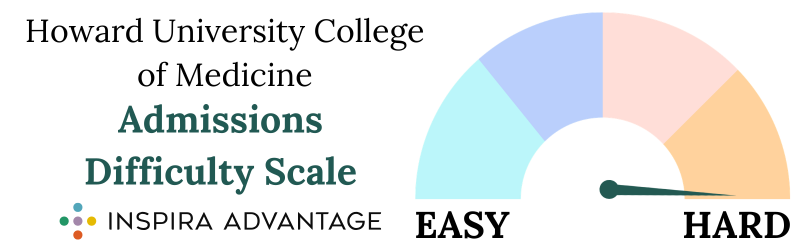
Getting into Howard University College of Medicine (HUCM) is difficult, but not impossible, with the right tips.
If you’re just here for the admissions requirements, click here.
Privacy guaranteed. No spam, ever.
Howard University College of Medicine Acceptance Rate: 1.44%
In the 2025-2026 admissions cycle, HUCM had an acceptance rate of 1.44%. This included 8,908 verified applications and 128 matriculants. In other words, roughly 1 out of every 70 applicants earned a seat in the entering class. So your application needs to be near-perfect to stand out.
Take a look at the interactive infographic below to see how HUCM’s acceptance rate has changed over the last few admissions cycles, based on data from the Association of American Medical Colleges (AAMC):
0%
Acceptance Rate
0
Total Applicants
0
Matriculants
<2 in 100
Your Odds
Out of every 100 applicants…
Matriculant
Did not matriculate
HUCM's acceptance rate has held between 1.37% and 1.50% across all four admissions cycles.
Acceptance rate by cycle
Admissions Cycle
Number of Applicants
Number of Matriculants
Acceptance Rate
2025-2026
8,908
128
1.44%
2024-2025
8,331
125
1.50%
2023-2024
8,465
127
1.50%
2022-2023
8,962
123
1.37%
HUCM admits roughly 125-128 students per year. Applicant volume dropped 7% from 8,962 (2022-2023) to 8,331 (2024-2025) before surging nearly 7% back up to 8,908 in the most recent 2025-2026 admissions cycle. The class size barely changed, moving only five seats from its lowest point (123) to its highest (128).
How Hard Is It to Get Into HUCM?
It’s very difficult to gain admission to HUCM. In the 2025-2026 admissions cycle, only 1.44% of applicants were accepted. HUCM could fill its incoming class 69 times over with qualified applicants. Your application needs to speak to exactly what HUCM admissions officers are looking for to stand out.
According to the AAMC, the national average acceptance rate for all accredited allopathic medical schools in the U.S. is 42.80%. HUCM’s acceptance rate is roughly 30 times lower than the national acceptance rate.
What Is HUCM's Acceptance Rate for In-State Applicants?
The in-state acceptance rate at HUCM is 4.26%. In the 2025-2026 admissions cycle, HUCM had 47 in-state applicants and just two matriculants.
D.C. residents represent only about 0.53% of HUCM's total applicant pool. But their 4.26% acceptance rate is nearly three times the out-of-state rate. However, only 2 of 47 in-state applicants earned a seat. Applying from in-state may provide a slight advantage. But it can’t make up for gaps in your academic profile or mission alignment.
What Is HUCM's Acceptance Rate for Out-of-State Applicants?
The out-of-state acceptance rate at HUCM is 1.51%. In the 2025-2026 admissions cycle, HUCM had 8,211 out-of-state applicants and 124 matriculants.
Out-of-state applicants make up roughly 92.2% of HUCM's total applicant pool and fill the vast majority of each incoming class. The volume of competition here is intense, so out-of-state candidates need to clearly articulate their connection to HUCM's mission of training physicians committed to serving underserved communities.
What Is HUCM's Acceptance Rate for International Students?
The international acceptance rate at HUCM is 0.31%. In the 2025-2026 admissions cycle, HUCM had 650 international applicants. Only two matriculated.
International applicants account for about 7.3% of HUCM's applicant pool, yet secured just 2 of 128 seats. At 0.31%, the international acceptance rate is nearly five times lower than the out-of-state rate. That makes it the most competitive application category. International candidates who are admitted typically demonstrate an exceptional fit with HUCM's mission, distinguishing them from the hundreds of other global applicants.
How Many People Apply to HUCM Every Year?
HUCM receives approximately 8,667 applications per year, the average over the past four admissions cycles. The average acceptance rate over that same period is 1.45%.
Privacy guaranteed. No spam, ever.
Admissions Statistics
HUCM Median MCAT Score: 507
The median MCAT score of accepted applicants at HUCM is 507. You need at least a 504 MCAT score to be considered for admission.
Here’s an interactive infographic comparing MCAT scores of accepted applicants in the 2025-2026 admissions cycle:
507
Median MCAT Score of Accepted Applicants
Howard University College of Medicine
500
10th Percentile
503
25th Percentile
507
Median Score
511
75th Percentile
516
90th Percentile
Enter your MCAT score
507
472490500510520528
Howard requires a minimum MCAT score of 504 for admission consideration. Scores are one factor in a holistic review.
In the table below, we list the MCAT score percentiles of matriculants and accepted applicants in the 2025-2026 admissions cycle:
MCAT Score Percentiles
MCAT Scores of Accepted Applicants at HUCM
MCAT Scores of Matriculants at HUCM
10th Percentile
500
498
25th Percentile
503
501
50th Percentile (median)
507
504
75th Percentile
511
508
90th Percentile
516
512
For the table above, we’ve used the most recent MSAR data available.
The table below shows section-specific MCAT scores for HUCM matriculants and accepted applicants:
MCAT Section
Median MCAT Section Scores of All Accepted Applicants at HUCM
Median MCAT Section Scores of Matriculants at HUCM
Chemical and Physical Foundations of Biological Systems
127
127
Critical Analysis and Reasoning Skills (CARS)
126
126
Biological and Biochemical Foundations of Living Systems
127
127
Psychological, Social, and Biological Foundations of Behavior
128
128
According to the AAMC, the national average MCAT score of medical school matriculants is 512.1 for the 2025-2026 admissions cycle. HUCM’s average MCAT score for all accepted applicants is 507.5, roughly 4.6 points below the national average.
What MCAT Score Makes You Competitive at HUCM?
An MCAT score of 511 or above makes you competitive at HUCM. This aligns with the top quarter of matriculants in the 2025-2026 admissions cycle. A 518 MCAT score aligns with the 82nd percentile of test-takers nationwide.
What this means for competitiveness:
⚈ Submitting a 507 MCAT score (median) can be competitive if you supplement it with a 3.88 overall GPA, excellent letters of recommendation, and an impressive application narrative.
⚈ Aim for a 516 MCAT score to be very competitive. This aligns with the top 10% of accepted applicants in the 2025-2026 admissions cycle.
⚈ HUCM will not consider a MCAT score of 503 or lower to be competitive. That puts you in line with the bottom quarter of matriculants in the 2025-2026 admissions cycle. Also, this falls below the minimum MCAT score requirement.
HUCM Median Overall GPA: 3.73
The median overall GPA of accepted applicants at HUCM is 3.73. You need a minimum overall GPA of 3.50 to be considered for admission.
The visual below shows how your overall GPA compares with that of HUCM accepted applicants in the 2025-2026 admissions cycle. Use it to estimate your competitiveness.
3.73
Median GPA of Accepted Applicants
Howard University College of Medicine
3.41
10th Percentile
3.56
25th Percentile
3.73
Median Score
3.88
75th Percentile
3.96
90th Percentile
Enter your GPA
3.73
0.001.002.003.004.00
Howard requires a minimum overall GPA of 3.50 for admission consideration. GPA is one factor in a holistic review.
Refer to the table below for the overall GPA percentiles of matriculants and accepted applicants in the 2025-2026 admissions cycle:
Overall GPA Percentiles
Overall GPA of Accepted Applicants at HUCM
Overall GPA of Matriculants at HUCM
10th Percentile
3.41
3.38
25th Percentile
3.56
3.51
50th Percentile (median)
3.73
3.71
75th Percentile
3.88
3.84
90th Percentile
3.96
3.95
According to the AAMC, the national average GPA of medical school matriculants is 3.81. HUCM’s accepted applicants averaged a 3.71 overall GPA, which is 0.10 points lower than the national average.
What Overall GPA Makes You Competitive at HUCM?
An overall GPA of 3.88 makes you a competitive applicant at HUCM. That’ll rank you with the top 25% of accepted applicants in the 2025-2026 admissions cycle.
What this means for competitiveness:
⚈ You can still be competitive if you have a 3.73 overall GPA (median) if you supplement it with a 511 MCAT score, impressive interview responses, and well-crafted essays.
⚈ If you have a 3.96 overall GPA, you’ll be seen as very competitive. This puts you in the top 10% of accepted applicants in the 2025-2026 admissions cycle.
⚈ You won’t be viewed as competitive if you submit a GPA of 3.56 or lower. That’s because it aligns with the bottom quarter of accepted applicants in the 2025-2026 admissions cycle and is only slightly above the minimum GPA requirement.
HUCM Median Science GPA: 3.66
The median science GPA of accepted applicants at HUCM is 3.66. You need a science GPA of at least 3.25 to be considered for admission.
The table below shows the range of science GPA percentiles at HUCM:
Science GPA Percentiles
Science GPA of Accepted Applicants at HUCM
Science GPA of Matriculants at HUCM
10th Percentile
3.24
3.18
25th Percentile
3.44
3.34
50th Percentile (median)
3.66
3.58
75th Percentile
3.85
3.82
90th Percentile
3.96
3.95
What Science GPA Makes You Competitive at HUCM?
A science GPA of 3.85 or above makes you competitive at HUCM. This proves you can compete with the top quarter of matriculants in the 2025-2026 admissions cycle. If you have a 3.66 science GPA or below, supplement it with a 3.88 overall GPA, a 511 MCAT score, and an impactful application narrative that aligns your mission with HUCM’s mission.
Privacy guaranteed. No spam, ever.
Howard University College of Medicine Admissions Requirements
MCAT score taken within three years of matriculation
Letters of recommendation: one health professions committee letter OR a letter packet that includes at least two letters from science faculty who taught you and gave you a grade (No limit on total number of letters, but at least two must be from science faculty.)
AAMC PREview exam (recommended but not required)
Clinical experience, community service, and demonstrated commitment to serving underserved and disadvantaged populations
In-person interview with faculty, if selected (interviews run September through late April and are by invitation only)
Criminal background check and drug screening upon matriculation
HUCM Prerequisite Course Requirements
HUCM requires a minimum of 71 semester hours from an accredited U.S. or Canadian college or university before you can matriculate. Every prerequisite course must be completed with a grade of C or better. Falling below that threshold in even one course means HUCM will not count it as satisfied.
Course
Semester Hours Required
Lab Required?
Biology
8
Yes
Inorganic (General) Chemistry
8
Yes
Organic Chemistry
8
Yes
Physics
8
Yes
College Math
6
No
English
6
No
Humanities (languages, art, music, history, philosophy, or religion)
6
No
HUCM Interview Format
HUCM uses a traditional, one-on-one interview format. Expect at least one conversation with a faculty member lasting approximately 35 to 40 minutes. The interviewer will have access to your full AMCAS application, secondary essays, and letters of recommendation. So treat every claim you made in writing as your truth for follow-up questions.
Plan to spend most of the day on campus. Beyond the interview itself, the interview day includes presentations on HUCM's mission and history, an overview of the curriculum, a financial aid session, and a campus tour. HUCM designs interview days to give you a full picture of the school. And the admissions committee pays attention to how you engage throughout the entire visit, not just during the formal interview.
HUCM interviews roughly 400 applicants each year. Interviews run from September through late April. Invitations arrive via email approximately three weeks before the suggested interview date. You choose the date that works best from the options provided.
Prepare for questions that test your alignment with HUCM's core mission. Expect to discuss:
Your experience working with underserved populations
Your understanding of health disparities
Your long-term plans to practice in communities with limited access to care
Generic answers about "wanting to help people" will not differentiate you from the other hundreds of candidates who also made it to interview day. Ground every response in a specific experience, outcome, or commitment you can point to in your own background.
What Is Howard University College of Medicine's Interview Rate?
HUCM interviewed 410 applicants out of 8,908 in the 2025-2026 admissions cycle, giving it an interview rate of 4.60%. More than 95 out of every 100 applicants never get the chance to sit down with a faculty member.
Of the 410 applicants interviewed, 128 matriculated, yielding a post-interview acceptance rate of roughly 31.2%. Compare that to the overall 1.44% acceptance rate, and the contrast is significant. Getting the interview invitation is the hardest filter in HUCM's process. Once you're in the interview room, nearly 1 in 3 candidates earns a seat.
Privacy guaranteed. No spam, ever.
Secondary Application
HUCM's secondary prompts center almost entirely on your relationship with underserved communities. Here are the prompts for the 2026-2027 admissions cycle:
Was your childhood home located in a rural, urban, or suburban area? (250 words)
How to Approach This Prompt
The admissions committee is evaluating whether or not you can reflect on how your childhood environment influenced your worldview, particularly around health, access, and community dynamics.
Start with a clear statement, such as "I grew up in a rural farming community in eastern North Carolina," or "I was raised in an urban neighborhood on the South Side of Chicago." Then pivot immediately to what that environment taught you.
Maybe growing up rural meant the nearest hospital was an hour away, and that distance shaped how your family approached preventive care. Maybe growing up in an urban neighborhood meant witnessing both a tight-knit community and the health consequences of food deserts and environmental neglect.
The strongest responses connect childhood geography to a specific observation or experience that planted the seed for a career in medicine.
One applicant described growing up in a suburban area but spending summers with grandparents in a rural Mississippi town where the only doctor had retired and was never replaced. She watched her grandmother drive 90 minutes for a routine checkup. That detail did more work than three paragraphs of general reflection because it grounded the response in something the admissions committee could see.
Applicants who grew up in suburban or affluent environments sometimes struggle with this prompt because they assume HUCM only wants stories of hardship. The admissions committee values honesty over performance. If your suburban upbringing exposed you to healthcare abundance, say so, and then describe the moment you recognized that abundance wasn't universal.
Have you lived in communities which are medically underserved, or where the majority of the population is economically and/or educationally disadvantaged? (250 words)
How to Approach This Prompt
HUCM's mission is to train physicians who will serve communities that the broader medical system has historically neglected. The admissions committee uses this prompt to assess whether you have firsthand knowledge of what it means to live in those communities, not just volunteer in them.
If you grew up in or lived in a medically underserved area, describe the reality of that experience without romanticizing or dramatizing it. What did healthcare access actually look like? Did your family use the emergency room for primary care because no clinics were nearby? Did you watch neighbors skip medications because of cost? Did educational resources in your schools leave gaps that affected health literacy in the broader community? Concrete details from daily life carry more credibility than statistics that the admissions committee already knows.
If you haven't lived in an underserved community, don't lie about a connection. The admissions committee wants honest answers. State that you haven't had that lived experience, then describe how you came to understand these realities through sustained engagement.
Maybe you spent a gap year working in a community health center. Maybe a long-term mentoring relationship exposed you to a family navigating systemic barriers. The key distinction is sustained exposure versus a one-time volunteer trip.
Avoid using this prompt to list volunteer activities. Keep this response focused on the experience of living within a community and what that proximity revealed about structural disadvantage.
Have you worked (volunteer or paid employment) with medically underserved, economically disadvantaged, and/or educationally disadvantaged populations? (250 words)
How to Approach This Prompt
The admissions committee intentionally separates this prompt from Prompt 2. Prompt 2 asks about living in underserved communities. Prompt 3 asks about working in them. Applicants who repeat the same content across both prompts waste valuable space and signal that they haven't thought carefully about the distinction between proximity and active service.
Focus on one or two experiences where your work created a tangible connection to people facing medical, economic, or educational barriers. Describe the population you served, your specific role, and what you learned about the systemic factors driving their disadvantage.
"I volunteered at a free clinic" is a starting point, not an answer. What did you do at that clinic? What patterns did you observe among patients? How did the experience change your understanding of what healthcare delivery looks like when resources are scarce?
If your experience is primarily educational rather than medical, that still works. Tutoring in under-resourced schools, mentoring first-generation college students, or working in adult literacy programs all demonstrate commitment to disadvantaged communities. Connect the experience back to healthcare by reflecting on how educational disadvantage intersects with health outcomes.
Avoid inflating your role or impact. The admissions committee has seen enough applications to distinguish between meaningful volunteer service and resume padding. Honest descriptions of modest but sustained contributions earn more trust than big claims about brief engagements.
After residency, do you plan to practice medicine in an underserved or disadvantaged community? (250 words)
How to Approach This Prompt
HUCM produces a disproportionate share of physicians who practice in underserved areas. The prompt is a direct assessment of whether your long-term trajectory aligns with the school's mission. Vague statements about "giving back" won't suffice. The admissions committee wants specificity about where, how, and why.
If you plan to practice in an underserved community, describe what draws you to that path. Connect your future plans to experiences from earlier in your application.
Maybe your childhood in a medically underserved area (Prompt 1) or your work at a community health center (Prompt 3) solidified a commitment to return to a community like the one you came from. Admissions officers value narrative continuity across multiple prompts.
Be specific about the type of practice you envision. "I plan to practice primary care in a rural community in the Mississippi Delta," tells the admissions committee something actionable. "I hope to serve wherever I'm needed" tells them nothing.
If you're interested in a particular specialty, explain how you'd bring that specialty to an underserved population. For example, a future dermatologist who plans to address skin cancer screening disparities in communities without dermatology access demonstrates mission alignment just as clearly as a future family medicine physician.
If you're not certain about practicing in an underserved community, don't write what you think HUCM wants to hear. Admissions officers interview applicants and will follow up on claims made in secondary essays.
A nuanced answer about exploring how your specialty could serve underserved populations reads better than a performative commitment you haven’t thought through.
Please provide any additional information you believe is important in evaluating your application (e.g., additional coursework, problems with academic record, disadvantaged status, etc.) (250 words)
How to Approach This Prompt
The prompt's parenthetical examples show what admissions officers expect: explanations of academic irregularities, additional coursework taken to strengthen a weak area, or context about disadvantaged status that hasn't been covered elsewhere. Treat this as a functional prompt rather than a creative one.
If you’re addressing an academic concern, follow a direct structure. Name the issue in the first sentence. Explain the circumstances briefly. Then describe the corrective action and its results.
One applicant wrote: "My GPA dropped to 2.8 during my sophomore year when I worked 35 hours per week to support my family after my father's disability. I reduced my work hours the following year and completed my remaining pre-med coursework with a 3.7 GPA." The admissions committee got the full picture in three sentences, and the remaining words reinforced the upward trajectory.
If you’re using the prompt to describe a disadvantaged status, focus on the dimensions of the disadvantage that haven't appeared in earlier prompts. Maybe you qualify for the Fee Assistance Program and want the admissions committee to understand the financial context of your application journey. Maybe you're a first-generation college student whose lack of mentorship created specific obstacles in navigating pre-med requirements. Add the context that makes your application make sense.
Avoid using this space to add another extracurricular activity or repeat strengths already visible in your primary application. Responses that don't address an actual gap or concern mitigate the prompt's purpose and suggest the applicant didn't read it carefully.
Did COVID-19 impact you preparing your AMCAS application? (250 words; indicate N/A if not applicable)
How to Approach This Prompt
HUCM includes this prompt so applicants can flag concrete ways the pandemic affected their application components. Canceled MCAT dates that delayed testing by a semester. Clinical experience hours that disappeared when hospitals restricted volunteers. A research project that ended prematurely when labs closed. A family health or financial crisis triggered by the pandemic that forced a gap year or reduced course load.
State the disruption, the timeline, and the recovery. Admissions officers don’t need a general account of how the pandemic was difficult for you. They need to understand specific gaps in your application and the steps you took to address them.
Keep the response proportional to the actual impact. If your MCAT was delayed by three months but you eventually tested and scored well, two to three sentences cover it. If the pandemic triggered several disruptions that fundamentally altered your application timeline, use more of the 250 words to walk the admissions committee through the sequence.
At this point in the application cycle, admissions committees have read years of pandemic-related explanations. Responses that stand out are factual, specific, and forward-looking. Responses that blend into the background are emotional, general, and focused on the shared difficulty of the era rather than individual circumstances.
If the pandemic didn't meaningfully disrupt your application, write "N/A" without hesitation. The admissions reviewer will not penalize you for lacking a pandemic hardship story.
Why Howard University College of Medicine? (2,000 characters)
How to Approach This Prompt
HUCM's identity as a historically Black medical school with a mission to serve underserved communities is not something to reference generically. The admissions committee wants applicants who understand what HUCM represents in American medical education and can articulate why that specific legacy and mission draw them to their school.
Open with a direct statement connecting your path to HUCM's institutional purpose. Then support it with one or two specific programs, clinical training opportunities, or community partnerships that align with your goals.
HUCM's clinical rotations at Howard University Hospital serve a predominantly Black patient population in Washington, D.C. The school's emphasis on producing primary care physicians for underserved areas is reflected in its match list and alumni practice patterns. The HBCU environment creates a training culture that many applicants from underrepresented backgrounds cannot find elsewhere. Name the specific elements that matter to you and explain why.
Avoid generic statements that could apply to any medical school. "Howard has excellent faculty and a strong curriculum," says nothing distinguishing. Also, avoid reducing HUCM to a single dimension of its identity.
HUCM is not just an HBCU; it’s also a research institution, a clinical training powerhouse, and a community anchor. The strongest responses engage with multiple facets of what makes HUCM distinctive rather than treating it as interchangeable with other mission-driven schools
Privacy guaranteed. No spam, ever.
How to Improve Your Chances of Getting Into Howard University College of Medicine
Structure Your Application Around HUCM's Four-Pillar Mission
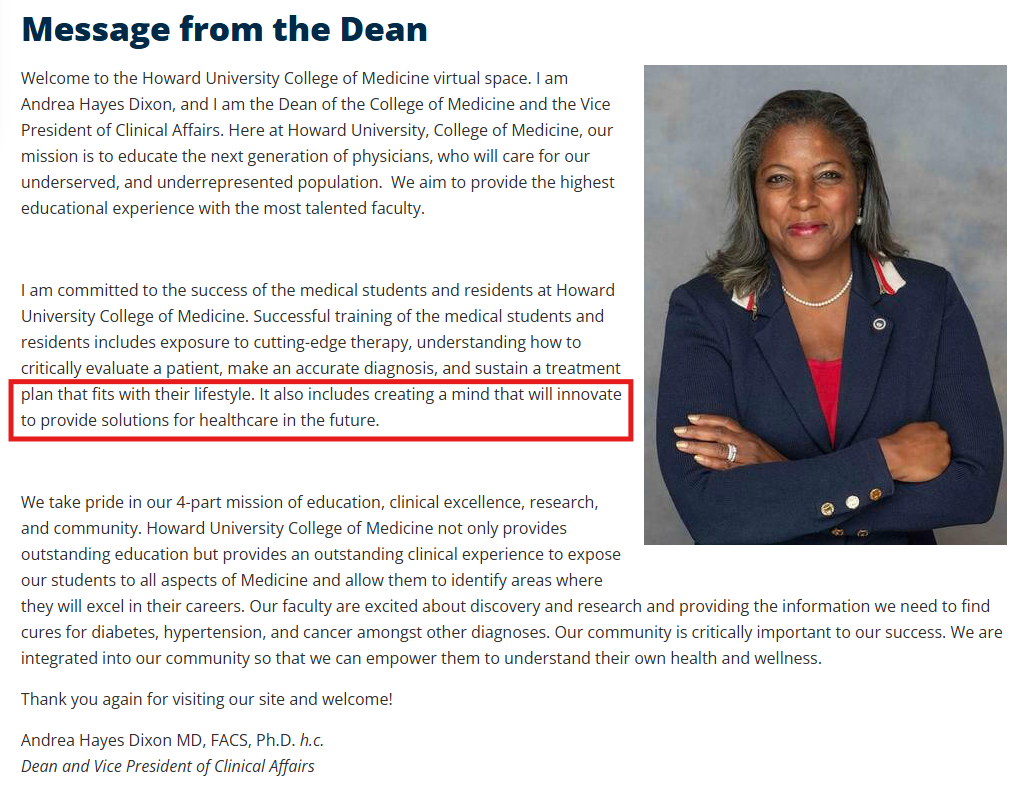
Andrea Hayes Dixon, HUCM's Dean of the College of Medicine, describes the school's identity as a "4-part mission of education, clinical excellence, research, and community" in her welcome letter. When you describe your extracurricular activities and experiences, organize them so the admissions committee can see evidence of engagement across all four pillars.
An applicant who logs 500 clinical hours but has no meaningful community service experience has only covered one pillar. An applicant who pairs strong clinical experience with sustained community health work, a research project, and evidence of academic curiosity across multiple disciplines gives the admissions committee a complete picture.
Before you submit, connect your entire application to all four pillars and identify any gaps. Map each activity, experience, and essay to education, clinical excellence, research, or community. If one pillar doesn’t have enough content, strengthen it before applying.
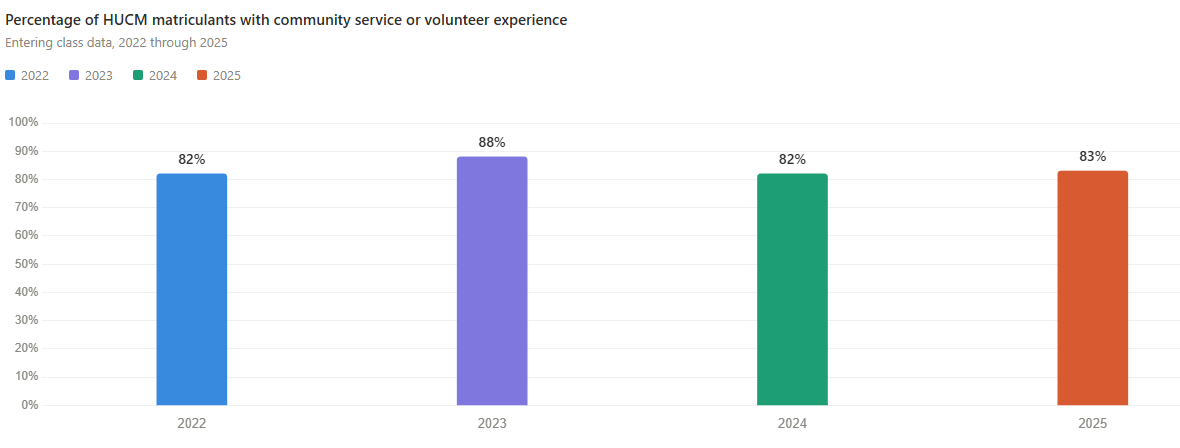
You should apply to HUCM with significant community service, since in the 2025-2026 admissions cycle, 83% of matriculants had some form of community service or volunteer experience on their application.
Applicants who demonstrate balance across all four pillars present a lower risk to an admissions committee that needs every seat in its 128-person class to produce the kind of physician HUCM wants to educate.
For more tips on how to address your volunteer experience in your medical school application, watch the video below:
Reference Specific HUCM Research Programs That Interest You in Your ‘Why Howard’ Essay
HUCM maintains research partnerships that most applicants never mention because they never look beyond the admissions page. The Howard University-Stanford Medicine Summer Research Program, the NIH-Howard Intramural Research Collaboration, the NCI/Center for Cancer Research Cancer Track, and the AI-Driven Computational Medicine and Smart Health Lab all represent active areas of institutional investment.
Naming one of these programs in your "Why Howard" essay and explaining how it connects to your academic interests shows you've explored HUCM at a level most candidates skip.
For example, an applicant interested in addiction medicine could reference the AI/ML Laboratory for Mental Health and Addiction, which investigates brain reward pathways associated with nicotine, alcohol, and opioids. Specificity at that level separates you from candidates who write a generic paragraph about HUCM's "commitment to research."
Connect your own research experience to one of these programs by name. For example, if your thesis explored a topic related to health disparities in minority populations, explain how HUCM's NIH-Howard Intramural Research Collaboration would allow you to continue that work with federal-level resources.
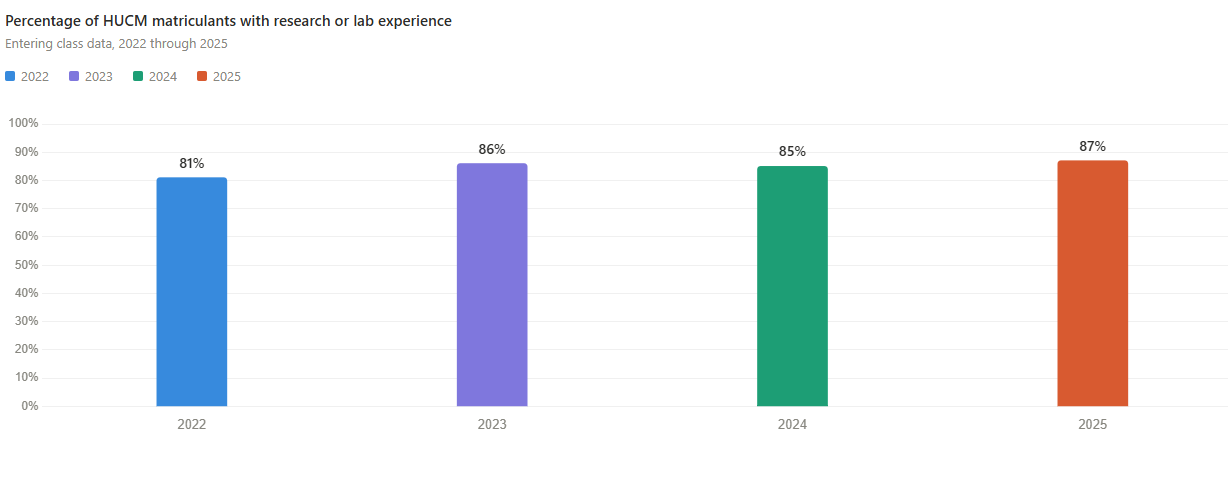
Nearly 87% of matriculants in the 2025-2026 admissions cycle had research experience on their application.
Connect that program to a specific experience from your background to read as someone who has already started thinking about how they'll contribute to HUCM's research mission as a student.
Show You Initiate Projects Instead of Just Participating in Them
HUCM's own interview page says volunteer missions, community service projects, and research presentations are "initiated, organized, managed, and run by student efforts." HUCM wants students who build things, not students who show up to things other people built.
If you founded a health literacy program at a community center, led a research team, or created a screening initiative for an underserved neighborhood, talk about it in your personal statement and interview.
The video below shows examples of what a good application narrative looks like:
If you haven't initiated anything yet, start now. You don't need to build a nonprofit from scratch. Identify a gap in health education or access within a community you already support and organize a response to it.
Coordinate a blood pressure screening event at a local church. Launch a peer tutoring program for pre-med students from underrepresented backgrounds at your university. The project scale matters less than the initiative behind it.
HUCM's pipeline programs page shows the school invests heavily in student-led academic reinforcement through programs like MedSTAR, where student leaders are "selected on the basis of academic performance and personal traits" to run review sessions and tutorials for their peers. Your application should already include at least one example of leadership.
Connect Your Experiences to Specific Health Disparities in Your Secondary Essays
Plan to practice in those communities after residency
Most applicants answer these questions in broad terms about "health equity." Stronger applicants name the specific disparity they've witnessed and the population it affects.
HUCM's own research labs focus on conditions like:
Sickle cell disease
Substance use disorders in underrepresented populations
AI-driven solutions for health disparities
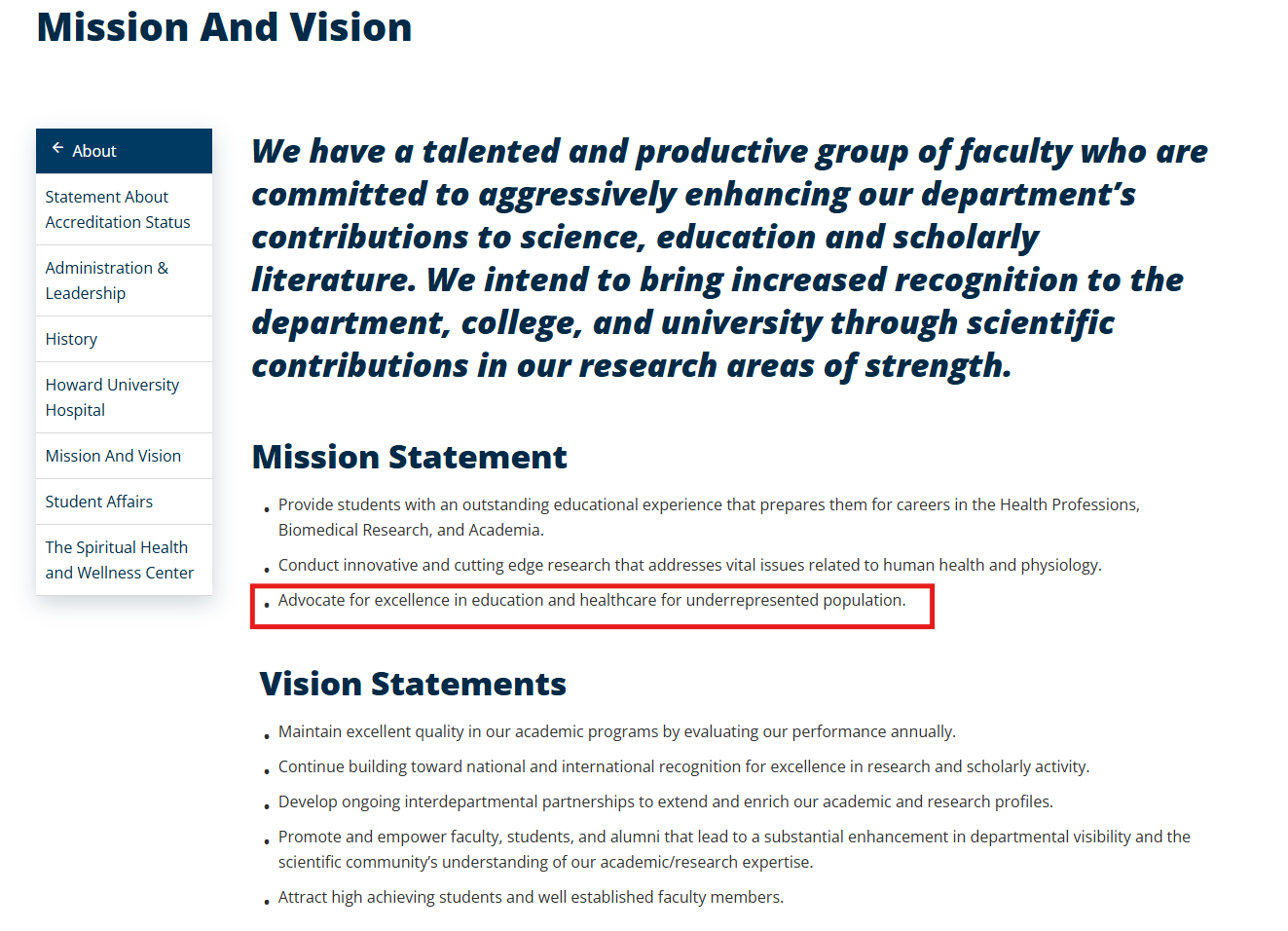
The school's mission and vision page frames this work as advocating for "excellence in education and healthcare for underrepresented population[s]."
If your clinical or volunteer work exposed you to a specific disparity, describe:
The condition
The community affected
What you observed about the gap between need and access
"Know about the school, where it is, what patient demographic they aim to serve,” Dr. Hasjim says. “Their medical school mission statement will be displayed and marketed and is something that you should definitely familiarize yourself with by going through their website and making sure that their end goals align with your own."
HUCM's mission statement, secondary prompts, and location in Washington, D.C., all point to the same patient population. Research who HUCM's patients are before you write a single word, and make sure your answers demonstrate that your goals align with the community HUCM intends to support.
Prepare for Your Interview by Understanding HUCM's ‘Physician-Scientist’ Identity
HUCM's MD program page describes its curriculum as designed "to produce the physician-scientist." The school expects its graduates to bridge patient care and scientific inquiry, contributing to research that addresses the health problems their communities face.
During your interview, you will be evaluated on whether you think like a physician-scientist or only like a future clinician. Prepare to discuss how a research question you've explored connects to a clinical problem you've observed.
If you spent time in a lab studying a mechanism related to a condition you later saw in a clinical setting, walk the interviewer through that connection. Andrea Hayes Dixon, HUCM's Dean, also emphasizes "creating a mind that will innovate to provide solutions for healthcare in the future" in her welcome letter.
Frame your long-term goals around both treating patients and advancing the knowledge base that improves treatment for underserved populations.
Practice making these connections before interview day. A strong answer sounds something like this:
"During my summer research on insulin resistance biomarkers, I kept thinking about the patients I'd seen at the free clinic who couldn't afford continuous glucose monitors. I want to study how we can develop lower-cost diagnostic tools for the populations that need them most."
A weak answer sounds something like this:
"I'm interested in research and clinical medicine."
The first answer demonstrates physician-scientist thinking. The second answer describes two interests without connecting them.
Get accepted to HUCM with Inspira Advantage. Work with an expert to transform your HUCM application from standard to stand out.
Traditional four-year Doctor of Medicine degree. The curriculum is designed to produce the "physician-scientist" through integrated blocks covering basic sciences, organ systems, clinical clerkships, and a Medicine and Society thread that runs through the first two years.
BS/MD Program
Accelerated six-year combined Bachelor of Science and Doctor of Medicine degree.
MD/PhD Program
Joint degree offered through the College of Medicine and the Graduate School.
MD/MBA Program
Five-year dual degree combining the MD with a Master of Business Administration from Howard's School of Business.
MS/PhD in Anatomy
Graduate research program housed in the College of Medicine's Department of Anatomy.
MS/PhD in Biochemistry
Graduate research program in biochemistry and molecular biology. Available as a Master of Science or Doctor of Philosophy degree through the Graduate School.
MS/PhD in Microbiology
Graduate research program in microbiology. Available as a Master of Science or Doctor of Philosophy degree through the Graduate School.
MS/PhD in Pharmacology
Graduate research program in pharmacology, which HUCM also refers to as Pharmaceutical Sciences. Available as a Master of Science or Doctor of Philosophy degree through the Graduate School.
MS/PhD in Physiology & Biophysics
Graduate research program in physiology and biophysics. Available as a Master of Science or Doctor of Philosophy degree through the Graduate School.
Tuition and Scholarships
In the 2025-2026 admissions cycle, tuition at HUCM was $58,608. After factoring in direct and indirect costs, the total cost of attendance for first-year students is $99,787.
How Much Does HUCM Cost for 4 Years?
The estimated cost of attendance for four years at HUCM is approximately $409,257 in tuition and fees. This breaks down as:
Year 1: $99,787
Year 2: $100,287
Year 3: $109,896
Year 4: $99,287
Scholarships
HUCM's Office of Financial Aid administers internal scholarships and loans funded directly by the College of Medicine. These awards are distributed based on both financial need and academic performance.
The Financial Aid Office determines eligibility for students who apply through the College of Medicine and recommends recipients based on availability. Most of these awards carry specific eligibility criteria, so file your financial aid paperwork as early as possible to maximize your chances.
Contact the Office of Financial Aid at (202) 806-4338 or raitcheson@howard.edu for details on which internal awards you qualify for.
Howard University College of Medicine Application Timeline
AMCAS application opens for the new cycle. Submit your primary application as early as possible. AMCAS verification can take several weeks during peak volume.
HUCM sends the first round of secondary application invitations via email to verified applicants. Invitations continue on a rolling basis through January 1.
August - April
Interview invitations are sent via email approximately one month before the suggested interview date. Interviews take place on Tuesdays and Wednesdays.
October 15
First acceptance notifications are sent to applicants.
December 15
AMCAS primary application deadline for HUCM. Your AMCAS application must be submitted and verified by this date.
January 15
Deadline to submit the HUCM secondary application (for applicants who submitted their AMCAS on or around December 15)
February 19
The AMCAS "Plan to Enroll" option becomes available. HUCM encourages accepted applicants holding multiple offers to use this tool to indicate their top choice.
March 15 - June 30
HUCM sends final notifications to applicants who will not be offered an interview.
April 15
HUCM strongly encourages applicants who have received more than three acceptances to narrow their offers to three schools and decline all others. Declining frees up seats for applicants on the alternate list.
April 30
The AMCAS "Commit to Enroll" option becomes available. Accepted applicants should select "Plan to Enroll" or "Commit to Enroll" and email hucmadmissions@howard.edu to confirm enrollment status. The $100 Good Faith Deposit is refundable until this date.
May 1
The $300 non-refundable Enrollment Fee is due for applicants who received offers between October 15 and April 15. Previously enrolled Howard University students have this fee waived.
May 1 – June 12
HUCM enforces the "Commit to Enroll" status. Accepted students must select one school, commit to the AMCAS tool, email HUCM to confirm, and pay both the Good Faith Deposit and Enrollment Fee by the deadlines specified in their decision letter.
June 12
HUCM reserves the right to rescind offers from any student who has not confirmed enrollment via email, committed in the AMCAS tool, and paid both required deposits by this date.
June 30
Deadline for accepted students to submit medical forms (immunization records and history) and any transcripts for coursework completed after AMCAS verification. International students must also submit financial information by this date.
Mid-July
Orientation begins, and the alternate/waitlist is deactivated.
FAQs
Does HUCM Accept Transfer Students?
Yes, HUCM accepts transfer students with advanced standing under limited circumstances. Applicants must have completed the first two years of medical school at a U.S. or Canadian LCME-accredited institution, be enrolled in good academic standing, and have a passing score on USMLE Step 1. HUCM does not accept transfers into the first-, second-, or fourth-year classes and will not grant admission based on coursework completed at a foreign medical school. Transfer availability can also vary from year to year due to curriculum adjustments. So check directly with the admissions office before applying.
Does HUCM Require the Casper Test or the AAMC PREview Exam?
HUCM does not currently require the Casper test or the AAMC PREview exam for the 2025-2026 admissions cycle. The PREview exam is recommended but not mandatory. However, previous admissions cycles did require Casper. So always verify the current requirements on HUCM's website before you apply; testing requirements can change from year to year.
Does HUCM Accept AP Credits or Community College Courses for Prerequisites?
HUCM accepts AP credits for select prerequisite courses, but not all. Online and community college courses are accepted in place of in-person courses, including lab components. Verify with the admissions office which specific AP scores satisfy which requirements because policies on credit acceptance vary by course and can change between cycles.
Does HUCM Give Preference to In-State Applicants?
No, HUCM does not give preference to in-state applicants. The school has no state residency requirement. And the vast majority of each incoming class comes from out of state. In the 2025-2026 cycle, 124 of 128 matriculants were out-of-state applicants. Your state of residence will not meaningfully impact your chances of admission.
Can I Visit HUCM's Campus Before Applying?
You can visit HUCM’s campus before applying, but there’s no formal event. HUCM hosts a Virtual First Friday Open House via Zoom on the first Friday of each month from August through March (excluding holidays). The session begins at 12 p.m. with a presentation and Q&A, followed by a virtual campus tour around 1 p.m. In-person unscheduled visits to the admissions office are not encouraged. Register for the open house through the link on HUCM's admissions page to get your questions answered directly by staff.
Does HUCM Accept Fee Waivers for the Secondary Application?
HUCM does not accept fee waivers for its $75 secondary application. The school states directly on its website that no fee waivers are honored, including AMCAS Fee Assistance Program (FAP) waivers. Budget for this cost when building your application list. And submit your secondary promptly after receiving the invitation, regardless of the fee.
Arush Chandna is the Co-Founder of Inspira Advantage and a nationally recognized expert on graduate school admissions. Arush has used his 12+ years of experience in higher education to help 10,000+ applicants get into their dream graduate programs.







.svg)


