Get in touch: +1 888 453 5021





Medical school is expensive enough that it's easy to assume loans are inevitable. But when I spoke with a dozen admissions experts on my team, they pointed out something interesting: While very few students earn full-ride scholarships, many leave thousands of dollars on the table simply because they don't know where to look or how to apply strategically.
Unlike loans, medical school scholarships are financial awards that don't have to be repaid, making them one of the most valuable ways to reduce the cost of earning your MD.
In this guide, I'll show you where those opportunities exist and how to maximize your chances of winning them.
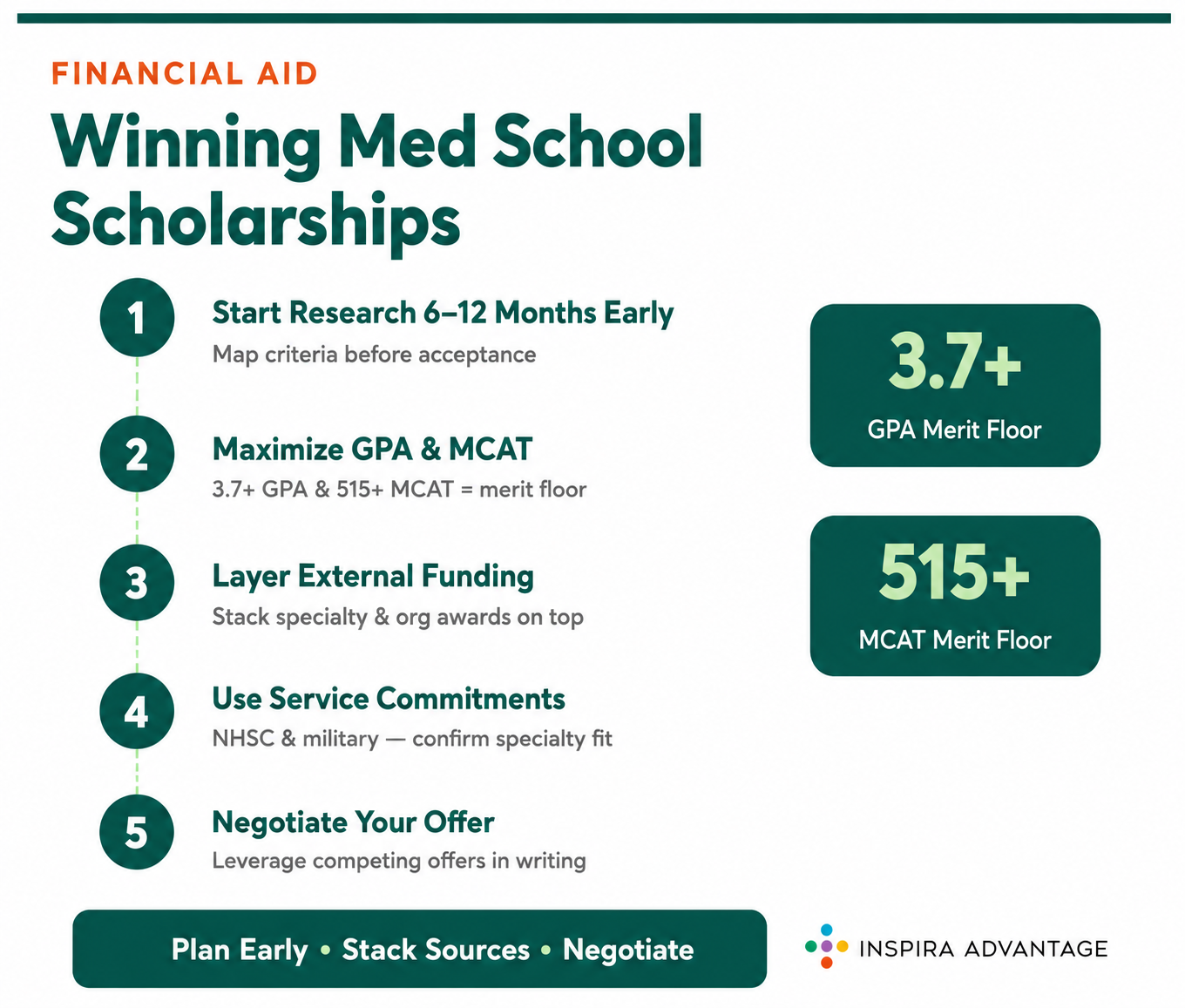
The most competitive scholarship applicants plan months in advance, use both external and internal options, and know exactly what admissions committees weigh before they submit a single application.
Here's a closer look at each of these tips:
When I asked the admissions experts on my team what they wish every incoming medical student knew about scholarships, almost all of them gave some version of the same answer: Stop thinking of scholarships as something you do after getting accepted.
The strongest applicants plan for them alongside their primary and secondary medical school applications from the very beginning.
Most applicants start scholarship research only after acceptance, which leaves no time to strengthen a weak application. By the time you're weighing offers in March or April, the leadership roles, sustained volunteer commitments, and research output that specific scholarships reward are already locked in from the past two years.
Start mapping scholarship criteria 6 to 12 months out. Pull eligibility requirements for 10 to 15 scholarships you'll likely qualify for, and note which ones require documented hours in a specific activity (rural health, underserved care, a named demographic). If a target scholarship rewards something you haven't done yet, that's still time to start it.
Committees can tell the difference between an application built around genuine, sustained work and one stretched to fit a prompt after the fact. The former reads as evidence. The latter reads as an afterthought. And reviewers who screen hundreds of applications a cycle notice the difference quickly.
Merit scholarship committees screen applicants based on numbers before anything else, and the threshold is higher than most applicants assume. A 3.70 GPA and 515+ MCAT are the typical floor schools use just to route your file into the merit pool; some private schools reserve their biggest awards for MCAT scores at 520 and above.
The David Geffen School of Medicine at UCLA covers the full cost of attendance for roughly 20% of its class through merit scholarships, and Vanderbilt University School of Medicine offers awards ranging from 75% to full tuition. Both schools filter on academic performance before looking at anything else in the application.
In fact, the admissions experts I spoke to say they specifically steer applicants with high stats, such as a 3.97 GPA and a 520 MCAT, toward schools like the David Geffen School of Medicine at UCLA because those numbers put them in range for the largest merit packages.
The pattern holds across schools: Strong personal statements and activities matter for admission, but for merit money specifically, your GPA and MCAT are doing most of the work before anyone reads a word of your essay.
Protect your GPA every semester and don't submit an MCAT score you could meaningfully improve with another few months of prep. A 3-point MCAT jump can move you from a school's average band into its top quartile, which is often the exact line that separates no scholarship from a substantial one.
Acceptance triggers automatic consideration for a school's internal merit pool at most programs, but automatic consideration means your application gets scored against a formula, not that anyone is actively working to maximize what you receive.
Full-tuition institutional scholarships only exist at a few schools, and applicants often think they’re far more common and easy to get than they actually are. Build your plan around external funding instead.
Specialty-specific foundations (rural medicine, primary care, specific research areas), professional organizations tied to your intended field, and background-specific scholarships run independent selection processes with far smaller applicant pools than national awards, and none of them draw from your school's aid budget. They stack directly on top of whatever your school offers rather than replacing it.
Pull the list of scholarships your target specialty's professional society offers before your first year even starts; most publish annual cycles you can plan around. Treat your acceptance letter's aid figure as a floor, not a ceiling, and build outward from there rather than assuming it reflects the most you can secure.
Service-commitment funding, military scholarships, the National Health Service Corps, and state rural physician programs have expanded as more states face primary care shortages, and it remains one of the few paths to substantial, close-to-guaranteed funding rather than a competitive long-shot award.
Before signing, get specifics in writing on four points:
These programs work well only if the required specialty and setting already match your actual career plan. Signing for rural family medicine funding while hoping to pivot to a competitive surgical subspecialty later creates a conflict you'll have to resolve by either breaking the contract at a high cost or abandoning the specialty you wanted.
Confirm the fit against your specific interests before you commit, not against a general willingness to "serve."
Financial aid offices hold discretionary "differential aid" budgets specifically to protect yield — the percentage of accepted students who enroll — so asking for more isn't a favor request; it's triggering a process the office already has in place.
Vague mentions of "another offer" get vague responses. Get the competing offer in writing first; then submit your request in writing to the financial aid director by name, citing the exact award amount and whether it's renewable across all four years.
Mid-tier and newer schools move fastest since they need your enrollment more than top-15 programs do. A school’s financial aid budget depletes in rounds, so your leverage is highest right after your second acceptance arrives, not right before the enrollment deadline.
Some schools counter with a stipend or housing allowance instead of cash, so decide in advance whether you're optimizing for the lowest net cost or open to a non-cash offer.
You should look for scholarships in four places: your own medical school's financial aid office, professional medical organizations, local and state-level sources, and vetted scholarship databases.
Most applicants only search the fourth one, which is exactly why so much money in the first three goes unclaimed. Funding decisions also get harder the longer you wait, and that's exactly how we can help. Inspira Advantage's team of experts maps scholarship deadlines against your application timeline so you submit both on schedule.
Most applicants spend hours hunting for outside scholarships before checking what their own school already offers.
Once you're admitted, you can call or email the financial aid office and ask specifically about your aid options, especially merit scholarships, need-based grants, endowed funds tied to your intended specialty, research stipends, emergency assistance, and awards that only open up after your first year.
Upper-year funding gets missed constantly because incoming students assume all institutional aid gets decided at admission. Ask directly whether new scholarships open once you've declared a specialty interest or completed specific coursework.
Specialty societies, national medical organizations, and one purpose-built database cover the funding that generic scholarship sites miss.
Many of these run a single application that automatically screens you for every award you qualify for rather than making you apply separately to each one. Start with:
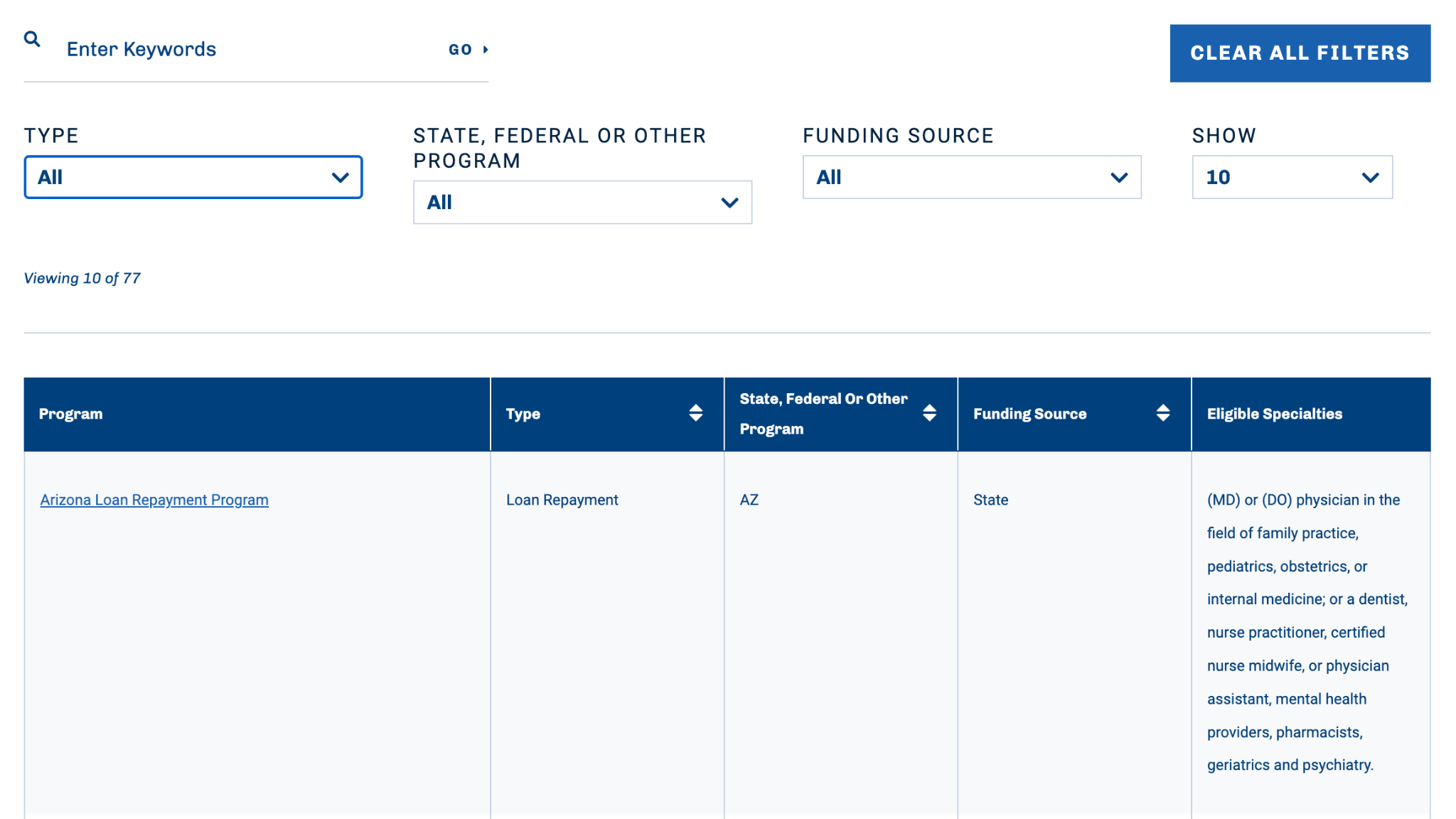
Source: AAMC
Apply to these even if you haven't finalized your specialty. Many, including the AMA Foundation's program, are only open to third-years approaching their final year.
Confirm every scholarship's legitimacy before applying, regardless of where you found it. A real scholarship never guarantees an award before review and never asks you to pay a fee just to submit an application.
National awards pull thousands of applicants competing for the same handful of dollars. A scholarship from a regional hospital system, state medical society, or local civic organization might draw a few dozen.
Check with hospitals and health systems in the area where you plan to practice, your state medical association, employers, religious organizations, and community foundations tied to your hometown or the region you attended undergrad.
Individual awards often land in the $1,000 to $5,000 range, but stacking several closes a meaningful gap in your total borrowing, and the odds are dramatically better than a national search suggests.
A pro tip to keep on track with all of these scholarships is to create a dedicated scholarship calendar or sheet. This one took me just a few minutes to create in Google Sheets:

Build a single spreadsheet with columns for the scholarship name, when it opens, the deadline, what it requires, and your submission status.
Most scholarship applications require a personal statement or essay, one or more letters of recommendation, a current resume or CV, academic transcripts, and proof of enrollment or acceptance.
Need-based scholarships typically also require financial documentation, such as a completed FAFSA or CSS Profile. Requirements vary by scholarship, so confirm the exact document list before your deadline approaches.
Centralizing this in one spreadsheet lets you spot which essays and letters can be reused across multiple applications instead of rebuilding materials from scratch each time a deadline approaches.
Medical school scholarships come from many different organizations and vary widely in award amount, eligibility requirements, and application process. Some automatically consider every admitted student, while others require separate applications, essays, interviews, or nominations.
Before applying, pay attention to:
Many students receive funding from multiple sources, making it possible to combine institutional scholarships with private or foundation awards.
A handful of medical schools cover tuition for every student or a percentage of students they admit. These are the most valuable awards available because they erase your single largest expense, but the schools that offer them are among the most competitive in the country:
Merit scholarships reward what you've already achieved: academic record, leadership, research, and service. Most of the awards below consider every admitted student automatically, so you don't apply separately:
Service scholarships offer some of the largest awards anywhere, often covering tuition, fees, and living costs in full. In return, you commit to working in an underserved community or serving in the military after training.
Private foundations and professional organizations fund students regardless of which accredited MD or DO program they attend. They often require leadership, service, or a specific background and involve a separate application:
For these closed scholarships, a medical school has to nominate you. Schools can usually only nominate a limited number of students each year.
Several organizations fund Black medical students and students committed to health equity. Some restrict eligibility to applicants from underrepresented racial and ethnic groups, while others open the door to anyone with a sustained record of serving underserved communities:
These awards support students who identify as Hispanic or Latino or who have shown a commitment to improving health outcomes in Hispanic communities:
Asian American medical students can obtain scholarships run by professional associations tied to specific communities. Most require membership in the sponsoring society and reward service to that community, so joining early in medical school positions you to apply when the cycle opens:
Building the Native American physician workforce is a stated priority for several national organizations, and their awards reflect it. Many include a service commitment in Tribal or underserved communities after graduation:
The scholarships below target LGBTQ+ medical students specifically, and the strongest ones pair funding with mentorship and professional networks that outlast medical school:
Several organizations offer women pursuing medicine awards centered on leadership, service, or a specific path like general practice:
The following scholarships are available to students from specific cultural, ethnic, or religious backgrounds:
Many of these scholarships receive fewer applications than national programs, making them excellent opportunities for eligible students. Even awards of $2,000 to $5,000 can substantially reduce borrowing when combined with institutional scholarships and other outside funding.
You receive a non-renewable scholarship once, typically during your first year, and it doesn’t continue in later years. A renewable scholarship pays out annually for a set number of years, usually all four years of medical school, as long as you meet the renewal conditions (most commonly maintaining satisfactory academic standing).
Yes, most renewable scholarships include conditions you have to maintain to keep receiving funds, such as a minimum GPA, satisfactory academic progress, full-time enrollment, or continued participation in a related program. Falling below these thresholds can result in reduced funding or complete loss of the scholarship for future years.
You can’t transfer institutional scholarships. They’re tied to the specific medical school that awarded them and don’t transfer if you switch schools mid-program. External scholarships from professional organizations or foundations sometimes do transfer, since the award goes to you as a student rather than to a specific institution.
Yes, you should still apply to scholarships, since many scholarships weigh factors beyond GPA, including financial need, leadership, community service, research experience, and a demonstrated commitment to underserved populations. Target the scholarships whose criteria match your actual strengths rather than skipping applications based on GPA alone.
Yes, most scholarships allow you to reapply in future cycles unless the award specifically restricts eligibility to incoming or first-year students only. Check each scholarship's eligibility requirements for cycle-specific restrictions, and use feedback from a rejected application, if any is offered, to strengthen your file for the next attempt.
There is no fixed limit on how many medical school scholarships you can apply for, and applying broadly is the standard strategy for reducing total debt. The real constraints are your time and the number of required essays and recommendation letters.
Yes, non-U.S. citizens can get some medical scholarships in the US. Some awards, including federal programs like the National Health Service Corps, require U.S. citizenship or permanent residency, while others, such as the MPOWER Global Citizen Scholarship, specifically target international and DACA students.
Yes, combining institutional, professional organization, and private foundation scholarships is common and is the strategy most students use to reduce total borrowing. Some scholarships do restrict simultaneous participation in other named awards, so check each scholarship's terms for stacking restrictions before assuming full compatibility.


.svg)


