Get in touch: +1 888 453 5021


A good diagnostic test emulates the actual MCAT's four sections. Here's what each section should cover and what it reveals about your readiness:
Treat your diagnostic score as a directional tool rather than a definitive prediction. Your section-level score breakdown is where you’ll get the most value from a diagnostic test.
For example, a composite score of 498 tells you very little on its own. However, a 498 with a 130 in Psych/Soc and a 121 in Chem/Phys tells you exactly where to spend your time studying. Focus on the section and your answers to the highest-yield topics rather than fixating on the overall number.
The main focus of a diagnostic test is neither your performance nor your score. Diagnostics are supposed to give you an accurate baseline on which to base your MCAT study schedule.
If you scored a 490, that doesn't define your maximum score. It defines your baseline score.
Expect about 240 hours of total MCAT prep time before you take the MCAT. Your diagnostic helps decide where those hours go.
Taking the right diagnostic test is one of the best ways to improve your MCAT score. A good diagnostic should:
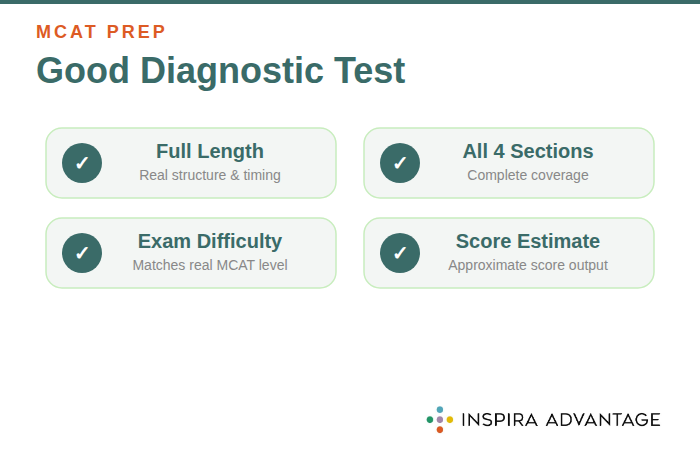
Any diagnostic that fails one of those criteria is not worth your time.
Dr. Jason Gomez, who scored in the 99th percentile on the MCAT and is an expert tutor at Inspira Advantage, stresses that open-book practice and extra breaks can actually inflate your score. During a free MCAT workshop hosted by Inspira Advantage, he emphasizes that true diagnostic value only comes from emulating the physical and mental constraints of the real testing center.
“Sit down for the full 7.5-hour block, take your breaks only when the actual MCAT schedule allows them, and treat the lunch break exactly as you would on test day.”
The MCAT is as much an endurance test as a knowledge test. A diagnostic taken in comfortable conditions with extra time will tell you what you know, but it won't tell you how you perform under pressure in the sixth hour.
Inspira Advantage's free MCAT practice test is an excellent starting point. You get a clear breakdown of your performance across all four sections in 341 pages, so you can immediately identify weak areas and build a targeted study plan from day one. It’s completely free with no strings attached.
The strategic advantage here is that taking Inspira's diagnostic test early preserves your limited AAMC practice exams for later in your prep when accurate score prediction matters most. You walk away with a reliable baseline and a roadmap for where to focus your study hours without burning through official materials before you've had time to improve.
Inspira Advantage’s MCAT tutors can help you achieve your target score on the MCAT. They use proprietary practice tests and dedicated study sessions you can’t get elsewhere to target your weaknesses and turn them into strengths.
Use an AAMC practice exam or a diagnostic test that closely replicates the real MCAT's structure, timing, and difficulty. An incorrect diagnosis will give you a misleading baseline and send your study plan off course.
The AAMC's official practice exams are an excellent choice for score prediction. The AAMC offers:
All tests use questions from previously administered MCAT exams with the same look, feel, functionality, scaled score, and percentile rank as an actual exam.
Start with Inspira's free diagnostic test to find your baseline score. Then use AAMC exams to ensure you get a competitive MCAT score.
Your diagnostic score means nothing if you don't extract actionable data from it. Most students look at their total, feel either relieved or discouraged, and move on. That approach wastes one of the most valuable tools in your entire prep cycle.
Here are five specific ways to turn your diagnostic results into a study plan that actually increases your score.
Go through each question you answered incorrectly and assign it to one of three categories:
Students often miss questions due to incorrect interpretation, math errors, and a lack of knowledge. Specifying the type of mistake helps you identify the pattern of your errors across each section.
A spreadsheet works best for tracking. Log these for every missed question, like the example below:
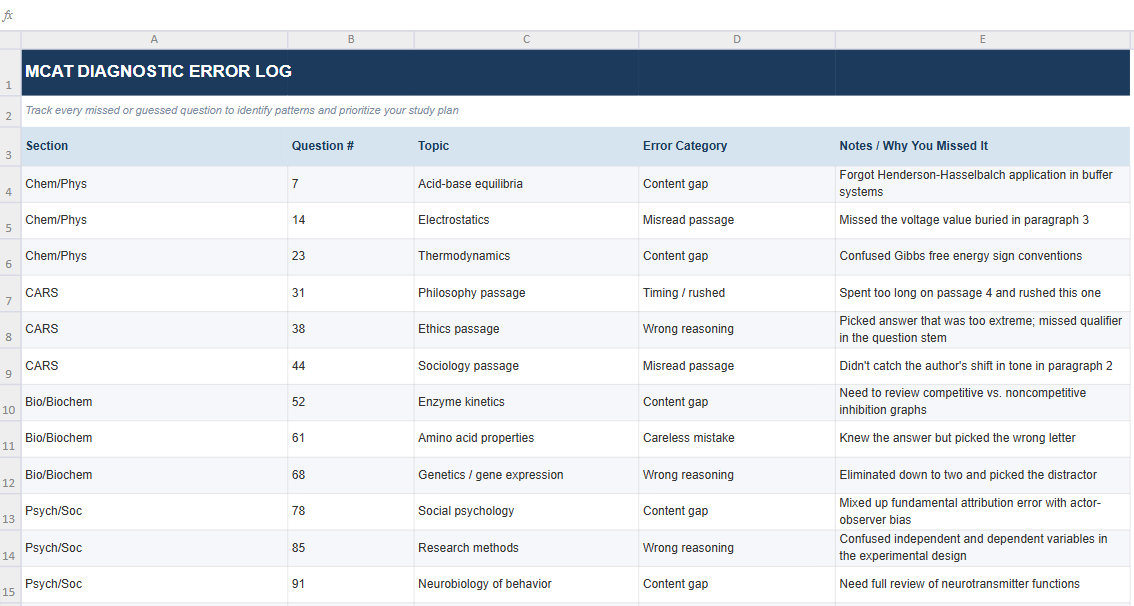
After 59 questions in Chem/Phys, you might find that 60% of your errors were content gaps in thermodynamics and electrochemistry, while only 15% were timing issues. That ratio tells you to prioritize content review over pacing drills for that section.
Without categorizing, you'd default to "study more chemistry," which is too vague to actually improve your score.
In our How to get a 515+ MCAT Score webinar, Ruchi Gupta, an expert tutor at Inspira Advantage, highlights that diagnostic tests are the best way to improve your weaknesses.
“Starting with a practice test can help you decide which kind of content you need to review first,” she says. “If you realize that you're not answering these questions quickly enough, then you can start with a lot of Time Passages to get you started.”
Ruchi says you should take a full-length test before any content review. That lets you build a study schedule based on objective data rather than subjective feelings about what you think you know.
Sometimes you get questions right just by guessing. There could be questions you answered correctly, but don't know how you arrived at that answer. Flag every question where you eliminated options and picked from the remaining choices without full confidence.
These lucky answers can hide real knowledge gaps that cost you points on test day when the question shifts from how you prepared for it.
Pull up the answer explanation for each flagged question and confirm you can explain the reasoning from scratch. If you can't, add that topic to your review list alongside your incorrect answers.
A diagnostic that shows 505 with 15 lucky guesses is technically a 498 once you account for the questions that could have gone either way.
Convert your section scores into a weighted time allocation for your study plan. For example, if you scored
Then, your lowest sections should receive the largest share of weekly study hours.
A student with the scores above might choose to allocate:
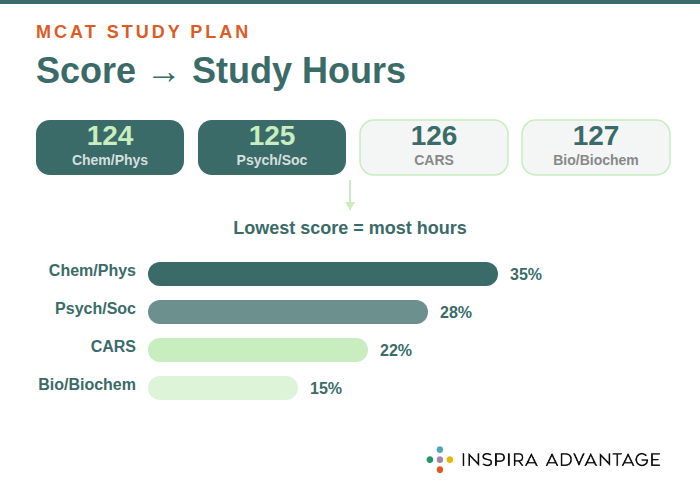
Reassess after every practice exam and shift your hours based on updated performance data. A fixed schedule that never adapts to your progress is just as wasteful as no schedule at all.
In our MCAT Secrets webinar, Dr. Austin Johnson, an expert MCAT tutor at Inspira Advantage who scored in the 99th percentile, highlights the importance of diagnostic tests.
“Until you simulate the MCAT, you don't know how you're going to respond cognitively over the course of eight hours, and the full load that it takes to get through all of these questions." He says.
Dr. Johnson explains that academic strength in individual courses does not automatically translate into MCAT success; use full-length simulations to understand how your focus and reasoning degrade over the course of the actual test.
After reading all the questions in a passage, go back through the passage and find the parts you used to answer the questions. This helps you figure out what types of information are important for you to answer the question in every passage.
The MCAT hides key data in dense paragraphs, figures, and tables. Your diagnostic review is where you train yourself to recognize which details matter and which are simply filler.
Mark the specific sentences, data points, or graph labels that are directly connected to a question. After doing this across 10 to 15 passages, you'll start noticing patterns in how the MCAT structures its passages.
Recognizing these patterns early shapes how you read passages for the rest of your prep.
After your diagnostic test, record all of your thoughts and feelings regarding the test and your performance in each section. Write about whether you felt:
Diagnostic test performance data alone doesn't capture the full picture. Your section four score might have dropped not because of a content gap, but because you were burnt out after five grueling hours and started rushing through passages.
Note the exact point where your focus started to shift, which breaks you took (and whether they helped), and any sections where anxiety caused you to second-guess answers you initially had right.
These patterns tell you whether you need to build endurance through timed practice blocks, adjust your break strategy, or develop a method for managing test-day stress. Address these factors early, and they won't sabotage a score that your content knowledge could otherwise support.
A good MCAT score is 511 or higher, with no section score falling below 127. Aim for this score range on your first or last MCAT diagnostic test to be prepared for the exam.
If you get a low score on your diagnostic tests, find your weak areas, create a focused study plan, use study resources, practice regularly, seek support if needed, and stay committed to your preparation. These steps will help you prepare to achieve a better MCAT score.
Yes. A diagnostic is the single most efficient way to start your MCAT prep because it eliminates guesswork. Without one, you're allocating countless study hours based on assumptions about what you know and don't know. Those assumptions are almost always wrong.
Students who skip the diagnostic test tend to either overprepare in areas where they're already strong or underestimate sections that need serious attention. Both mistakes cost weeks of study time you can't afford to waste.
Only take a half-length diagnostic test if you have limited time or want a less overwhelming initial assessment. A full-length diagnostic test offers a more comprehensive evaluation and simulates actual MCAT conditions. A shortened diagnostic test might save you a few hours upfront, but it won't show how performance fatigue affects you in the later sections.
A full-length MCAT diagnostic test takes about 7.5 hours when you include breaks. The MCAT test duration is 6 hours and 15 minutes, excluding breaks, with four sections lasting 90 to 95 minutes each, with optional breaks between them.
You should take at least two full-length diagnostic tests to prepare for the MCAT. Take your first diagnostic test before you start studying to establish your baseline score. Take the other diagnostic test after you finish studying to gauge how prepared you are for test day.
Dr. Jonathan Preminger was the original author of this article. Snippets of his work may remain.
Orthopaedic Surgery Resident Physician
Lewis Katz School of Medicine at Temple University


We’ll send you a 100+ page MCAT practice test created by one of our expert 99th percentile tutors. No strings attached.


.svg)

