One of the most common questions students ask me, our admissions counselors, and themselves is whether medicine is actually the right path for them. It’s a difficult question to answer because becoming a doctor requires years of coursework, clinical training, and commitment, and it can be hard to change direction once you're deep into the process.
Many students assume they'll figure it out later through upper-level science courses, research opportunities, or clinical experiences during college. But the reality is that you can start exploring medicine much earlier. High school summer programs give students an opportunity to experience healthcare, research, and patient-centered work before college even begins.
And the benefits extend beyond career exploration. The right program can help you develop practical skills, build relationships with mentors, gain research experience, and position yourself for opportunities that might otherwise take years to access.
In this guide, I'll cover the best medical summer programs for high school students, what each offers, and how to choose the right fit for your goals.
Privacy guaranteed. No spam, ever.
Our List of the Top 15 Pre-Med Summer Programs
Here is our list of the top 15 pre-med summer programs for high school students, their location, cost, focus, and deadlines.
Location: Palo Alto, California Grade Level: High school juniors Duration: 5 weeks Cost: Free (research stipend included) Focus: Clinical exposure & public health research Deadline: March 23, 2027*
Five weeks of fully funded clinical and research immersion at Stanford, with a stipend. Rare for free programs to have the duration, institutional prestige, and depth of mentored exposure SMYSP offers.
One of the few programs open to students as young as ninth grade, with dedicated biomedical and neuroscience research tracks taught by Penn faculty. Early access to multi-discipline research is rare at the high school level.
Location: Omaha, Nebraska Grade Level: Grades 10–12 Duration: 1 week Cost: Free Focus: Healthcare career exploration Deadline: Varies by session
A free, no-barrier entry point into healthcare exposure for students who want to explore the field before committing to longer or more expensive programs. Ideal for students testing whether medicine is the right path.
Location: Washington, D.C. Grade Level: Ages 15+ Duration: 1–3 weeks Cost: $7,610–$9,085 Focus: First-year med school curriculum, emergency medicine skills Deadline: Rolling admissions
Cadaver observation and emergency medicine simulations give students a preview of first-year medical school that no other high school program replicates. The curriculum mirrors actual med school coursework.
College credit eligibility and a GPA threshold create a more academically rigorous cohort. Students explore medicine and neuroscience at one of the top research hospitals in the country.
Location: Oakland, California Grade Level: Grades 10–12 (age 16+) Duration: 7 weeks Cost: Free (with $3,000 stipend) Focus: Biomedical research (one-on-one mentored) Deadline: February 2027*
Seven weeks of one-on-one mentored biomedical research, fully funded with a $3,000 stipend. The individual mentorship model and program length make the research experience closer to what undergraduates typically access.
Location: Indianapolis, Indiana Grade Level: HS seniors & undergrads Duration: 8–10 weeks Cost: Free (stipend given) Focus: Cancer-focused biomedical & clinical research Deadline: January 31st, 2027 or February 28, 2027*
A paid, NCI-designated cancer center research experience lasting up to ten weeks. The cancer-specific focus and clinical research component make the exposure more specialized than general biomedical programs.
Location: Houston, Texas Grade Level: Age 18+ (HS seniors & undergrads) Duration: 8 weeks Cost: Paid Focus: Biomedical lab research at Texas Medical Center Deadline: Varies
Placement at the Texas Medical Center, the largest medical complex in the world, with eight weeks of paid lab research. The setting and institutional depth offer exposure that most high school programs cannot match.
Location: Oakland, California Grade Level: Grades 9–12 (age 15+) Duration: 5 days Cost: $1,950 Focus: Hands-on clinical skills (suturing, EKG, CPR certification) Deadline: Rolling (spring & summer sessions)
One of the only programs where students leave with a tangible clinical certification (CPR) and hands-on skills like suturing and EKG reading. A five-day format makes it accessible without a multi-week commitment.
Location: Bethesda, Maryland (+ other campuses) Grade Level: HS seniors, undergrads, grad students Duration: 8–10 weeks Cost: Paid (stipend based on education level) Focus: Biomedical & behavioral research Deadline: February 2026 (closed)
The most prestigious federal research internship available to high school students. NIH placement carries significant weight on a college application and provides access to labs and mentors at the highest level of biomedical research.
Location: Fort Lauderdale, Florida Grade Level: Grades 9–12 Duration: 5 days Cost: ~$1,600 Focus: Osteopathic medicine, clinical immersion, certifications Deadline: Varies by session
One of the only programs that introduces high school students to osteopathic medicine specifically. Students explore DO pathways alongside clinical certifications, a distinction no other program on the list offers.
Location: Pittsburgh, Pennsylvania Grade Level: Juniors/seniors (age 16+) Duration: 6 weeks Cost: Paid Focus: Women's health, reproductive biology & infant health research Deadline: February 2027*
The only program on the list focused exclusively on women's health and reproductive biology research. Six weeks of paid, specialized research in a niche that few high school students have early access to.
Paid neuroscience research at an internationally recognized institute with access to brain imaging and structural neuroscience labs. The Max Planck name carries global research credibility that stands out on any application.
Location: Multiple locations (American University, Duke, Northwestern, UC Berkeley, UCLA, Yale, and more) Grade Level: Grades 6–12 Duration: 6–12 days Cost: $3,895–$4,095+ Focus: Medical simulations, leadership development, clinical exposure Deadline: Rolling
The widest geographic reach of any program on the list, with sessions at universities across the country. Students as young as sixth grade can attend, making NSLC the earliest entry point to structured medical exploration available.
Location: Northern California (Oakland HQ + regional sites) Grade Level: Ages 16–19 (priority to juniors/seniors) Duration: 7 weeks Cost: Paid (minimum wage+) Focus: Healthcare career exposure across departments Deadline: January 9, 2027*
Seven weeks of paid, cross-department healthcare exposure at one of the largest integrated health systems in the country. Rotating through departments gives students a broader view of healthcare careers than single-focus programs provide.
*Deadlines are estimated based on 2026 deadlines. Dates for the 2027 summer programs have not been released but will be updated once they are.
Other Pre-Med Summer Programs for High School Students
The following programs met most but not all of the selection criteria we used to build our ranked list above, whether due to a lack of direct institutional affiliation, a focus on classroom learning over hands-on clinical or research exposure, or other factors. They still offer strong medical exposure through reputable organizations and are worth exploring depending on your goals, location, and schedule.
Tufts Pre-College Mini Med School: A one-week program for high school students that introduces core medical concepts through hands-on labs, casework, and clinical mentorship.
Emory Pre-Med Institute: A three-week noncredit residential program for rising juniors and seniors that covers anatomy, clinical rotations, and medical ethics at one of the top research universities in the Southeast.
Envision NYLF Medicine and Health Care: A six- to eight-day program for grades nine through 12 that combines medical simulations, clinical skills labs, and healthcare site visits with a residential college campus experience. Held at multiple locations, including Yale, UCLA, Emory, Rice, UC Berkeley, and the University of Michigan.
Boston University RISE Internship/Practicum: A six-week summer research program for rising seniors that places students in university-level STEM labs with individual faculty mentors. RISE is more competitive and time-intensive than most programs on this list, making it a strong fit for students ready for a deep research commitment.
Columbia University Pre-College Program: Columbia's Summer Immersion program offers health sciences tracks for high school students looking to study in a university setting. Students can take college-level courses and earn academic credit while living on Columbia's Morningside Heights campus.
Privacy guaranteed. No spam, ever.
How We Selected the Best Pre-Med Summer Programs
We evaluated summer programs open to high school students and selected the 15 that offer the strongest combination of hands-on medical exposure, institutional credibility, and accessibility. Every program on our list met three core criteria:
Direct clinical or research exposure: We prioritized programs that place students in labs, hospitals, simulation centers, or mentored research environments. Programs offering only lectures or campus tours without hands-on components did not qualify.
Institutional affiliation: Every program on this list operates through or in partnership with an accredited university, medical center, or federal research institution. We excluded standalone commercial camps without institutional backing, even if they offer medical-themed content.
Mentorship or direct faculty access: Programs where students work one-on-one or in small groups with physicians, researchers, or faculty, not just large lecture halls with 200 students watching a presentation.
We also ensured there were free, stipend-funded programs alongside paid options to represent the full spectrum of programs you can pursue based on your needs.
For tailored pre-med guidance, including how to choose a good summer program and make the most of the mentorship and networking opportunities these programs can provide, meet with a counselor at Inspira Advantage.
Privacy guaranteed. No spam, ever.
Benefits of Attending a Pre-Med Summer Program in High School
A pre-med summer program helps you make smarter decisions about your college path, your major, and whether medicine is the right career before you invest years of coursework and thousands of dollars finding out.
Here’s a closer look at some of the key benefits of pursuing a pre-med program:
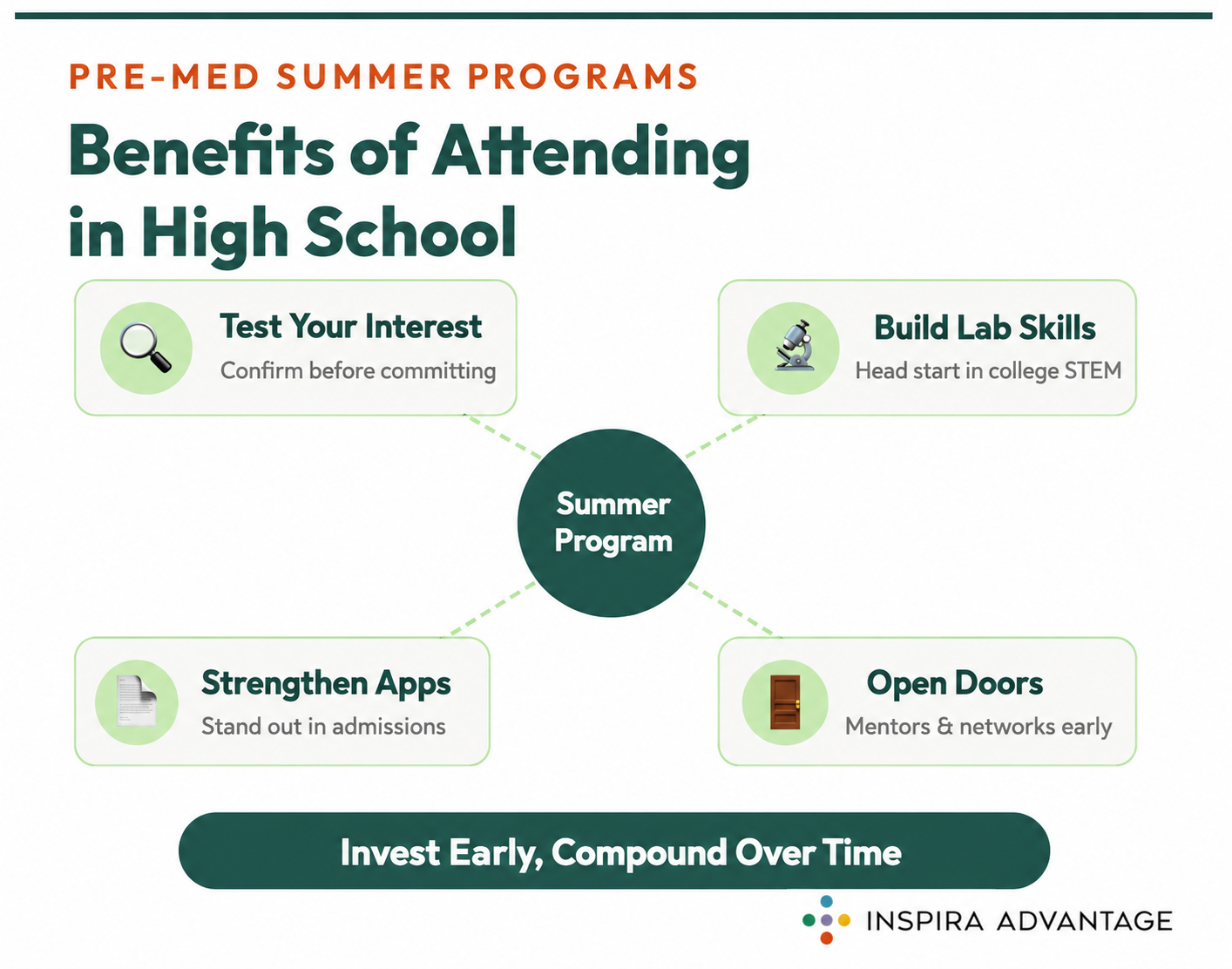
Test your interest before committing to a pre-med track. A summer program lets you experience what healthcare careers actually look like before you build your entire college plan around them. Students who arrive at college already confident in their direction choose stronger majors and build more focused extracurricular profiles.
Build foundational skills that give you a head start in college. Programs that teach lab techniques or research methodology prepare you for the pace and expectations of undergraduate science courses. Students who enter college biology or chemistry having already worked in a lab setting adjust faster and are more likely to perform better.
Strengthen your college and future medical school applications. A structured summer program at a recognized institution shows that you moved beyond stating interest and actually pursued it. Getting into a stronger undergraduate program opens more doors to research labs, clinical networks, and advising resources that matter when you eventually apply to medical school.
Open doors to future opportunities. Many summer programs connect students with faculty mentors, research networks, and alumni communities that continue to be useful in college. A student who completes a research internship at the NIH or UCSF in high school has a professional reference and a working relationship that can lead to undergraduate research positions, letters of recommendation, and access to projects that would otherwise take years to find. The program itself is not the end goal. The relationships and skills you build through it are what compound over time.
Laimi Ngela, a Global Health Placement Advisor at Go-Elective Abroad, highlights how meaningful pre-med experiences can strengthen both college applications and a student’s longer-term path toward medicine:
“A strong pre-med program gives students more than something to list on an application. It gives them real experiences to reflect on, helps clarify their interests, and shows they have taken meaningful steps to explore medicine. For college applications, that can demonstrate initiative and genuine curiosity. Over time, the perspective and confidence students gain can help them make more intentional choices about clinical exposure, research, mentorship, and their path to medical school.”
Privacy guaranteed. No spam, ever.
How to Choose the Right Pre-Med Summer Program For You
You should choose a pre-med program that aligns with your actual curiosity, match the program type to the outcome you want, and consider whether attending a program at a future university could give you an early advantage.
Here’s how to think through each one:
Consider Programs at Schools You Might Attend for Undergrad
We always tell students the best time to start preparing for medical school was yesterday, and a pre-med summer program in high school is one of the earliest ways to do that. The exploration you do now shapes how you choose your major, which labs you pursue, and how quickly you build the clinical and research hours that medical schools actually evaluate during undergrad.
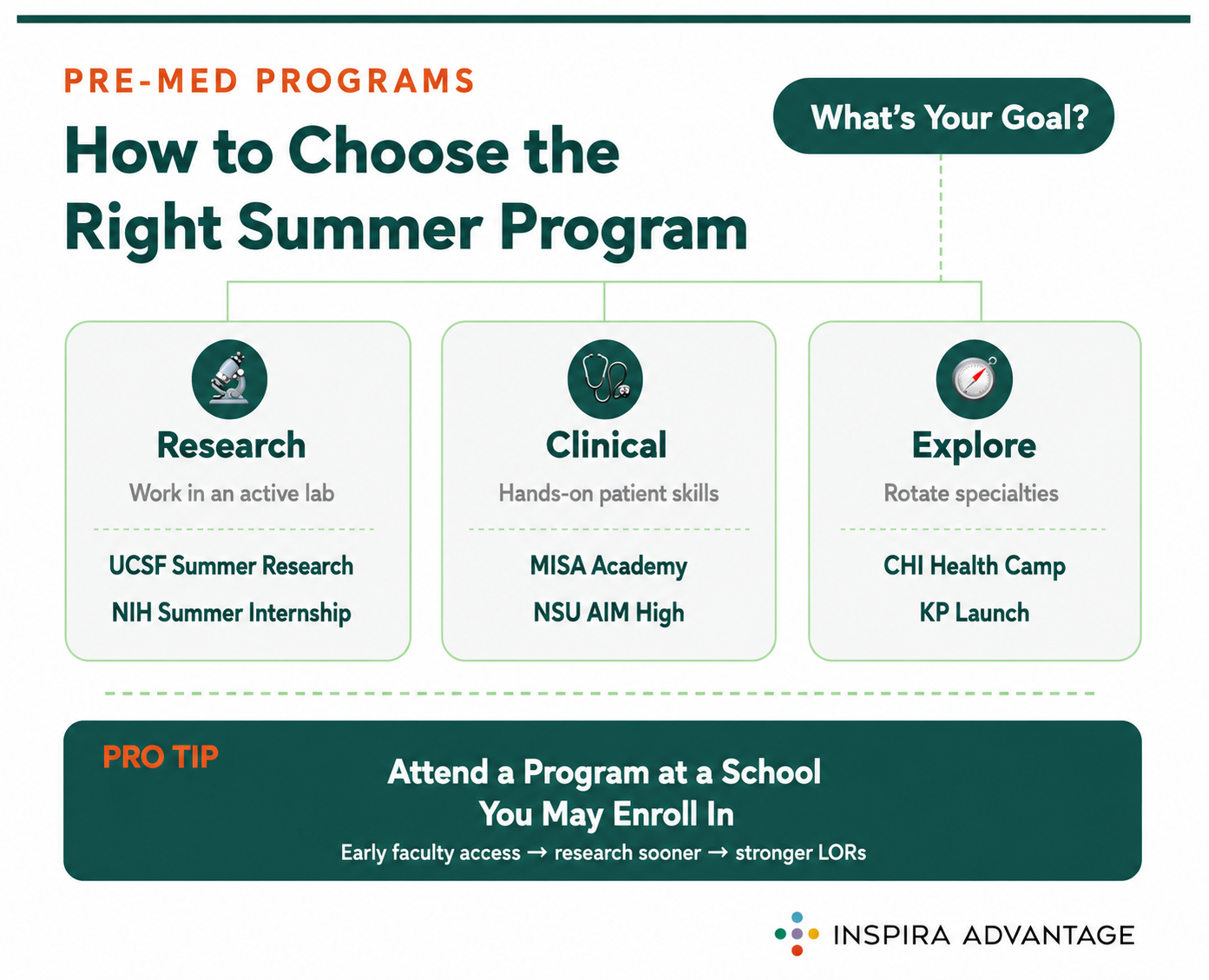
One way to maximize that early start is to choose a program at a university you’re considering for college.
University-run programs like the Penn Summer Academies, the Johns Hopkins Pre-College Summer Programs, and the Georgetown University Medical Immersion Academy put you in direct contact with institutional faculty, not third-party instructors. Summer cohorts are small, so you have a real opportunity to introduce yourself to a professor or researcher months before other freshmen ever set foot on campus.
That head start can lead to undergraduate research positions sooner, access to projects that other first-year students will not find for semesters, and faculty relationships that deepen over four years rather than two.
I've seen students attend a summer program at a university, enroll there a year later, and start freshman year already knowing a professor, a research lab, or a mentor on campus. Those relationships often open doors to opportunities that would otherwise take semesters to find. You should take every advantage you can get. And starting early is one of the easiest ones to act on.
Match the Program Type to the Outcome You Want
Since many of these programs cost several thousand dollars, take time to read the actual curriculum before you apply. Look past the program name and marketing language. A program that advertises "research experience" might mean observing a lab rather than working in one.
The right fit depends on where you are in your thinking. If you already know you want to do biomedical research, programs like the University of California, San Francisco Summer Student Research Program or the National Institutes of Health Summer Internship Program (SIP) place you one-on-one with a faculty mentor in an active lab for several weeks. You leave with real skills, not a surface-level overview.
If you’re more drawn to the clinical side of medicine, the Medical Immersion Summer and Spring Academy (MISA) and the NSU AIM High (Achieve in Medicine) program teach hands-on skills like suturing, EKG interpretation, and CPR certification that let you test whether patient-facing work is where you belong.
If you’re still figuring out whether medicine is even the right path, start with a broader exploration program like the Health Care Career Exploration Camp (CHI Health) or Kaiser Permanente KP Launch, where you rotate through multiple departments and specialties before narrowing your focus.
The goal isn’t to simply pad your college application. The goal is to walk away knowing more about what you want, what you don’t want, and what to pursue next.
Privacy guaranteed. No spam, ever.
FAQs
Should You Take a Pre-Med Summer Program?
Yes, you should take a pre-med summer program if you want to explore whether medicine is the right career path before committing to a pre-med track in college. A summer program gives you direct exposure to clinical environments, research labs, or healthcare career settings that you can’t access through regular high school coursework.
The experience helps you make more informed decisions about your major, your extracurriculars, and whether the day-to-day reality of medicine matches what you imagine. If you’re unsure whether you want to pursue medicine, a broad exploration program is a low-risk way to find out.
If you already know you want to go pre-med, a research- or clinical-focused program lets you build foundational skills that give you a head start in college.
Do Medical Schools Care About High School Summer Programs?
No, medical schools don’t evaluate your high school activities when reviewing your application. Admissions committees focus on what you accomplished during college: your GPA, MCAT score, clinical hours, research experience, letters of recommendation, and personal statement.
A summer program you completed in 10th grade will not appear on your medical school application. The value of a pre-med summer program in high school is indirect. It helps you arrive at college with a clearer sense of direction, stronger study habits in science, and, in some cases, an early faculty relationship at the university you attend.
Those advantages compound over four years of undergrad and ultimately produce a stronger medical school application.
How Hard Is It to Get Into a Pre-Med Summer Program?
Competitiveness varies widely depending on the program. In general, the more a program invests in you financially (free tuition, stipends, housing), the harder it is to get in. Free, stipend-funded programs at top institutions are the most selective.
The Stanford Medical Youth Science Program (SMYSP) and the University of California, San Francisco Summer Student Research Program accept small cohorts and receive hundreds of applications, so acceptance rates are low.
The National Institutes of Health Summer Internship Program (SIP) is similarly competitive. Paid programs with rolling admissions, like the Georgetown University Medical Immersion Academy or the Penn Summer Academies, are more accessible because enrollment isn’t capped as tightly.
Programs like the National Student Leadership Conference (NSLC) Medicine and Health Care program accept most applicants who meet basic eligibility requirements.
Can You Earn College Credit Through Pre-Med Summer Programs?
Yes, some pre-med summer programs offer college credit. The Johns Hopkins Pre-College Summer Programs award transferable college credit for completed coursework. The Penn Summer Academies offer credit-bearing options depending on the track you choose.
The National Student Leadership Conference (NSLC) Medicine and Health Care program also provides the opportunity to earn credit. Not every program offers credit, and credit-bearing programs tend to cost more. So confirm whether the credits transfer to the colleges you’re considering before factoring this into your decision.
Programs that don’t offer formal credit, like the University of California, San Francisco Summer Student Research Program or the National Institutes of Health Summer Internship Program (SIP), deliver value through research experience and mentorship instead.
Are Pre-Med Summer Programs Worth the Cost?
A pre-med summer program is worth the cost if you choose one that aligns with your goals and you treat it as an active learning experience rather than a line on your activities list.
Programs ranging from $1,600 to over $10,000 represent a significant investment, so evaluate what you’re actually getting: hands-on lab time, direct faculty mentorship, certifications, or broad career exploration. Several excellent programs cost nothing.
The Stanford Medical Youth Science Program (SMYSP), the University of California, San Francisco Summer Student Research Program, the IU Simon Comprehensive Cancer Center Summer Programs, and the Health Care Career Exploration Camp (CHI Health) are all free and some include stipends.
Can Pre-Med Summer Programs Strengthen Your College and Medical School Applications?
Yes, a pre-med summer program can strengthen your college and medical school applications by demonstrating initiative, intellectual curiosity, and sustained interest in a specific field.
College admissions officers at competitive universities review thousands of applicants who list "aspiring doctor" as a goal. A structured program at a recognized institution shows you took concrete steps to explore that interest rather than simply stating it. The experience also gives you more specific and compelling material for your college essays and interviews.
A student who can describe a week of mentored neuroscience research or a rotation through an emergency department has a more concrete story to tell than a student whose only evidence of interest is a stated career goal.
Arush Chandna is the Co-Founder of Inspira Advantage and a nationally recognized expert on graduate school admissions. Arush has used his 12+ years of experience in higher education to help 10,000+ applicants get into their dream graduate programs.






.svg)


