Get in touch: +1 888 453 5021




A DAT Academic Average (AA) of 20-22+ (on the old 1-30 scale) or 430-460+ (on the 200-600 scale) is a good score, placing you ahead of the typical dental school applicant. Scores around 18-19 fall in the average range, but scoring 21 or above significantly strengthens your candidacy at most dental programs.
Each DAT section is scored individually on the new 200-600 scale, and the AA is a separate scaled score reflecting your overall academic performance, not a sum of the other sections.
We based our score breakdown on the official percentile data from the American Dental Association, which maps every possible DAT score to a national percentile ranking based on a normative sample of more than 30,000 test-takers:
The DAT is very difficult. The DAT covers biology, general chemistry, organic chemistry, and perceptual ability across a five-hour test that moves fast and doesn't give you much time to answer each question.
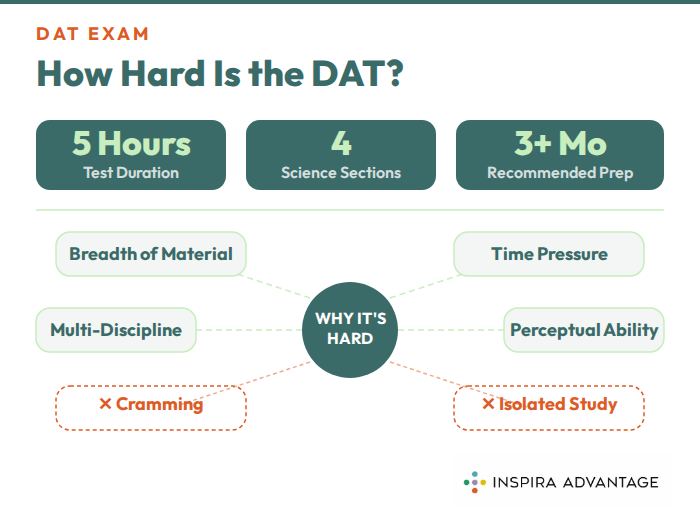
What makes it difficult isn't just any single section in isolation. It's the sheer breadth of material you need to internalize to earn a good score. Most successful test-takers spend at least three months in dedicated prep. And that timeline exists for a reason. Cramming doesn't work when the exam pulls from that many disciplines at once.
This video offers advice on how to earn a good DAT score from Dr. Helina Tessima, a 99th percentile DAT tutor at Inspira Advantage.
The DAT is less challenging than the MCAT. It focuses more on direct content recall than on deep critical thinking and, in many cases, on the physics required for the MCAT. The MCAT is longer (roughly 7.5 hours) and emphasizes passage-based analysis, whereas the DAT (roughly 4.5 hours) is shorter and includes a unique Perceptual Ability Test (PAT).
Your DAT score is one of the most important parts of your dental school application. However, dental schools evaluate candidates holistically. That means they review your academic averages, including your cumulative GPA, science GPA, and prerequisite course performance, as well as all your non-academic experiences. A strong DAT score won't rescue a weak GPA, and a high GPA won't automatically offset a below-average DAT.
Many programs use DAT scores as a filter before a human ever reads your application. If you fall below a program's minimum threshold, your application may never reach human eyes, regardless of how compelling the rest of it is. This makes hitting the right score range a prerequisite, not just a bonus.
Achieve a top DAT score with the guidance of top 1% coaches. Learn from experts who’ve mastered the exam, with personalized strategies and proven techniques to help you excel.
Yes, dental schools look at your individual DAT section scores — and more closely than you think. A strong Academic Average with a notably weak Perceptual Ability or Reading Comprehension score can raise flags at programs that weight those sections heavily. Some schools publish minimum section score requirements in addition to overall AA requirements, so check each program's admissions page before you apply.
Your DAT is a significant factor in the admissions process. The difference between a 470 and a 510 may look small on paper, but at schools where the average matriculant scores above 510, it can be the difference between an interview and a rejection. At less selective programs, a score above the school's average is typically enough to keep your application moving forward. And the rest of your profile supplements your candidacy.
Yes, you can get into dental schools with a low DAT score, but it won’t be easy. A below-average DAT score forces the rest of your application to work much harder. For example, a near-perfect GPA, extensive research experience, and exceptional letters of recommendation can offset a weak DAT score at some programs, particularly those that take a more holistic approach to admissions. However, schools with hard minimum score cutoffs will screen you out before any of that context is considered.
If you know how to study for the DAT but received a score below the 40th percentile, a retake is almost always the better move before submitting your applications.
The DAT is scored on a three-digit scale ranging from 200 to 600, in 10-point increments. The ADA introduced this scale on March 1, 2025, replacing the old 1-30 scale most dentists and advisors are familiar with. Each section receives its own individual score, and your AA reflects the mean across all sections except Perceptual Ability and Reading Comprehension.
DAT scores are reported through two systems:
All scores sent to dental schools appear on the new three-digit scale. The ADA rescaled older pre-March 2025 scores to match the new scores.
If you took the DAT before March 2025 and want to compare your old score to the new scale, the ADA maps scores from the old 1-30 range to their three-digit equivalents. An old Academic Average of 18, for example, converts to a 390 on the new scale.
Here are the average scores of some of the top dental schools in the U.S.:
Retake the DAT if your current score falls below the average of the schools you're targeting. A score that sits at or below a program's average puts you at a statistical disadvantage from the moment your application is reviewed.
The more important question isn't whether to retake it; it's whether you're ready to score significantly higher. Retaking the DAT and getting a similar or lower score hurts your application more than the original score did.
Dental schools can see every DAT attempt, and a plateau or declining score signals that you can no longer improve. Before you register for a retake, identify exactly where your preparation fell short. Knowing this will help you tailor your study plan to help you fully understand the content.
Don't retake the DAT if your score already meets or exceeds the average at every school on your list. Chasing a marginally higher score when you're already competitive is rarely worth the time. It would be better to focus on strengthening other parts of your application.
Also, avoid retaking if you can't commit to a significantly different preparation strategy. Doing the same thing over and over and expecting a different result is the fastest way to stall your application cycle.
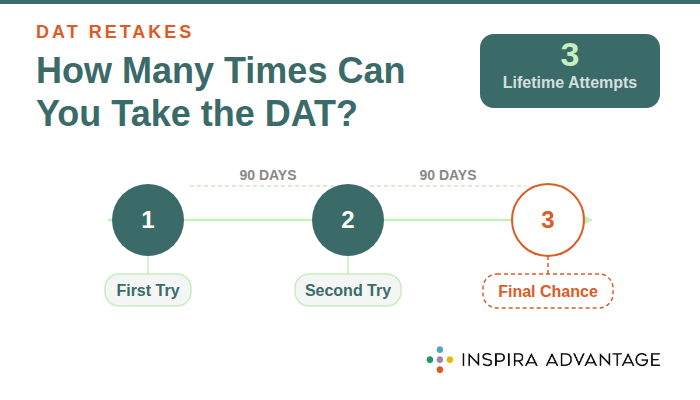
You can take the DAT up to four times within a 12-month period, and you have to wait at least 60 days between attempts. If you've taken the exam more than three times total, you'll need special permission to retest. After a fifth attempt, you're limited to one retake every 12 months.
Admissions committees can see every score on your record. So build a realistic study plan before your first attempt rather than relying on multiple retakes.
A 430 Academic Average (AA) on the DAT puts you at the 75th percentile nationally, meaning you scored higher than roughly three-quarters of all test-takers. This is widely considered a competitive score, comparable to the average admitted student at many dental programs.
The hardest parts of the DAT are Perceptual Ability and Organic Chemistry. Perceptual Ability tests spatial reasoning skills, and no college course prepares you for it. Improvement requires consistent, deliberate practice over weeks, not a last-minute cram session. Organic Chemistry tests reaction mechanisms, stereochemistry, and functional group transformations. Gaps in foundational knowledge quickly surface under timed conditions.
The highest possible DAT score is 600 on the three-digit scale introduced in March 2025. Every section has a maximum of 600. Your Academic Average also reaches 600.


.svg)


