Get in touch: +1 888 453 5021



Take six to eight full-length MCAT practice tests to fully prepare for the MCAT. Taking three to four practice tests leaves gaps in your timing strategy and content diagnosis. Taking more than 10 practice tests usually results in incremental score increases.
However, the real value of practice tests isn't the number itself. It's about spacing them correctly in your study schedule (every one to two weeks), so you have time to review each exam and improve your weaknesses before taking the next one.
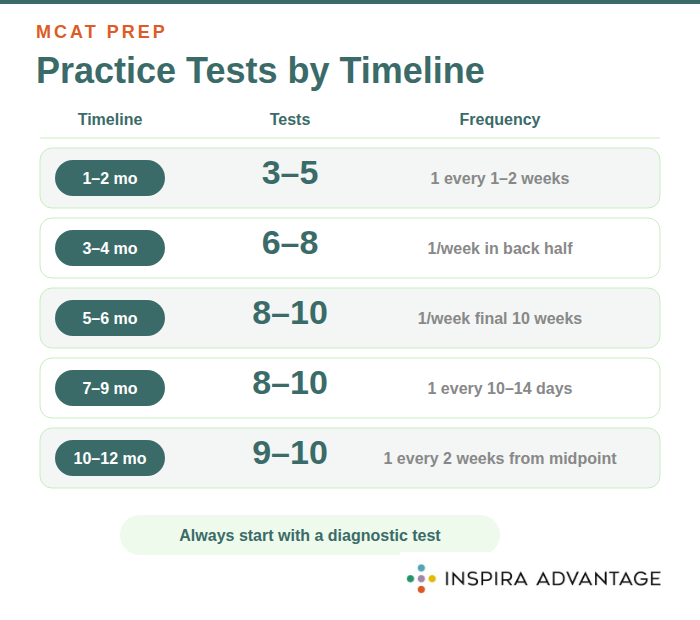
Your ideal full-length practice test count depends entirely on how long you have before test day. Cramming 10 full-lengths into a six-week window creates burnout without meaningful score improvement. Spreading four tests across a year wastes momentum. Match your volume to your timeline.
Between full-length tests, keep your MCAT skills sharp by practicing with a daily question and answer explanation.
All MCAT prep timelines require taking at least one diagnostic test to get a better idea of your baseline score.
Begin your study timeline with a full-length diagnostic test and end it with full-length practice tests that simulate test day conditions.
Notice that the upper limit for practice tests is around 10, regardless of the timeline length. More prep time doesn't mean more tests. It means more content review between tests and deeper post-exam analysis.
Practice tests improve your score through two mechanisms:
The first 3-4 exams deliver the biggest increases because they expose the broadest weaknesses in your content foundation. You'll find entire high-yield topics you thought you understood but can't apply under timed conditions.
Tests 5-8 shift the value toward pacing and endurance. By that point, you've addressed the glaring content gaps.
Score gains come from learning when to cut losses on a tough passage, managing fatigue in the afternoon sections, and improving your CARS timing. These are skills you can only build by sitting through the full 7.5-hour experience repeatedly.
After tests 9 and 10, you’ll probably see only small improvements. Score fluctuations at that stage usually reflect daily variability (such as sleep, focus, and stress) rather than genuine knowledge gaps.
If your scores plateau even after 10 practice tests, adding 1-2 more full-length exams probably won’t help. Targeted section practice and content review will.
Take a full-length test no more than once per week. Every practice exam needs at least two to three days of dedicated review afterward. That review process matters more than the test itself.
Spend day one going through every question you flagged, got wrong, or guessed correctly on. Spend day two drilling the content areas that those mistakes revealed. Skipping that cycle turns practice tests into expensive time sinks that produce scores without meaningful learning.
Reserve your heaviest testing volume for the final 6-8 weeks, when your content foundation is good enough to actually benefit from test-day simulation.
Take your final practice test 5-7 days before your scheduled MCAT date. That gives you enough time to review without cramming and prevents the score anxiety that comes from testing too close to the real thing.
More than 12 full-length practice tests is too many for most students. If you aren’t seeing any improvement by practice test 12, the likely issue is the quality of your prep resources.
The Association of American Medical Colleges (AAMC) offers five scored practice exams plus the free Sample Test. Those six exams are excellent resources because they use previous questions written by the same people who write the real MCAT.
You can also use our free full-length MCAT practice test when preparing for the MCAT. Expert tutors who scored in the 99th percentile on the MCAT created our full-length test, and they know what questions most students struggle with. In 341 pages, we give you a comprehensive answer breakdown, using real questions from previous MCAT tests.
Save your AAMC full-lengths for the final five to six weeks before test day. Use our free MCAT practice test earlier in your timeline to learn your weaknesses and build stamina.
Build your study schedule backward from your registered test date. A practical framework for each study timeline looks like this:
Take every practice test under realistic conditions. Wake up at the same time you will on test day. Use the same break timing. Eat the same snacks. Sit in a quiet room for the full duration without pausing.
Students who pause sections or skip the lunch break during practice tests are more likely to underperform on the real exam because they haven’t experienced genuine test-day fatigue.
To find your ideal study schedule, use our free MCAT study schedule tool.
A downward trend across your final three practice tests is the clearest sign you aren't ready. Dropping scores in the last stretch of prep usually indicate burnout, unresolved content gaps, or both.
Pushing through to test day, hoping for a rebound, rarely works. Postponing your test date by four to six weeks to address the root cause protects you from a voided score.
Average scores after five or more full-lengths point to a structural problem in your study approach rather than a volume problem. You need to change how you review.
Go back to the questions you missed and categorize them. Are you missing questions because you:
Each one of these missteps requires a different fix. More full-lengths only help with improving your timing.
Large score inconsistencies indicate erratic fundamentals. You're likely relying on topic familiarity to help you on different exams and then freezing when passages don't align with your strengths.
If this is the case, go back and improve your weakest content areas before testing again.
AAMC practice tests are the only exams written by the same organization that writes the real MCAT. The passage complexity, answer choice structure, and scoring algorithm all emulate what you'll face on test day.
Your scores on these exams are the most accurate predictor of your real MCAT score. Treat these six exams as an irreplaceable resource. Once you've seen a passage, you can never unsee it. Retaking an AAMC full-length can inflate your score and destroy its predictive value, which is where Inspira Advantage’s MCAT practice test can supplement your practice.
Take third-party practice tests early in your prep to identify your weaknesses and build stamina. Sitting for 7.5 hours under timed conditions builds the endurance and mental resilience you need to ace every section of the exam.
Reviewing missed questions in our exam shows you content gaps just as effectively as AAMC material.
Then transition to AAMC full-lengths during your final five to six weeks. By that point, your content foundation should be sufficient enough to benefit from AAMC's more nuanced question style.
You want your last four to five practice test scores to come from AAMC exams because those are the numbers you'll use to decide whether you're ready for test day.
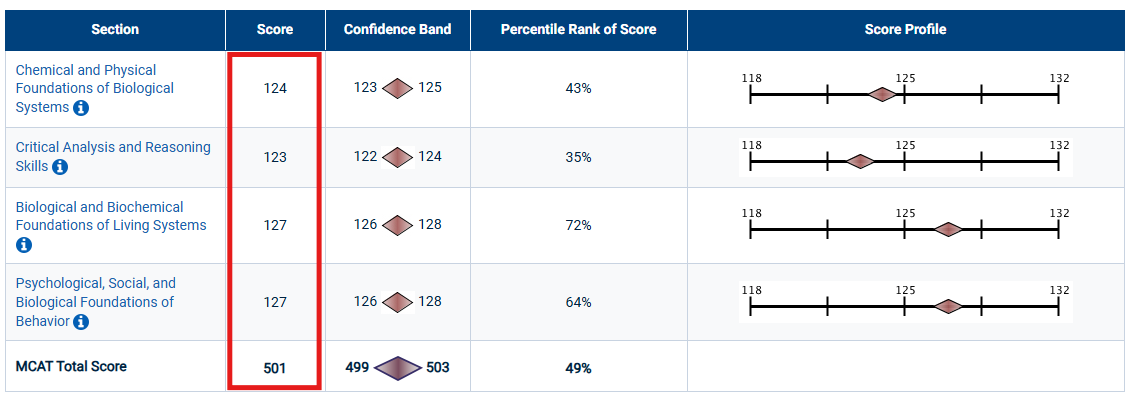
Every AAMC full-length generates a score report that breaks your performance down by content category and science skill. Most students look at their overall score and move on, but that wastes the most valuable part of the practice test.
Export or take a screenshot of your performance breakdown after every exam. Track your accuracy rates across the AAMC's 10 foundational concepts and four scientific reasoning skills over multiple tests. You’ll find that patterns emerge quickly.
You might find that you consistently miss questions involving amino acid chemistry regardless of which section they appear in. Or that your experimental design reasoning drops when passages include complex figures.
Build your review days around those patterns rather than rereading entire textbook chapters. For example, if your data shows a 60% accuracy rate on metabolism questions across three exams, spend your review time doing targeted metabolism passage practice rather than another full-length.
Stop taking full-lengths when you've identified specific weak areas. Switch to timed section practice and content drills until your accuracy in those categories improves. Then return to a full-length to validate the fix.
Book an MCAT mentoring session and get a study plan built around your specific weaknesses, target score, and timeline rather than a generic prep schedule that treats every student the same. Our tutors scored 520+ on the MCAT. They've already navigated the exact score plateaus and content gaps you're facing right now.
Yes, seven full-length practice tests are enough to prepare for the MCAT on a three- to four-month study timeline. Taking seven practice tests gives you enough data to track score trends, build stamina for the 7.5-hour exam, and identify content gaps across all four sections.
Five full-length practice tests are the minimum for a competitive MCAT score. Five exams give you enough prep to build test-day endurance and spot scoring trends, but they leave little room for error in your review process.
Third-party MCAT practice tests can be more challenging than the real MCAT for some, particularly on the science sections. Third-party MCAT practice tests are intentionally designed to skew difficulty upward so students feel more prepared on test day. AAMC official practice tests are the closest match to actual exam difficulty because they use retired questions from the same item bank and question-writing process.
AAMC practice tests can predict your actual MCAT score within one to three points when you average your last three full-lengths. AAMC exams use retired questions and the same scoring algorithm as the real test, making them the only reliable predictors. A single practice test score is not a reliable predictor on its own, since MCAT performance fluctuates with sleep, focus, and passage difficulty.
Three full-length practice tests are the absolute minimum for MCAT readiness on a one-month timeline. Three exams give you barely enough data to establish a scoring baseline, identify your weakest sections, and build minimal stamina for the 7.5-hour test. Fewer than three tests leave you guessing about your readiness rather than deciding based on real data.
It’s better to prioritize content review first and practice tests second. Taking full-lengths on a weak content foundation produces discouraging scores that don't reflect your actual potential. Spend the first half of your prep timeline building knowledge across all four sections, then shift to one practice test per week during the back half.
Orthopaedic Surgery Resident Physician
Lewis Katz School of Medicine at Temple University


We’ll send you a 100+ page MCAT practice test created by one of our expert 99th percentile tutors. No strings attached.


.svg)

