Get in touch: +1 888 453 5021





We recommend you start studying for the MCAT at least six months before your test date, and no later than one month before if you're retaking the test.
Here’s a look at when you should start studying for the MCAT, based on your registered test date.
The table below matches each study timeline to the student profile it fits best, along with the intensity and weekly hour commitment you should expect.
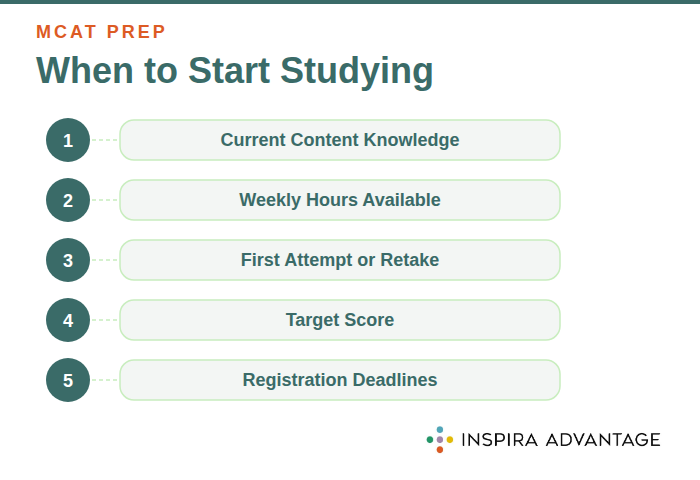
Knowing when to take the MCAT depends on five factors:
Students who just finished biochemistry, organic chemistry, and physics will need less time to prepare for the MCAT than students who haven’t even looked at those courses in two years.
Take a diagnostic practice test before optimizing your study plan. Your baseline score reveals exactly how much ground you need to cover and prevents you from wasting weeks reviewing material you already know.
A student studying 40 hours per week can prepare in three months. A student who studies 10-15 hours per week alongside a full course load needs to start much earlier to hit the same total prep hours.
Most successful test-takers have between 300 and 350 total study hours. Divide that number by your realistic weekly availability, and you'll know how much time you need to properly study for the MCAT.
If you’re retaking the MCAT, you already have a significant advantage because you know:
A retaker who scored a 505 and needs a 510 typically doesn't need a six-month strategy overhaul. Two to three focused months targeting weak sections and refining test-taking strategy will typically hit your target score more than repeating the entire content review.
The gap between your diagnostic score and your target score dictates everything. For example, if you scored a 500 on your diagnostic test and you need a 515, you’re dealing with a 15-point gap that requires serious content review and extensive practice.
However, if you’re starting at 508 and you need to get to 512, you can focus on:
Higher point gaps require earlier start dates because you need more cycles of content review, practice exams, and targeted support.
The AAMC sets registration deadlines of 60, 30, and 10 days before each test date, with fees increasing at each stage. Secure your test date early and work backward from there to figure out the right amount of time you need to study.
Don’t study first before choosing your MCAT date, as most of the available dates will have run out by the time you’re ready to register. Register first; then build your schedule around that fixed endpoint.
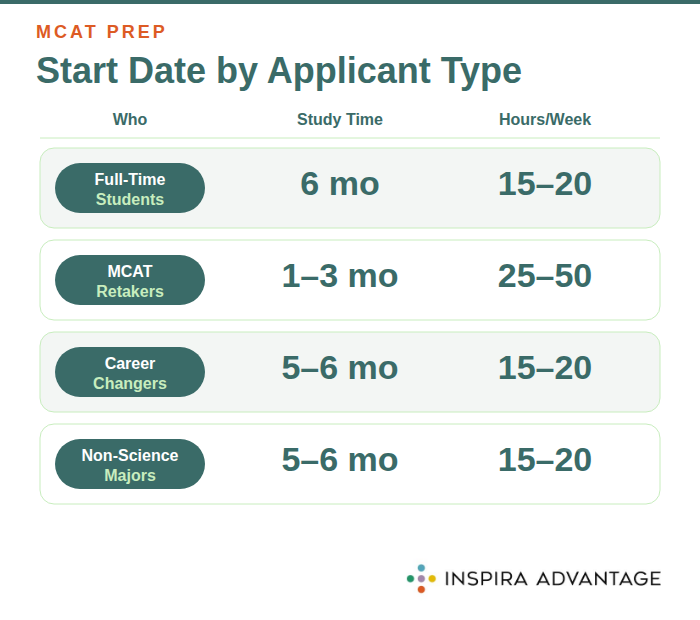
Start studying six months before your MCAT test date, at a rate of 15-20 hours per week. Studying for the MCAT while carrying a full course load means that test content will be competing for space in your brain every single day.
Start with content review during lighter academic weeks and shift toward full-length practice exams once your finals end. The best approach for full-time students is to schedule your MCAT for early summer so your heaviest study block falls after the spring semester ends, and you can dedicate uninterrupted weeks to multiple practice tests.
Start studying one to three months before your MCAT test date. Aim for 40-50 hours per week if you're on a one-month timeline, 30-35 hours at two months, and 25-30 hours at three months. Use your previous score report as a blueprint for what to prioritize. Find your AAMC score breakdown and identify the exact sections and subtopics where you lost the most points.
If you scored a 505 and need a 512, you don’t need to relearn amino acid structures from scratch. You need to hone in on the content gaps and test-taking errors that prevented you from achieving your target score.
Dedicate that time almost entirely to:
Skip the full content review and resist the urge to start over from page one of your prep books.
Start studying five to six months before your MCAT test date, at a rate of 15-20 hours per week, since working 40+ hours per week only leaves you time to study in the evenings and on weekends. Trying to cram 300+ study hours into two or three months on that schedule leads to burnout before you ever sit for the exam.
Split up your study strategy into two phases:
Use your weekend mornings for timed practice since that's when you'll simulate real test-day conditions.
Start studying five to six months before your MCAT test date, at a rate of 15-20 hours per week. Maybe you took physics as a sophomore and haven't reviewed any of the material since. Maybe organic chemistry never made sense the first time. A weak foundation in one or more prerequisite subjects means you're not just reviewing material. You're relearning it.
Spend the first two to three months rebuilding content knowledge in your weakest areas before adding in practice exams. Focus on one subject at a time rather than rotating through all four sections simultaneously. Once you close the foundational gaps, shift toward full-length timed exams and CARS practice for the final two months.
Taking a diagnostic practice test on day one is especially important here because it shows you exactly which subjects need a full rework versus a light refresh.
Your first step is to take a full-length AAMC practice exam under timed conditions. Don't study for it. Don't review anything beforehand. The entire point is getting an honest baseline score that shows exactly where you stand across all four sections.
Ruchi Gupta, who studied at the Yale School of Medicine and is an expert admissions counselor at Inspira Advantage, provides valuable advice in our competitive MCAT score webinar:
"There is no better way to start studying than taking a full length practice exam. Starting with a practice test can help you decide which kind of content you review first."
Write down your score for each section and note which content areas you had to guess the most. That breakdown becomes the blueprint for your entire study plan. Without it, you'll waste the first few weeks reviewing topics you already know while ignoring the ones actually hurting your score.
Rank the four sections from weakest to strongest after taking a diagnostic test. Start your first two weeks of studying by improving your lowest-scoring section exclusively.
Dr. Synthia Lay, a psychiatry resident, MD graduate of the Keck School of Medicine, and expert advisor at Inspira Advantage, stresses the importance of identifying your strengths and weaknesses early in our MCAT study schedule webinar:
"The first step is finding out everything you need to know about the MCAT ... and then you want to figure out your baseline ... identify your strengths and weaknesses so then you can figure out which sections you need to focus more on ... you prioritize your time that way ... It's so individual to every person but you want to be able to spend more time on your weaknesses."
Most students make the mistake of starting with their strongest subjects because it feels productive. It's not. Early weeks are when your energy and motivation peak.
Spend that momentum on biochemistry if biochemistry is your weakest area. Spend it on CARS if CARS is your problem section. You'll rotate in your stronger sections later, but the first block of study time belongs to whatever needs the most work.
Dr. Lay emphasizes that starting is as much about research as it is about studying. By establishing a baseline immediately, you avoid the common pitfall of spending equal time on all sections, allowing you to target the subjects where you have the most room for growth.
Use a physical or digital calendar and mark your test date. Count backward and assign specific subjects to specific days. For example, Monday might be a biology content review. Tuesday might be chemistry practice problems. Saturday morning might be a full-length practice exam every other week.
The key is to make every single day between now and test day count before you begin. Vague plans like "I'll study biochem this week" almost never come to fruition. Dr. Aditya Khurana, a radiology resident at the Mayo Clinic and long-term counselor at Inspira Advantage, recommends planning well ahead in our MCAT 101 webinar:
"Once you figure out your baseline, you gather your resources. Then from there, you create your schedule. Your schedule is going to differ depending on what's going on in your life. You should at least map out your schedule five or six weeks out in advance."
A day-by-day calendar with assigned topics creates accountability and shows you immediately when you're falling behind.
If you’re struggling to stay on track, reward yourself once you complete the task. It doesn’t have to be big or cost money. Maybe you get to watch your favorite movie that Saturday evening if you actually drill two full-length practice exams in the morning. Small rewards go a long way.
Secure your MCAT date and pay the registration fee before you begin any content review. An unregistered test date makes exam prep feel optional, and optional deadlines don't create urgency.
Once you've committed financially and have a confirmed date on your AAMC account, procrastination becomes much harder. Registration also forces you to work backward from a fixed point rather than working through an open-ended study plan.
Choose your MCAT date based on when you need scores back for your application cycle, then build everything around that anchor.
Before your first real study session, have every resource ready to go:
Spending your first study day shopping for books or comparing prep courses online isn't studying. It's procrastination disguised as productivity.
Decide on your core resources ahead of time, set them up on your desk or in your digital workspace, and make day one about actual content review.
Three months is enough time to study for the MCAT if you have a strong science foundation and can commit to 25-35 hours per week. Spend the first month on content review, the second month mixing content with full-length practice exams, and the third month on timed practice tests and targeted remediation. Students who scored below 500 on their diagnostic test or have significant content gaps across multiple subjects should consider a longer timeline of four to six months.
You should start taking full-length MCAT practice exams after completing four to six weeks of content review. Take one full-length exam every two weeks under real testing conditions, including timed sections and standard break structure. Spend the day after each exam reviewing every missed question and categorizing errors as content gaps, reasoning errors, or careless mistakes. Save the official AAMC practice exams for the final two months of your study plan because they are the most accurate predictors of your real score.
You should study for the MCAT for 300-350 total hours to be fully prepared across all four sections. Divide that number by your available weekly study hours to determine your ideal timeline. For example, a student studying 20 hours per week would need roughly four months. A student studying 10 hours per week needs six months to reach the same total preparation.
You should finish at least biology, general chemistry, organic chemistry, biochemistry, and physics before starting dedicated MCAT prep. Studying for the MCAT without completing these courses forces you to learn foundational content and test strategy simultaneously, which doubles your workload and extends your timeline. Psychology and sociology prerequisites are helpful, but you can effectively self-study them with prep books and flashcards if you haven't taken them yet.
Register for the MCAT before you start studying so your test date serves as a fixed deadline that drives your entire study plan. Choose a date three to six months out based on your content foundation and weekly availability, then build your schedule backward from that anchor. The AAMC charges increasing late fees at the 60-day, 30-day, and 10-day registration deadlines, so registering early also saves you money and guarantees your preferred test date and location.
Dr. Akhil Katakam was the original author of this article. Snippets of his work may remain.


We’ll send you a 100+ page MCAT practice test created by one of our expert 99th percentile tutors. No strings attached.

.svg)

