Get in touch: +1 888 453 5021




I sat down with some of our 520+ scoring DAT tutors and asked them one question: What do the highest-scoring students do differently from everyone else? Their answers were surprisingly consistent.
Top scorers don't study more. They study with more structure. Most pre-dental students start their DAT prep feeling overwhelmed by the volume of material and unsure where to focus first. We put these tips together to fix that.
Every strategy below comes directly from tutors who scored in the 99th percentile and have coached hundreds of students through the same process. The goal is to create a study plan that makes the entire dental school prep cycle feel manageable rather than chaotic.
Here are the best tips to help you prepare for the DAT and achieve a competitive score.
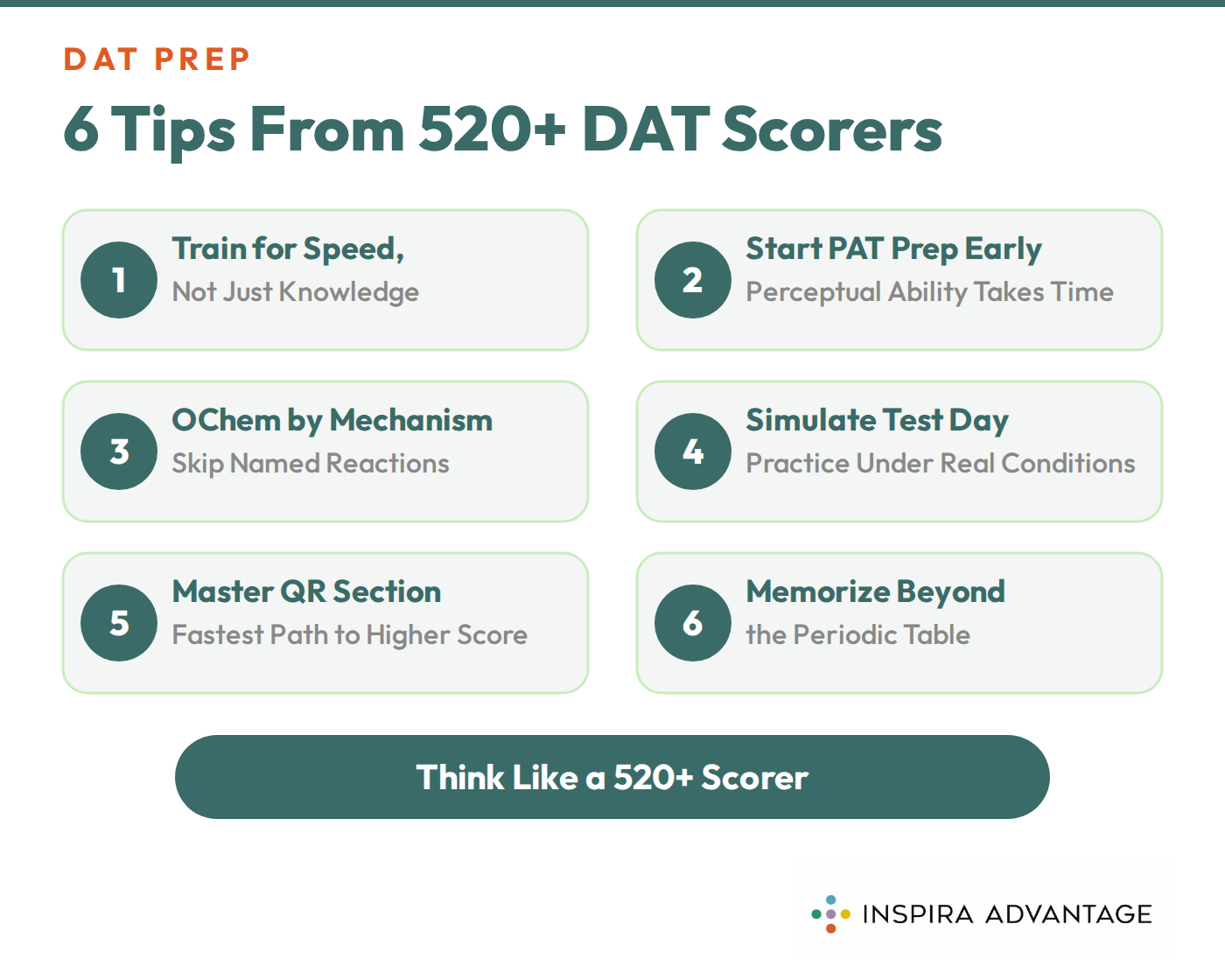
Practice every session under timed conditions from day one of your prep. The DAT isn't primarily a knowledge exam; it's a speed exam. Most students who underperform knew the material but couldn't execute under time pressure.
The science sections give you roughly one minute per question, and the Perceptual Ability Test (PAT) is even tighter.
From day one of your DAT study schedule, every practice session should be timed. Untimed practice builds a false sense of readiness that falls apart on test day.
In our dental school webinar, Dr. Helina Tessema, a graduate of Tufts University School of Dental Medicine and an Inspira expert advisor, shares her insights on the DAT:
"It's about endurance — this is not a sprint," she says.
Using a structured prep course helped her build the daily discipline needed to stay consistent. And she emphasizes that sitting down to plan how to study for a long exam can be daunting without such a framework.
Once you're consistently getting questions right, shift your entire focus to getting them right faster.
Download the perfect DAT study schedule in just two minutes or less below.
PAT is the one DAT section where content knowledge won't save you. No college course teaches you to mentally unfold three-dimensional objects or visualize cross-sections through irregular shapes.
Every other section on the DAT maps to a class you've already taken. PAT doesn't. That makes it a pure skill-building exercise, and skill-building requires volume spread across months rather than intensity packed into a final week.
High scorers practice PAT daily from day one. Even 15 to 20 minutes of focused PAT work each day compounds dramatically over an eight to 12-week study cycle. Students who wait until the last two weeks to start PAT drills consistently run out of time before they've learned the pattern recognition speed the section demands.
You get 40 seconds per question across 90 items. That pacing punishes anyone still "learning" the question types on test day.
Prioritize the subsections that feel most unnatural first. Keyhole (aperture) questions and three-dimensional view recognition tend to have the steepest learning curves because they require you to rotate and project objects mentally with no reference point.
Hole punching and cube counting improve faster with practice, but still need consistent reps to reach the speed the timer demands.
Use a PAT generator early in your prep to track accuracy and speed per subsection, and shift your daily practice toward whatever isn't clicking yet.
Group your study by mechanism type (SN1 vs. SN2, E1 vs. E2, electrophilic addition, nucleophilic acyl substitution) and learn to predict products from first principles. Look at a substrate and identify:
This approach lets you work through most organic chemistry questions without having seen that exact reaction before. It also makes it far easier to handle the curveball questions the DAT is known for.
The DAT rewards reaction logic, not reaction memorization.
Getting a good DAT score for dental school can only happen if you set up your practice environment to simulate the real exam. Simulate the same:
Take at least three full-length practice exams this way. Keep breaks within the scheduled window and resist the urge to redo a section you didn't like.
Every accommodation you give yourself in practice is a crutch you won't have on test day. Students who train in realistic conditions consistently feel more composed when it counts.
Review core Quantitative Reasoning concepts early in your prep timeline, especially data interpretation and word problems. The content caps at the pre-calculus level:
A focused two- to three-week review can move your Quantitative Reasoning score more than the same time spent drilling biology.
Most pre-dental students haven't touched math since freshman year, which is exactly why this section has the most room for rapid improvement. Spend your time on the question types that cost the most minutes, not the ones that feel hardest conceptually.
You'll have a periodic table on test day. Atomic masses, element symbols, and electron configurations are all right there. High scorers treat that boundary between "provided" and "not provided" as the single most important filter for their memorization strategy.
Put your energy into what the exam won't hand you:
Too many students spend hours drilling element symbols they'll already have in front of them. That time compounds fast over a study cycle. Every hour you spend memorizing something the exam provides is an hour stolen from material you'll actually need to recall under pressure.
Build a "must memorize" list during your first week of studying and audit it against the provided reference materials. 520+ scorers revisit that list weekly and cut anything that overlaps with what's given. The goal isn't to memorize everything. The goal is to memorize only what the exam demands you carry into the room yourself.
Take our DAT pop quiz to find out if you’re ready for the exam.
After speaking with some of our top DAT tutors, one mistake became very clear to me: Most applicants study every DAT section the same way as other sections.
They read the chapter, complete a set of practice questions, review what they missed, and move on. That approach works fine for Survey of the Natural Sciences, where the content is mostly formula-driven. But it falls apart completely for PAT, where there's little to no content to review.
I separated the strategies below into section-specific tips to help you master the DAT. The students who score highest aren't the ones who study the most hours. They're the ones who match their study approach to what each section actually tests.
Prioritize your weakest science subsection first, because the Survey of the Natural Sciences (SNS) is really three mini-exams disguised as one. You face 100 questions in 90 minutes, spanning:
The students who score 520+ on the SNS don't study all three subjects equally. They identify which subsection drags down their composite and spend time closing that gap.
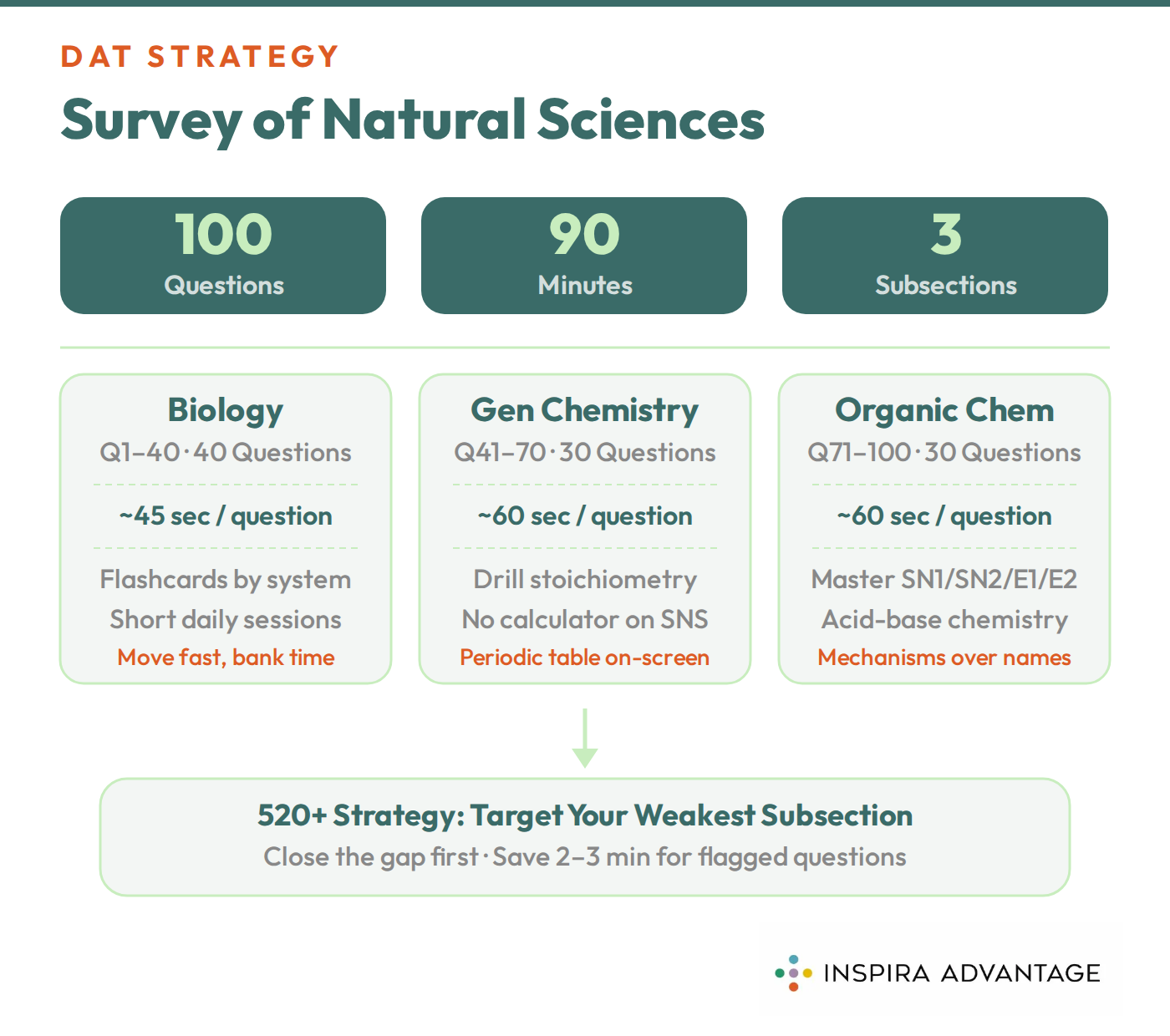
High scorers build flashcard decks organized by system and review them in short daily sessions rather than marathon cram blocks. Biology questions move fast, so you should spend less time per question here and bank extra minutes for the chemistry subsections.
General chemistry and organic chemistry both require problem-solving under pressure. You get an on-screen periodic table for general chemistry, but no calculator anywhere in the SNS.
Top scorers drill reaction mechanisms and stoichiometry problems until the setup becomes automatic. For organic chemistry specifically, focus on mastering SN1/SN2/E1/E2 distinctions and acid-base chemistry. These reaction types appear repeatedly, and confident identification saves you a lot of time on test day.
Aim for roughly 45 seconds per biology question, 60 seconds per gen chem question, and 60 seconds per organic chem question. Stick to that, and you'll have about two to three minutes at the end to revisit flagged questions.
Treat PAT prep like athletic training, not academic studying. The Perceptual Ability section tests spatial reasoning and 3D visualization across 90 questions in 60 minutes, split into six subtypes:
Unlike every other section on the DAT, memorization is essentially useless here. Your score increases through repetition and pattern recognition.
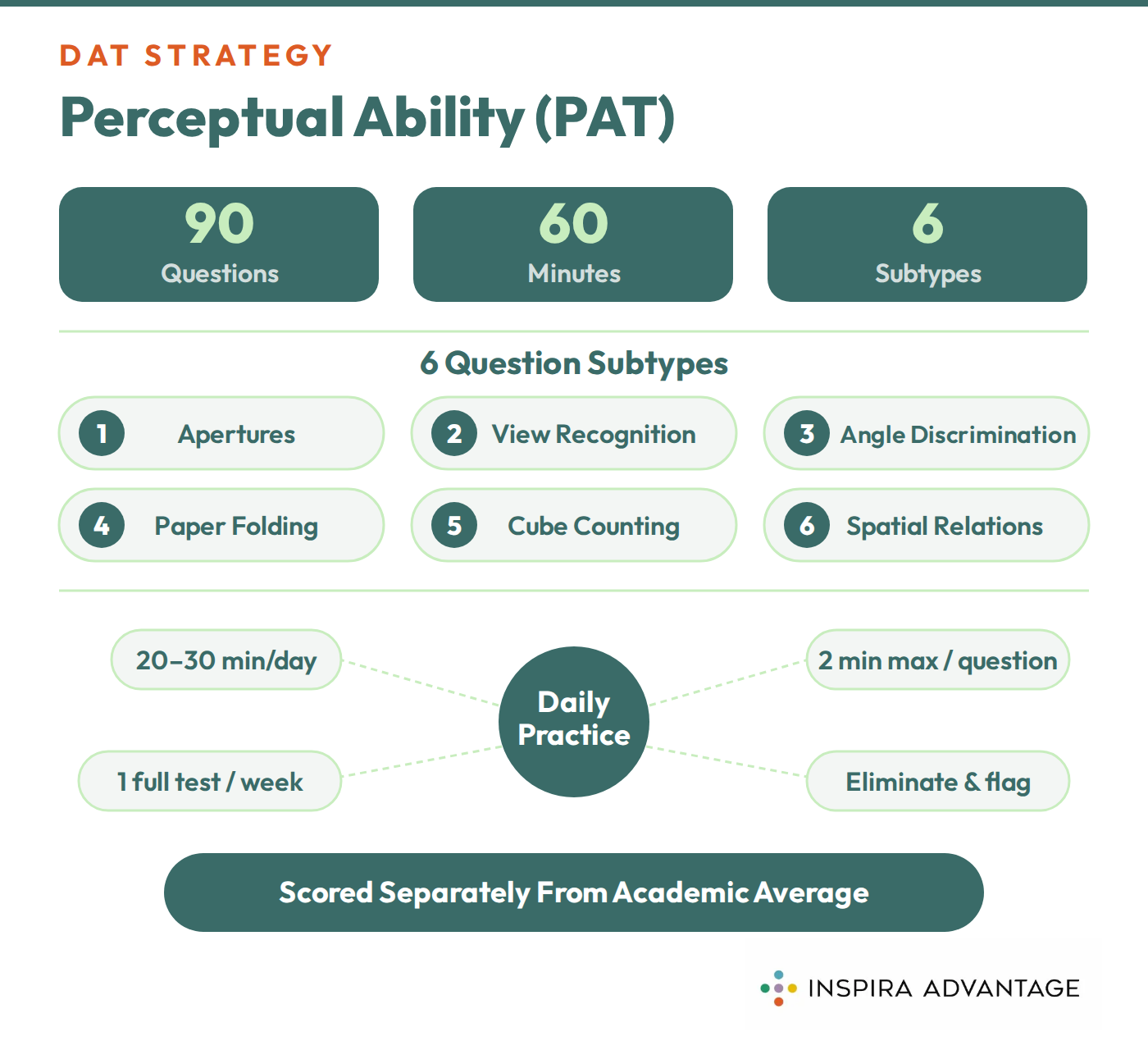
Build a daily practice habit of 20-30 minutes rather than occasional two-hour sessions. Spatial reasoning improves through consistent, short exposures that incrementally train your visual memory. One full-length PAT practice test per week on top of those daily blocks gives you both the skill development and the stamina you need for test day.
Develop a section-order strategy before you sit for the real exam. Not every subtype takes the same amount of time, and most 520+ scorers rearrange their approach based on personal speed.
Never spend more than two minutes on a single question. If you’re struggling, flag it and move on. Elimination is your best friend here. Even when you can't solve a problem outright, ruling out one or two clearly wrong answer choices dramatically improves your odds.
Keep in mind that PAT is reported as a standalone score separate from your Academic Average. A weak PAT won't drop your AA, but dental schools do look at it independently on your application.
Read strategically, not thoroughly. The Reading Comprehension (RC) section gives you three dense scientific passages and 50 questions to answer in 60 minutes. You are not expected to have prior knowledge of the topics, and every answer lives somewhere inside the passage text.
The trap most students fall into is reading each passage carefully from start to finish before working through any questions. Top scorers use a search-and-retrieve approach instead.
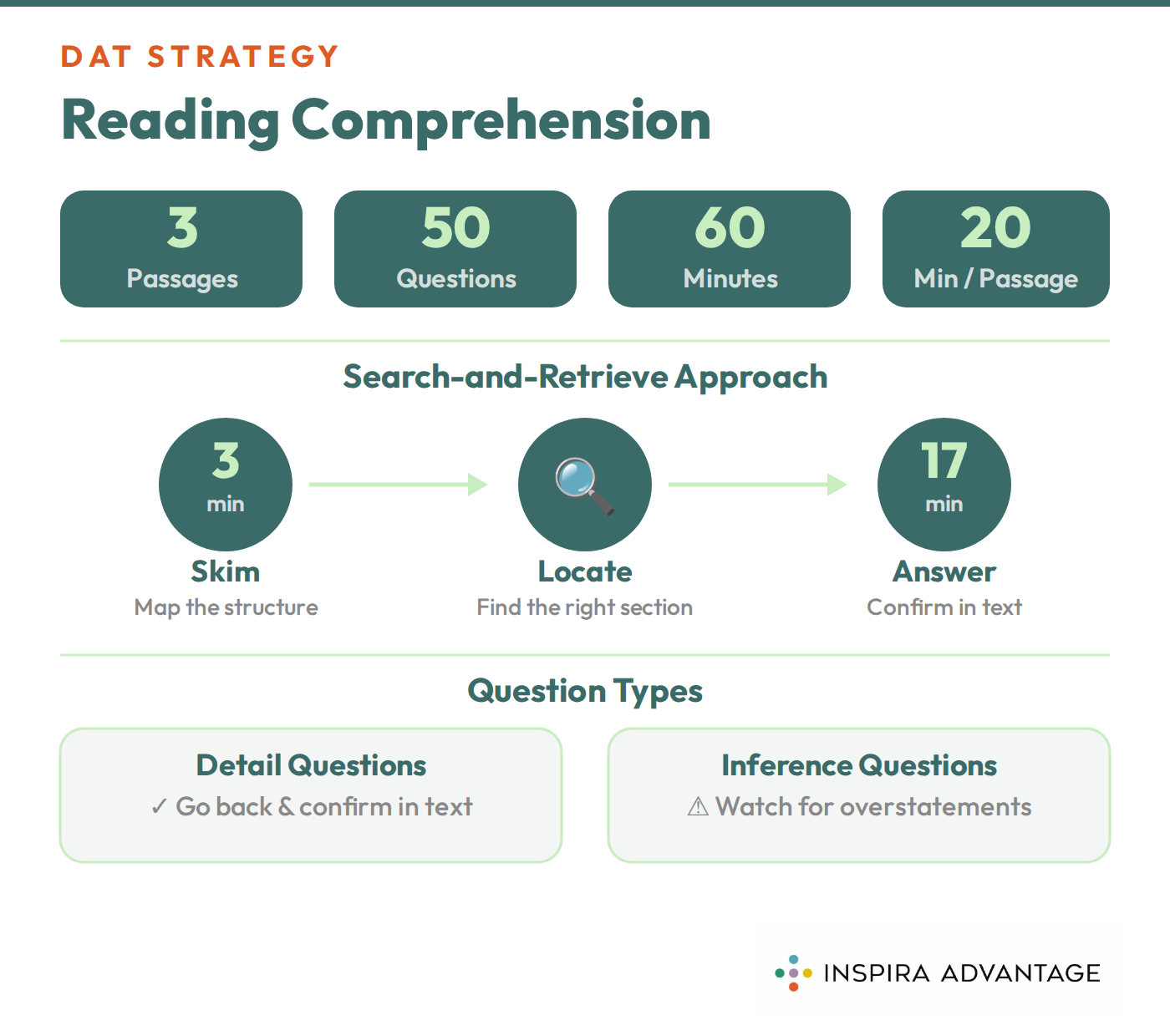
Spend two to three minutes on your first read-through to visualize the passage structure. Find where each major idea lives (paragraph by paragraph) without trying to memorize details. Then move on to the questions and use your mental map to quickly locate the relevant section.
For detail-oriented questions, go back to the text and confirm the answer rather than relying on your memory. For inference questions, pay attention to qualifying language in the answer choices. Wrong answers on inference questions almost always overstate or distort what the passage actually says.
Timing discipline matters more in RC than in any other section. With roughly 20 minutes per passage (including its questions), you can't afford to spend 12 minutes reading and only eight minutes answering. Aim for a three-minute skim followed by 17 minutes on the questions. Practice this ratio on every full-length test until it becomes second nature.
Know what's actually tested and focus your prep there. Quantitative Reasoning (QR) is the final section of the DAT, which includes 40 questions in 45 minutes covering:
You get an on-screen calculator, but top scorers rely on it as little as possible because the interface is slow and clunky. Mental math and estimation get you through most problems faster.
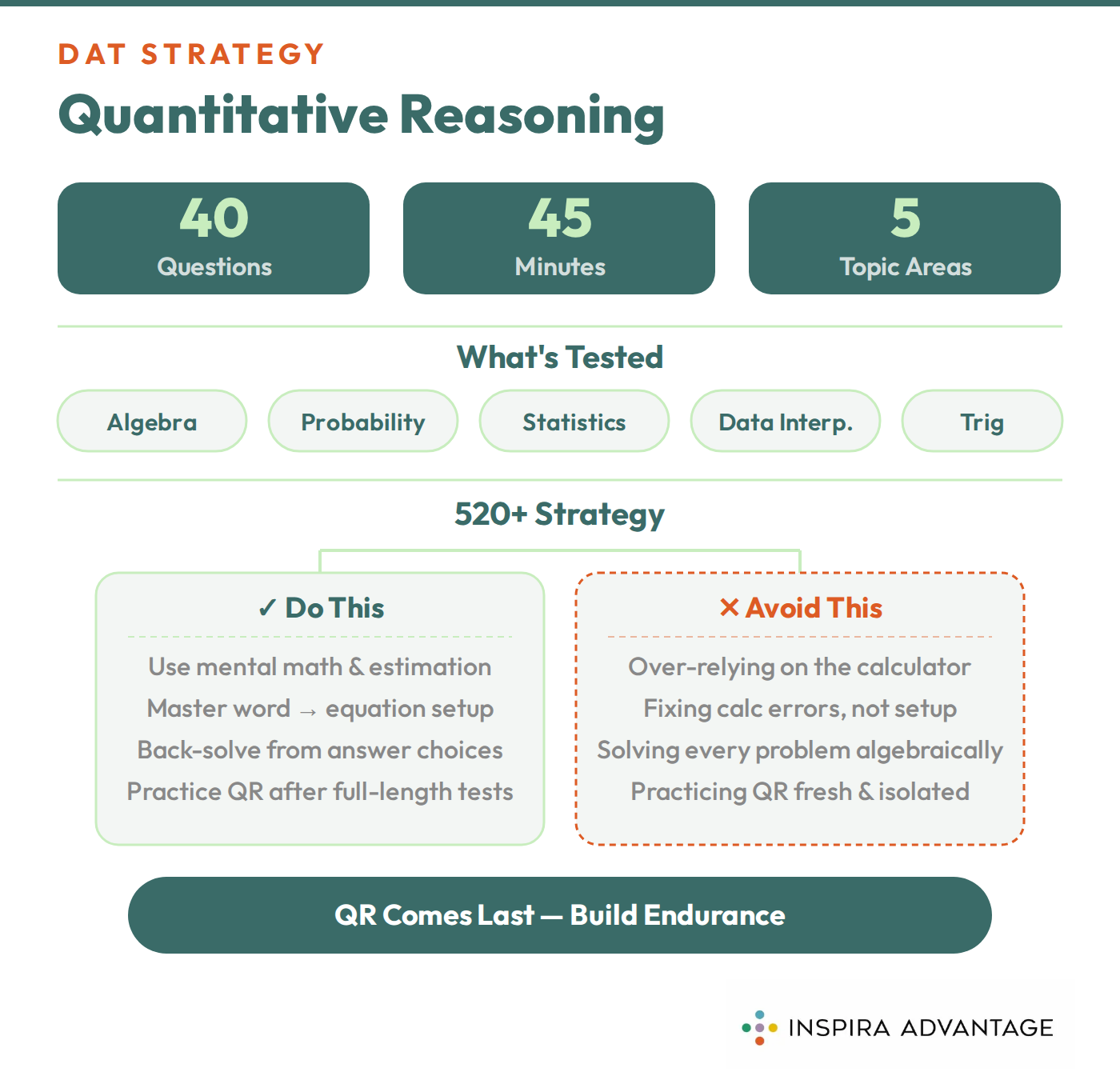
The biggest score increases come from mastering word-problem translation. QR questions frequently test whether you can convert a written scenario into the correct equation.
When you review missed problems, focus on where the setup went wrong rather than where the math failed. A calculation error is a one-time mistake; a setup error is a pattern that will cost you points across the entire section.
When a problem feels overwhelming, plug the answer choices back into the question and see which one works. Many QR problems are designed to be solved more quickly by answer elimination than by formal algebraic methods.
Because QR comes last on the exam, fatigue is a factor you have to account for. Students who take full-length practice tests consistently get burnt out by the final section.
Build your test-day endurance by always practicing QR at the end of a full-length simulation rather than in isolation. Your real QR score will reflect how you perform after three hours of testing, not how you perform fresh on a Saturday morning.
Plan for 10 to 14 weeks of dedicated DAT preparation, with 15 to 25 hours of study per week. This timeline gives you enough room to complete a thorough content review, build your PAT skills through daily practice, take four or more full-length practice exams, and circle back to weak areas without feeling rushed. Most students who score in the 90th percentile or above fall within this range.
However, your ideal DAT timeline depends on how much recent science coursework you've completed and how comfortable you are with the material. A student finishing up organic chemistry and biology in the same semester may only need eight to 10 weeks, while someone who's been out of the classroom for a year or more should plan closer to 14 to 16 weeks to account for content re-learning.
Take a diagnostic practice test before you build your schedule. Your baseline score is the most honest indicator of how much ground you need to cover.
Schedule your DAT after you've completed your core prerequisite coursework in biology, general chemistry, and organic chemistry. Taking the exam while this material is still fresh gives you a significant advantage during content review.
Most pre-dental students take the DAT during the summer between their junior and senior years, which aligns well with application timelines and provides enough lead time to retake the exam if needed.
Dental schools operate on a rolling admissions process, which means earlier applicants have access to more seats. If you're planning to apply through the ADEA Associated American Dental Schools Application Service (AADSAS) in June, aim to have your DAT score finalized by late May or early June, so your application is complete from the moment it's submitted. A strong application that arrives in August with a DAT score already attached is in a better position than one submitted in June with a score pending.
Inspira Advantage can help you improve your DAT score. Our 99th percentile tutors with years of experience provide expert strategies, personalized study plans, and proven tips to ensure you receive an outstanding score for dental school.
One month can be enough time to study for the DAT, but only if you already have a strong foundation in the sciences and can commit to full-time, structured preparation. Most high scorers dedicate 10 to 14 weeks to their prep, which allows time for content review, timed practice, and full-length exams with adequate rest between them. Compressing that timeline into four weeks means sacrificing depth in at least one or two sections, leaving almost no margin for weak areas that surface during practice tests. If you're working with a shortened timeline, prioritize the PAT and Quantitative Reasoning sections first, since these offer the fastest score gains per hour invested.
If you’re challenged with specific subjects on the DAT, isolate the specific topics within the subject that are causing difficulty rather than re-studying the entire subject from scratch. Use your practice test results to identify patterns. If you're consistently missing acid-base chemistry questions, that's a targeted gap, not a sign that you need to redo all of general chemistry. Persistent trouble with a section after two weeks of focused effort is a sign to seek outside support, whether that's a tutor, a study group, or a different resource that explains the material in a way that clicks for you.
The hardest sections of the DAT for most students are the Perceptual Ability Test and the Organic Chemistry section. The PAT tests spatial reasoning skills that most pre-dental students haven't been formally trained in, which can make it feel unfamiliar and unintuitive at the start of prep. Organic chemistry is challenging because the DAT emphasizes reaction logic and mechanism prediction over straightforward memorization, so students who learned organic chemistry by memorizing flashcards often struggle to apply that knowledge under exam conditions.
Take at least four full-length practice tests spaced across your DAT study timeline. Your first practice test should be a diagnostic test before you begin serious content review, to establish your baseline and tell you where to focus. Space the remaining exams roughly every two to three weeks, with at least one in the final week taken under exact test-day conditions. Follow each practice test with a thorough review session where you analyze every missed question, identify the underlying concept, and track whether your errors were content gaps, timing issues, or misreads of the question.
You can self-study for the DAT without a prep course, but it’s difficult. The key is to build a structured study schedule with clear daily and weekly goals, rather than simply reviewing material without a plan. Use a combination of a content review book, a question bank with detailed answer explanations, dedicated PAT practice software, and full-length practice exams to replicate what a course would provide.
If you DAT practice score plateaus, shift your focus from content review to error analysis. Go through your last two to three practice tests and categorize every missed question. Think about whether it was a content gap, a timing error, a misread of the question stem, or a careless mistake. Most plateaus occur because students keep studying the same way rather than addressing the specific failure pattern holding their score back.
Start studying for the DAT 10 to 14 weeks before your test date, assuming you can dedicate 15 to 25 hours per week to preparation. This timeline gives you enough space to complete a full content review, build up your PAT skills through daily practice, take multiple full-length practice exams, and still have time to revisit weak areas that emerge along the way. Students who begin too early often burn out or lose retention on material they reviewed in the first few weeks. Set your test date first; then count backward to find your ideal start date.


.svg)


