Get in touch: +1 888 453 5021


The table below outlines the typical dental school application timeline and key dates to keep in mind:
Start building your application the moment you start university. Dental schools evaluate your entire academic record, not just your senior year GPA. Every prerequisite grade, every clinical hour, and every relationship you build with a professor or dentist counts from day one.
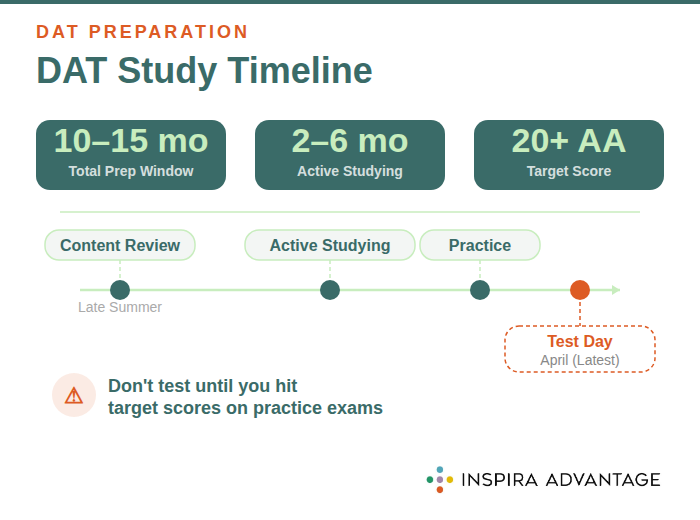
Plan to spend 10 to 15 months, leading up to your application submission date, preparing for and completing the DAT. That puts most applicants in a study window running from late summer through April of the year they plan to apply.
The DAT covers biology, general chemistry, organic chemistry, perceptual ability, reading comprehension, and quantitative reasoning. Most applicants study for two to six months before sitting the exam. Two months is realistic only if your science coursework is recent and strong. Six months is appropriate if you need to review multiple subjects from scratch.
Set your test date first. Working backward from a target score gives you a study schedule with real structure. Aim to finish the DAT by April at the absolute latest. Finishing earlier gives you time to retake it if your score falls below your target range before applications open.
Target scores vary by school. A 20 AA is considered competitive across most programs, but top-tier schools typically admit students with averages above 21 or 22.
Don’t write the DAT before you consistently hit your target score on full-length practice exams. Test day is not the place to find out where your preparation gaps are.
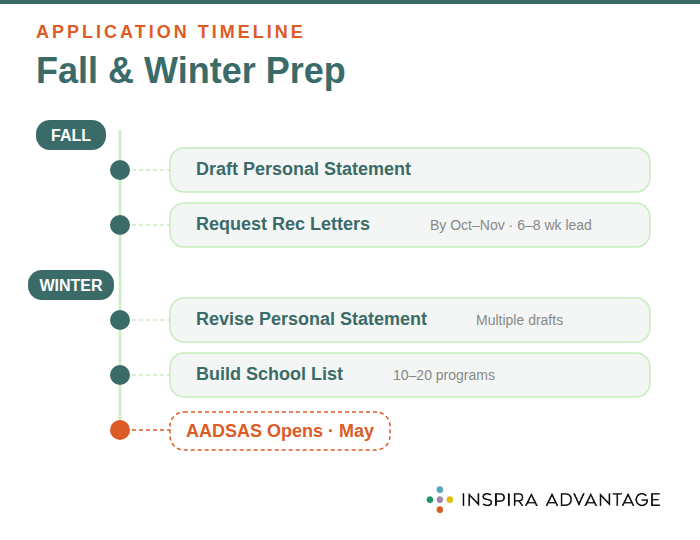
Use the fall and winter before your application year to build every component of your application, so it's ready when AADSAS opens in May. Applicants who wait until the portal opens to start writing scramble to submit and lose ground in rolling admissions.
Start drafting your personal statement in the fall and requesting your recommendation letters by October or November at the latest. Give recommenders at least six to eight weeks and provide them with your personal statement, resume, and a brief note on why you are applying. Make it easy for them to write something specific.
Give yourself enough time to revise your personal statement multiple times. The personal statement is not a resume in paragraph form. It should explain why you’ve chosen dentistry, specifically, using concrete moments from your clinical or academic experience.
"I shadowed a dentist and knew it was right for me" is not a clear moment to use in your personal statement. "Watching Dr. Rodriguez restore a patient's ability to eat without pain after years of avoiding treatment is what made the decision clear" is much better.
When finalizing your school list, research acceptance rates, GPA ranges, DAT averages, and mission fit. Build a balanced list across reach, match, and safety schools. Apply to 10 to 20 programs, depending on your competitiveness.
Submit your AADSAS application as close to the June 1 opening as possible. Dental school admissions operate on a rolling basis, meaning schools begin reviewing and interviewing applicants as soon as verified applications arrive. Every week you delay is a week that interview slots and seats fill without you.
AADSAS typically opens for submission in early May and begins transmitting verified applications to schools around June 1. Verification takes two to six weeks after you submit, depending on volume. Applicants who submit in early May receive verification and school transmission by late May or early June.
Applicants who submit in July receive verification in August, when many programs have already filled a significant portion of their interview pools.
The competitive window is narrow. Most dental schools hold rolling interviews from June through November. To submit in early May, your personal statement, activity descriptions, school list, and transcript requests must be complete before the portal opens.
Use the fall and winter preparation phase to build every component so you are ready to submit on day one, not day 60.
Expect secondary applications to arrive two to four weeks after AADSAS transmits your primary application to each school. Most programs send secondaries to every applicant before reviewing files, so receiving one doesn’t signal that you have been screened in. It signals that you need to respond quickly.
Complete each secondary within one to two weeks of receiving it. Programs track response time. A secondary that sits unanswered for three weeks signals low interest. And some schools screen applicants out on that basis alone.
Prepare before your secondaries arrive. Most programs ask variations of the same questions:
Draft responses to these core prompts during your preparation phase so you aren’t starting from scratch once you get your secondary application.
Many schools also publish their previous cycle prompts online. So review them before the application opens to build your response bank early.
Customize every "Why us" response. Generic answers are easy to spot. Reference specific programs, faculty research, clinical training structures, or community outreach initiatives that align with your goals. Admissions readers review hundreds of applications. A response that names a specific simulation lab or underserved community clinic partnership stands out because it proves you did the work.
Budget time and money for secondaries. Application fees range from $50 to $150 per school, and completing 15 to 20 secondaries well requires focused effort over several weeks.
Practice telling your stories clearly and thinking out loud under pressure before any dental school interview. Most programs use one of three formats: traditional one-on-one interviews, Multiple Mini Interviews (MMIs), or panel interviews. Each one tests you differently, and your preparation strategy should reflect that.
Do at least three to five full mock interviews before your first real one. Practice with someone who will give direct feedback, not just encouragement. Record yourself if possible. Most applicants are surprised by how often they use filler words or give answers that are technically correct but lack specific examples.
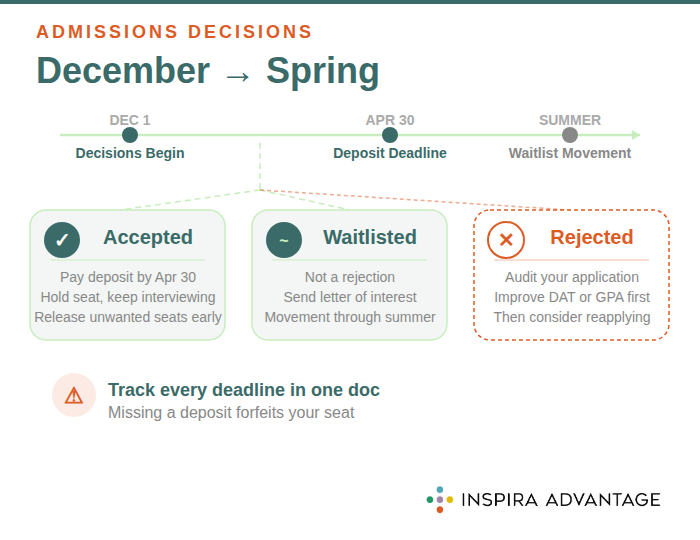
Admissions decisions begin rolling out on Dec. 1 for most ADEA AADSAS-participating schools. Programs continue releasing acceptances, waitlist notifications, and rejections through the spring. Do not interpret silence before December as a negative signal. Many programs hold decisions until they have completed their full interview cycle.
Acceptance typically comes with a seat deposit deadline of April 30. If you receive an early acceptance but are still waiting on preferred schools, hold the seat while continuing to interview. Release seats you do not plan to accept as early as possible so that waitlisted applicants have time to respond.
Keep in mind that being waitlisted is not a rejection. Movement happens consistently through April and into the summer as accepted applicants choose between programs. Send a letter of continued interest to programs where you remain waitlisted. Keep it concise: Reaffirm your interest, note any meaningful updates to your application, and confirm you will attend if accepted.
Rejection requires an honest audit before you decide to reapply. A low DAT score or GPA below a program's published range requires a concrete improvement plan, not just another application cycle.
Track every deadline, deposit, and decision date in a single document. Missing a seat deposit deadline forfeits your acceptance.
Here is the ideal timeline to follow to ensure you submit a strong application that maximizes your chances of getting into dental school:
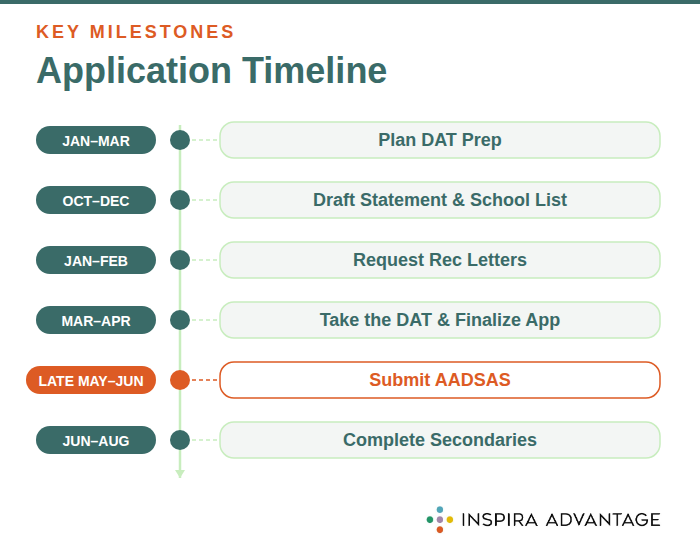
Applicants who reverse-engineer their timeline from the submission date, develop their core narrative months in advance, and lock in recommenders early consistently submit stronger, more polished applications on day one. The following tips break down exactly when to tackle each major milestone to submit a successful application.
Start with the end date and work backward. The application portal historically opens around June 1st, and submitting on day one creates a measurable advantage because dental schools review applications on a rolling basis. Every week you delay, your file moves further down the queue.
In our dental school application webinar, Herchel Patel, an advisor at Inspira Advantage and dental student at the University of Michigan School of Dentistry, stresses that early planning is the single biggest leverage point in your timeline. Pin June 1 as your hard submission deadline.
Work backward and set soft deadlines that you track:
Patel suggests using a simple Google Sheet for your experience inventory. Create columns for the experience name, category, total hours, your role, and a notes column for standout moments you want to reference later. Color-code each row green, yellow, or red based on how draft-ready the entry is so you can see your progress at a glance as you move into the writing phases.
Build your "why dentistry" narrative early into your timeline, because the answer you develop here will shape your personal statement, secondary essays, and interview responses.
Generic answers will not differentiate you. In our interview webinar, Patel warned that interviewers hear the same responses constantly:
"The people interviewing you have heard the classic response that 'I had braces when I was young' or 'my parents do dentistry' or 'I want to help people'” he says. “They're looking for something deeper that you see in dentistry."
To avoid having a cliche answer, identify two or three specific qualities of dentistry that resonate with you personally. Patel recommends considering the creative problem-solving aspect, the process of diagnosing and building individualized treatment plans, or the professional lifestyle the career offers.
The key is specificity. Sit with the question, 'What draws me to dentistry beyond helping people?' starting in February or March. Draft two or three distinct angles, test each one with a mentor or friend, and refine the strongest version before your personal statement draft begins in April. By interview season, your answer will sound practiced without sounding rehearsed.
Lock in your letter writers no later than the March of your junior year. Approaching recommenders early protects the quality of your letters and keeps your entire timeline from slipping.
Helina Tessema, a fourth-year dental student at Tufts University School of Dental Medicine who interviews prospective students, identifies January to March as the ideal window. As she shares in our webinar on the application process:
“You never want to put the people that you're asking for a letter of recommendation in a situation where they have to rush one off," she says.
In January, make a shortlist of three to five potential writers. Prioritize professors and supervisors who know your work ethic firsthand, not just your name.
In February, schedule brief in-person meetings to ask. Provide each writer with a one-page summary of your experiences, goals, and the recommendation deadline. By March, confirm every writer has committed and mark their deadlines on your master calendar. Following up politely in April keeps letters on track without creating last-minute pressure for anyone involved.
Working with a dedicated dental school application consultant gives you a strategic partner who knows what admissions committees prioritize, helps you build a cohesive narrative, and keeps your timeline on track from brainstorming through interview prep. The earlier you start, the more runway you have to strengthen weak areas before they become liabilities on your application.
You’ll know when to apply for dental school when you have completed or nearly completed all prerequisite coursework, taken the DAT, secured strong letters of recommendation, and accumulated meaningful clinical and shadowing hours.
Most applicants apply during the summer between junior and senior year of college, submitting their AADSAS application as close to the June 1 portal opening as possible. If any of these core components are missing or weak, delaying one cycle to strengthen your profile almost always produces a better outcome than rushing an incomplete application.
Rolling admissions means dental schools review and accept applicants continuously as completed applications arrive, rather than waiting until a single deadline to evaluate everyone at once. Early applicants compete for the most available seats. As the cycle progresses, fewer spots remain, and the process becomes increasingly competitive.
You can submit your AADSAS application as early as June 1, which is historically when the portal opens each cycle.
Most applicants receive their first interview invitations between August and December after submitting in June. Some schools send decisions within a few weeks of the interview, while others wait until January through March to release final acceptances.
Applying early in the cycle typically shortens your wait time because schools begin reviewing files as soon as verification is complete. Expect the entire process from submission to final decision to take anywhere from three to nine months.
AADSAS verification typically takes four to six weeks during peak submission periods in June and July. Verification involves AADSAS confirming your transcripts, coursework, and GPA calculations before forwarding your application to dental schools.
Applicants who submit later in the summer frequently experience longer delays, which pushes their verified application further down the rolling admissions queue.
Dr. Jonathan Preminger was the original author of this article. Snippets of his work may remain.
Orthopaedic Surgery Resident Physician
Lewis Katz School of Medicine at Temple University


Get 15+ free dental school personal statements written by our succcessful applicants free of charge. No strings attached.

.svg)

