Get in touch: +1 888 453 5021




Here is a step-by-step guide on how to prepare and submit your medical school requirements, the best timeline to follow, and strategies to craft the best application.
The first step in getting into medical school is clearly defining why you want to pursue medicine. This reason drives every part of your application, including your personal statement, activities list, secondary essays, and interviews.
Medical schools expect a specific, experience-based motivation, not a generic desire to “help people.” Vague answers weaken your application and signal limited self-reflection.
At this stage, focus on three questions:
Your goal is to reach a clear, experience-backed reason for pursuing medicine that you can build on in later steps. This clarity will guide how you approach every part of the medical school application process that follows.
MD programs follow a traditional allopathic model focused on diagnosing and treating disease, while DO programs emphasize a holistic, patient-centered approach and include additional training in osteopathic manipulative treatment (OMT).
You apply to medical school through a centralized application service based on the type and location of the schools you are applying to:
While each system differs slightly, all three ask you to submit the following application materials:
Accuracy and consistency matter. Admissions committees use these applications as their primary screening tool, so errors or omissions can delay verification or weaken your application.
After schools review your primary application, many will invite you to complete secondary applications a few weeks after you submit your primary application. These are school-specific essays and questions used to assess fit, motivation, and alignment with each program.
You can major in any subject for medical school, as they do not require a “pre-med” or science major. What matters is that you complete the required prerequisite courses with a high GPA. There is no way to bypass these prerequisites, regardless of your major.
Choose a major you genuinely enjoy. Students tend to perform better and earn higher grades in subjects they find engaging. Medical schools also value applicants with diverse academic backgrounds, not just biology majors.
In general, medical schools require the following prerequisite coursework:
Prerequisite requirements vary by school. Always confirm course and lab requirements for each medical school you plan to apply to and plan your coursework accordingly.
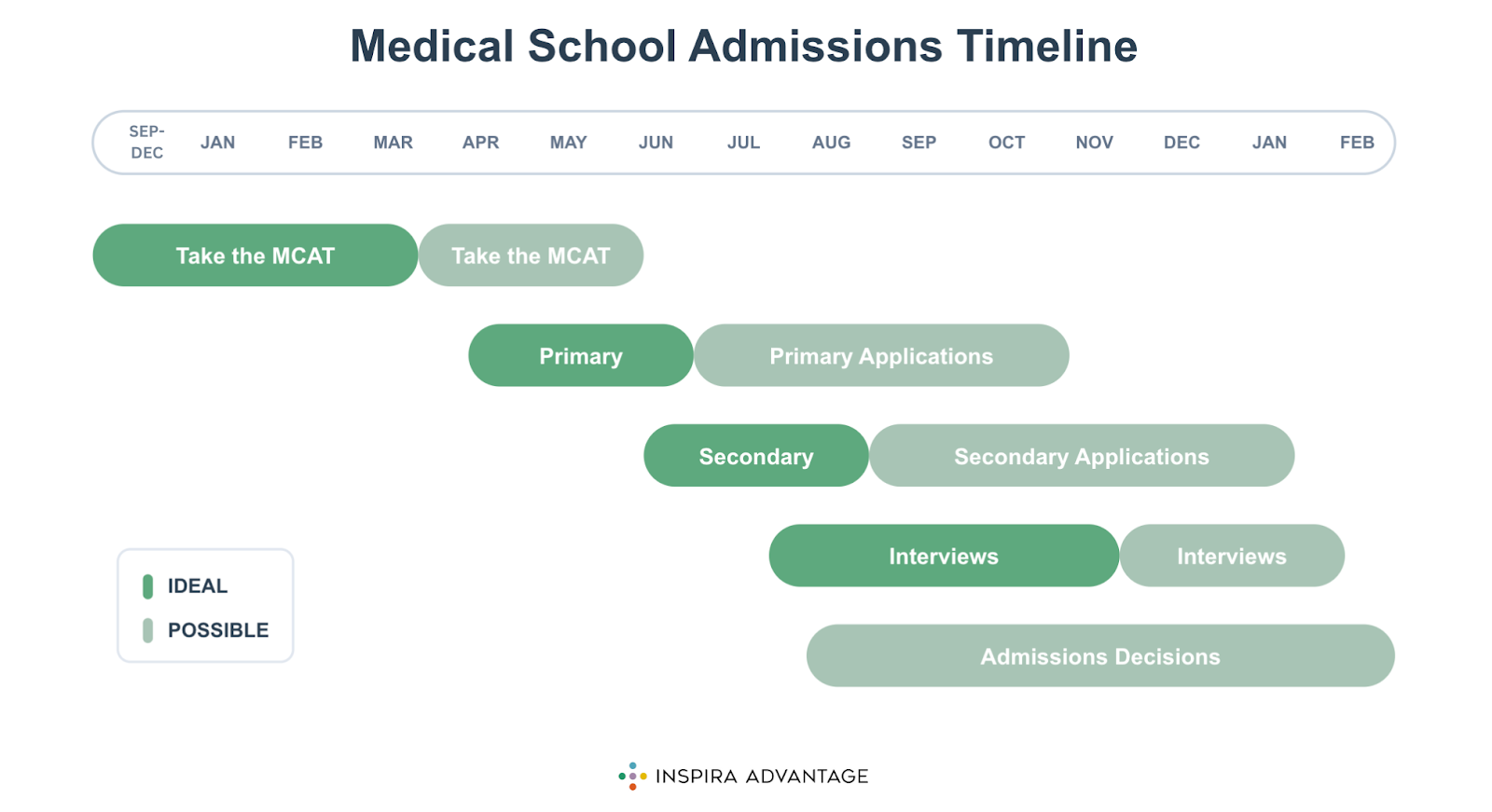
Getting into medical school requires strict attention to the application timeline. You must meet all deadlines, and applying early improves your chances of receiving interviews and acceptances.
Below is a typical AMCAS timeline for MD applicants:
To be competitive for medical school, you need meaningful clinical, community service, research, extracurricular, and professional experiences. While most schools do not list strict experience requirements, successful applicants consistently show depth, continuity, and intentional involvement, not last-minute hour collection.
Admissions committees evaluate quality and duration, not just totals.
As Chiamaka Okorie, a former admissions committee member at Dartmouth’s Geisel School of Medicine and current counselor at Inspira Advantage, explains in our Med School Application Q&A:
“When I look at an application, the system shows me exactly when you started and stopped an activity … if I see something you did for one month right before applying, it begs the question — did you really care about this?”
Admissions committees can see the full timeline of your involvement. Short, last-minute activities often signal resume padding, while long-term commitments demonstrate genuine interest, reliability, and readiness for medical training.
Below are the core experience categories medical schools expect to see on competitive applications.
Clinical experience shows that you understand patient care and the realities of healthcare. Focus on hands-on roles and stay involved over time.
Examples include:
Long-term involvement matters more than reaching a specific hour count.
Shadowing allows you to observe physicians in real clinical settings and understand daily medical practice.
Examples include:
Consistent exposure carries more weight than brief or last-minute shadowing.
Research experience strengthens your application by demonstrating analytical thinking and intellectual curiosity. While not required at most schools, it can be a strong differentiator.
Examples include:
Sustained participation matters more than project count.
Volunteering demonstrates service orientation, reliability, and a genuine commitment to others, especially underserved communities. While medical schools rarely list volunteering as a formal requirement, most successful applicants have substantial service experience, making it an important component of a competitive application.
This pattern is reflected in admissions data shared by the AAMC. The 2025 entering class completed more than 16.8 million community service hours prior to matriculation, averaging 717 hours per student. In other words, sustained service is common among accepted students.
Examples of volunteer service you can participate in include:
Choose causes you care about, and commit long-term. For example, volunteering at the same community clinic every week for a year and taking on increasing responsibilities will have far more impact than only volunteering at a clinic for a month with little responsibility.
In addition to these core areas, relevant extracurriculars and hobbies can strengthen your application if they show leadership, consistency, and personal growth.
Extracurricular activities show leadership, teamwork, and personal interests outside academics and medicine. These experiences add dimension to your application when pursued consistently.
Examples include:
Medical schools value extracurriculars that reflect commitment, growth, and genuine interest—not resume padding.
You have to take the Medical College Admission Test (MCAT) to apply to medical school.
The MCAT is a passage-based, multiple-choice exam with four sections:
The exam includes 230 questions and takes 7 hours and 30 minutes total, including breaks.
MCAT scores are highly competitive.
Admissions committees treat the MCAT as a top selection factor, and matriculant scores continue to rise each year. According to the AAMC, the mean MCAT score for all of the 2025 applicants was 506.3. For matriculants, the mean score was 512.1. That’s up from 511.8 in 2024.
This trend shows that medical schools are admitting applicants with increasingly strong MCAT performance. As a result, earning a high MCAT score is essential for remaining competitive. Aim to exceed the median MCAT score of the schools you plan to apply to.
Most students spend 300-350 hours preparing for the MCAT, usually over three to five months. Many students study around 20 hours per week, depending on their academic background and target score.
Plan your test date carefully. The MCAT is offered January through September, and taking it earlier in the year helps you apply on time.
Your medical school list plays a major role in whether you receive interviews and acceptances. A strong list is balanced, realistic, and data-driven.
When building your list, focus on four essentials:
A strategic school list maximizes your interview chances.
Write strong secondary essays by answering each prompt directly, using specific examples, and reinforcing the same core narrative across your entire application. After you submit your AMCAS primary application, medical schools will send you secondary applications, which include short-answer and essay prompts that you must complete to remain under consideration.
Admissions committees use secondary essays to evaluate your communication skills, maturity, and fit with the school’s mission. Strong secondaries also show whether your motivation for medicine is clear and consistent across your application.
Start by identifying what each prompt is testing. Most schools ask about your “why medicine,” commitment to service, experience with diversity, resilience, or why you are a good match for their program.
Write each response using a clear structure: answer the prompt in the first sentence, describe a specific experience that proves your point, and explain how that experience prepared you for medical training.
Avoid generic statements that could apply to any applicant. Instead of writing “I want to help people,” explain what you observed, what you did, and what you learned. For “Why this school?” essays, reference specific programs, curriculum features, research opportunities, or patient populations that align with your goals.
Edit every essay for clarity and flow. Remove repetition, tighten wording, and ensure every sentence adds value to the essay.
Medical schools invite applicants to interview after reviewing their primary and secondary applications. An interview invitation means you are academically qualified.
To perform well, focus on the following:
Strong interview performance shows that you are prepared, thoughtful, and ready for medical training.
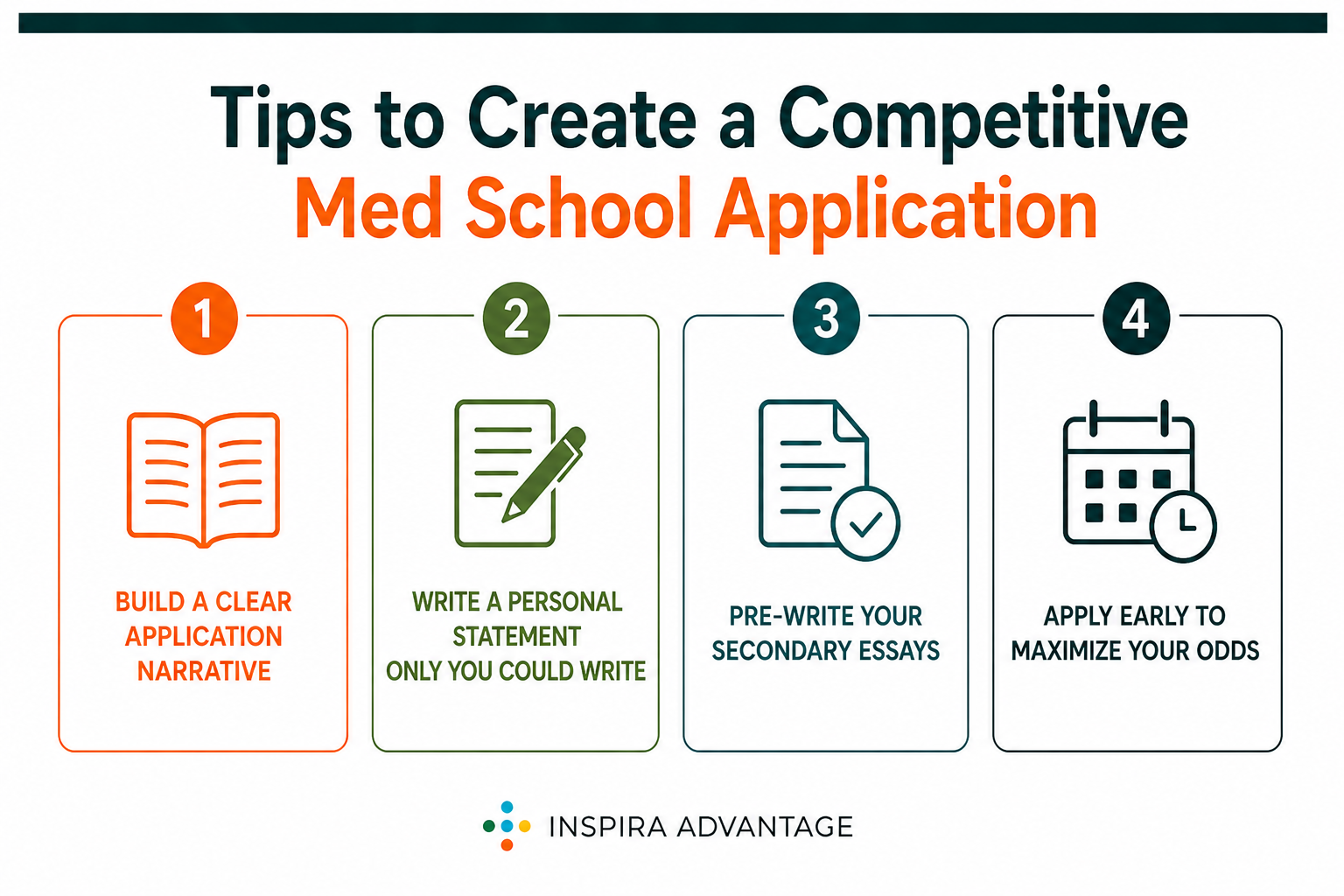
Here are four tips to maximize your chances of getting into medical school:
Admissions committees do not evaluate experiences in isolation. They look for a cohesive story that explains why medicine fits you.
In our Crafting the Perfect Med School Application webinar, Dr. Katherine Munoz, a plastic and reconstructive surgery resident at the University of Wisconsin and counselor at Inspira Advantage, emphasizes that admissions committees evaluate coherence, not just credentials:
“Standing out is more than checkboxes,” she says. “It’s about creating a longitudinal narrative that shows your interests and growth over time.”
A strong application connects your personal statement, activities, and secondaries around shared themes such as service, research, leadership, or advocacy. Your experiences don’t need to be identical, but they should reinforce a consistent story.
A clear narrative makes it easier for reviewers to remember you and advocate for you during admissions committee discussions.
In the Crafting the Perfect Med School Application webinar, Dr. Munoz discusses how reviewers distinguish strong personal statements from forgettable ones:
“If a sentence could apply to any applicant, it probably needs to be rewritten,” she says.
Many personal statements fail not because they are poorly written, but because they are interchangeable.
Statements like “I learned the importance of compassion” or “This experience confirmed my desire to become a physician” are technically correct but reveal nothing unique about the applicant.
Strong personal statements anchor reflection in specific moments, specific actions, and specific insights. Instead of listing what you did, explain what changed because you did it.
Describe the patient interaction, conversation, mistake, or realization that altered how you think about medicine. Then connect that moment to how it shaped your goals or values.
If a paragraph could be copied into another applicant’s essay without sounding out of place, it is likely too vague. Admissions readers look for evidence that your motivation for medicine developed through lived experience, not generalized exposure.
Holtzer also shares insight from both the applicant and advisory side on one of the most overlooked advantages in the application cycle: pre-writing secondaries.
“That month between submitting your primary and getting verified is a golden month,” he says. “You can pre-write your secondaries and submit them right away when July hits.”
Most secondary prompts repeat from year to year, so applicants can pre-write and write them well by drafting early, revising multiple times, and getting feedback before submission.
Applicants who pre-write can submit within days instead of weeks, which keeps their application moving early in the review queue.
Fast turnaround signals preparation, motivation, and serious interest in the school. In a rolling admissions system, those signals matter.
Applying to med school early significantly improves your chances at schools with rolling admissions. Committees review applications as they arrive, and seats become more limited over time.
In our Medical School Application Q&A webinar, Nate Holtzer, an MD-PhD student at USC’s Neuroscience Graduate Program and current Inspira Advantage consultant, explains why timing matters just as much as strength:
“If you get your secondary in at the end of July versus mid-July, that difference can be months in when you hear back,” he says. “It really pays to be proactive and early.”
Because many medical schools use rolling admissions, early applicants are reviewed when more interview slots and seats are still available. Applying later forces admissions committees to compare strong applicants against a shrinking number of open spots.
Applying early does not mean rushing. It means preparing months in advance so your application is complete, polished, and verified as soon as submission opens.
For more help making these critical decisions and to submit applications vetted by experienced med school admissions mentors, consider speaking to one of our experts today.
Yes, it’s OK to take a gap year before applying to medical school. Taking one or more gap years is common and often strengthens applications. Medical schools value applicants who use gap years intentionally.
Productive gap years include clinical work, research, service, teaching, or full-time employment that demonstrates maturity and commitment to medicine. Many matriculants now apply after at least one gap year.
Yes, you can apply to medical school as a non-traditional applicant. Non-traditional applicants include career changers, older students, and those who did not major in science.
Schools use holistic review and value diverse life experiences, transferable skills, and clear motivation for medicine. Your background can be an advantage if you clearly connect it to your decision to pursue medicine.
If you aren’t happy with your GPA or MCAT, you can improve your competitiveness by retaking prerequisite courses, completing post-baccalaureate or Special Master’s Programs (SMPs), or retaking the MCAT with a meaningful score increase. Upward academic trends matter more than isolated setbacks.
You only need to take the Casper test if your specific schools require it. Around 30 MD and DO programs in the U.S. require or recommend the Casper as part of their admissions process. Requirements vary by school and can change each cycle.
Before registering, check each school’s admissions website to confirm whether the Casper is required, optional, or not used at all. You should only take the test if at least one of your target schools lists it as a requirement.
Whether it’s better to attend an in-state or out-of-state medical school depends on cost, admissions preference, and fit. Public schools often favor in-state applicants and offer lower tuition. Some private schools charge the same tuition regardless of residency. Financial aid policies, mission fit, and residency placement outcomes should weigh more than location alone.
If you’re reapplying to medical school, make meaningful improvements before reapplying. Schools expect clear changes between cycles. Improve your academics, strengthen your clinical or service experience, rewrite your essays, and refine your school list. Reusing the same application without growth significantly weakens your chances. Interview performance is also a common reapplicant gap.
The top medical schools in the United States are:
Getting into medical school involves completing prerequisites, earning a bachelor’s degree, gaining clinical and service experience, earning a competitive MCAT score, submitting strong primary and secondary applications, and performing well in interviews.
Most medical schools screen applicants with a minimum GPA of around 3.00, but competitive GPAs are much higher. In the 2025-2026 admissions cycle, the mean GPA for applicants was 3.67, while the mean GPA for matriculants was 3.81, as reported by the AAMC.
This gap shows that accepted students typically exceed minimum requirements by a wide margin. Strong science performance, upward academic trends, and post-baccalaureate coursework can help offset weaker GPAs, but applicants should aim to be above a school’s median GPA to remain competitive.
It is significantly more difficult for international applicants than for domestic applicants to get into medical school. Many U.S. medical schools accept few or no international students. Additional challenges include financing requirements and restrictions on eligible degrees. Successful international applicants usually have strong academics, U.S. coursework, and extensive clinical exposure.
You should apply to medical school as early in the cycle as possible. For AMCAS, submitting in late May or early June remains optimal due to rolling admissions. Applying late can reduce interview opportunities even for strong applicants. If your profile needs improvement, waiting a cycle is often the better strategy.
Orthopaedic Surgery Resident Physician
Lewis Katz School of Medicine at Temple University


Get 25+ free medical school personal statements written by our succcessful applicants free of charge. No strings attached.



.svg)

