In this guide, we’ll explore how to get into Emory University School of Medicine (EUSOM), its acceptance rate, GPA and MCAT benchmarks, application requirements, and what the EUSOM admissions committee values most.
If you’re just here for the requirements, click here.
Privacy guaranteed. No spam, ever.
Emory University School of Medicine Acceptance Rate: 1.07%
Emory University School of Medicine has an acceptance rate of 1.07%.
The Association of American Medical Colleges’ (AAMC) Medical School Admission Requirements (MSAR) database report states that Emory Medical School received 12,671 verified applications in the 2025-2026 admissions cycle and 136 students matriculated.
Here is a closer look at Emory University School of Medicine’s admissions cycles over the past four years, as reported in the AAMC’s archived data.
Year
Acceptance Rate
Number of Applicants
Number of Matriculants
2025-2026
1.07%
12,671
136
2024-2025
1.16%
12,880
150
2023-2024
1.08%
12,882
139
2022-2023
1.18%
12,390
146
0.00%
Acceptance Rate for Emory University School of Medicine (2025–2026)
0
Applications Received
0
Matriculated Students
0:1
Applicant-to-Seat Ratio
Out of 100 applicants, roughly 1 is accepted:
Matriculated
Not Admitted
Acceptance rate by cycle
Emory consistently receives 12,000–13,000 applications each year for roughly 136–150 seats. Over the past four admissions cycles, the acceptance rate has ranged from 1.07% to 1.18%, making it one of the most selective medical schools in the country. These numbers reflect holistic admissions — MCAT scores and GPA are important, but the committee also weighs research, clinical experience, personal statement, and mission alignment.
EUSOM’s average acceptance rate from 2022-2023 through 2025-2026 is 1.12%, which means that only about 1 out of every 90 applicants ultimately matriculated.
Emory School of Medicine’s class size stayed relatively consistent during this period, ranging from 136 to 150 matriculants. The largest class appeared in the 2024-2025 cycle (150 students), which also corresponded with EUSOM’s highest acceptance rate in the dataset at 1.16%.
Even in EUSOM’s most favorable year, barely more than 1 applicant per 100 matriculated, reinforcing how competitive the program remains.
At the same time, EUSOM’s applicant volume stayed consistently high, hovering around 12,390 to 12,882 applicants each year.
How Hard Is It to Get Into Emory University School of Medicine?
It is extremely difficult to get into Emory University School of Medicine because the school accepts a very small percentage of a large, highly qualified applicant pool.
In the most recent admissions cycle (2025-2026), Emory School of Medicine received 12,671 applications for only 136 matriculant seats, meaning the school could fill its entire incoming class more than 93 times over with the number of students who applied.
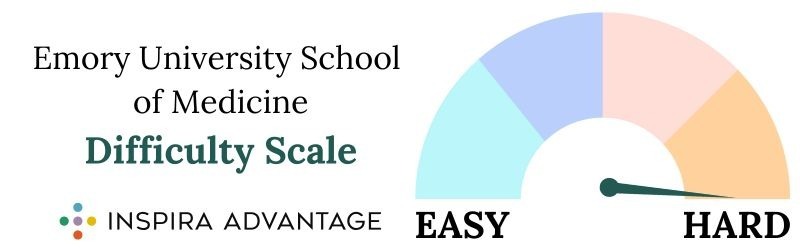
We created the EUSOM’s Admissions Difficulty Scale by comparing acceptance rates and overall selectivity across all accredited U.S. medical schools.
You can significantly improve your chances of acceptance to EUSOM by working with Inspira Advantage’s admissions experts, who help you refine your strategy, avoid common mistakes, and present a more compelling application.
What Is Emory University School of Medicine’s Acceptance Rate for In-State Applicants?
Emory University School of Medicine's acceptance rate for in-state applicants is 3.42%. Out of 935 Georgia residents who applied, 32 matriculated, representing about 23.5% of EUSOM's 136-person entering class. In-state applicants made up just 7.38% of the total verified application pool but earned a disproportionately higher share of seats relative to their numbers.
What Is Emory University School of Medicine’s Acceptance Rate for Out-of-State Applicants?
Emory University School of Medicine's acceptance rate for out-of-state applicants is 0.89%. Out of 11,029 out-of-state applicants, 98 matriculated, accounting for 72.1% of EUSOM's entering class. Out-of-state applicants dominate the applicant pool at 87.05% of verified applications but convert to a seat at a significantly lower rate than in-state candidates.
What Is Emory University School of Medicine’s Acceptance Rate for International Students?
Emory University School of Medicine's acceptance rate for international applicants is 0.85%. Out of 707 international applicants, six matriculated, making up 4.4% of EUSOM's entering class. International applicants represented 5.58% of the verified application pool and converted at a rate comparable to out-of-state domestic applicants.
How Many People Apply to Emory University School of Medicine Every Year?
Approximately 12,400 to 12,900 students submit verified applications to Emory University School of Medicine each year. Application volume held remarkably consistent across the past four cycles, ranging from 12,390 to 12,882, while class size remained stable at roughly 136 to 150 matriculants. That combination of high volume and a fixed number of seats is what keeps EUSOM's acceptance rate anchored below 1.2% year over year.
Privacy guaranteed. No spam, ever.
Admissions Statistics
Emory University School of Medicine Median MCAT Score: 517
The median MCAT score among accepted applicants at Emory University School of Medicine is 517. The median MCAT score among matriculants is 515. EUSOM does not publish a minimum MCAT score for admission consideration.
Here is the full percentile distribution for accepted applicants and matriculants:
Percentile
MCAT Score for Accepted Applicants
MCAT Score for Matriculants
10th Percentile
511
509
25th Percentile
514
512
Median
517
515
75th Percentile
519
517
90th Percentile
523
521
517
Median MCAT Score of Accepted Applicants
Emory University School of Medicine
511
10th Percentile
514
25th Percentile
517
Median Score
519
75th Percentile
523
90th Percentile
Enter your MCAT score
517
472490500510520528
Emory University School of Medicine does not publish a minimum MCAT requirement. The MCAT is one factor in a holistic review that also considers GPA, research, clinical experience, service, leadership, and personal qualities.
Here is how accepted applicants scored across each MCAT section:
MCAT Section
Median Score
Chemical and Physical Foundations of Biological Systems
129
Critical Analysis and Reasoning Skills
128
Biological and Biochemical Foundations of Living Systems
129
Psychological, Social, and Biological Foundations of Behavior
130
A 517 MCAT score sits at the 94th percentile nationally. Even the 10th percentile of EUSOM accepted applicants, a 511, outperforms roughly 82% of all test takers.
The AAMC reports a national average MCAT score of 506.3 for applicants. EUSOM's accepted applicant mean of 516.4 sits more than 10 points above that benchmark, placing it among the most academically selective medical schools in the country.
What MCAT Score Makes You Competitive at Emory University School of Medicine?
A 519 MCAT score makes you competitive at Emory University School of Medicine, placing you in the top 25% of accepted applicants.
Here is how each score tier maps to your standing among EUSOM admits:
⚈ A 517 MCAT puts you at the median of accepted applicants, meaning you just meet the academic threshold.
⚈ A 519 MCAT places you above three-quarters of accepted applicants. At this level, the admissions committee shifts from evaluating whether you meet the bar to assessing what you bring to the class and how you align with EUSOM's mission.
⚈ A 523+ MCAT puts you at the 90th percentile of accepted applicants. A 523 signals rare academic strength and removes MCAT as a variable in your application entirely.
Emory University School of Medicine Median GPA: 3.89
The median total GPA among accepted applicants at Emory University School of Medicine is 3.89. The median total GPA among matriculants is 3.85. EUSOM does not publish a minimum GPA requirement.
Here is the full percentile breakdown for accepted applicants and matriculants:
Percentile
Total GPA of Accepted Applicants
Total GPA of Matriculants
10th Percentile
3.61
3.61
25th Percentile
3.78
3.73
Median
3.89
3.85
75th Percentile
3.96
3.94
90th Percentile
3.99
3.98
3.89
Median Total GPA of Accepted Applicants
Emory University School of Medicine
3.61
10th Percentile
3.78
25th Percentile
3.89
Median GPA
3.96
75th Percentile
3.99
90th Percentile
Enter your total GPA
3.89
Emory University School of Medicine does not publish a minimum GPA requirement. GPA is considered alongside MCAT scores, research, clinical experience, and overall fit.
The AAMC reports a national average GPA of 3.67 for all medical school applicants. EUSOM's accepted applicant mean of 3.84 sits 0.17 points above that figure.
The spread from 3.61 at the 10th percentile to 3.99 at the 90th tells you EUSOM does admit some candidates below the mid-3.7 range when the rest of the application is exceptional, but the middle 50% of accepted applicants clusters tightly between 3.78 and 3.96.
What GPA Makes You Competitive at Emory University School of Medicine?
A 3.96 GPA makes you competitive at Emory University School of Medicine, placing you in the top 25% of recently accepted applicants.
Here is how each GPA tier maps to your standing among EUSOM admits:
⚈ A 3.89 GPA aligns with the median of accepted applicants. You meet the academic benchmark precisely, but more half the accepted class has a higher GPA.
⚈ A 3.96 GPA places you above three-quarters of accepted applicants. At this level, GPA stops functioning as a vulnerability and becomes an asset. The admissions committee focuses on fit, mission alignment, and what you bring to the EUSOM community.
⚈ A 3.99 GPA puts you at the 90th percentile of accepted applicants. Even here, research productivity, clinical impact, and essay quality carry the same weight they do for candidates at the median. A near-perfect GPA earns attention but does not close the file.
Emory University School of Medicine Median Science GPA: 3.85
The median science GPA among accepted applicants at Emory University School of Medicine is 3.85. The median science GPA among matriculants is 3.80.
Percentile
Science GPA of Accepted Applicants
Science GPA of Matriculants
10th Percentile
3.49
3.45
25th Percentile
3.69
3.63
Median
3.85
3.80
75th Percentile
3.95
3.93
90th Percentile
4.00
3.99
The science GPA distribution spans 0.51 points from the 10th to the 90th percentile among accepted applicants, a wider spread than total GPA. That range tells you EUSOM does admit candidates with science GPAs in the high 3.4s when the rest of their application demonstrates exceptional strength, while the top quarter of the admitted pool sits at 3.95 or above.
The 90th percentile reaching 4.00 means a meaningful share of accepted applicants earned near-perfect marks across all science prerequisites.
What Science GPA Makes You Competitive at Emory University School of Medicine?
A 3.95 science GPA or higher makes you competitive at Emory University School of Medicine, placing you in the top 25% of recently accepted applicants.
If your science GPA falls between 3.69 and 3.85, you land within the middle range of the accepted pool and clear EUSOM's initial academic benchmarks.
At that level, a strong MCAT score, meaningful research experience, and essays that demonstrate clear mission alignment become the factors that move your application forward.
Privacy guaranteed. No spam, ever.
Emory University School of Medicine Admissions Requirements
To apply to Emory University School of Medicine, submit the following:
EUSOM allows all prerequisite coursework to be completed as late as July 2026 to apply for the 2026-2027 admissions cycle.
Privacy guaranteed. No spam, ever.
Secondary Application Essays
You must complete EUSOM’s secondary application with short essay responses of 200 words or less.
Your responses should show clear motivation for medicine, reflect EUSOM’s mission-driven focus on community health, and demonstrate how your experiences prepared you to contribute to EUSOM’s learning environment and patient population.
Emory School of Medicine’s 2025-2026 secondary essay prompts are:
Essay 1: Your Plan for 2025-2026
“List your entire curriculum plan for the 2025-2026 academic year. If you are not in school, please briefly describe your plans for the coming year.”
How to Approach This Prompt
Keep this response straightforward. If you are enrolled in courses, list them clearly by semester. If you are working, describe your role, responsibilities, and what you are gaining from the experience. If your plan includes a mix of coursework and employment, explain both.
Admissions readers are evaluating how you are spending the year before potential matriculation. If you are completing prerequisites, strengthening your science GPA, or gaining clinical hours, state that directly. A brief sentence connecting your current activities to your readiness for medical school adds useful context without over-explaining.
Essay 2: Your Health-Related Experiences
“Briefly describe your health-related experiences. Be sure to include important experiences that are in your AMCAS application, as well as any recent experiences.
How to Approach This Prompt
Summarize your clinical and health-related experiences in a structured, efficient way. Start with your most significant or recent experience and work backward. For each experience, name your role, the setting, and what you took away from it.
Do not just repeat your AMCAS activity descriptions. The prompt says "briefly describe," which means EUSOM wants a narrative overview that connects your experiences into a coherent trajectory, not a bulleted copy of your application.
If you shadowed in cardiology, worked as an EMT, and volunteered at a free clinic, explain how those experiences built on each other and shaped your understanding of patient care. If you have new health-related experiences since submitting your primary application, highlight them here. Recent additions signal that you are actively building your clinical profile, which strengthens your candidacy.
Essay 3: Why You Want to Join EUSOM
“Briefly describe your interest in Emory and the Emory degree program you have selected.”
How to Approach This Prompt
Name the degree program you selected (MD, MD/PhD, MD/MPH, MD/MBA, etc.) and explain why it fits your career goals. Then connect your interest to specific features of EUSOMs program.
EUSOM's strengths include its clinical training network across Emory Healthcare, Grady Memorial Hospital, Children's Healthcare of Atlanta, and the Atlanta VA Medical Center.
Grady is one of the largest public hospitals in the Southeast and serves a predominantly underserved patient population, giving students exposure to a wide range of clinical conditions and health equity challenges. If that clinical environment connects to your goals, say so and explain why.
Beyond clinical training, EUSOM offers strong research infrastructure through partnerships with the CDC and the Winship Cancer Institute, global health opportunities through its longstanding programs in Africa and Asia, and a curriculum that integrates health systems science early.
Pick two to three specific elements and tie each to something in your background or future plans. Avoid general praise about EUSOM’s reputation.
Essay 4: Your Experience With Under-Served Communities
“Emory School of Medicine is committed to recruiting and educating medical students who will help deliver quality health care and will promote the health of our patients. In our community, this includes learning about and addressing the health care needs of our most under-served populations. Please describe any of your activities that have been in service to under-served communities.”
How to Approach This Prompt
Choose one to two experiences working with underserved communities and describe them with specificity. Name the community, your role, and what you did. Then shift into reflection: what did you learn about the barriers that community faces, and how did the experience shape your understanding of healthcare delivery?
EUSOM takes its commitment to underserved populations seriously, particularly given its partnership with Grady Memorial Hospital and its location in Atlanta, a city with significant health disparities across neighborhoods. If your service experience connects to the kinds of challenges you would encounter in EUSOM's clinical training environment, draw that line explicitly.
Avoid listing every volunteer experience on your resume. Depth matters more than breadth here. One well-developed example that shows genuine engagement, reflection, and growth will outperform a surface-level tour of multiple activities.
If your work with underserved communities revealed a gap in care that you want to address as a physician, name that gap and explain how EUSOM’s training would prepare you to do so.
Essay 5: Updates in Your Candidacy
“If you have any updates or new information to report since you have submitted your AMCAS primary application, please briefly describe it below.”
How to Approach This Prompt
Only use this space if you have something substantive to add, such as new grades, a completed research project, a new clinical role, an updated MCAT score, or a meaningful experience that occurred after your primary submission.
Keep the tone factual and forward-looking. State what changed, when it happened, and why it matters to your candidacy. Do not use this space to rehash content from other essays or to add resume padding. If nothing has changed since your primary application, leave it blank.
Emory University School of Medicine Interview Format
Emory University School of Medicine conducts interviews virtually through Zoom. Each interview day includes both a group interview and a one-on-one interview. Interviewers use an open-file format, meaning they review your application before speaking with you.
What Is Emory University School of Medicine’s Interview Rate?
Emory University School of Medicine has an interview rate of 4.85%. In the most recent cycle, 615 out of 12,671 verified applicants received interview invitations. In-state applicants had the highest chance of being invited, with 118 of 935 applicants (12.62%) receiving interview invitations.
Out-of-state applicants had a 4.21% interview rate, with 464 of 11,029 invited to interview, while international applicants had a 4.67% interview rate, with 33 of 707 invited to interview.
Privacy guaranteed. No spam, ever.
How to Improve Your Chances of Getting Into Emory University School of Medicine
Here are three tips to get into EMUSOM.
1. Develop a Cohesive Personal Brand Across Your Entire Application
Emory University School of Medicine looks for applicants who present a clear narrative that connects their clinical experience, research involvement, service work, and long-term goals. A cohesive theme makes your application easier to evaluate because it shows what consistently motivates you and what you want to contribute as a future physician.
In our Crafting the Perfect Med School Application webinar. Dr. Katherine Munoz, a plastic surgery resident at the University of Wisconsin and an Inspira Advantage admissions consultant, notes that application narratives should have a continuous, longitudinal theme woven throughout all aspects of your application.
She says that if you have a specific theme that makes you, you, it needs to be displayed in multiple places, such as your personal statement, extracurricular activities, letters of recommendation, and secondary application.
To strengthen your EUSOM application, choose a theme that aligns with Emory Med’s mission, such as health equity, community health, research impact, or service to underserved populations, and reinforce it across your personal statement, activity descriptions, and secondary essays.
2. Prioritize Longitudinal Depth in Extracurriculars Over Superficial Breadth
EUSOM admissions committees value sustained involvement more than short-term participation in many unrelated activities. You strengthen your application by showing progression over time, such as staying committed to a service organization, building relationships in a single clinical setting, or earning leadership responsibilities through consistent involvement.
“Some people think … I’ve done a thousand different volunteer opportunities and that’s really going to show admissions committees that I can handle all of these obligations,” she says.
However, she explains that “what would benefit applicants much more … is to do one or two things for a longer period of time.”
She adds, “If that means you devote … one or two hours every other week for three years … that would be more meaningful to me than someone who does 30 hours in a month and never does that thing again.”
This type of longitudinal engagement is what Emory University School of Medicine is looking for. It shows discipline, maturity, and genuine motivation. It also gives EUSOM clearer evidence that you can commit to demanding responsibilities over time, which directly mirrors the expectations of medical school training.
3. Build Meaningful Research or Lab Experience to Match EUSOM’s Academic Expectations
Emory University School of Medicine strongly favors applicants with sustained research or lab experience, especially because EUSOM trains students in a highly academic and research-driven environment. The MSAR shows that the vast majority of Emory Med School matriculants had research or lab experience across recent admissions years:
94% in 2022
98% in 2023
97% in 2024
96% in 2025
These numbers show that research is not optional for most successful applicants.
To stay competitive, you should pursue research early and remain involved long enough to demonstrate intellectual growth, responsibility, and initiative. EUSOM values applicants who can explain their research question, describe their role clearly, and reflect on what they learned about scientific problem-solving.
Even if you do not publish the research, consistent involvement in a lab or clinical research setting, with a strong letter of recommendation to confirm your impact, signals that you can think critically, contribute to academic medicine, and succeed in an evidence-based training environment.
Privacy guaranteed. No spam, ever.
MD Programs Offered
Emory University School of Medicine offers the following MD programs:
Program
Length
Key Information
Doctor of Medicine (MD)
4 years
Emphasizes early patient contact and active learning, with clinical training beginning early in the curriculum.
MD/MPH
5 years
Dual-degree program with Emory’s Rollins School of Public Health for students pursuing training in population health and public health leadership.
MD/MBA
5 years
Joint program with Emory’s Goizueta Business School for students interested in healthcare leadership, administration, and innovation.
MD/MA (Bioethics)
5 years
Dual-degree option for students interested in clinical ethics, policy, and ethical decision-making in medicine.
MD/MSCR
5 years
MD and Master of Science in Clinical Research program for students seeking formal training in biomedical and clinical/translational research.
MD/PhD
7–9 years
Physician-scientist training program combining medical education with intensive doctoral research.
Tuition and Scholarships
Emory University School of Medicine sets tuition and fee rates each year through its Board of Trustees. For the 2025-2026 academic year, EUSOM charges $29,500 per semester in MD tuition.
EUSOM estimates the total cost of attendance for the 2025-2026 academic year at approximately $109,402. This figure includes tuition, mandatory fees, and typical living expenses such as housing, food, transportation, books, supplies, and personal costs.
EUSOM’s cost of attendance estimate covers a 12-month period, which helps applicants compare financial aid and budgeting requirements across medical schools on the same timeline.
How Much Does Emory University School of Medicine Cost for 4 Years?
Based on Emory’s estimated annual cost of attendance, the total projected cost for four years of medical school is approximately $437,608. This estimate may vary depending on housing, transportation, and personal spending.
Scholarships
Emory University School of Medicine offers financial aid through institutional scholarships, federal loans, and need-based institutional loan programs. The Office of Financial Aid awards nearly 70 scholarships based on eligibility determined through the FAFSA and CSS Profile, and EUSOM does not require any supplemental scholarship applications.
EUSOM automatically considers all accepted students for merit-based awards, including international and DACA applicants, without requiring a separate application.
One of the Emory School of Medicine's most competitive awards is the Robert W. Woodruff Fellowship, which covers full tuition plus a stipend for four years. EUSOM also offers the Dr. G. Keith Pilling Scholarship, a full-tuition scholarship awarded once every four years to a U.S. citizen with strong academic merit and financial need.
Students can also use federal aid options such as the Direct Unsubsidized Stafford Loan and GradPLUS Loan, along with Emory’s institutional loan programs and payment plan.
Emory University School of Medicine Application Timeline
Submit the Emory Supplemental Application (including photo and fee)
December 1, 2026 (11:59 PM EST)
Submit all letters of recommendation through the AMCAS Letter Service
March 1, 2027
Recommended deadline to submit FAFSA and CSS Profile
April 30, 2027
Final decision deadline for students accepted to both the MD and MD/PhD program
June 1, 2027
Deadline to select Plan-to-Enroll through AMCAS CYMS
July 20, 2027
Deadline to select Commit-to-Enroll through AMCAS CYMS
Due to EUSOM’s high applicant volume, you should submit both your AMCAS and secondary application as early as possible to ensure your file is reviewed as soon as possible.
FAQs
Does ESUOM Accept Transfer Students?
Emory University School of Medicine only considers transfer applicants from accredited U.S. or Canadian allopathic medical schools if the request comes directly from the Dean of Education of the student’s current medical school.
The dean must submit a written request to Emory’s Dean of Admissions explaining the reason for transfer. EUSOM reviews these requests on a case-by-case basis, and it does not consider transfer requests that students submit directly.
Does Emory University School of Medicine Require Casper?
Emory University School of Medicine does not list Casper as a requirement in its admissions process.
Does Emory University School of Medicine Offer Early Decision?
Emory University School of Medicine does not offer an Early Decision Program (EDP) for its MD admissions process. Apply through the standard AMCAS timeline as early as possible for the best chance of acceptance.







.svg)


